This is the question asked by Sinnott et al in a paper is Volume 24 Number 2 of Minerals Engineering
According to the authors, models for understanding the basic concepts of fine grinding and how they apply to the design of stirred media mills have not yet matured. While spherical media in tower mills has previously been studied, real grinding media shape in stirred mills can range from spherical (steel/ceramic balls) to highly non-spherical (sand or slag) resulting in very different media and grinding dynamics. Handling the contact mechanics of non-spherical particles is a challenge for numerical models, and very few studies dealing with non-spherical particle shape exist in the literature.
Discrete Element Method (DEM) simulations of dry media flow in a pilot-scale tower mill were performed for four cases with different shaped grinding media, in order to understand how flow and energy utilisation within a stirred mill depend on media shape. Differences in media transport, stress distribution, energy dissipation, and liner wear were observed in the tower mill for the spherical and non-spherical cases. A significant departure from sphericity of the media leads to strong dilation of the bed, reduced bulk density, and a reduction in active volume and collisional power levels leading to a reduction in power draw for the mill. In addition, highly non-spherical media tend to pack tightly near the mill walls forming a near solid layer around the inside of the mill shell which results in poorer transport and mixing, as well as increased wear rates on the screw impeller. Grinding performance in stirred mills appears to deteriorate strongly when using highly non-spherical media.
Does anyone have any practical experience in this area? It would be interesting to have your comments.
Showing posts sorted by relevance for query media shape. Sort by date Show all posts
Showing posts sorted by relevance for query media shape. Sort by date Show all posts
Wednesday, 5 January 2011
Monday, 21 April 2025
Comminution '25: a summary of the technical presentations
Comminution '25, the 14th in the series, was held at the Vineyard Hotel, Cape Town from March 31st to April 3rd, 2025 and was attended by 237 delegates from 29 countries.
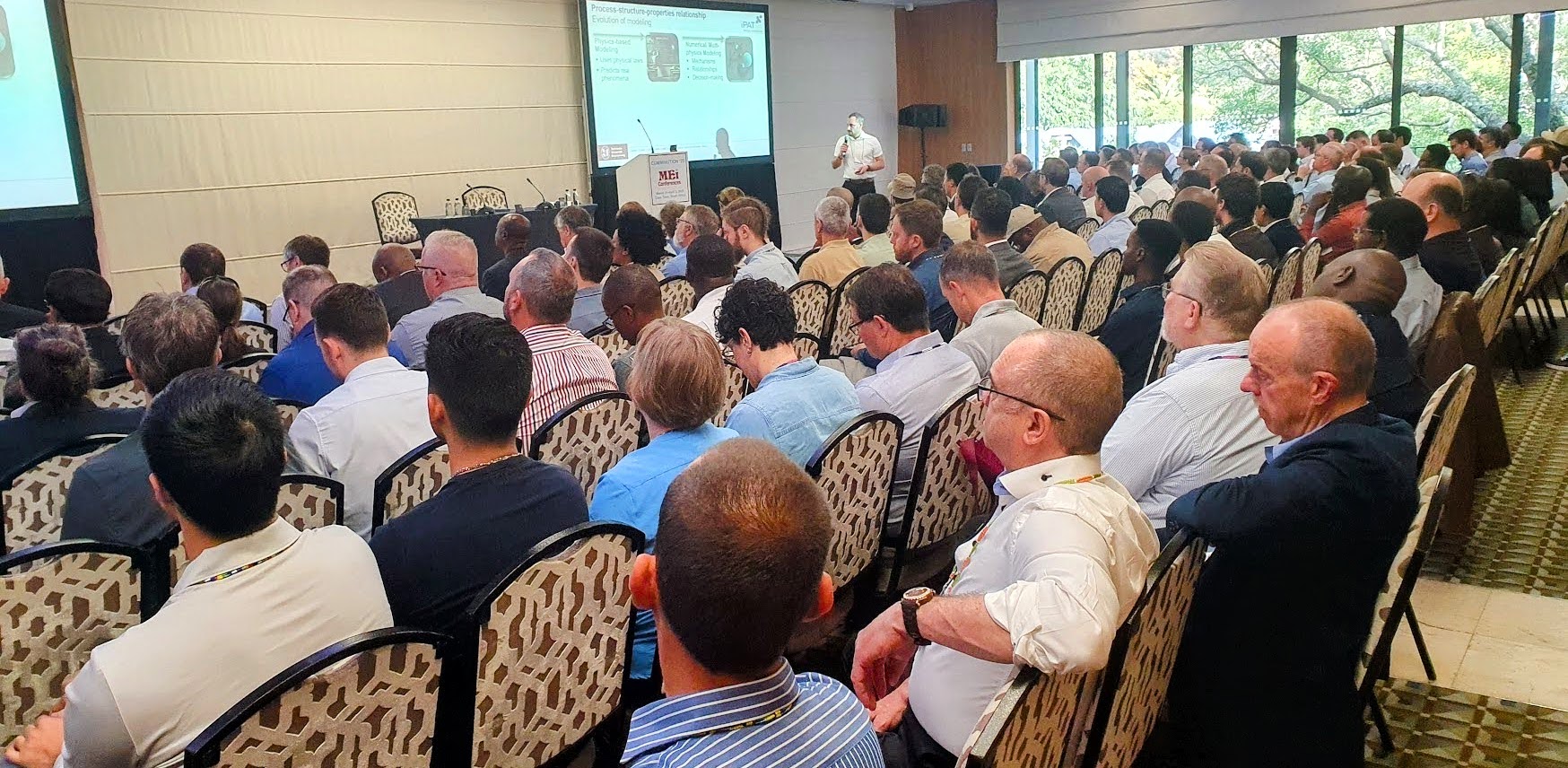
Following is a very brief summary of the presentations made over the four days. This summary is intended to guide you to the extended abstracts associated with the presentations, oral and poster, most of which are available online as open-access. Unfortunately not all presenters responded to requests for extended abstracts, but for those that did their names are linked directly to their papers in the online Proceedings. Short abstracts for all technical session papers can be found on the programme on the conference website.
The extended abstracts have not been refereed, but all the presenters have been invited to submit their final papers for peer-review to a virtual special issue of Minerals Engineering.
Monday March 31st
Technical Session 1
Chairpersons: Grant Ballantyne (Ausenco, Australia) and Malcolm Powell (Libner Design Services, Australia)
Over the past few years Artificial Intelligence (AI) has been revolutionising many fields, including comminution, by predictive modelling, AI driven calibration, optimisation and process control or via the use of surrogate models. In the first keynote lecture of the conference, Carsten Schilde, Professor for Digitisation of complex systems in process and production engineering, at TU Braunschweig, Germany, showed how rapid leaps in AI methods are accelerating comminution modelling.
 |
| Carsten Schilde (right) |
Marcos de Paiva Bueno, CEO of Geopyörä, Finland, then discussed the development and validation of artificial intelligence models to predict standard comminution parameters.
 |
| Marcos de Paiva Bueno (left) |
Túlio Campos, a Research Fellow at the University of Rio de Janeiro, Brazil, then looked at advances in mathematical modelling of compression breakage.
Fine grinding of multi-component systems is of great importance in numerous industries, especially prevalent in minerals engineering and recycling, but there is a lack of systematic studies that describe their grinding behaviour in the micron and submicron range. To address this challenge, Maximilian Tobaben, a research associate at TU Braunschweig, Germany, focused on the description of multi-component fine grinding tests using a model mixture of quartz and limestone through a mechanistic modelling approach.
Túlio and Maximilian were judged winners of the Global Comminution Collaborative prizes for the best student presentations at the conference.
.jpg) |
| Túlio and Maximilian |
Sandile Nkwanyana is a senior engineer in the comminution group at Mintek, South Africa. He explored the complex dynamics of slurry flow in grinding mills, in order to find comminution’s ‘sweet-spot’- the intersection of grinding power and slurry transport.
 |
| Sandile Nkwanyana (left) |
Innovation and digital transformation are seen as key tools to develop (left) new products and solutions that significantly improve operating processes, particularly in improving energy and water usage while minimizing waste, said Yufan Mu, an R&D Engineer at Molycop, USA. She presented a case study of machine learning's role in optimising mill performance, identifying different mill environments for semi-autogenous and overflowing ball mills using clustering.
 |
| Yufan Mu (right) |
Christoph Thon, a Research Associate at TU Braunschweig, Germany, said that traditional models for wet stirred media mills assume static optimal process conditions, limiting their effectiveness when process conditions change during operation. He proposed population balance models for real-time nonlinear model predictive control, integrating AI-based soft sensors for online tracking of particle size distribution and viscosity, two-way coupled CFD-DEM simulations enhanced by AI to investigate spatial bead patterns, and evolutionary approaches for PB-model integration, such as genetic algorithms.
Oliver Schindler, a Research Assistant at TU Bergakademie Freiberg, Germany discussed dynamic simulation-based calibration of industrial control systems for enhanced operational phase transitions and stability in processing plants.
 |
| Christoph Thon and Oliver Schindler |
Diego Mesa is an R&D Senior Specialist at Aminpro, Chile. He is also a Research Associate at Imperial College, UK and he described the application and validation of the MiniBond test, a cost-effective alternative to the traditional Bond ball mill Work Index test for assessing ore hardness.
Depending on ore texture, minerals can display breakage behavior independently of grain boundaries and result in mostly random breakage or can break along grain boundaries resulting in preferential liberation and non-random breakage. Understanding the fracturing behaviour using tests developed for measuring rock mechanics parameters can inform how rocks and minerals respond to external stresses in comminution applied to particles across different scales. Carolina Carvajal, a PhD Student at the JKMRC, Australia, discussed micromechanics of minerals by nanoindentation, leading to insights into fracture behaviour from onset to propagation.
 |
| Diego Mesa (centre) and Carolina Carjaval |
Technical Session 2
Chairpersons: Paul Shelley (Molycop, USA) and Diego Mesa (Aminpro, Chile and Imperial College, UK)
In the first paper of the session Holger Lieberwirth, the Director of Institute TU Bergakademie Freiberg, Germany presented work aimed at quantifying the impact of mineral microstructure on the comminution of ores and rocks.
 |
| Holger Lieberwirth (left) |
Simon Bahnmüller is a research associate in the group of this morning's keynote speaker Carsten Schilde at TU Braunschweig, Germany. He described a study investigating the breakage behavior of slag particles. By-products of metallurgical processes, slags are complex multicomponent systems containing valuable minerals and metals. Their heterogeneous structure and chemical composition pose challenges for efficient recovery and recycling. Understanding their physical and chemical properties, especially breakage behavior, is essential for developing effective recycling strategies.
 |
| Simon Bahnmüller (left) |

Tim Lundquist, the Global Director of Mineral Processing Sales with Disa Technologies, USA, described Disa's High-Pressure Slurry Ablation (HPSA) technology. HPSA processes solid feed material in slurry form, propelled by high-pressure pumps through opposing nozzles that generate impinging jets within a collision housing. This process induces particle-to-particle collisions in a high-energy zone, creating intergranular fractures along grain boundaries. Tim reviewed potential applications and future developments.
Vivian Moutinho is a PhD Student at the University of Rio de Janeiro, Brazil and she looked at the influence of mineralogy and texture on the fragmentation behavior of iron ores.
 |
| Vivian Moutinho |
Gauti Asbjörnsson, Associate Professor at the Chalmers University of Technology, Sweden, then explored the potential of signal integration of instrumentation, such as noise, vibration, high-frequency monitoring and vision systems and the implementation of novel analytics, such as fault detection and condition monitoring, to improve the operational performance and lifetime of cone crushers.

The performance of ball mills is influenced by ore characteristics, the design of the mill and the operating conditions. It is common knowledge that the feed characteristics have a significant influence on milling performance. The main feed characteristic considered are ore competence and particle size distribution (PSD). Fortune Mdluli, Metallurgy Leader at Two Rivers Platinum, South Africa showed how the influence of feed PSD on the performance of ball mills in an industrial plant was quantified by a grind curve approach.
Adolph Mwale is Head of Technology Management at Metso, South Africa. He described a study commissioned to develop a model for predicting ball mill performance which incorporates the influence of discharge configuration in addition to other operational and design variables.
 |
| Adolph Mwale (right) |
In the final paper of the day Arno Kwade, Head of Institute TU Braunschweig, Germany, discussed dry fine grinding in ball mills and stirred media mills. which is becoming of increasing importance. In recent years, tumbling ball mills and stirred media mills have been designed for dry processing and up-scaled to industrially relevant sizes. However, the transport of the dry powder through the mill chamber, which influences the holdup and mean residence time. is very much different from wet milling and Arno discussed the transport and milling behaviour in the mill as a function of the flowability of the powder.
 |
| Arno Kwade (centre) |
Tuesday April 1st
Technical Session 3
Chairpersons: Richmond Asamoah (University of South Australia, Australia) and Bern Klein (University of British Columbia, Canada)
Energy efficiency is a primary focus for the mineral processing flowsheets of the future. In recent years, High Pressure Grinding Rolls (HPGR) have demonstrated significant energy savings as compared to conventional SAG mill circuits. Investigations have demonstrated the potential for replacement of ball mills with more energy efficient technologies. In parallel, advances in sensor-based sorting (SBS) allow the rejection of low grade rock ahead of energy intensive comminution. The integration of energy efficient comminution with sensor-based sorting has the potential to significantly reduce overall mineral processing energy usage, as discussed by Bern Klein, of the University of British Columbia in his opening keynote address.
 |
| Bern Klein (left) |
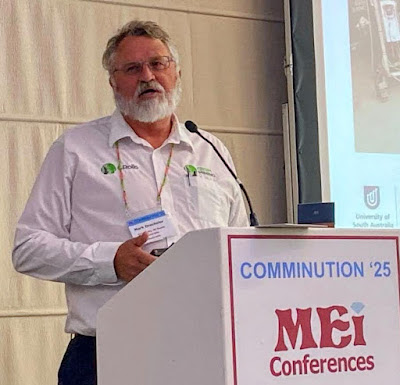
Mark Drechsler has over 40 years mining and infrastructure engineering industry experience and in April started his PhD at the University of South Australia researching the energy and mineral processing benefits of his innovative comminution technology called GRolls. He presented a paper showing the results of an extensive laboratory testing program to determine the size reduction and energy efficiency performance of the GRolls technology for a wide range of industry supplied ore feed materials.
It was good to see that one of my old CSM students, Graham Davey, is now Director, Stirred Mills at Metso. Graham is based in the UK providing stirred mill product management and process engineering for mining and engineering companies throughout the world and he discussed the Vertimill. which has been widely adopted but has faced challenges in managing wear life and measuring charge levels. To address these issues, a new detection system has been developed, in conjunction with a DEM model. By combining the technologies, a novel way to determine and manage wear life and optimise liner design has been developed. Graham showed the practicality of the DEM model for Vertimill liner wear prediction with a sample numerical case for the Vertimill and how it can be used to validate new screw designs without long onsite trials.
 |
| Graham Davey (centre) |
HPGR circuits are being increasingly adopted in the mining industry’s pursuit of processing higher volumes of ore. Bjorn Dierx has the global responsibility for the HPGR product line at Weir Minerals, The Netherlands, and he discussed advancements in HPGR-based comminution circuits and reported the value proposition and limitations for adopting multi-staged HPGR circuits, combined with innovative dry classification and beneficiation opportunities.

Felix Heinicke, Senior Process Manager at Köppern, Germany, reviewed fundamental research on the downstream effect of HPGR, and reporting on its physical basis and limits. Two examples for leaching of gold ore and application of bottle roll testing were presented to support the general findings.
 |
| Felix Heinicke (right) |
Leseka Moatlhodi holds a BEng and a MEng in Mineral Processing from the University of Leeds. She is now a PhD student at the University of Cape Town, developing methods to minimise diamond breakage in comminution circuitsand she looked at the effect of HPGR operating pressure and roll speed on the breakage of diamonds.
Sonny Mwansa, Principal Process Engineer-Mills, with Bradken Resources, South Africa, discussed the revision of top-up ball size and liner design post pre-crushing ahead of a SAG mill circuit.
In the final paper of the session Adam McElroy, Specialist Development Engineer at Boliden Mineral, Sweden, discussed the effect of feed size distribution on autogenous milling, using Boliden case studies.
Technical session 4
Chairperson: Sherry Bremner, University of Cape Town, South Africa
Jaclyn Kogler, a process engineer with Metso, USA, detailed the complexities, including commissioning procedures and operational intricacies, of a Metso Single Stage semi-autogenous (SAG) pilot mill, operated in closed circuit with a Metso Ultrafine Screen. The findings of the pilot trial are beneficial for determining SAG mill scale-up in accordance with design criteria, providing guidance for future applications in mineral processing.
.jpg) |
| Jaclyn Kogler |
SAG milling circuits are almost always associated with high throughput mining operations with aggressive production targets. The main role of the SAG mill is to achieve and maintain the desired feed rate while the role of the ball milling circuit is to achieve and maintain the target product size. While there are a few industrial levers available to make it easier to maintain the desired feed rate, the simplest change is to increase the SAG mill ball size. The key benefits include unlocking a wider operational range and reducing ball consumption. Other benefits could be an increase in SAG mill feed rate, or maintaining the same feed rate at a lower ball load and/or slower mill speed. Brian Cornish, of ME Elecmetal provided valuable insight into optimising SAG milling performance with bigger balls.
 |
| Brian Cornish |
In his second presentation at the conference, Sandile Nkwanyana of Mintek then discussed the effect of ball load on SAG mill collision environment and performance.
Paul Cleary is a Chief Research Scientist at CSIRO Data61, Australia. He has been at the forefront of the development and application of particle based computational methods for the prediction of the behaviour of physical systems for many years and is recognised as one of the great pioneers of the Discrete Element Method (DEM). He is also a leading developer of the Smoothed Particle Hydrodynamics (SPH) method for industrial fluid dynamics and he presented a complete particle scale model for the prediction of SAG mill performance, based on a coupled DEM+SPH model which can be used to predict the motion of solid charge and the slurry phase respectively.
Mario Calvo is the Managing Director of Electrodrives, Spain. He described the optimisation of comminution at Ban Houayxai mine, Laos, by upgrading to variable speed in a fixed-speed SAG mill.
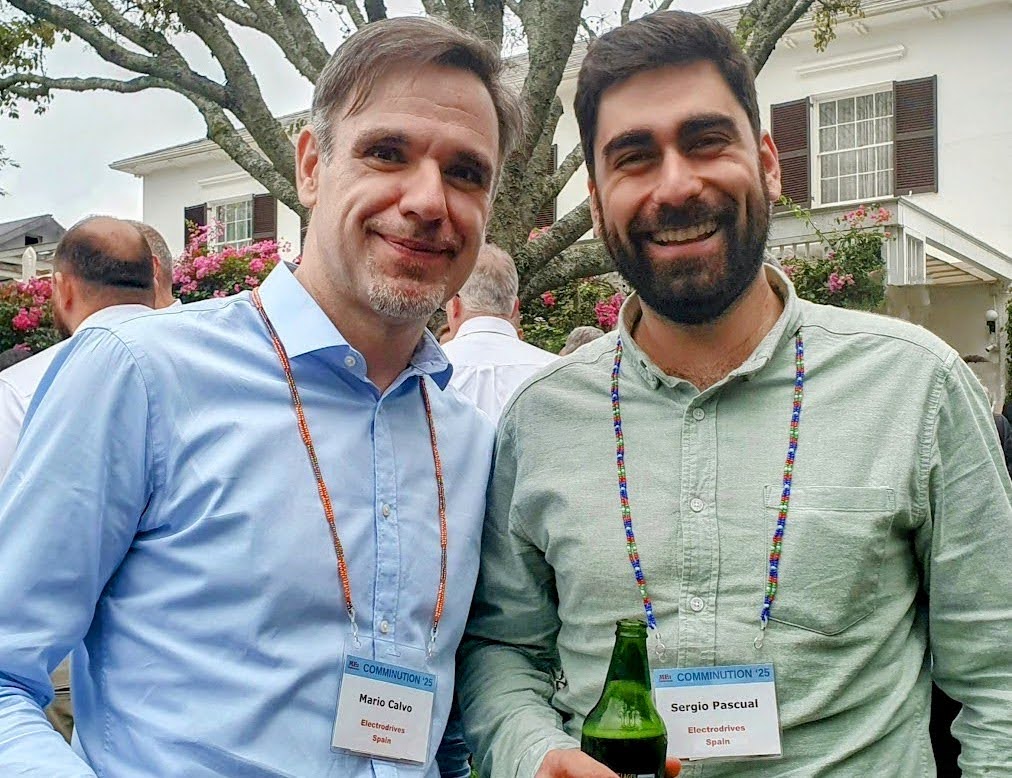 |
| Mario Calvo (left) |
The final paper of the day was given by Richmond Asamoah, a Senior Research Fellow at the University of South Australia. He presented a study investigating the unique acoustic frequency signature of varying mill feed size with links to ore mineralogical characteristics in an autogenous and semi-autogenous mill.
 |
| Richard Asamoah (left) |
Wednesday April 2nd
Technical Session 5
Chairpersons: Mark Drechsler (University of South Australia and Gyratory Roller Solutions Pty Ltd, Australia) and Graham Davey (Metso, UK)
The day began with a keynote lecture from Grant Ballantyne, Technical Director at Ausenco, Australia. He discussed how new comminution and classification technologies are regularly hitting the market with promises to reduce energy, improve liberation and reduce costs, but asked how can we identify the fine wine from the snake oil? For example, improved energy efficiency can be achieved at the detriment of wear, or improved liberation can be achieved without improving recovery. Grant explored the range of evaluation methodologies that are available for the discerning metallurgist, as well as some lessons that can be learned from previous ineffective assessments.

The keynote was followed by two presentations which promise a lot. In the posting of 10th February, the question was asked if high voltage pulse power is the next great innovation in comminution.
Flávio André, a research officer at Australia's JKMRC presented a study, co-authored by the late Frank Shi, detailing the development and optimisation of a laboratory-scale HVP electrode-grizzly system. Findings highlight HVP’s capacity to separate valuable minerals from gangue before energy-intensive grinding stages, offering a more sustainable mineral processing alternative.
Following Flávio's presentation, Nathan Flaman, the CEO of French company I-ROX, showed how the company is collaborating with BHP to scale up its own application of the pulsed power technology. I-ROX aims to reduce the cost of comminution by slashing the energy and consumables required and increasing flotation recoveries as a result of improved mineral liberation. The effects on mineral liberation were shown in a paper presented at Process Mineralogy '24.

Collectors are vital flotation reagents, but collector adsorption behaviour linked to mineral surface alterations due to varying grinding conditions is not well understood, as the grinding environment, wet or dry, significantly alters the surface and pulp chemistry of sulphide minerals,affecting collector adsorption. Theophilus Amos-Judge, a postgraduate student at the University of South Australia, examined the collector adsorption behaviour of copper sulphide ores and model minerals, specifically chalcopyrite, subjected to both dry and wet grinding with different grinding mechanisms. Results highlighted the critical importance of controlling the comminution environment on downstream flotation performance, particularly for slow floating particles.
Harshita Gupta, Manager Research & Discovery Portfolio at BHP, Australia, presented insights from a 12-week open innovation comminution challenge ran by Think & Act Differently, the innovation team at BHP. Twelve innovators collaborated to test their technologies against conventional BHP processes. The outcomes of this challenge not only demonstrate the potential for innovation within the sector but also serve as a model for future collaborative efforts aimed at addressing industry challenges.
 |
| Harshita Gupta (bottom right) |
Kanishk Bhadani, post-doc researcher at Chalmers University of Technology, Sweden, presented a study to develop a framework for integrated optimisation of crushing, milling and classification (cyclone) processes to enhance throughput and product quality reporting to the downstream process.
Jeremy Hanhiniemi, Director of Technology and Innovation with Weir, Australia and Adjunct Fellow at the JKMRC, Australia, described the ‘Parallel Flow Sheet’: a HPGR-Stirred-Mill-CPF flow sheet concept for energy efficiency and tailings improvement.
 |
| Jeremy Hanhiniemi (2nd left) |
Johnny Kalala is a senior process consultant with DRA Global, South Africa and he looked at the use of breakage rates trends in (S)AG mill followed by ball mill circuits to explain past comminution circuit trends and to propose new circuits.
Taking us to the lunch break, Leonardo Espinoza, a metallurgical technician with Antamina, Peru described the analysis and prediction of ball mill overload in SABC circuits.
 |
| Leonardo Espinoza (centre) |
Technical Session 6
Chairpersons: Jenny Wiese (Metcelerate, South Africa) and Warren Little (Kansanshi Mining, Zambia)
Most crushing and grinding circuits are designed to handle variable ore feed with changing competency and hardness. However, ore with high clay content presents unique challenges that necessitate careful consideration in the flowsheet design. Rajiv Chandramohan, Director and Head of Process Optimisation, at Ausenco, Australia, offered a technical guide with practical design and operating strategies, supported by examples, for processing high clay ores.
 |
| Rajid Chandramohan (right) |
Classification plays an important role in the grinding circuit. The benefits of improved classification efficiency on wet-grinding ball mill circuit have been reported in the past. Despite its poor classification efficiency, hydrocyclones are still the most used classifiers in these grinding circuits. Vladimir Jokovic, Team Leader at CSIRO, Australia, discussed the benefits of semi-inverted hydrocyclones in a closed grinding circuit pilot scale study.
The performance and energy efficiency of SAG and ball mills is highly affected by the mills’ charge composition of ore and media. In his second paper of the day, Jeremy Hanhiniemi proposed a relationship between size specific energy achieved by SAG mills, and their media volumetric fractional filling in the charge and in the mill overall. Flowsheet designs in brownfield expansions employing pre-crushing, for example, can be devised considering this to both best utilise the existing mill assets, as well as employ the new equipment investment effectively.
SABC circuits are energy and water intensive large, fixed plant that require grinding media and liners. The innovative GRolls comminution technology is low energy,requires no grinding media, is flexible and modular in operation suitable for wet or dry circuits to process complex low grade future ores using renewable energy sources. Mark Drechsler, in his second presentation at the conference, presented the results of an extensive laboratory testing program to determine the size reduction, energy efficiency, breakage mechanisms and mineral liberation performance of the GRolls technology for both dry and wet feed, the benefits for downstream beneficiation processes including early gangue minerals rejection strategies, and the potential for the new comminution technology to augment or replace SABC circuits.
Although cheaper energy processes are developing, access to water is often restricted or limited, particularly in some of the main mining countries with scarce water resources, such as Australia, Chile or Peru. Carsten Gerold, of Loesche, Germany, described a recent development allowing integration of intermediate sorting of a middlings size fraction, via magnetic separation or coarse flotation, into the dry Loesche Vertical Roller Mill grinding-classifying process while still producing a primary feed for the downstream process. enabling the separation of coarse gangue at an early stage of the process.
Reduced energy and water consumption are mandatory for enhanced sustainability. The Vertical Roller Mill (VRM) is a dry grinding system that is capable of achieving this said Caroline Woywadt, Director Process Technology at Gebr. Pfeiffer, Germany. She said that dry grinding with VRM gives a substantial benefit in energy savings, the energy consumption being about 30 to 40% lower than that of traditional mill systems in the mining industry.
 |
| Caroline Woywadt (left) |
Recovery losses resulting from the fines fraction of the grinding circuit product is an issue in many gravity and flotation circuits, said Brian Putland, Managing Director with Orway Mineral Consultants, Australia. Losses need to be balanced against improved liberation from grinding finer. and predicting the fines content is essential for accurate full-scale plant design and optimisation, particularly for plants with deslime circuits. Brian examined the factors influencing fines generation in various comminution circuits.
Thursday April 3rd
Technical Session 7
Chairpersons: Brian Cornish (ME Elecmetal, Australia) and Gauti Asbjörnsson (Chalmers University of Technology, Sweden)
Chris Greet is a Principal Consultant at Mineralis Consultants, Australia, and is now part-time at Magotteaux as a Global Mineral Processing Specialist. A regular at MEI's comminution and flotation conferences, he presented the first paper in the morning session, asking "so, you want to change the grinding media in your ball mill- what happens next?
Paul Shelley of Molycop, USA presented work exploring an alternative to the Marked Ball Wear Test for evaluating the abrasion performance of grinding balls.
 |
| Chris Greet and Paul Shelley |
Ion Gurnett, Senior Metallurgist with Glencore Technology, Australia said that it has been hypothesised that increasing the specific gravity of the grinding media within a stirred mill will result in subsequent increased efficiencies within the milling process. Ion's paper challenged that hypothesis by IsaMill testwork aiming to develop an economic model to use as for evaluating ceramic media selection in a stirred horizontal mill.
 |
| Ion Gurnett (left) |
Pieter Kruger, Regional Applications Engineer with Russell Mineral Equipment, South Africa, described recent advancements in relining technology and support tailored for African mill operators, including site case studies for enhancing efficiency, safety, and operational uptime.
Stephen Gwynn-Jones, Group Manager-Products at Russell Mineral Equipment, Australia, presented a data-driven framework for enhancing mill relining performance and safety.
 |
| Stephen Gwynn-Jones and Pieter Kruger |
Rajiv Chandramohan, Director and Head Of Process Optimisation at Ausenco, Canada discussed focused investigations providing insights into how grinding mills should potentially be operated to improve grinding efficiency by leveraging media shape.
Ersin Yazici of Karadeniz Technical University, Türkiye, discussed the development of a wireless sensor network system for real-time abrasion monitoring and forward prediction for rubber lifter bars in grinding mills.
 |
| Ersin Yazici (right) |
Paul Toor, Comminution Consultant with Toornado Metallurgy, Australia looked at designing SAG mill liners for performance, not life, an update on a paper given at Comminution '12.
The high cost of horizontal grinding mill downtime is well known and widely discussed, yet many of the up-front design considerations that can minimise downtime are overlooked or forgotten. Jared Le Cras, Director-Mill Reline Equipment at Metso, Australia, addressed this issue, by systematically reviewing every aspect of grinding mill maintenance that should be considered during the plant engineering phase.
In his second paper of the morning, Glencore's Ion Gurnett discussed the factors involved in the design of stirred mill testwork, how these can influence the overall specific energy, and why it is important to thoroughly evaluate the ability to scale up when conducting technology trade-offs.
Technical Session 8
Chairpersons: Alex Wang (King’s Beads Ltd, China) and Aubrey Mainza (University of Cape Town, South Africa)
Matthew Toll is a Metallurgical Account Manager with Global Met Tech, Australia, He described an improved signature plot analysis approach to incorporate variable feed particle size in the determination of stirred mill grinding energy requirement.
 |
| Matthew Toll (centre) |
Ion Gurnett was back for his third presentation of the day. Using the IsaMill as a case study, he showed how material selection may not only reduce mill downtime, but also influence the overall specific energy for grinding, and why it is important to understand materials of construction in testwork, and the processes involved in evaluating new materials and designs prior to market release.
Sherry Bremner, a Senior Lecturer at the University of Cape Town is a physicist and academic with expertise in granular flow modelling, mineral processing, and comminution. She looked at single particle tracking in DEM for use in validation of PEPT experiments in a horizontal stirred mill.
 |
| Sherry Bremner |
Okay Altun, an Associate Professor at Hacettepe University, Türkiye, discussed the energy optimisation opportunities, and the result of modelling works for HIGMill operation at a copper regrind application.
The Ro-Star vertical stirred mill has been many years in development. Its inventor, Rainer Imhof, was cognisant of the high energy requirements to liberate minerals at such fine sizes and decided to go back to first principles and revisit the design to improve the efficiency of the mill. The new Ro-Star mill is a joint-venture development between Maelgwyn Mineral Services (MMS) Ltd of Wales and ERSEL Heavy Machinery Inc. of Türkiye. Michael Battersby, Managing Director of MMS detailed the principal and concepts behind the new design together with the design, development and testing of a laboratory, pilot and an industrial sized 600kW unit.
 |
| Michael Battersby (left) |
Luis Marcelo Tavares, a Professor at the University of Rio de Janeiro (UFRJ), Brazil, described advances in vertical stirred media mill modelling using the UFRJ mechanistic mill model.
 |
| Luis Marcelo Tavares (left) |
In the final paper of the conference Kai Johnston, a metallurgist at Glencore Technology, Australia discussed how in standard stirred mill laboratory testwork, the particle sizing method employed and how it affects the reported specific energy requirements are often overlooked. Lasersizing is often employed as the industry gold standard for its ability to achieve consistent and accurate results across several different commodities. However, in the context of stirred milling, particle characteristics like shape and surface properties can compromise its ability to accurately portray the sample’s particle size. The underlying impact of this can be detrimental to the resulting mill sizing causing overestimation of reported power requirements. Using the IsaMill as a case study, Kai demonstrated why it is important to understand how the particle sizing technique selected can influence signature plot results, when to apply alternate analytical particle sizing techniques and how to improve lasersizing for signature plot testwork.
 |
| Kai Johnston (centre) |
A final thanks to all those who presented their work at the conference, and we hope to see you all again at Comminution '27.
Wednesday, 13 April 2016
Day 3 at Comminution '16
 |
| Early morning view of Table Mountain from the conference centre |
The penultimate day began with another fine keynote, from Malcolm Powell of the JKMRC.
ZEISS is displaying its SmartZoom 5 microscope which is ideally suited to measure wear processes on grinding media and bearings used during rock breakage thanks to its ability to build up a 3D model of a sample and quantify surface roughness. Ben Tordoff also presented a seminar to around 20 delegates during the lunch break, looking at applications of X-Ray microscopy in the mining industry.
 |
| Cathy He of King's Ceramics, with Randall Crisp and Ben Tordoff of Zeiss |
We last saw Bernhard Kloos of German company Doering, 10 years ago at Ultrafine Grinding '06 in Falmouth. The family owned Doering foundry is the leading manufacturer of cylindrical cast grinding media "CYLPEBS", made from a low alloy chilled cast iron and is exhibiting for the first time at an MEI conference. CYLPEBS are slightly tapered cylindrical grinding bodies with equal length and diameter, the shape having been developed to maximize available grinding due to bulk density and surface area advantages and their internal structure providing wear resistance and shape retention.
 |
| Amanda with Bernhard |
Like Doering, Polycorp Ltd, a privately owned Canadian Company is exhibiting for the first time. Polycorp specialises in the design and manufacture of engineered elastomeric parts, such as grinding mill liners. Their products use polymer based materials, primarily rubber, for abrasion, impact, contamination and/or chemical protection.
 |
With Bob Stevens and Tabash Bhattacharjee of Polycorp
|
At the end of the day's sessions we met in the gardens for the "Happy Hour" where I managed to photograph representatives from five of the six institutes comprising the Global Comminution Collaboration, which identifies comminution research needs and unifies the approach to working on these needs. The only missing institute was the University of Rio de Janeiro, the other five institutes being Australia's JKMRC, Sweden's Chalmers University, the University of Cape Town, Germany's Technische Universitat Braunschweig, and Turkey's Haceteppe University.
 |
| Members of the Global Comminution Collaboration |


Twitter @barrywills
Saturday, 5 February 2011
New Comments Alert
There are new comments added to the following blog postings since the last comments alert:
Final calls for abstracts for Computational Modelling and Physical Separation '11
What is the future for electronic sorting?
Geopolymerisation and the pyramids
How do you search for journal publications?
Is media shape important for grinding performance in stirred mills?
Minerals engineering's crucial role in sustainability
Brisbane floods- the clean-up begins
Hydrometallurgy- is it bucket chemistry?
Physical Separation '11 timetable published
We welcome your comments on blog postings. If you do not have a Google account, the simplest way to add a comment is by selecting 'anonymous' as your profile, but please leave your name and affiliation in the comment.
Final calls for abstracts for Computational Modelling and Physical Separation '11
What is the future for electronic sorting?
Geopolymerisation and the pyramids
How do you search for journal publications?
Is media shape important for grinding performance in stirred mills?
Minerals engineering's crucial role in sustainability
Brisbane floods- the clean-up begins
Hydrometallurgy- is it bucket chemistry?
Physical Separation '11 timetable published
We welcome your comments on blog postings. If you do not have a Google account, the simplest way to add a comment is by selecting 'anonymous' as your profile, but please leave your name and affiliation in the comment.
Tuesday, 1 February 2011
Monday, 25 April 2016
Comminution '16 conference diary
Comminution '16, the 10th in the MEI series, was held at the Vineyard Hotel, Cape Town, in consultation with Prof. Aubrey Mainza, of University of Cape Town, and was sponsored by Keramos, Starkey & Associates, Magotteaux, King's Ceramics & Chemicals, Crush Force, Grinding Solutions, Industrie Bitossi, TOMS, ZEISS, FLSmidth, Cenotec, CITIC Heavy Industries, Outotec, Russell Mineral Equipment and Loesche. Media sponsors were International Mining, Industrial Minerals and AT International, and the Coalition for Eco-Efficient Comminution (CEEC) was an industry advocate.
Monday April 11th
I welcomed the 177 delegates from 23 countries to Cape Town, noting that numbers this year are considerably lower than two years ago, for obvious reasons.

Prior to officially opening the event, I had the pleasure of presenting the 2015 MEI Young Person's Award to Hakan Dundar of Turkey's Hacetteppe University (posting of 11th April).
The search to improve comminution efficiency will undoubtedly include some novel new technologies, but significant benefits are also likely from evolving existing technologies, new ways of operating, and combining the old with the new. In his keynote lecture, which opened the conference this morning, Joe Pease, of Mineralurgy Pty Ltd, Australia, asked whether advances in drilling, blasting, crushing, HPGRs and stirred milling could relegate the SAG mill to a curiosity during our careers?
Joe is chairman of the Coalition for Energy Efficient Comminution, and we are pleased to have CEEC as an industry advocate. Following Joe's keynote, Grant Ballantyne of Australia's JKMRC discussed the use of the CEEC comminution energy curves to assess equipment performance. The database that supports the curves has more than tripled in size in the last year to include more than 1,600 Mt/y of rock throughput at a specific comminution energy input of 17.9 kWh/t. Presenting the data in the form of the energy curves allows operations the opportunity to measure their baseline performance and map relative improvements due to equipment selection and performance. One of the standard energy curves presents the size specific energy (energy required to produce new minus 75 µm material: kWh/t-75µm). The marker size of 75 µm is effective for assessing the performance of most SAG and ball mills, but on some occasions another size might be preferred. Grant described a methodology for converting results conducted with different marker sizes for comparison on the size specific energy curves.
 |
| Joe Pease (centre) and Grant Ballantyne (right) with CEEC Director Mike Battersby of Maelgwyn Mineral Services |
Prior to the coffee break, Dave Capstick, of FLSmidth, South Africa, showed how milling energy and CAPEX requirements in the processing of refractory gold ores can be substantially reduced by the use of the Krebs cyclone technology as a desliming cyclone prior to fine grinding in a VXP mill. The cyclone removes the portion of the ore that is already below the target milling size and doesn’t require any size reduction for liberation. This approach by combining two technologies as an integrated bundled design can significantly reduce the project CAPEX by reducing the number of mills required. Also by eliminating a portion of the ore overall milling energy costs are substantially reduced.
The long coffee break in the exhibition and poster area gave everyone their first opportunity of viewing the 15 poster displays and talking to the representatives from the 19 companies exhibiting.
 |
| Cobus Kotze, Chris Rule and Brian Loveday at the DMM booth |
Following the coffee break, five papers, from Germany, Canada, Sweden and Australia examined ways of reducing comminution costs, by circuit optimisation, reduction of energy consumption and media wear. Holger Lieberwith of the TU Bergakademie Freiberg, discussed selective comminution, the exploitation of selected ore characteristics in order to enrich the valuable minerals in certain fractions while other fractions are left with uneconomic low amounts of valuable material only. A simple classification step will produce a pre-concentrate in this case, while other fractions can be discarded or processed separately. He introduced methods to quantify the degree of selectivity in comminution and presented successful examples with a number of different ores.
After an excellent Vineyard lunch, the afternoon session got underway with a paper from Michael Toifl of Montanuniversitaet Leoben, Austria, on the the influence of irradiation parameters on the microwave-induced damage of rocks for industrial applications. Lorena Guldris then presented the second paper from the large group representing Chalmers University, Sweden. She highlighted the increasing global demand for rare earth minerals and an increased need for development of more efficient extraction processes of such materials. Comminution models commonly predict size reduction with the focus on a single component, but few models integrate the mineral composition. Her paper focused on defining a multi component model, combining size reduction and mineral liberation.
 |
| Lorena Guldris (left) with Chalmers University colleagues |
Taking us up to the coffee break, Lidia Auret of Stellenbosch University, South Africa, discussed the importance of early detection and root cause identification of abnormal events in industrial processes and in a joint paper from Stellenbosch and Curtin University, Australia, Chris Aldrich, formerly with Stellenbosch, now with Curtin, discussed the importance of the optimal control of mill circuits in the cost-effective operation of concentrator plants, and the neurocontrol of a ball mill grinding circuit by use of covariance matrix adaptation evolution strategies.
Three papers followed the coffee break, the first by Ari Rantala of conference sponsor Outotec. who discussed advanced grinding circuit control using on-line analyser systems.
Speed is a key factor in the efficiency of current multi-stage semi-autogenous and ball mill circuits and more recent latest generation High Pressure Grinding Rolls. A joint paper from the University of British Columbia, Canada, and Ingeteam Power Technology, Spain, presented by Fisher Wang, of UBC, showed how variable speed drives give the flexibility to maintain the process performance and product ore size between desired limits.
At SAG '11 in Vancouver Peter Rubie delivered a paper entitled “Simulation as a tool to enable world’s best mill relining practice” in which he described conference sponsor Russell Mineral Equipment's development of a Discrete Event Simulation-based technology. Managing Director John Russell ended the day's sessions by showing how the continued development, evolution and application of this work is now yielding expected and unexpected results. Its effectiveness has now been proven in all areas of mill relining including concentrator plant design, mill relining technology selection and application, liner design, liner exchange sequence and relining crew performance.
 |
| John Russell (centre) with his large team |
After a very full day of presentations, it was good to relax with a few glasses of wine in the Vineyard gardens, for the first of our 'Happy Hours' (see posting of 11th April for more on Day 1).
 |
| Morning presenter Dave Capstick (2nd left) relaxing with Chris Martin, Alex Wang, Cobus Kotze, Cathy He and Henry Deng at the first Happy Hour |
Tuesday April 12th
As in most fields of endeavour, much of comminution science originates in close association with academic research. The successful development of new comminution science into real business practice is well exemplified by inventions such as high-pressure grinding. But beyond new plants and capital expansions, how is the science helping industry make the best use of the equipment at their immediate disposal? This was a question asked by Rob McIvor, of Metcom Technologies, Inc., USA, in his keynote lecture which introduced the second day sessions.
Plant operations present numerous rewards and challenges to the people who run them. Among their many tasks, metallurgical staff are responsible for the processing performance of the grinding circuits, both daily production and continuous improvement. Means to identify viable process improvement opportunities, and to engage management when needed to achieve implementation, are needed. These include the use of meaningful technical terminology, appropriate metrics, clear economic analysis, and means for follow-up validation that improvements were achieved. Rob presented practical tools for plant staff and company management that bridge the gap between grinding science and daily plant practice. As demonstrated by numerous case studies, these can affect meaningful, sometimes major, grinding process improvements in today’s existing industrial operations.
Following the keynote, Jianjun Tian, of CITIC SMCC Process Technology Pty Ltd, Australia discussed the company's comprehensive solutions, from flowsheet design and equipment selection to circuit optimization, in a paper co-authored with Steve Morrell. Steve is founder of CITIC SMCC Process Technology Pty Ltd which provides independent technical services to various mining projects, mainly in the area of comminution circuit design, technology and equipment selection, and optimization of mineral processing plants. It operates as an independent consulting company, and is ultimately owned by CITIC Heavy Industries, a market leader in China with equipment operating successfully in China and around the world including Asia, Europe, America, Africa and Australia, and it is good to have them involved in the conference as both a sponsor and exhibitor.
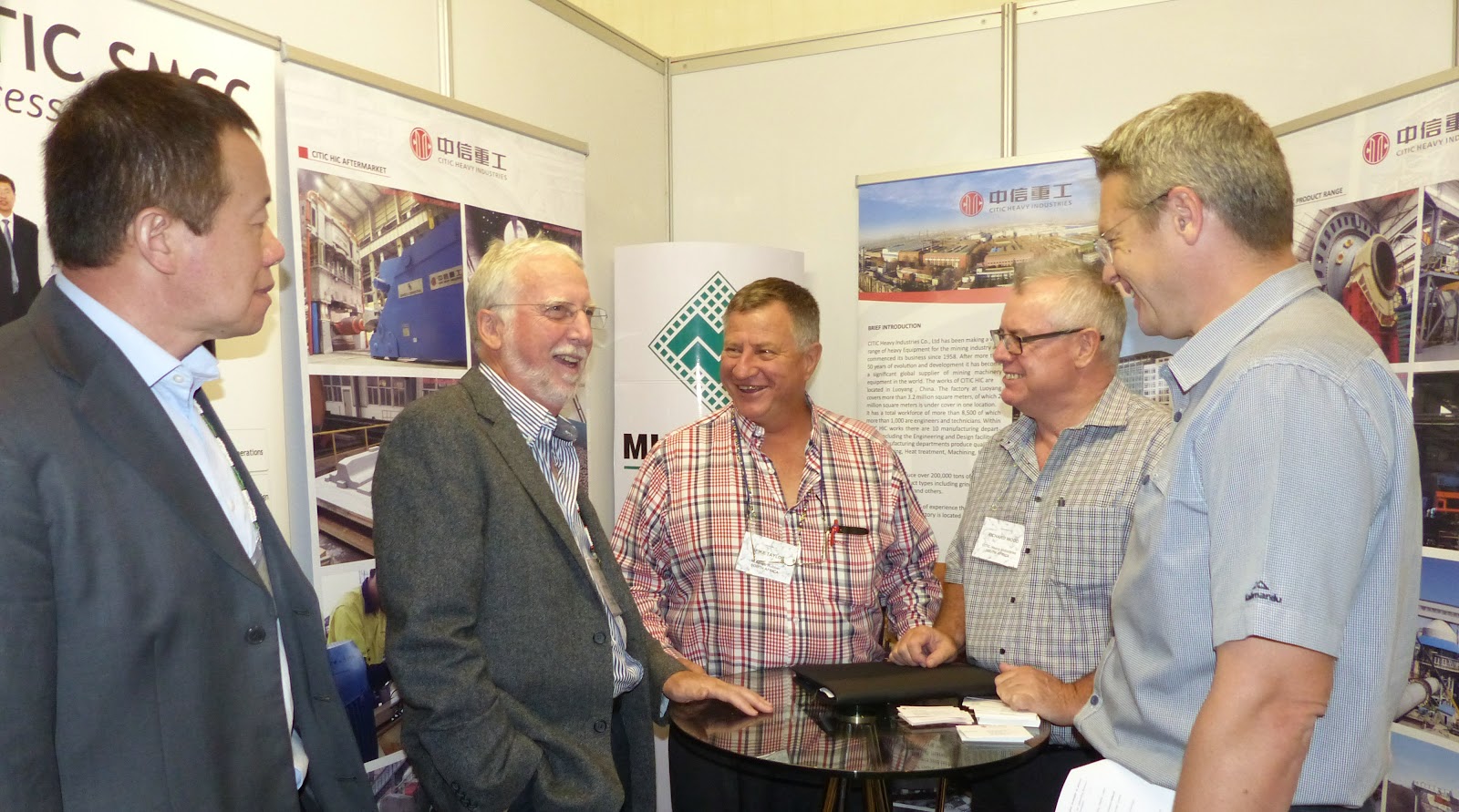 |
| Steve Morrell (2nd left) with Spike Taylor of Multotec Rubber (centre) and CITIC's Jianjun Tian, Richard Wood and Michael Rauscher |
Prior to the coffee break, Johnny Kalala, of Hatch, South Africa, described the commissioning and start up of the MMG Las Bambas milling circuit, located in Cotabambas, Apurimac region of Peru. Las Bambas has significant mineral resources and ore reserves of copper, gold, silver and molybdenum. Once in production, it is estimated to have a life of mine in excess of 20 years and in its first full year of operation, it is expected to be one of the top three copper producing mines in the world.
Crushing was the topic of the 6 papers after the break, commencing with Hamid-Reza Manouchehri describing a new generation of Sandvik Mining's high capacity cone crushers, designed to intensify crushing performance in hard rock comminution.
Johannes Quist of Chalmers University, also of Sweden, showed how DEM simulations have been used to evaluate cone crusher performance, and Paul Cleary, of CSIRO, Australia, showed how DEM can be used to predict liner evolution for a cone crusher.
 |
| Paul Cleary with Claudio Schneider |
Ryan Bracey, of the JKMRC, Australia, also described how DEM modelling has been used to evaluate the performance of the EDS multi-shaft mill, a novel device combining a series of rotating shafts with attached flingers which impact gravity fed material. Currently the mill is at pilot plant scale operating with a F80 below 40 mm and milling up to 80 tph, depending on ore type. A 1:4 scale model of the 10 shaft mill was on view on the Energy and Densification Systems (EDS) stand. South African company EDS was formed in 2005 and the Multishaft Mill is designed and produced in South Africa, EDS having strategically registered international patents in over 45 countries worldwide. The mill's footprint is approximately 2m x 1m and has a height of less than 2.5m and weighs less than 5 tons. The milling action combines a number of processes to provide an output product to match various specifications. These processes are crushing, milling, densifying, blending and attrition.
 |
| MEI's Jon at the EDS booth with Ryan Bracey and EDS's Jeff Wain, Boaz Friedland and Andrew Toy |
Robbie Brown, of Stone Three Mining, South Africa, discussed various simulated control strategies to improve crusher performance and in a further Chalmers University paper Magnus Evertsson developed a previous theory for lifetime assessment of cone crushers which was used as a foundation for evaluation of full-scale operating cone crushers in minerals processing plants.
 |
| Robbie Brown, centre with Lidia Auret and Brandon Wakefield of Stellenbosch University |
The afternoon session was devoted to High Pressure Grinding Rolls (HPGR), which are increasingly being adopted in modern plants as tertiary crushers, often as an alternative to SAG mills.
Gerard Van Wyk of ThyssenKrupp Industrial Solutions, Germany, asked if dry finish grinding with HPGRs could be the next step ahead in mineral comminution? Historically, HPGRs have been used mainly as tertiary crushers in mineral applications for the production of ball mill feed. In the cement industry, however, HPGR systems have been successfully applied for grinding limestone, clinker and slag to a final product fineness (P80) of between 30 and 90 µm without the need for downstream ball milling. The total energy consumption of HPGR finish grinding systems in the cement industry has been found to be 30 to 50 % lower than in ball mill systems. This leads to the question of whether the same methodology can be adopted in the mineral industry. Such a step would require the use of dry rather than wet grinding systems. Traditionally, dry grinding systems have been only an exception in mineral processing, since most post grinding processes are wet. However, there are successful, mainly ball mill based, dry grinding examples in gold, nickel and iron ore.
Persio Rosario, of Hatch, Canada, presented a technical and economic assessment of a non-conventional HPGR circuit and Holger Lieberwirth, of TU Bergakademie Freiberg, Germany, examined modelling work with HPGR to predict throughput, specific energy and fineness of the product for edge recycling circuits. Holger also discussed the dynamics in double roll crushers in a further presentation.
Multiple trade-off studies have been estimated assessing the performance of HPGR versus SAG milling resulting in energy savings of between 11 and 32 per cent. But as observed by Grant Ballantyne of the JKMRC one factor that is often misrepresented in these studies is the change in the Bond Work Index. There is a perceived tendency for the Bond test to overestimate the reduction in ball milling energy requirements for HPGR products because of the increased production of fines. Grant's presentation rigorously assessed the actual change in BWi achieved through the use of HPGR technology; outlining the effect of ore mineralogy and the relationship between the laboratory tests and the achieved site performance.
In the final paper of the day Hernan Anticoi, of Universitat Politècnica de Catalunya Barcelona Tech, Spain, discussed the use of population balance models in determining energy consumption applied to high pressure grinding rolls, after which during the coffee break delegates were invited to hear Aubrey Mainza and Indresan Govender present a short introduction to the potential use of Positron Emission Particle Tracking in developing comminution and classification models for design, optimisation and control (see posting of 21st March for full details).
And then an hour later coaches took us to the nearby Kirstenbosch Botanical Gardens for an informal evening of food, wine and entertainment in an idyllic setting under Table Mountain (see posting of April 12th for more photos of the dinner and of Day 2).
 |
| Dinner at Kirstenbosch |
 |
| A very informal evening |
Wednesday April 13th
Day 3 began with another interesting keynote, from Malcolm Powell, of JKMRC, Australia. He began by saying that predicting the performance of the whole mining process is surely the holy grail of predictive simulation, which he calls ‘integrated process prediction’. The objective is to be able to predict the response of the processing chain, from mining to concentration, to changes in the ore type. This can apply to greenfields design - selecting processing options to optimise the overall mine performance within the constraints and aspirations of the greater community and environment; expansion and optimisation of existing plant to deal with changes in economic drivers and ore types; and on-line control - predictive reaction to ongoing changes in ore processing types in an operation.
In order to achieve this there are several broad key components that are required: ore characteristics based on in-situ rock properties; prediction of how the rock fragments; the ability to predict and track progressive mineral liberation of the rock through the reduction process; the response of rock to separation processes as a function of the rock mineralogical properties. Malcolm looked at the value of this integrated approach; the challenges it poses; the technology and capability we require; and how as a comminution community we can address the challenges.
 |
| Malcolm Powell (right) with Arno Kwade and Indresan Govender |
Okay Altun of Hacettepe University, Turkey, discussed closed circuiting HPGRs via air classification, showing that closing the circuit was more energy efficient than open circuit operation.
Loesche Vertical Roller Mills (VRM) have been used since the 1930s to grind cement raw material. They operate with two, three, four or six rollers and combine drying, grinding and classification operations in one unit. Hacettepe University is one of the world leaders in cement grinding and Hakan Benzer discussed evaluation of the performance of the mill in mineral ore processing. Following on from this, Warren Little, of the University of Cape Town, discussed the potential of the Loesche VRM operated in closed circuit with an air classifier as an alternative high compression grinding mill for the platinum industry.
 |
| Hakan Benzer (right) with Magnus Evertsson and Aubrey Mainza |
Carsten Gerold, of Loesche, Germany, then showed how a VRM has been used succesfully in a hard rock application at Foskor Pty (Ltd) in Phalaborwa, South Africa for the past 16 years. In 1999, Foskor upgraded plant production capacity from 2.1 million tons to 2.7 million tons making use of a Loesche dry VRM process with a Loesche Mill type LM 50.4 over the wet rod and ball milling process used elsewhere at Foskor.
SAG milling was next on the agenda, with two papers from Australia and South Africa taking us to the lunch break.
Paul Cleary, of CSIRO, showed how applying DEM to prediction of tumbling mill performance is challenging because several different modes of breakage are active in the process. His presentation discussed the prediction of the evolution of rock size distribution, throughput and product size in AG and SAG mills by incremental damage, chipping, rounding and abrasion mechanisms.
Adrian Hinde, of AH Consulting, South Africa provided a critical review of the quantification of breakage kinetics for AG/SAG mills in terms of a single function, the so-called cumulative rates function, which has received attention in the literature for more than twenty years. His review emphasised predicting both the steady state and dynamic performance of single-stage and primary AG/SAG circuits. One of the challenges of modelling such circuits is predicting the behaviour of the mill at throughputs leading to ball and total charge loads above those corresponding to the maximum mill throughput capacity or power draw. This region of operation, which is inherently unstable unless appropriate control action is taken, leads to the generation of grind curves needed to guide the optimisation of AG/SAG circuits.
SAG milling also dominated the afternoon session, which started with a further paper by Paul Cleary showing how a coupled DEM-breakage-SPH model could be used to predict coupled rock breakage and slurry transport in a 3D pilot SAG mill.
Engineering feasibility studies have become a significant cost in the mining industry. Starkey & Associates Inc., of Canada, has completed a feasibility level grinding study in five weeks on the Borden Gold Project, now owned by Goldcorp. John Starkey described the testwork campaign and the steps taken to facilitate a rapid analysis turnaround. The program included a site visit, sample selection, SAGDesign testing on ten samples and a final mill sizing analysis. It was estimated that a comparable comminution program of this detail would require three to six months to complete.
 |
| John Starkey (3rd left) and Spencer Reeves of Starkey & Associates, with Peter Radziszewski and Brian Loveday |
Feed preparation plays a key role in the performance of circuits involving SAG milling. Variations in the feed size distribution affect the throughput and circuit stability which leads to fluctuations in the product size distribution. The inconsistencies in the product size lead to loss of recovery downstream, especially in situations where coarse unliberated particles are produced due to unstable operation in the comminution circuit. Aubrey Mainza, of University of Cape Town described surveys carried out to assess the influence of feed size on the performance of the Tarkwa Gold Mine CIL circuit in Ghana, conducted when the plant was treating ore with different feed size distributions. He also discussed the importance of treating a consistent feed size distribution on the stability of the circuit and the benefits of processing feed with a reasonably good balance between coarse rocks that act as media and fines in the feed on both throughput and product size.
Aubrey's co-author Paul Bepswa presented an assessment of different ore responses to changes in SAG mill operating conditions at Kansanshi Mining in Zambia. The Kansanshi copper ore body consists of distinct sulphide and oxide zones as well as a transitional zone called the mixed ore zone. The three zones exhibit distinctly different mineralogical characteristics. As a result, the mine employs different metal extraction routes resulting in the operation of three parallel grinding circuits each dedicated to treating one of the three ore types. The installed power for each circuit reflects the distinctly different strength characteristics of the three ore types. A series of optimisation surveys performed recently at the operation found that the throughput capabilities of each circuit depended primarily on the operating conditions imposed on the respective SAG mills in each circuit. The paper assessed the responses of each ore type to changing SAG mill operating conditions using the SAG Model in JKSimMet as a diagnostic.
 |
| Elvis and Johnny |
The Freda Rebecca Gold Mine (FRGM) is situated near the town of Bindura, north-east of Harare, Zimbabwe. FRGM comprises a shallow underground operation and processes ore through a single facility utilising a combination of crushing, conventional SAG milling, a combined gravity and CIL process, electro-winning and bullion smelting. Secondary crushing of the ore before the two SAG mills has been integrated in the circuit in order to increase the throughput by 10% while maintaining the fineness of grind. Johnny Kalala, of Hatch, South Africa, and Elvis Mudoti of FRGM gave a joint presentation, describing the optimisation of the secondary crushing stage before SAG milling.
And then to finish the day, a complete change of topic, with Elizma Ford, of Mintek, South Africa evaluating the potential throughput benefit of adopting Derrick fine screening technology in a PGM slag ball mill circuit. She discussed how a PGM producer was interested in expanding the capacity of one of their conventional ball mill circuits closed with hydrocyclones. Mintek was contracted to quantify the effect on circuit throughput associated with changing from the current hydrocyclones to Derrick fine screening technology. The paper described the modelling approach followed as well as the results from simulation work to quantify the potential for throughput improvement. It is becoming well known that the ability of these machines to accurately classify by size only at efficiencies in the mid 90% range, as fine as 45 micron, has resulted in a paradigm shift in milling circuits, replacing hydrocyclones in the closing of secondary and tertiary circuits. Talking earlier to the Derrick representatives, I was interested to learn that the company, based in New York State, is a third generation family owned business.
 |
| Elizma with Derrick's Jean Makola of South Africa and Baojie Zhang of USA |
Following questions, it was back into the Vineyard gardens to enjoy the second of our Happy Hours (more photos of Day 3 on the April 13th posting).

Thursday April 14th
 |
| Sandile with co-author Brian Loveday |
The final day got off to a good start with a presentation by Sandile Nkwanyana of the University of KwaZulu-Natal who showed that adding pebbles to a ball mill can be a very attractive option for improving grinding efficiency. Marcelo Perrucci of ABB, Switzerland then described grinding milll optimization through SmartMill technical and commercial analysis, an embedded control for variable-speed drives, that utilizes online data for continuous, standalone control of mills.
Claudio Schneider of CETEM, Brazil discussed coarse particle milling in what he called "the abnormal breakage region". When particles are relatively large with respect to the grinding ball diameters that constitute the mill charge they are not properly nipped by the balls and tend to remain unbroken in the holdup. The particle sizes that can be fed to a ball mill depend on the ball size distribution of the charge and more specifically, the diameter of the make-up ball. This is also a function of the tenacity of the particles as this controls the size at which the selection function is maximum for a given ball charge. Particles that are larger than the size at which the selection function is maximum are said to be in the abnormal breakage region. There are a number of situations in which it is desired to feed the mill with coarse particles, particularly in primary milling stages. This allows for a reduction of the number of crushing stages and crushers before the milling stages. Also, smaller diameter ball charges are usually more efficient. In some cases a knowledge about the behaviour in the abnormal breakage region may allow for substituting conventional ball mills with the more efficient Vertimills, loaded with ball charges of smaller diameters. Characterizing for the abnormal breakage region is also important for understanding ROM mills ad AG/SAG mills as in these cases a considerable number of impacts will be in the abnormal region.
And then the rest of the day was devoted to stirred milling, reflecting the increasing importance of these mills in the minerals industry. Two papers from the Technical University Braunschweig, Germany examined axial grinding media distribution and rheological effects in wet stirred media milling.
The Outotec HIGmill is a relatively new technology and concept for fine grinding applications and is based on existing, well proven stirred milling technology. Following the launch of this vertical fine grinding technology in the metalliferrous mineral processing industry, Outotec embarked on an intensive testing campaign and three papers from Outotec discussed the development of the mill.
In February 2015, First Quantum Minerals (FQM) commissioned a new fine grinding circuit targeted at boosting the metallurgical performance of its Kevitsa copper/nickel concentrator operation in Finland. At the heart of this circuit is a 700 kW HIGmill producing a 20 micron regrind product for enhanced mineral particle liberation with improved downstream flotation performance. The start-up of this fine grinding circuit provided a unique opportunity for scale-up evaluation. Harri Lehto, of Outotec Finland, discussed the main outcomes of the recent developments of test validations and benchmarking against an industrial size unit, the overall performance of HIGmill in Kevitsa concentrator plant and observed plant performance improvements.
Alex Heath of Outotec Australia then described the development of a grinding power model to predict the power draw of the HIGMill and Hanspeter Erb, of Swiss Tower Minerals Ltd, Switzerland, reviewed the metallurgical performance of the mill in a primary milling application in the hard rock mining industry.
 |
| Alex Heath and Angie Voges of Outotec demonstrating the virtual reality system for training operators in mill relining |
Taking us up to the lunch break were two papers describing the performance of another type of stirred mill, Metso's Stirred Mill Detritor (SMD). This is a fine and ultrafine grinding mill that is used with feed sizes up to 200 microns and product sizes below 10 microns. It is currently being employed in many tertiary, regrind, and ultrafine grinding applications around the world. and Adam Moore, of Metso, USA explored the best practices for implementing this unit in mineral processing applications.
As discussed by Simon Bailey, of Grinding Solutions Ltd, UK, one of the key differences between SMDs and other types of stirred mill (IsaMill, for example) is the shaft orientation and stirrer type. This, along with the geometry of the mill, results in the formation of a vortex in the mill charge. The shape of this vortex is determined by mill and rotor design, impeller speed and charge (media and slurry) properties. He described an investigation, in collaboration with Magotteaux, into the effects of mill charge on power draw and grind size showing that a spike in power draw is obtained under operating conditions that results in an unstable vortex. Operation of the mill in unstable vortex conditions is shown to yield poorer grinding performance than operating in more stable conditions. The study demonstrates that industrial SMD operation can be optimised and energy consumption reduced by understanding and controlling better the mill speed and charge, in order to maintain stable vortex conditions.
 |
| Felicity and Nick Wilshaw and Simon Bailey of Grinding Solutions, with MEI's Barbara |
The final session continued with the theme of stirred mills. Peter Radziszewski, of Metso, Canada, discussed the effect of pressure profile on stirred mill impeller wear, an area which has received little attention in the literature.
In dry grinding processes, which are usually designed as mill-classifier circuits, fine powders are not easy to produce and to handle. Particle-particle interactions which increase with decreasing particle size lead to agglomeration and material adherence and, thus, to a lower energy efficiency. The different challenges concerning grinding performance and material transportation can be solved by an appropriate application of grinding aids, and Paul Prziwara of Technische Universität Braunschweig, Germany showed how a new laboratory vertical stirred media mill for dry fine grinding has been developed in order to investigate grinding aids in a more representative way than using common laboratory tumbling and planetary ball mills.
Minas-Rio is an Anglo American property located in Brazil that started its operation at the end of 2014. The Minas-Rio regrind circuit is currently the largest Vertimill installation in the world with sixteen VTM-1500 Vertimills installed in closed circuit with hydrocyclones. Claudio Schneider, of CETEM, Brazil, described how the grinding efficiency of this circuit was verified through a sampling campaign and the results showed that the measured specific energy consumption was similar to the predicted specific energy consumption estimated at the engineering design stages of the project. He discussed the results obtained from the Vertimill model for scale-up and simulation, which has recently been developed based on the population balance modeling technique and validated with extensive data from Vertimill pilot scale tests.
There are many companies worldwide, some exhibiting at the conference, who produce ceramic beads for stirred mills so there is variation in formulations and processes which affect the cost of the media and impact on competence and performance. Paul Hassall, of SEPR Saint-Gobain ZirPro, France, discussed the behaviour of ceramic beads in ultra fine grinding mills, reviewing the developing morphology of ceramic beads during extended operations in high energy stirred mills. Mills operate with a ‘working mix’ or ‘seasoned charge’, invariably meaning that worn beads of various sizes are present in the mill. These beads can effect mill efficiency, overall media wear and particularly mill wear and Paul reported on preliminary findings of wear profiles of typical ceramic media and some of the potential effects of extended use.
It was good to see three delegates representing regular sponsor, Chinese company King’s Ceramics & Chemicals Co. Ltd, at the conference again. Alex Wang presented a paper showing how grinding media affects wet grinding in stirred mills, reviewing the relationship between stress intensity of grinding media and grinding efficiency. He showed that grinding efficiency can be optimized by choosing suitable graded grinding media with optimum density.
 |
| Jon and me with King's Alex Wang, Cathy He and Henry Deng |
Chris Greet is a regular attendee at not only the comminution series but also the flotation conferences, and his company, Magotteaux Australia sponsors both series, so it was appropriate that Chris should end the conference with a very thought provoking question: does stirred milling have an impact on the pulp chemistry and subsequent flotation response? In recent times the application of stirred mills to regrinding duties within base metal sulphide flotation plants has increased in popularity, particularly as the target liberation size for cleaner flotation has decreased to below a P80 of 38 microns. However, while these machines provide the means to achieve the desired size reduction efficiently to obtain liberation very little attention has been paid to the impact on the pulp chemistry of the system and how this will influence the subsequent separation process. Chris examined the changes in the pulp chemistry (the pH, Eh, dissolved oxygen, temperature and oxygen demand) across a stirred mill grinding a copper rougher concentrate prior to cleaner flotation. It was apparent that while the regrind circuit product has the right particle size distribution to produce a high degree of liberation, the pulp chemistry is not necessarily optimal for efficient separation via flotation. That is, the stirred mill discharge has a reducing Eh, low dissolved oxygen concentration and a high oxygen demand. These pulp chemical properties can be conducive for pyrite flotation, which leads to dilution of the copper concentrate. An interesting conclusion to end the conference, and maybe provide the inspiration for papers at Flotation '17?
 |
| Chris Greet (right) with Joe Pease and Steve Morrell |
In his excellent summary of the conference, MEI Consultant Aubrey Mainza noted that energy was highlighted as one of the major challenges but there were no papers presented that addressed water utilisation, which is becoming just as important as energy, and may be more important in the future. He remarked on the fact that, although there had been excellent papers presented, and many innovations on display at the exhibition, the people who would have benefitted a great deal, the operators, were to a large extent noticeably absent. He felt that, although times are hard at present, operators would have benefitted a great deal from what was on offer and they should seriously consider being present at Comminution '18.
In closing the conference, Amanda thanked everyone, sponsors, exhibitors, presenters, chairmen, delegates and the wonderful staff of the Vineyard Hotel for a very memorable week, and announced that Comminution '18 would be held at the Vineyard again in April 2018.
More on day 4 on the April 14th posting.
All the technical papers, and most of the poster papers are available in draft form from MEI Online, and authors have been invited to submit final papers for peer-review for possible inclusion in a special comminution issue of Minerals Engineering.
Twitter @barrywills
Subscribe to:
Posts (Atom)