Showing posts with label Zambia. Show all posts

Wednesday, 16 December 2020

Doug Edmunds 1944-2020: an Nchanga legend

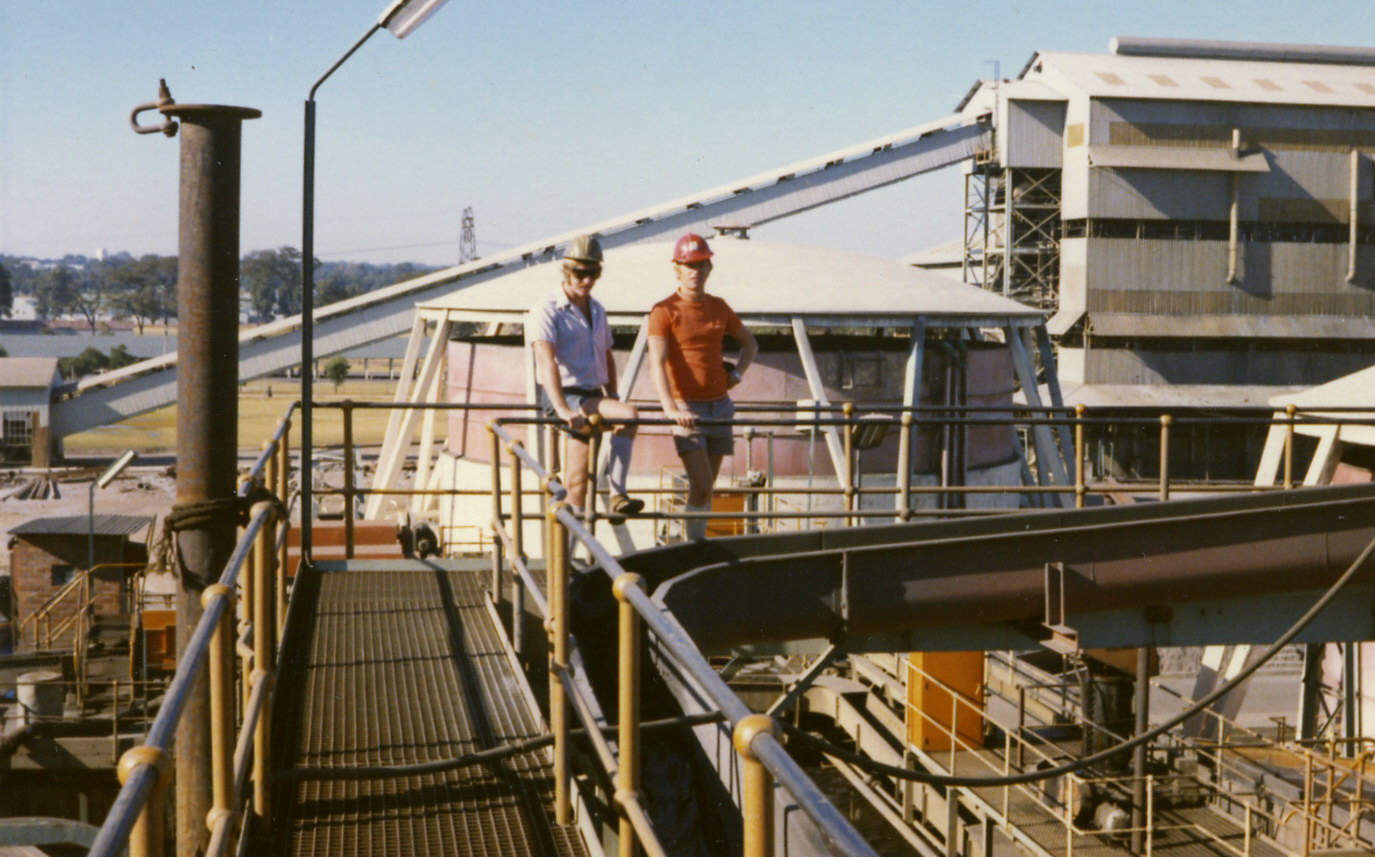
With Doug at Nchanga
Rugby Club, 1973

Sad news from Scotland of the death of Dr. Doug Edmunds, a fellow Nchanga metallurgist, who I worked with on the Concentrator from 1970-72, but for several years I knew via the Nchanga weighlifting and rugby clubs.

Doug was a larger than life character who crammed a wide range of experiences into his life. He initially went to Glasgow University before switching to Strathclyde, where he graduated in applied science before obtaining a Ph.D. in metallurgy. He was a Blue from both universities and in the 1960s claimed seven Scottish shot and discus titles as well as three British Universities’ titles and was Scottish weightlifting champion.

He spent three years in Zambia from 1970 and won the national heavyweight weightlifting title, organised the country’s first Highland Games, played for the national rugby team and represented Zambia at the Commonwealth Games in Edinburgh as well as the World Powerlifting Championships in the USA.

The photo below was taken in the Nchanga gym in 1971 and it is a sobering one as I am the sole survivor of that group, Peter Fiore dying in 2014 and metallurgist Vic Bryant last year.

Peter, Doug, Vic and me, Chingola 1971

On his return to Scotland Doug built his family milk business into one of the UK's biggest dairies, and, concentrating on the Highland Games, he won the World Caber Tossing Championship in 1976 and 1978.

But Doug was most well known for founding TV's World’s Strongest Man competition, becoming a highly recognisable figure clad in black with trademark stetson as he sat shouting instructions. He is survived by his wife, Linda, daughter, sons, four grandchildren and a great granddaughter. One of his sons, Gregor, from Doug's first wife Moira has followed in his father's footsteps, becoming a winner of a World Highland Games and Scotland's Strongest Man.

Doug was a tremendous character, a gentle giant, who I feel privileged to have known.

@barrywills

Monday, 15 June 2020

Memories of Nchanga's High-Grade Leach Plant

During my 4 years at Nchanga in the early 1970s my first two years were spent on the concentrator, before being transferred to the commisioning team for Stage I of what would eventually be the giant tailings leach-solvent extraction-electrowinning plant, the brainchild of the legendary Jack Holmes (MEI Blog 5th September 2018). Stage I was an interim plant designed to treat stockpiled low grade oxide copper concentrates by leaching and cementation in Kennecott Cones.
Stage I Tailings Leach Plant 1972. Kennecott Cones and Leach Pachucas
The cementation plant did not operate for very long as it was soon absorbed by Stage II and I did not see the final enormous tailings leach plant, which began operation in 1974, until my visit to Nchanga in 2012.
A section of the Tailings Leach Plant in 2012 with the smelter in the background
Copper is characterised by having a whole suite of economic ore minerals, and many are present in the Nchanga ore body. Underground ore contains mainly suphide minerals, chalcocite, chalcopyrite, covellite, bornite, while the shallower open-pit ore contains oxidised minerals, mainly the bright green malachite, blue azurite, as well as cuprite and chrysocolla. All these minerals responded to processing in various ways.
When I left Nchanga in 1973 these minerals were concentrated by flotation in two stages, first a relatively straightforward sulphide flotation circuit, and then treatment of the sulphide tailings by sulphidisation using sodium hydrosulphide, before floating the oxidised minerals. Not too successfully, however, as the final tailings contained substantial amounts of refractory minerals, notably chrysocolla and cuprite, and to a lesser extent malachite and azurite. The tailings leach plant was initially conceived to treat these tailings, but so successful was piloting that the 'oxide' flotation circuit was dispensed with and the giant plant treated the tailings from sulphide flotation as well as tailings impounded in tailings dams.
So when commisioning of Stage I had been completed I did not realise that my transfer, for my few remaining months in Zambia, would be to a plant which would also soon become obsolete, the high-grade leach plant. This section tank-leached the oxide flotation concentrates in dilute sulphuric acid, the resultant copper sulphate solution being transferred to the tank house to produce electrowon copper.
With fellow metallurgist Peter Glass, 1973
Electrowinning tankhouse
Copper cathode stockpile with Sandy Lambert
I found things had changed enormously when I returned to Nchanga 8 years ago. In the early 70s sulphide concentrates were shipped by rail to the smelter at Kitwe around 30 miles away. Now a giant flash smelter treats these concentrates at the rate of 12,000 tonnes of anode copper per month, and sits on the site of the old high-grade leach plant.
Although my few months on the leach plant provided a catalyst for our move from Zambia, I have fond memories of those few months, particularly of the people that I met, many of whom I still keep in touch with.
Leach plant personnel 1973, BW, Eric Plumridge, Phil Cudby, Ian Noble, Corrie Koen, Peter Glass and Paul Smithson
Times change but memories linger on.

Saturday, 21 December 2019

Death of Victor Bryant: a true hands-on mineral processor

Many people who have been in the mining industry as long as I have will have crossed paths at some time with Victor Bryant, who died on December 1st in Canada. Vic spent almost 50 years in the mining industry in various capacities such as Operations and Project Engineer, Plant Manager, Senior Process Metallurgist, Mill/Concentrator Superintendent and other senior positions.
When I first nervously set foot in the metallurgists' office at Nchanga in 1969, the first of my many days in this industry, it was Vic Bryant who welcomed me. Soon he and his wife Joanna (Jo) became great friends and we shared many of our Zambia experiences with them, including our memorable adventure in East Africa in 1971, where Vic and I spent a night in a Tanzanian prison cell, accused of spying for Uganda!
Tanzania 1971: Barbara with Jo and Vic Bryant and their son Andrew
We went our separate ways after Zambia, but kept in touch and met up occasionally in various parts of the world.
With Vic in the Philippines in 1983
With Vic and Jo at Niagara Falls, 1990
Vic was Vice President and Senior Metallurgist for Micon International Limited between 2005 and 2011 and prior to that spent 10 years with Fluor Daniel consulting on projects for PT Newmont in Indonesia, Phelps Dodge and Asarco in South Peru, BHP in Santiago, Chile, Cyprus Corp. in Arizona and Peru, and numerous other worldwide projects.
He was a Director of Highbank Resources Ltd., Canada from 2002 prior to his becoming CEO/President and retiring from Highbank in 2015.
Our thoughts today are with Jo and their children Andrew and Deborah, and their six grandchildren.

Thursday, 3 October 2019

More Nchanga catch-ups

The photo below was taken during our first few months in Zambia, in late 1969. We made friends early and here we are spending a day by one of the sunken lakes near Luanshya.

Left to right are Barbara and me, Alan Minty, fellow metallurgist Tony Watts, Ann Howieson, Pete Love, Chris Hulme and Jens Mende.
We caught up with Alan Minty and his wife Sheila in Cape Town in 2005, on a visit to Robben Island, but the whereabouts of the others proved elusive, until early this month, when I had a message on LinkedIn from geologist Pete Love. Now semi-retired, he is a consulting geologist based in Eastbourne in Sussex, and we had a long phone conversation reminiscing about the good times in Zambia, particularly our early years when we ran a weekly disco, aided by computer specialist Jens Mende
Saturday night fever in Chingola, with Pete, and Jens Mende

Great days, but Pete had some very sad news as well, that Jens had been tragically killed twelve years ago.

Pete and Pam Love at their home in Sussex
Pete and I will stay in touch now, but we would love to hear from anyone who has news of the others in the photo. I would particularly like to know what became of Tony Watts, who was a metallurgist on the concentrator when I arrived in October 1969.

Thursday, 24 January 2019

Sad news from Cape Town on the death of Roger Thomas

Some very sad news in from Cape Town this morning, of the passing of Roger Thomas, who I managed to contact five years ago, via the blog.  We got together for the first time in 44 years, over coffee at the Vineyard Hotel during Comminution '14.  Barbara and I became great friends with Roger and his wife Janet, and we would meet up for dinner on each of our visits to Cape Town, the last time being only two months ago.
With Roger at the Vineyard Hotel during Comminution '14
Roger was acting plant metallurgist on the concentrator when I arrived in Zambia.  He often reminded me of when he supervised my first duty on the concentrator- looking after the daily and monthly metallurgical accounts. I have vivid memories of Roger praising me for how quickly I produced the first monthly account, and then the next day berating me, as I had completely cocked it up, but at least I was never asked to do this again!
Roger and Janet were adventurous, and they certainly made the most of their time in Zambia, travelling to East Africa (as we did), and climbing Kilimanjaro (which we did not do). They also made an overland trip to UK, driving through India and Afghanistan, something which no sane person would attempt today.
Roger and Janet left Chingola in early 1971 to study for MBAs at the University of Cape Town. He then left the metallurgical profession to develop his entrepreneurial skills, first in boat building and truck hire and then in engineering supply, where he became Managing Director and then Chairman of a company supplying anticorrosive and low friction products. After retirement seven years ago Roger and Janet, and their three children, settled in Constantia, a suburb of Cape Town.
Roger and Janet visiting us in Cornwall during the summer of 2017, with their friends Kathy and Rod Whyte (centre)
After a brave battle with cancer, Roger died last night at home surrounded by his family. Our thoughts are with Janet and the family at this sad time.

Wednesday, 11 July 2018

Zambia: Looking back a few years

Amanda and a few Cu-Co Africa delegates strolled down to Victoria Falls yesterday afternoon, and the photo suggests that the water flow is very much higher than it was at the same time three years ago, when I also photographed delegates by the Eastern Cataract:
Amanda (4th left) with delegates yesterday.........
.....and delegates at the same conference in July 3 years ago
And looking back even further; Amanda looks very much at home in the Livingstone shabeen below, thanks to her early training in Chingola way back in 1972, shortly before she left Zambia for the UK. She is clearly enjoying her first visit back to Zambia!
 

Wednesday, 20 July 2016

Good news from Australia and sad news from Chile

Good news from Australia that Prof. Alban Lynch (see In conversation, 11 August 2014) is to be inaugurated into the Australian Prospectors & Miners’ Hall of Fame, in the category of Technologist and Scientists. The induction ceremony will be held in Melbourne in November. Congratulations from all at MEI.
Alban Lynch (left) receiving the IMPC Lifetime Achievement Award
from Eric Forssberg, Brisbane 2010

And some sad news from Chile, of the death on July 17th of Roger Kelley at his home in Santiago. I worked with Roger at Nchanga in the early 1970s and until his illness he worked as an independent metallurgical consultant, travelling enthusiastically around the world. Our thoughts are with his wife Elizabeth, and son Steven.
With Roger Kelley (left) and Cyril O'Connor, in Santiago, 2013
Twitter @barrywills

Tuesday, 19 April 2016

Copperbelt reminiscences over lunch

Barbara and I are staying at the Winchester Mansions Hotel in Cape Town this week, and today we had a wonderful lunch in the company of Roger and Janet Thomas, and Rod and Kathy Whyte, sharing memories of our Copperbelt experiences and the people that we have all known over the intervening years.
Roger, Barbara, Rod, Kathy, me and Janet
We had a reunion with Roger, who I had not seen for 44 years, last year at the Vineyard Hotel. We worked together for a short time during my early years in Zambia. He is now retired and living in nearby Constantia, and he and Janet are good friends with Rod and Kathy, who live in Johannesburg but are house guests this week in Cape Town. Rod and Roger were at the same school in Bulawayo, and then left for University in England, Roger to Birmingham and Rod to Leeds.
Rod commenced studies at Leeds in 1963, the same year as me, so it is amazing that our paths have never crossed until today. He studied Chemical Engineering, me Metallurgy, in the Houldsworth School, so we must have attended the same communal lectures.
Rod's experience is vast having spent 11 years on the Zambian Copperbelt and 26 years with Anglo American in South Africa. During his long-standing career with Anglo American he was involved in various capacities in Research and Development, Plant Operations and New Business Development.
In his capacity as Head of Metallurgy, between 1998 and 2004, he was the senior metallurgist in the company with responsibility for the effective functioning of the metallurgy discipline within Anglo American. His experience is multi-commodity, covering a range of different process areas (mineral processing, hydrometallurgy, pyrometallurgy) in a number of countries worldwide. More specifically, he has an in-depth knowledge of copper metallurgy and processing, from various deposits in the Zambian Copper belt as senior metallurgist, as Chairman of Anglo American Research Laboratories and also as a Director of Palabora Mining Company Ltd.
All too soon lunch ended, but it was great to catch up with Roger and Janet again, and to finally share memories with Rod and Kathy after all these years. We have all had interesting experiences around the world via our great industry and I know that we would all be delighted to hear from anyone who worked with us during our long careers.

Twitter @barrywills

Thursday, 16 July 2015

The Smoke That Thunders

Of all the places that I have visited in the world, the Mosi-oa-Tunya (the smoke that thunders), better known as the Victoria Falls, is the most wondrous. "Real Africa" has become a bit of a cliché but this area of the mighty Zambezi, the 4th longest river in Africa, is just that- real Africa, wild and magnificent.

The spray from the Falls rises out of the African bush
Zambia September 1969

This month I visited the Falls for the 7th time, and the experience never palls. Barbara and I first passed through here in 1969, en route to the Zambian Copperbelt from Cape Town (posting of 25 November 2010), but in all our subsequent visits we have been based on the Zimbabwean side of the river. This time we spent a week on the Zambian bank, thanks to the SAIMM Copper - Cobalt Conference at the Avani Victoria Falls Resort near the town of Livingstone and situated in the heart of the Mosi-oa-Tunya National Park. The Zambezi forms the border between Zambia and Zimbabwe, so the falls are shared by the two countries, and the park is 'twin' to the Victoria Falls National Park on the Zimbabwean side.

Victoria Falls is roughly twice the height of Niagara, but while it is neither the highest nor the widest waterfall in the world, it is classified as the largest, based on its width of 1,708 metres (5,604 ft) and height of 108 metres (354 ft), resulting in the world's largest sheet of falling water.

To appreciate the full grandeur of the Falls you must take to the air, so we took a short helicopter tour to view the full width of the Zambezi plunging into the awesome crevice in the relatively flat plateau.


Geologically Victoria Falls is the result of soft sandstone that fills huge cracks in the hard basalt rock of the plateau. As the Upper Zambezi flowed across the plateau in ancient times, it found the cracks and started wearing away the softer rock, eventually creating a series of deep gorges. Geologists estimate that the river has been falling into these gorges for at least the last 100,000 years. As the rock wears away, the cataract follows these gigantic cracks and moves further upriver across the plateau.

The first of the series of gorges
The Victoria Falls bridge from the Boiling Pot

From the first gorge the river takes a zigzag course through the gorges. When it travels through the second gorge, it passes along a pool known as the "Boiling Pot." During high water this part of the river is filled with heavy turbulence and whirlpools. It is often at this location that objects, animals, and sometimes people, are deposited along the edge of the water after they have been unlucky enough to have been swept over the falls.

A short walk down to river level in the boiling pot is definitely worth the effort and always a good place to relax and talk to local people as the river races towards the Victoria Falls bridge which spans Zambia and Zimbabwe, and also the location of one of the world's most famous bungee jumps.

Meeting friendly locals by the Boiling Pot
The river continues zigzagging through a total of six gorges, which range from 400 to 800 feet (120-240m) deep, before settling into a steep-walled chasm known as the Batoka Gorge which is filled with wild rapids, providing one of the world's most spectacular white water trips. In the distant past, each of these gorges has been the location of an earlier version of Victoria Falls which has moved further upstream as the river has eroded away the sandstone. After travelling a further 120 miles (200km) the river empties into the man-made Lake Kariba, and then on into Mozambique and the Indian Ocean.

From the Zambian bank of the river the well maintained trail begins at the Eastern Cataract and leads to the Knife Edge bridge, which often provides a drenching due to the close proximity of the falling water, and then on to the view across the second gorge and Danger Point in Zimbabwe.


The Eastern Cataract
The Victoria Falls and Knife-Edge bridges

Crossing the Knife-Edge Bridge

The Falls viewed from the second gorge
Looking across the second gorge to Danger Point in Zimbabwe
No visit to the Falls is complete without viewing from the Zimbabwean side, and we walked across the Victoria Falls Bridge into that beautiful country, like Zambia populated by friendly people, despite its economy and tourist industry being ruined by its despotic leader. But things are obviously improving, and Victoria Falls town was vibrant with many street cafes, and new luxury lodges have sprung up since our last visits, such as the Victoria Falls Safari Lodge, where we stopped for coffee and from the decking watched shy kudu drinking from a small waterhole, watched with interest by vultures in a nearby tree.


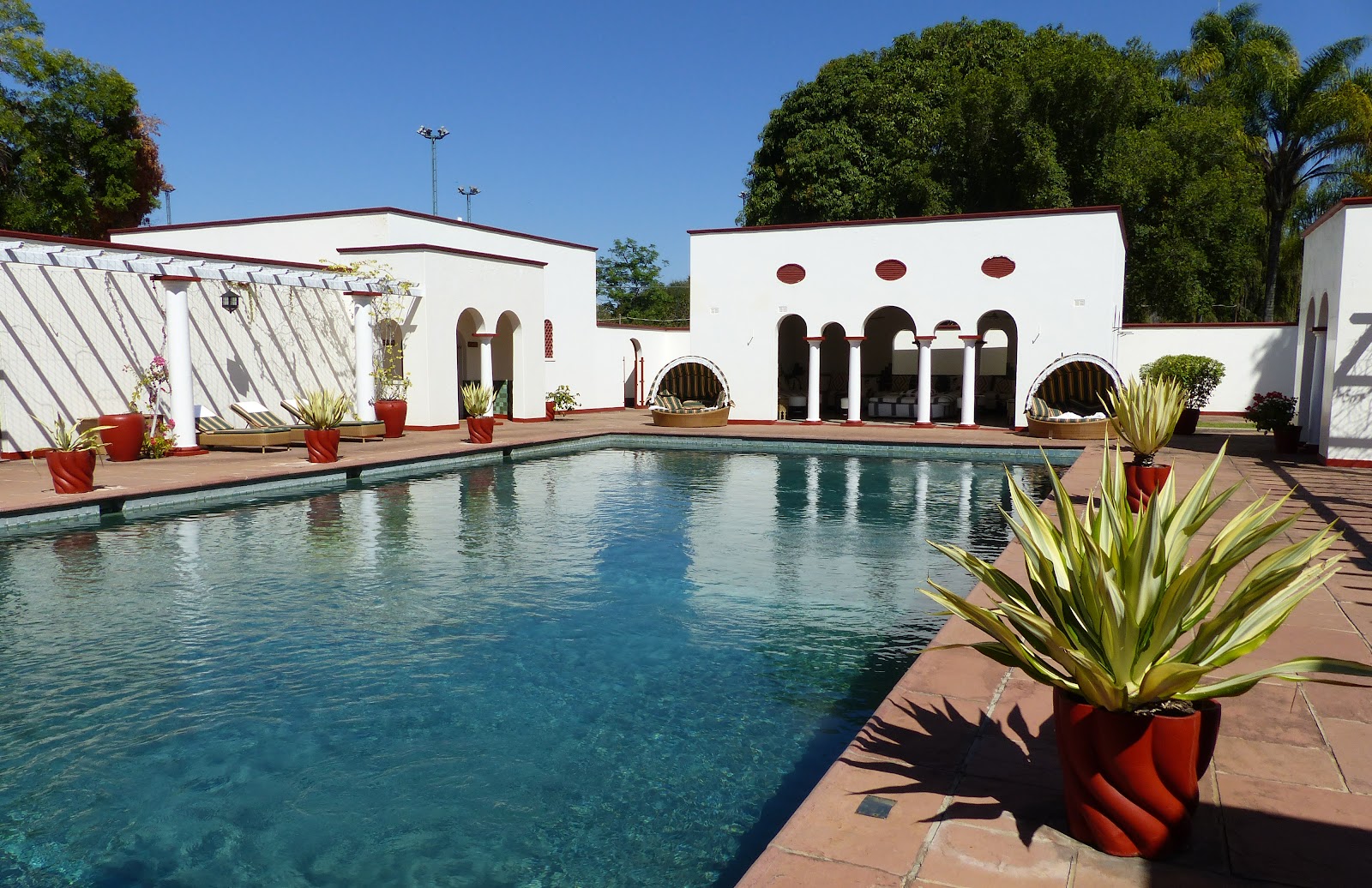
Victoria Falls Hotel is one of the great hotels of Africa. We first stayed there in 1970, and expected faded Victorian elegance this time, but were pleasantly surprised to see it in pristine condition, and had an excellent lunch on the terrace with the Mosi-oa-Tunya in the distance.

The magnificent Victoria Falls Hotel, Zimbabwe


Then along the track from the hotel to the Rain Forest, to pay our US$30 entrance fee to view the Falls!

The Devil's Cataract

The Main Falls
Approaching Livingstone Island
Sitting in the middle of the river on the very edge of the abyss is Livingstone Island. It was here that the Scottish missionary and explorer David Livingstone was taken by dug-out canoe, and became the first European to view the Falls on 16 November 1855. As was the tradition in those times, he named them after his Queen. In his diary he wrote: “....scenes so lovely must have been gazed upon by angels in their flight.” We visited the island for High Tea and a wet and muddy tour to view the Falls from only a metre or so from the 350 ft plunge, the highlight being a rather scary, but unforgettable, dip in one of the deep pools by the long drop.


An extreme close-up view of the Falls from the Livingstone Island rock pool

A view of the rock pool from the Rain Forest
From only a short distance upriver it is hard to imagine that the river will soon take its precipitous plunge into the giant crack in the surrounding plateau, and a cruise on the Zambezi is a wonderful way to enjoy an evening sundowner, watching hippos in the tranquil waters while Africa provides one of its spectacular sunsets.

Cruising the tranquil Zambezi


Further upriver the Chobe River in nearby Botswana empties itself into the Zambezi, and we spent a day across the Botswanan border in Chobe National Park, famed for its teeming wildlife, particularly the greatest concentration of elephants anywhere in the world (see also posting of 22nd July).
By the Chobe River, Botswana
This was a short break that I would recommend to anyone. A very relaxing way to see "real Africa" without the long demanding drives that we have experienced in East Africa, Limpopo and Namibia. However, be aware that what you see at Victoria Falls is very seasonal, due to the distinct rainy and dry seasons in this part of Africa. The minimum flow, which occurs in November, is around a tenth of the April figure; this variation in flow being greater than that of other major falls. July is usually an ideal time for visiting this area. Although it is easily accessible from Cape Town if you are attending an MEI Conference, there is a fair chance that after a November conference, at the end of the dry season, the Falls may be less than spectacular, as the photo below shows, taken during my visit in September 1995.

The "Falls" in September 1995
I can guarantee, however, that if you visit after a March or April conference you will be rewarded by an awesome spectacle of the Falls in full flood, although this is not a great time for photography, or for keeping yourself and your camera dry!

"Viewing" the Falls in full flood

More on Zambia