Thursday 22nd April
It was good to have Joe Pease, of Mineralis Consultants, Australia on Tuesday's panel discussion. Four years ago he and his colleague Bill Johnson (posting of 27 August 2020) were inducted into the International Mining Hall of Fame, for their pioneering work in bringing stirred milling into the minerals industry in the mid-1990s.
 |
| Joe Pease (left) with Bill Johnson |
Stirred mills were introduced into the minerals industry for ultrafine grinding of refractory ores, but their use is now being extended into coarser size ranges, the subject of a paper this morning by Monday's keynote speaker Chris Rule.
It is difficult to overestimate the impact that stirred milling has had on comminution circuits, and the morning session contained 9 presentations on stirred mills and their associated ceramic media, from Australia, Canada, France, South Africa and UK, including two from conference sponsor Keramos, an Australian based company with over 20 years experience in the manufacture and supply of cutting edge ceramic grinding media into the mining and minerals industries.
Media for stirred mills is now a very competitive business, and apart from Keramos, there are three more dedicated suppliers exhibiting, sponsor Dakot from South Africa, and two from China, sponsor King's Beads, and Betterwear New Material, a welcome new company to the comminution series. It was interesting to browse their brochures in their booth.
The final session of the conference, on Mills and Circuits, began with a presentation by Glenn Stieper, of conference sponsor Glencore Technology, Australia. He stressed that as resources degrade towards complex ores, larger plants and throughputs are needed to achieve the same project economics, but this is in conflict with a concurrent demand for better safety, environmental, capital cost, operational cost and energy performance.
To address this conflict, mineral processing must evolve and Glencore Technology has developed a concentrator design that achieves a smaller volume of capital equipment, a lower profile and footprint, less environmental impact and greater safety. This is via the marriage of its first 5MW M20,000 IsaMills with a full circuit of new and larger throughput Jameson Cells.
Australia’s Russell Mineral Equipment, a global leader in the design, manufacture and supply of grinding mill relining technologies and services, has made massive contributions to recent comminution conferences, sponsoring and having three exhibit booths and 15 representatives at Comminution '18.

This year has been no exception. The company is sponsoring once more, has a virtual booth, and 17 registered delegates, and in the final session a presentation by Stephen Gwynn-Jones on automated mill relining, which was followed by a presentation by Waldo Verster of Multotech, South Africa on mill liner optimisation.
Following a full day of presentations Jon Wills announced the result of the draw for the generous prize donated by conference sponsor Cancha. This was a 12 month subscription to Cancha Geometallurgy Software, including training and support, worth US$2,900. Cancha is an integrated geometallurgical toolkit for sample selection, 3D visualization, model generation, and data analysis and bridges the gap between geological knowledge and comminution simulators. The lucky winner was Ann-Christin Böttcher, of TU Braunschweig, Institute For Particle Technology, Germany.
Jon then brought proceedings to an end by thanking the sponsors once more, as well as all the presenters, exhibitors, and the delegates for being so active in the discussions. All that was missing was an invitation to adjourn to the Vineyard Hotel Gardens for a final drinks function, but hopefully this will happen at Comminution '23.
 |
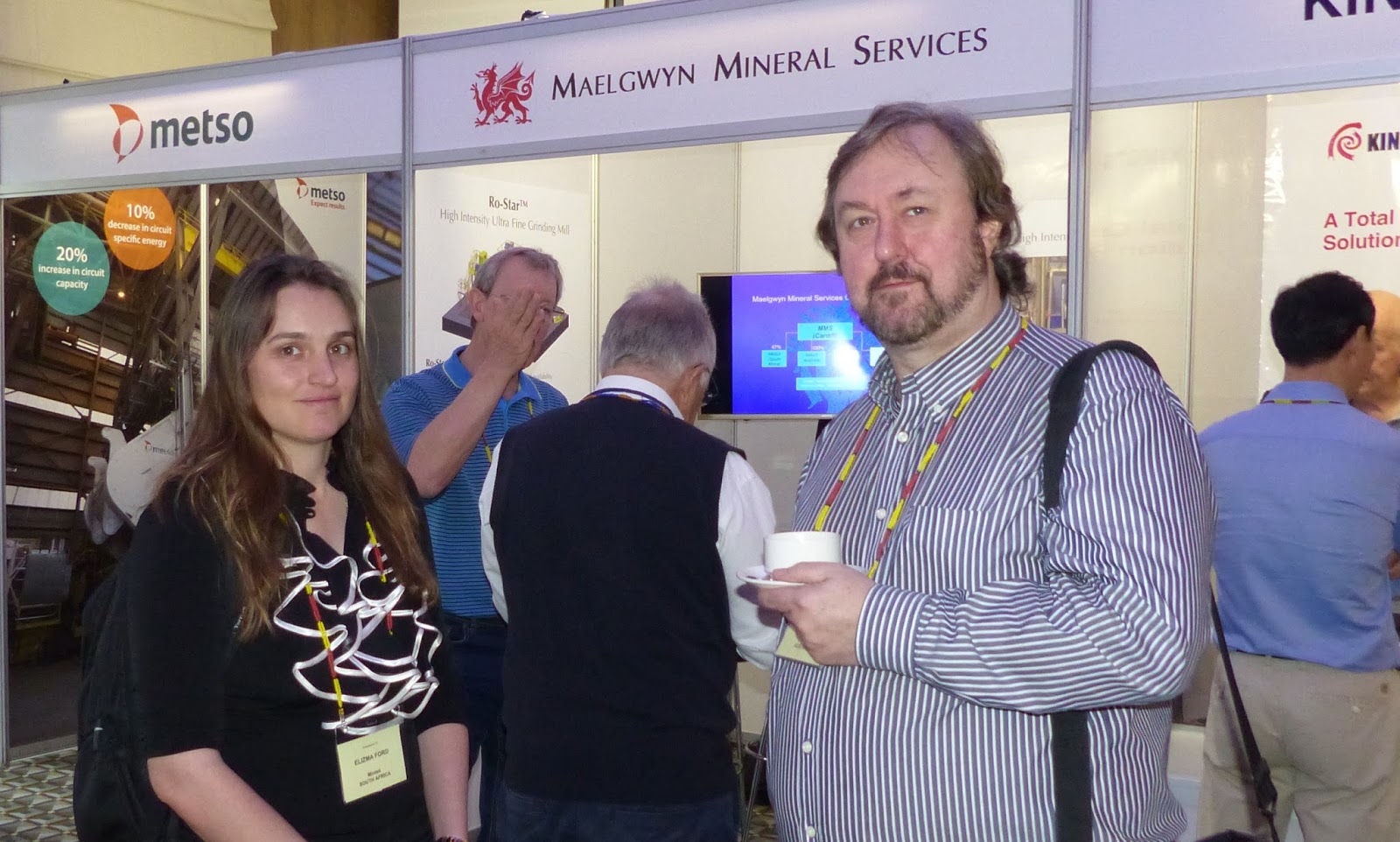
| Memories of Comminution '18 |
Despite this being our first online conference we have been very pleased with the way that it progressed. The 67 presentations were very professional and there was a great deal of delegate interaction. These discussions can continue for a further 6 months, as the conference will remain online, and we invite further registrations at any time. At the moment there are 213 registered delegates and this number is increasing daily.
We would greatly appreciate your feedback on the event, and invite you to submit your comments and criticisms to this blog post, as your opinions will be of great value to us as we progress to future events.
Thankyou all of you for your support.