Showing posts with label Sizing. Show all posts

Sunday, 28 July 2024

An update on Comminution '25

It was interesting to hear that one of the Comminution '25 sponsors, Weir Minerals, a global leader in innovative mining technology, has launched the all-new ENDURON® Orbital range of vibrating screens. Engineered for sand and aggregate, construction, and small tonnage mining operations, the new screens are designed to meet the most demanding of applications as they feature an all-bolted construction, significantly improving reliability by eliminating welding in high-stress areas, the leading mode of failure in vibrating screens.

Screens are replacing classifiers in many grinding mill circuits as classifying by size-only they give a sharper separation than hydrocyclones with multidensity feeds and reduce overgrinding of the dense minerals. and another leading manufacturer, Derrick Corporation, also a Comminution '25 sponsor, will also be highlighting their new developments in this area,

New comminution and classification technologies are regularly hitting the market with promises to reduce energy, improve liberation and reduce costs, but Grant Ballantyne, a Technical Director at Ausenco, Australia, will ask, in his keynote lecture at Comminution '25, how can we identify the fine wine from the snake oil? For example, improved energy efficiency can be achieved at the detriment of wear, or improved liberation can be achieved without improving recovery. What is the truth behind the curtain? And how can we find this truth as quickly and efficiently as possible? Grant's presentation will explore the range of evaluation methodologies that are available, as well as some lessons that can be learned from previous ineffective assessments.

Grant is also a Director of CEEC, one of the conference's industry advocates and he is an Adjunct Associate Professor at the University of Queensland. In 2019 he won the CEEC medal and in 2017 was awarded the MEI Young Person's award.

Things are looking good for Comminution '25. Abstracts are already coming in and 20 companies are signed up for sponsorship, the latest being Maelgwyn Minerals Services and Molycop.

#Comminution25

Monday, 24 June 2024

Physical Separation '24: a summary of the technical presentations

Physical Separation '24, the 8th in the series, was held at the Vineyard Hotel, Cape Town from June 10-12, 2024 and was attended by 80 delegates from 17 countries.

Following is a very brief summary of the presentations made over the three days.  This summary is intended to guide you to the extended abstracts associated with the presentations, most of which are available online as open-access. Unfortunately not all presenters responded to requests for drafts, but for those that did their names are linked directly to their papers in the online Proceedings.

The drafts have not been refereed, but all the presenters have been invited to submit their final papers for peer-review to a virtual special issue of Minerals Engineering.

Monday June 10th

Technical Session 1

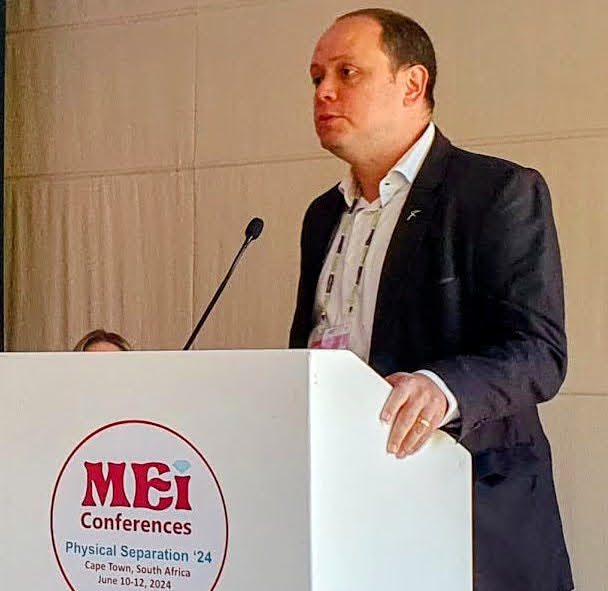
Is physical separation still relevant in 2024? This was the question asked by James Agenbag, the regional sales manager for Africa and Europe for Mineral Technologies, South Africa in his opening keynote lecture. It is of critical importance he argued, as it is the most energy-efficient, chemical-free means of sorting and upgrading minerals. It will become an even more vital first-stage in future flow sheets. In addition, physical separation will also become a critical step in the recycling of batteries, cables, cell-phones and other electronics as we start to close the metal loop and start to re-use more and mine less.

James Agenbag (centre) with Mineral Technologies colleagues

Ajay Sihota, Director for Precious Metals Recovery with FLSmidth Ltd, Canada then discussed best practices in gravity circuit design and operation and the practical considerations involved in determining ore amenability, scale-up, design, operation, and maintenance of the modern gold gravity circuit. 
Ajay Sihota

The Reflux Classifier achieves powerful synergy between an upper system of inclined channels and lower fluidized bed arrangement, delivering gravity separation in a single stage of separation. With over 240 installations around the world, the technology has been used to beneficiate iron ore, mineral sands, metallurgical coal, potash, chromite, lithium, and other base metal oxides. Pedro Pinto, of ArcelorMittal, UK, evaluated the variation of fluidisation water and bed density in the performance of the Reflux Classifier on Western Africa iron ore fines.

Pedro Pinto

Kevin Galvin is the inventor of the Reflux Classifier and is Director of the ARC Centre of Excellence for Enabling Eco-Efficient Beneficiation of Minerals at the University of Newcastle, Australia. He is a recipient of numerous awards including the Ian Wark Medal, ATSE Clunies Ross Award, and Antoine Gaudin Award in mineral processing. He described the step-change improvement in gravity separation utlising the latest in a series of improvements.

Joshua Starrett is a PhD candidate, supervised by Prof. Galvin at the University of Newcastle. He discussed his work on the Reflux Classifier, aimed at maximising the performance of the particle size classification using inclined channels and the challenge of expanding the range of separation sizes beyond the previous limit of 180 microns. 

Joshua Starrett and Kevin Galvin

The GradePro is a modified version of the original Reflux Classifier technology and includes two key modifications to the original design: a reduced mixing chamber area and the use of secondary fluidisation water. These modifications allow for better stratification of particles by density and the removal of light gangue particles before they even enter the bed. Lance Christodoulou, of FLSmidth, USA showed how the the GradePro has been used to enhance the recovery of valuable minerals from low-grade ores and tailings.

Lance Christodoulou

Wynand Roux


Taking us to the lunch break, Wynand Roux, a lecturer at the University of Pretoria, South Africa, presented a study employing numerical modelling to explore the intricate hydrodynamics of a lab-scale inclined fluidised bed based on the Reflux Classifier design. 


Technical Session 2

Chris Ndoe
In the first presentation after lunch Chris Kaseba Ndoe, a PhD candidate at the University of Johannesburg described his work aimed at optimising chromite recovery from chrome plant tailings in South African Middle Group chromite seams using a Wilfley shaking table. Response surface methodology and central composite design facilitated the optimisation process.

There is a growing demand for lithium as it is primarily used in the production of batteries. Nichole Maistry, a Senior Engineer at Mintek, South Africa,described how two lithium bearing ores, namely spodumene and lepidolite, underwent gravity separation via heavy liquid separation laboratory tests to determine the amenability of each ore to upgrade by gravity processes, such as dense medium separation.

Nichole Maistry (right) with Mintek colleagues

Maria Cristina Vila

Maria Cristina Vila
is Associate Professor in the Department of Mining Engineering at the Faculty of Engineering of the University of Porto, Portugal and she showed how dense media cyclone models have applied to the pre-concentration of a diamond ore from Angola.

Tebogo Mokgomola, an Engineer at Mintek, investigated the effect of conventional crushing and HPGR on the pre-concentration of South Africa's UG2 ore by DMS to ascertain if the crushing method can minimise PGM losses.  

Tebogo Mokgomola with Mintek colleagues

Tomas Machalek is a project manager with Heidelberg Materials AG, Germany and is also studying for a PhD at VSB - Technical University of Ostrava in the Czech Republic. His work involves technical support for quarries and sand & gravel pits and he described the optimisation of a suction dredger’s discharging pipeline.

Tomas Machalek (left)
More on Day 1

Tuesday June 11th

Technical Session 3

One of the most important developments in recent years as been sensor-based sorting as a pre-concentration process prior to crushing. It is a dry process so reduces overall water as well as energy consumption.

Conference sponsor Steinert is a leading player in this field, and Priscila Esteves, is the laboratory manager at Steinert Latinoamericana, Brazil, and she leads the development of Sensor-Based-Sorting applications in Latin America. She discussed the utilisation of sensor-based-sorting technology to enhance the quality of low grade iron ore.

Priscila Esteves (centre)

Jacek Kolacz, CEO of conference sponsor Comex Polska, Poland described how ore pre-concentration by sensor-based sorting is a complex process and must be optimised, especially when several sensors are applied. Therefore, a new optimisation method has been developed using an AI model to achieve efficient identification of required materials during sorting.

Jacek Kolacz (centre)

Vitor Andrade, a Process Engineer with Vale, Brazil, showed that understanding the amenability of the sensor for each type of ore is fundamental for obtaining better performance and can help calibrate the optimum threshold. He presented a performance evaluation of a particle sorting X-ray transmission sensor for different types of copper ore and their composition influence on the sensor performance.

Vitor Andrade (centre) with Vale colleagues

After the coffee break Tom Newman, a process engineer at ST Equipment & Technology LLC, USA, described the development of a dry separation system using a tribo-electrostatic belt separator, which requires no water or chemical additives. 

Athule Ngqalakwezi, a Senior Engineer at Mintek, South Africa then looked at the effects of mineralogical difference on magnetic separation of two magnetite tailings samples sourced from the northern part of South Africa.

Athule Ngqalakwezi (centre) with Mintek colleagues

Taking us to the lunch break Thiago Piacentini, Manager at Sibelco, USA discussed how high purity quartz is pivotal in advancing decarbonization through photovoltaic cells and enabling digitization via semiconductors and optical fibers. The primary reservoir for such quartz is found in North Carolina's leucogranite Appalachian deposits, rich in plagioclase, K-feldspar, mica, and heavy minerals. Existing purification methods, mainly flotation, incur high costs due to chemical reagents, mechanical complexity and extensive waste treatment. He described a study  exploring the efficacy of Pulsating Wet High Intensity Magnetic Separation in streamlining the purification processes.

Thiago Piacentini (right) with Francois Burger (Stark Resources, South Africa)

Technical Session 4

Frikkie Enslin, applications manager with Multotec Process Equipment, South Africa, focused on an important aspect relating to maximising profits in mineral processing- the lifecycle management and optimisation of the heart of many mineral processing plants, the hydrocyclone. He showed that cyclone lifecycle optimisation must move away from "one size fits all" to customised solutions.

Frikkie Enslin (centre) at the welcoming drinks function

Following on from this, Victor Portnov, the CPO and founder of conference sponsor Conundrum AI, a technology company that provides a software platform for implementing, deploying, and running AI process control in the mining industry, described the control and optimization of hydrocyclone classification performance with predictive models.

Victor Portnov with Jenni Sweet of Mine3, South Africa at Mill Circuits '24

Khuthadzo Mudzanani,a research engineer at Mintek, South Africa, presented case studies from various mining operations on how wet sieving efficiency is influenced by mineral ore physicochemical properties and operational conditions,

Khuthadzo Mudzanani (centre) with Mintek colleagues

As the original presenter could not attend, Max Richter, of the University of Cape Town, stepped in to present work laying the groundwork for a phenomenological screening model, offering a fundamental understanding of granular transport on vibrating screens.

In the final paper of the day Lesigen Moodley, of Eskom Research, South Africa described the microlithotype particle type classification and enrichment of coal maceral concentrates with the Reflux Classifier, Float-Sink and De Beers RhoVol techniques.

More on Day 2

Wednesday June 12th

Technical Session 5

Andrew Vietti, Director at Vietti Slurrytec, South Africa, introduced a model for understanding dispersive clay behaviour for tailings solid/liquid separation applications, highly dispersive clays within tailings often being the cause of poor flocculation and of poor dewatering unit process performance.

Andrew Vietti with his colleague Fredre Dunn

With high grade iron ore deposits in South Africa depleting, focus is placed on the use of low-grade ores. Tebogo Kale, of Gravitas Minerals, South Africa, described a new fine iron ore beneficiation process, The Kalahari Process, that aims to address the shortcomings of current technologies, with the Optima Classifier® at the heart of the circuit. The Optima Classifier® has proven its ability to produce a low, medium, and high-grade iron ore concentrate at economically favorable yields while also minimizing capital and operational costs. 

Tebogo Kale with his Gravitas colleague Franco van de Venter

CO2 emissions, water consumption, and tailings generation have driven the industry to develop environmentally friendly technologies. Thailli Conte, a geologist at Vale, Brazil, described a route for dry processing of iron ore which combines microwave technology for moisture reduction with the dry concentration of hematite and goethite fines in rare-earth permanent magnet concentrators.

Thailli Conte (centre) with Vale colleagues

Gravity separation, magnetic separation or flotation are often used to upgrade ilmenite-containing ores prior to smelting. The choice of minerals processing technology depends on the mineralogical properties, liberation size and associated gangue. Getrude Marape, head of Physical Separation at Mintek presented a study investigating the recovery of fine ilmenite by magnetic separation.

Gertrude Marape (centre) with Mintek colleagues

While bauxite residue (BR) is considered a waste product, it carries metals which can be recovered while minimizing the environmental impact. Kornel Tobiczyk, head engineer at Norwegian University of Science and Technology, Norway, presented a sustainable route for efficient extraction of metals from BR using hydrogen reduction followed by magnetic separation.

Kornel Tobiczyk (3rd left)

Technical Session 6

The production of chrome ore is growing, mostly as an outcome of China's rising demand. South Africa was the top exporter globally in 2021. The typical South African chrome concentration plant consists of 4 or more stages of spirals, still discarding chrome tailings with a grade of up to 20% Cr2O3. Franco van de Venter, process manager with Gravitas Minerals, South Africa, described a new chrome recovery process, ChromEx, which employs the use of the Optima Classifier®, with the aim of increasing overall chrome recovery and decreasing the tailings grade to less than 12% Cr2O3. 

Inga Sixhuta, an engineer in training at Mintek, discussed the characterization and processing of low-grade chromite ore for development of Cr mesoporous catalysts for oxidative desulphurization of dibenzothiophene.

Inga Sixhuta (2nd right) with Mintek colleagues at registration

The Beauvoir granite is a highly differentiated intrusion considered as one of the most promising hard-rock lithium deposit in Europe. It also contains interesting amount of tin in cassiterite, niobium and tantalum in colombo-tantalite and microlite. Bastien Demeusy, of the University Of Lorraine, France, described the concentration of tin, niobium and tantalum from the Beauvoir granite using a Falcon SB concentrator.

Bastien Demeusy with his co-author Lev Filippov

The conference came to an end with two papers on microwave technology from Vale, Brazil. Mariana Pereira is a Master Analyst at Vale and she described the calcination of kaolinite in a novel microwave rotating furnace. Vale's Kassia Toccolini then showed how a pilot plant study is proving that microwave technology for drying ores is becoming a green alternative, particularly in areas where clean electricity is largely available.

With Kassia Toccolini and Mariana Pereira

More on Day 3

A final thanks to all concerned in making this a great conference, the sponsors, exhibitors, chairpersons, presenters and delegates, and last but not least the wonderful staff at the Vineyard Hotel.  We would greatly appreciate your comments on this posting.

A reminder also that the next conference in the series, Physical Separation '26, will be held at the Vineyard from April 20th to 23rd, 2026.

#PhysicalSeparation24

Thursday, 23 May 2024

Fine screening and mill relining technology: great news from two regular comminution sponsors

Derrick Corporation is a family-owned and operated company and has been a regular sponsor of MEI's comminution conferences, so it is good to welcome them back to join the other 17 sponsors already signed up for Comminution '25.

Derrick Corporation is a pioneer of wet and dry fine screening and their latest designs are commonly used now in grinding circuits as alternatives to hydrocyclones. Although the late Prof. Alban Lynch was involved with hydrocyclones for very many years, in his conversation with me he said that "the way they are used now is an absolute nonsense, with circulating loads in some cases of well above 200%. The future is high frequency screens.....it is very clear that these screens are so much better than hydrocyclones."

By classifying by size-only, screens, compared to hydrocyclones, give a sharper separation with multidensity feeds and reduce overgrinding of the dense minerals. 

Some of the Derrick team at the 2022 SME Meeting in Salt Lake City

At Comminution '16 Elizma Ford, of Mintek, South Africa, evaluated the potential throughput benefit of adopting Derrick fine screening technology and  concluded that it is becoming apparent that the ability of these machines to accurately classify by size only at efficiencies in the mid 90% range, as fine as 45 micron, has resulted in a paradigm shift in milling circuits, replacing hydrocyclones in the closing of secondary and tertiary circuits. At Comminution '18 Martyn Hay, of Eurus Mineral Consultants, South Africa, also emphasised that over the past decade there have been a number of success stories where cyclones have been replaced by wet screening resulting in improved grinding efficiency, higher throughput, lower operating work index, better liberation and increased recovery in downstream flotation. He highlighted that inefficiencies in classification account for the majority of metal loss from the milling/flotation process as well as excessive mill power draw.

And I take the opportunity here of congratulating another regular comminution conference sponsor, Australia’s Russell Mineral Equipment (RME), a global leader in the design, manufacture and supply of grinding mill relining technologies and services, who was named last month as the winner of Australia’s 50 Most Innovative Manufacturers Export Award category and received a Top Ten Gold Award at the Australian Manufacturing Forum Event  held in Sydney. Australia’s 50 Most Innovative Manufacturers is an annual initiative aimed at recognising excellence in manufacturing across Australia. Congratulations RME and we look forward to seeing your huge team again at Comminution '25.

The RME team at Comminution '23

#Comminution25

Wednesday, 11 May 2022

Physical Separation '22 Day 3: Classification, and panel discussion on the future of physical separation

Wednesday 11th May

The theme of the final day's technical session was Classification and Solid-Liquid Separation, with eight presentations, from Australia, Canada, Chile, India and Peru.

Perhaps the most ubiquitous separation machine in the minerals industry is the hydrocyclone, and five of the presentations involved the use and design of these important devices.

Shashank Shekhar Pathak, of Weir EnSci, Weir Mineral India, presented a theoretical approach to develop a predictive model of the air core in hydrocyclones and Shuvam Mohanty, of the University of New South Wales, Australia, described the parametric analysis of axial flow hydrocyclones with suitably designed numerical experiments at various operating conditions. The effect of inlet dimensions, vortex finder length, and vortex finder diameter on the performance and flow pattern were computationally investigated using large eddy simulation for twelve hydrocyclone separators altogether. The results shows that the maximum tangential velocity and axial velocity profiles in the hydrocyclone decreases with increasing inlet dimensions, vortex finder length and diameter. 

The handling of tailings is of great importance in mining. Efficient tailing management is necessary for safe disposal as well as reutilisation of tailings to provide a sustainable solution to the modern mining industry. The Double Effect (DE) hydrocyclone is a double efficiency classification unit, working as a single stage without the need for additional pumping. The double classification helps dramatically reduce the amount of fine material entrained by coarse material, that might occur with a single stage and, at the same time, helps improve water recovery in the process. Chandranath Banerjee, of Weir EnSci, Weir Mineral India, presented a parametric study to analyse the physical response of design and operating variables of a DE hydrocyclone on the classification behaviour of mine tailings.


The KREBS CycloWash is an FLSmidth patented, ancillary elutriation (cleaning) device that markedly improves the desliming performance of standard cyclones, as it also reduces operating costs. The CycloWash, located in the lower/apex section of the hydrocyclone, injects water into the cyclone, and the injection water displaces the fines-laden water in the partially thickened underflow pulp. The result, essentially, is a second stage of classification taking place, where the displaced water with fines joins the normal cyclone overflow. The coarse solids are thickened, and they discharge through the apex orifice as a thoroughly deslimed underflow. 

Pablo Hinojosa, of UNSA, Peru, said that there must be a contingency plan for the classification of tailings via hydrocyclones in situations of high fines in the tailings entrance feed, so that actions including shutting down cyclones are avoided. If cyclones are closed, the pressure will increase and therefore more sand will be lost in the overflow (especially in conditions of tailings with good quality of input material, that is, a feed with coarse quality). He proposed reducing the content of fines in the underflow by reducing the diameter of the truncated cone of the CycloWash (a size that is close to the diameter of the apex), with the aim of improving the quality of underflow. In this way, a better quality underflow will be obtained when there is a high content of fines in the feed.

The design and operation of hydrocyclone cluster distributors is reported to have a significant impact on grinding circuit classification and therefore the overall minerals processing circuit performance.  Nirmal Weerasekara, of Weir Minerals, Australia, introduced a novel approach of assessing the performance of hydrocyclone distributors by employing a coupling between Computational Fluid Dynamics assessment and JKSimMet cyclone assessment, including classification and roping detection, novel hydrocyclone distributor designs then being compared against traditional designs using this approach.

According to Joshua Starrett, of the University of Newcastle, Australia, high-performance particle size classification is emerging as an enabler for achieving step change improvement in mineral beneficiation. He said that conventional mechanical screens provide sharp separations but are limited by decreasing performance at lower cut sizes and impacts of wear. Similarly, traditional devices such as hydrocyclones can offer good separations but are significantly impacted by water entrainment of fine particles. Joshua presented a study utilising a REFLUX™ Classifier, with water as a fluidising medium, to classify feed suspensions based on particle size. The partition curves were remarkably sharp, exhibiting virtually no ultrafine entrainment with the coarse underflow, and virtually no oversize particles in the overflow. 

The slurry flow properties in the compression zone of a thickener are challenging to predict, mainly due to the high concentration of solids causing non-Newtonian flow behavior. More accurate prediction of slurry sliding velocity at the thickener floor would enable the development of better thickener models, control strategies, and unit designs. An inclined open flume is often used to investigate such flows, where the slurry with known properties is fed and monitored as gravity-driven. Guilherme Anrain, of University of British Columbia, Canada, presented work using open-channel flow data available from the literature and data from their experiments to train machine-learning models — parameters including flow rate, flume slope, slurry depth, and slurry rheological properties.

In the final presentation in the session Christian Ihle, of the University of Chile, highlighted how water shortage and low ore grades present in many mineral processing plants lead to high water recirculation, which can lead to low water quality without proper treatment. Inclined plate clarifiers are a low footprint solution to remove turbidity from such streams. The presentation focused on the study of the effect of heating of the downward facing wall of such inclined elements, both on particles settling and re-suspension. 

After a short break, Erin Bobicki, of the University of Alberta, Canada, chaired a two hour panel discussion on 'Looking to the Future: Physical Separation in 2030'. The panelists were Peter Amelunxen, formerly with Hudbay Minerals, Canada, now Vice-President of Technical Services at Capstone Copper, Canada, Priscila Esteves, of Steinert, Brazil, Kevin Galvin, of University of Newcastle, Australia, and Neil Rowson of the University of Birmingham, UK.


There was wide range of discussion, including how different processes, such as gravity, flotation and magnetic separation will need to be integrated more in future as ores become more complex. It was a superb discussion, led by an excellent chairperson in Erin Bobicki, with highly experienced panelists with diverse specialties. It should be essential viewing for anyone in our industry.

Following the discussion, Jon Wills thanked the panelists and all those who have presented work over the last 3 days. He hoped that by the time of the next Physical Separation conference, in two years time, we would be meeting face to face again in Falmouth.

The recordings of the panel discussion and all the presentations at the conference are available on demand for the next 6 months, so it is not too late to register to access these.

All presenters have been invited to submit papers on their work for peer-review in a virtual special issue of Minerals Engineering.

Once again, we thank our sponsors for their support throughout these difficult times.


#PhysicalSeparation22

Monday, 9 May 2022

Physical Separation '22 Day 1: Gravity Concentration, and Plant Practice

Monday 9th May

Physical Separation '22 is the 7th in the MEI series, and the first to be totally online. We have a fine programme over the next three days, covering gravity and magnetic separation, sorting and microwaves, classification and solid-liquid separation.

Amanda and Jon Wills opened the conference this morning, welcoming our 50 delegates from 13 countries, and thanking our sponsors, Hudbay Minerals, Gravity Mining and Steinert, our Media Partners International Mining and Imformed, and Industry Advocates the Coalition for Eco-Efficient Comminution (CEEC), the Cornwall Mining Alliance and the Critical Minerals Association.

Amanda explained that we had to commit to an online event some time ago due to the pandemic, but previous physical separation conferences have been held in Falmouth, where we hope to be back in 2 years time. Cornwall is the most appropriate venue for these events, as the county is regarded as being the birthplace of modern mining, and in its 19th century heyday the tin and copper miners upgraded their ore by physical methods, gravity concentration and hand sorting, the only methods available at that time. These methods began to fail as the ores mined became leaner and more finely grained, and froth flotation came to the rescue in the early 20th century.

Gravity concentration has, however, over the past few decades enjoyed a strong revival, with the development of enhanced gravity machines allowing the treatment of finer grained ores. There is also a strong awareness that gravity concentration is more environmentally friendly than flotation, and is cheaper and simpler. Improvements have also been enhanced by more efficient classification methods and we were fortunate to have Kevin Galvin, Laureate Professor at the University of Newcastle, Australia, the inventor of the Reflux Classfier, open the first technical session, Gravity Concentration, with a keynote lecture "New challenges for gravity concentration and classification of fine particles" (see posting of 7th February 2022).

Kevin Galvin (right) at Physical Separation '19, with Stuart Saich of Promet101

Following Kevin's keynote were six presentations from Australia, Canada, France, South Africa and Turkey.

Mineral processing flowsheets that include gravity concentration typically utilise significant quantities of energy and water for materials transport and optimum metallurgical performance. These flowsheets are prime candidates to benefit from innovative approaches to lower water consumption. Edward Hart, of Mineral Technologies, Australia, described a proprietary surge bin design that has recently demonstrated suitability in upgrading minerals by rejection of fine/low specific-gravity particles and in addition allowing pumping of high pulp density slurries that were previously not considered practical.

Water-pulsated jigging is one of the earliest methods of gravity concentration but, as explained by Mahmut Camalan, of the Turkish Energy Nuclear and Mineral Research Agency, the process is adversely affected if drag forces cause particles to fall at constant or terminal velocities and he proposed two methods, sample preheating and polymer addition to the jig water, to reduce drag forces, sample preheating enhancing separation at low to moderate pulsation, and polymer addition at moderate to fast pulsation.

Falcon SB concentrator

Over the years innovations in gravity concentration have allowed the treatment of much smaller particles than in the past and enhanced gravity devices have become standard equipment in most gold recovery processes because they are a simple, inexpensive, and effective way of recovering free gold. The Falcon Concentrator is one such device and Sepro Systems of South Africa has developed a new centrifuge bowl that significantly improves gold recovery from grinding circuits. Wynand Erasmus described the evolution of the Falcon gravity concentrator from inception to present day and presented a case study illustrating the gold recovery improvements of the new Sepro Frontier™ bowl at the pilot and industrial plant scale.

Gillian Omaga, of Université de Lorraine, France, described the use of a Falcon Concentrator to recover critical metals as by-products of lithium processing from a rare-metal granite. The application of a Selfrag high-voltage electric pre-treatment stage before grinding increased the performance of the separation. 

Numerical and experimental invesigations on a Falcon Concentrator were performed at the University of British Columbia, Canada, using a fully coupled numerical model for slurry flow, which  was developed to be generalisable for dense slurry flows. Utkan Caliskan compared the numerical results to the experimental results obtained on a lab-scale Falcon L40 unit.

Franco van der Venter, of Gravitas Minerals, South Africa, described the Optima Classifier™, a multi-commodity hindered settler, which separates fine minerals based on density. The beneficiation of fine coal, chrome and iron ore was evaluated in this study. It was found that the Optima Classifier™ was able to produce market specific products in a single stage for all commodities evaluated. It was also found that using the Optima Classifier™ to beneficiate fine minerals is not only economically feasible, but also reduces the environmental impact of fine mineral disposal.

Optima Classifier

Following the mid day break were three presentations on Plant Practice.

Much of the remaining iron ore resources in Brazil consist of low-grade itabirite, which are currently processed in complex circuit flowsheets. Accordingly, a typical industrial itabirite circuit would include a four-staged crushing/screening plant, followed by grinding in a closed-circuit ball mill, desliming in hydrocyclones and final ore mineral concentration in reverse flotation circuits. In recent years Vale implemented various initiatives for investigating alternative processes towards simplified flowsheets. Accordingly, the proposed disruptive flowsheet consists of a primary crushing stage, SAG milling, primary concentration using Vertically Pulsating High-gradient Magnetic Separation, and a final concentration stage using the Reflux Classifier. The inventor of the Reflux Classifier, this morning's keynote speaker, Kevin Galvin, described such a circuit, which would eliminate several unit operations, by excluding secondary to quaternary crushing, desliming stages, complex flotation circuits, thickening and the flotation reagent plant. 

Artisanal gold mining is based on empirical methods which reduce the efficiency of concentration processes and increase their environmental impact. Flor Granda-Arce, of Universidad de Ingenieria y Tecnologia, Peru, described the use of a water-only cyclone (WOC) for the concentration of valuable heavy minerals from placer deposits in Madre de Dios, one of the richest (and most affected) areas in the Amazon basin. The presentation highlighted the potential of using WOCs as an environmental alternative for the processing of placer deposits in this region and the specific behaviors for different minerals, especially those carrying rare earths (Ce, La) and transition metals (Zr, Ti).

The concentration and transportation of ore, concentrates, or tailings are two common challenges mining companies today. Mining companies are seeing lower available valuable metals or minerals with an increased gangue-minerals concentration which makes handling of slurries more difficult. Difficulties in handling of slurries can lead to a reduction of a mill's working life due to the filling of tailings ponds, or there can be difficulty in filtration of tailings or concentrates or pumping ore that has been slurried over long distances in pipelines. While synthetic polymers are necessary to achieve faster liquid-solid separation rates, polymers can impart negative rheological characteristics to slurries. In the final presentation of the day Lawrence Andermann, of Suez Water Technologies & Solutions, USA, discussed methodologies for measurements of rheological properties of various kinds of slurries; such as viscosity, slump tests, Marsh Funnel, and Vane Rheometry.

All of the conference presentations are available on demand, so it is not too late to register.

#PhysicalSeparation22

Saturday, 7 September 2019

European Symposium on Comminution and Classification (ESCC '19)

The European Symposium on Comminution and Classification (ESCC) started over 55 years ago, held mainly in Germany with the past two Symposia held in Sweden and Turkey, and on September 2-4 for the very first time in UK, at the University of Leeds.
The iconic University of Leeds Parkinson Building
Sponsorship support was provided by DEM Solutions, ESSS, Freeman Technology, Hosokawa Micron, IFPRI, MEI, Quadro, Retsch, Surface Measurement Systems, WAB and Ytron.
Around 80 extended abstracts were received, which were scheduled for two parallel oral presentation sessions and two evening poster sessions along with exhibitions by the symposium sponsors. There were three plenary and six keynote lectures from leaders in the field, outlining the recent progress relevant to chemical and allied, food, mineral and pharmaceutical industries. The programme included the following themes: fundamentals of size reduction, innovations in milling and classification, nanomilling, mechano-chemistry and solid state transformations, pharmaceuticals and foods, attrition and wear, and related modelling. The notable number of abstracts received on modelling made it possible to divide them into sub-themes: mechanistic, population balance, discrete element and coupling with computational fluid dynamics.
The extended abstracts are available for download as a pdf file, and it is planned to make them searchable and available for future reference via the University of Leeds website.  The Elsevier journal Powder Technology will publish a selection of the contributions in extended full manuscript.
Monday September 2nd
After a brief opening by the conference chairman, Prof. Mojtaba Ghadiri, of the University of Leeds, who welcomed the 103 delegates, 36% from UK and 26% from Germany, the first plenary lecture was given by Arno Kwade, of Technische Universität Braunschweig, Germany.
Mojtaba Ghadiri and Arno Kwade
The most used energy storage system today is the lithium-ion battery, and Prof. Kwade discussed how mills are used for particle breakage and particle dispersing within the long process chain from the raw material to the final lithium-ion battery cell and its recycling at end of life.
Following the keynote the morning split into parallel sessions on Fundamentals, and Mechanistic Modelling of Size Reduction.
There were two keynotes in the afternoon session.
Lian Liu
Lian Liu of the University of Surrey, UK, showed how predictive modelling of comminution processes is essential for improving the process design, process optimisation, quality control and reducing operational cost. In her talk, two examples of dynamic mill models based on the population balance model were presented. The first one is for tumbling mills such as ball and SAG/AG mills used in the mining industry. The mill models for tumbling mills were developed in a generic dynamic model structure which incorporates ore breakage characteristics, transport, classification along the mill, a discharge function, and energy consumption.
Surface properties are critical for pharmaceutical manufacturing with an increasing trend towards the use of fine particles in pharmaceutical development where the surface will be increasingly important. Milling is often a unit operation of choice for size reduction in pharmaceutical processing although a range of surface changes can occur in crystalline solids subsequently affecting further processing, handling and performance. Jerry Heng, of Imperial College, UK showed that crystalline materials are anisotropic and milling results in the generation of new surfaces exposing different crystal facets varying in facet specific surface energy.
The International Fine Particle Research Institute hosted a reception in the evening to coincide with the display of the thirteen posters submitted.
 
Tuesday September 3rd
The day began with a plenary lecture by Michael Juhnke, of Novartis Pharma AG, who discussed the production of engineered drug particles by size reduction techniques, providing case studies for commercialized products where size reduction techniques could provide an essential element to enable key drug product features.
In a mid-morning keynote Wolfgang Peukert, of Institute of Particle Technology, Friedrich-Alexander University Erlangen-Nürnberg, Germany showed how milling at the nanoscale is a fascinating field involving aspects of nanomechanics, internal defect formation and defect stability, colloid and formulation science as well as mechanochemistry. Inorganic and organic nanoparticles including drug particles, novel 2D materials such as graphene or boron nitride and even nanoemulsions can be produced this way.
Wolfgang was a keynote speaker at Comminution '14, and is shown below (right) with fellow Comminution '14 keynote speakers Tim Napier-Munn and Alan Muir.
Luís Marcelo Tavares, of Universidade Federal do Rio de Janeiro, Brazil, is a familiar face at MEI's comminution conferences, and will be a keynote speaker at Sustainable Minerals '20 next year. In the first of the afternoon's keynotes Marcelo discussed how the discrete element method (DEM) is a powerful tool to describe the behaviour of particulate flows. However, in some cases, breakage is not taken into account, leading to biased results. This becomes critical for simulations where particle flow and particle size reduction cannot be properly decoupled. The Tavares breakage model, implemented in the commercial platform Rocky DEM, takes in consideration important rock behaviour based on the energy dissipated in a contact to determine if a particle will break or not, specifying the progeny size distribution generated on a breakage event.
The final keynote lecture of the day was given by Steffen Sander, of Hosokawa Alpine Aktiengesellschaft, Germany, who showed how air classification utilising deflector wheel classifiers has been state of the art in powder processing for many decades. The micro processes taking place inside these machines are still not fully revealed and remain subject to further investigations and he gave some examples of technical solutions to meet the requirements.
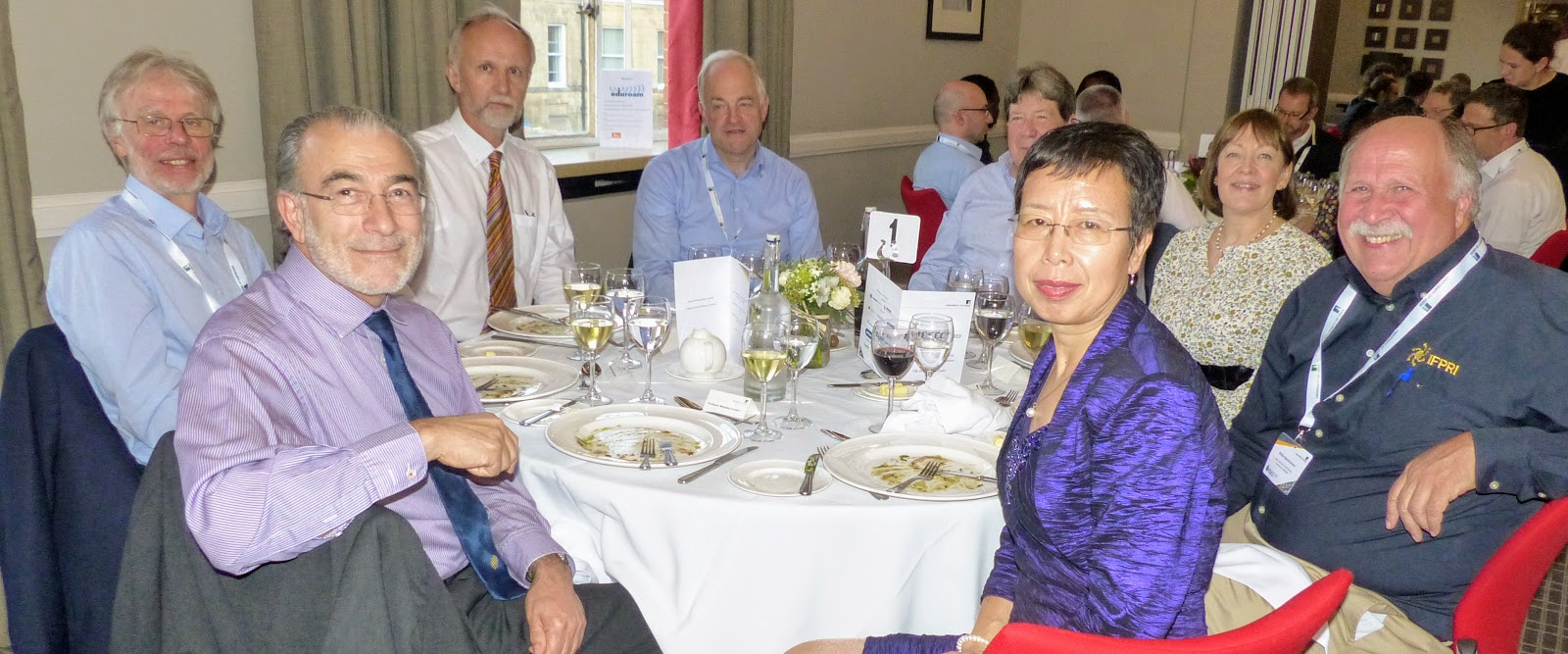
The day ended with a fine conference dinner at University House, with an entertaining after dinner talk from Jonathan Seville, Professor of Formulation Engineering at the University of Birmingham. Jonathan was for many years editor-in-chief of Elsevier's Powder Technology.
Conference chairman Mojtaba Ghadiri, with (clockwise) Wolfgang Peukert, Jonathan Seville, Arno Kwade,
Iain and Nicky Crosley, Willie Hendrickson and Lian Liu
Klaas Van der Wielen, Rudolf Landsmann and Marko Hilden
Paul Cleary with Barbara and Barry Wills
 
Marcelo Tavares, Mojtaba Ghadiri, Aubrey Mainza and Malcolm Powell
 Wednesday September 4th
The final day began with a plenary lecture from Malcolm Powell, of the University of Queensland's JKMRC, and a regular contributor to MEI's comminution conferences, who said that it is high time to dramatically upgrade historic empirical comminution models, that are based on back-fitted breakage rates, to mechanistic models. He presented an approach to embracing the available computational power and the progress in understanding of comminution systems to rewrite models to be predictive and reliable with respect to the range of conditions to be encountered in the current and future devices we use in industry. Underpinning such an approach is the need for appropriate measurement of breakage properties, that include mineral association, that respond to the range of conditions encountered in comminution equipment for mineral processing.
Malcolm is the founder of the Global Comminution Collaborative (GCC), a collaboration between the JKMRC in Australia, Sweden's Chalmers University, the University of Cape Town, Germany's Technische Universitat Braunschweig, the University of Rio de Janeiro, and Turkey's Haceteppe University, all, apart from Turkey, being represented in Leeds this week. 
GCC members Malcolm Powell (Australia), Arno Kwade (Germany), Magnus Evertsson (Sweden),
Aubrey Mainza (South Africa), Marcelo Tavares (Brazil) and Hakan Benzer (Turkey) at Comminution '14
GCC stalwart Aubrey Mainza, of the University of Cape Town, has been a long-time consultant to MEI's comminution series and in the final keynote lecture he showed how integrating classification into circuits during design and equipment selection is an important aspect in developing robust comminution circuits.
ESCC '19 has been a very well organised conference, so congratulations to Prof. Ghadiri and his team. The final act of the day was the presentation of prizes, sponsored by DEM Solutions, to the best student presentations. Well done Lori Gonnet of IMT Mines Albi, France, and Paul Fabio Prziwara of Technische Universitat Braunschweig, Germany.
ESCC '21 will be held in Toulouse, France, the exact dates yet to be finalised.