Showing posts with label In conversation with. Show all posts

Thursday, 27 August 2020

In conversation with Bill Johnson: Stirred Milling Pioneer

Although Dr. Bill Johnson has been for several years one of my most respected Minerals Engineering reviewers, I met him for the first time only three years ago, at the SME Annual Meeting in Denver, where he was inducted into the International Mining Hall of Fame.  Later in the year he was in Cape Town to present a keynote lecture at Flotation '17

Bill Johnson (right) with his long time colleague Joe Pease in Denver
for their induction into International Mining Hall of Fame
In over 45 years in minerals processing, Bill has made outstanding advances to the treatment of complex ores. He pioneered the use of the paradigm of size-by-size mineral liberation-class behaviour, and is a masterful user of this approach to drive major improvements to mineral processing plant design and performance. He was pivotal to the development of flowsheets and new processes for McArthur River, Mount Isa, Hilton and George Fisher, and has provided highly skilled technical support for a global array of operations.

Bill’s professional achievements have been recognised by the award of the President’s Medal from the Australasian Institute of Mining and Metallurgy for his work on advancing the processing of complex sulphide ores in 1993 and the CSIRO Medal for his contribution to the commercial development of the Jameson flotation cell in 1990. Recently, in 2008, he received the Mineral Industry Operating Technique Award, which was shared with Peter Woodall for the development of the IsaMill technology.

Dr. Johnson has had substantial careers in operations, research and education. He provided leadership of the Minerals Process Engineering program at the University of Queensland from 1998 to 2005 and in 2002 and 2003 leadership of the Division of Mining and Minerals Process Engineering was an additional responsibility. He continues to provide training and professional development on specialist topics for the minerals industry. He is presently an Adjunct Professor at the Julius Kruttschnitt Minerals Research Centre, a part of the Sustainable Minerals Institute, and a Principal Consultant with Mineralis. His educational and training experience includes teaching undergraduates and supervising postgraduate research together with running “in house” courses on advanced topics for technical staff. Bill is a respected mentor and widely known for his success in developing the professional skills of many minerals processing engineers during his time in the corporate sector and academia.

Bill Johnson was born in Stanthorpe, Queensland on 18 January, 1947.  When he was young, his grandparents told him many stories of the Cania Goldfield in Central Queensland.  Cania had an unusually long life as a goldfield and as a small town with some permanent residents. Gold was discovered just to the north of Cania Gorge in 1870 and the township known as 'Cania Goldfields' soon sprang up along Three Moon Creek. The township's population fluctuated over time until mining finally ended in the early 1920s. The waters of Lake Cania eventually covered the remains of the goldfields after Cania Dam was built on Three Moon Creek in the early 1980s.

Bill's grandparents had lived on or near the goldfield during the first 30 years of their lives, their involvement being mainly in the commerce in the town. Bill's mother was born in 1920 and started school in Cania. 

The background of Bill's family history in mining in Australia dates back to 1853, when his great-great grandparents left England with their two young sons, apparently attracted by the gold rush which commenced in Australia in 1851. They disembarked in Melbourne and travelled to southern New South Wales, where two further sons were born, the first of these, Noah Smith, being Bill's great-grandfather, born in 1855. 

The family followed the gold discoveries in a northerly direction, eventually reaching the major Gympie Goldfield in southern Queensland in 1867, the year of its discovery. This major field continued to be important until around the time of World War 1. The family largely remained in Gympie, but Noah did not. The Eidsvold Goldfield was proclaimed in November 1887 and Noah, now married with one daughter born in 1887, moved north from Gympie to Eidsvold in 1888. In 1893, he moved a little further north to the Monal Goldfield where he is shown in the photo below of a gold processing plant, holding two daughters, the one born in 1887 and another born in 1889. Bill’s grandmother, born in 1892 at Eidsvold, was too young to be in the picture. In 1896, Noah moved to the Cania Goldfield, a short distance away, for the rest of his life.

Monal stamp mill, 1890s


Top left: Bill with his sister Janette in the school playground in 1955,
where his father was the sole teacher. Bill was 8 and Janette 2.

Top right: Bill at school in 1957
Bottom: Bill and his younger brother gold panning at Ballarat in 1976
During his schooldays Bill developed a love of chemistry, and believed that the minerals industry was a way of applying chemistry and obtaining employment, given the range of possibilities in Australia at that time. He was awarded a Commonwealth Scholarship to attend university by the Federal Government. As part of the scholarship scheme, before attending the University of Queensland, it was necessary to be interviewed by an adviser employed by the Federal Government on possible suitable courses. Options included geology and geophysics. It seems that the adviser had a creative streak because he also provided an option which he called a Metal Chemist, which combined all the chemistry subjects with all the extractive metallurgy subjects and Bill was the only person to take this grouping of subjects at the university while he was there, and in 1967 he graduated, majoring in chemistry, with a minor in metallurgy. 

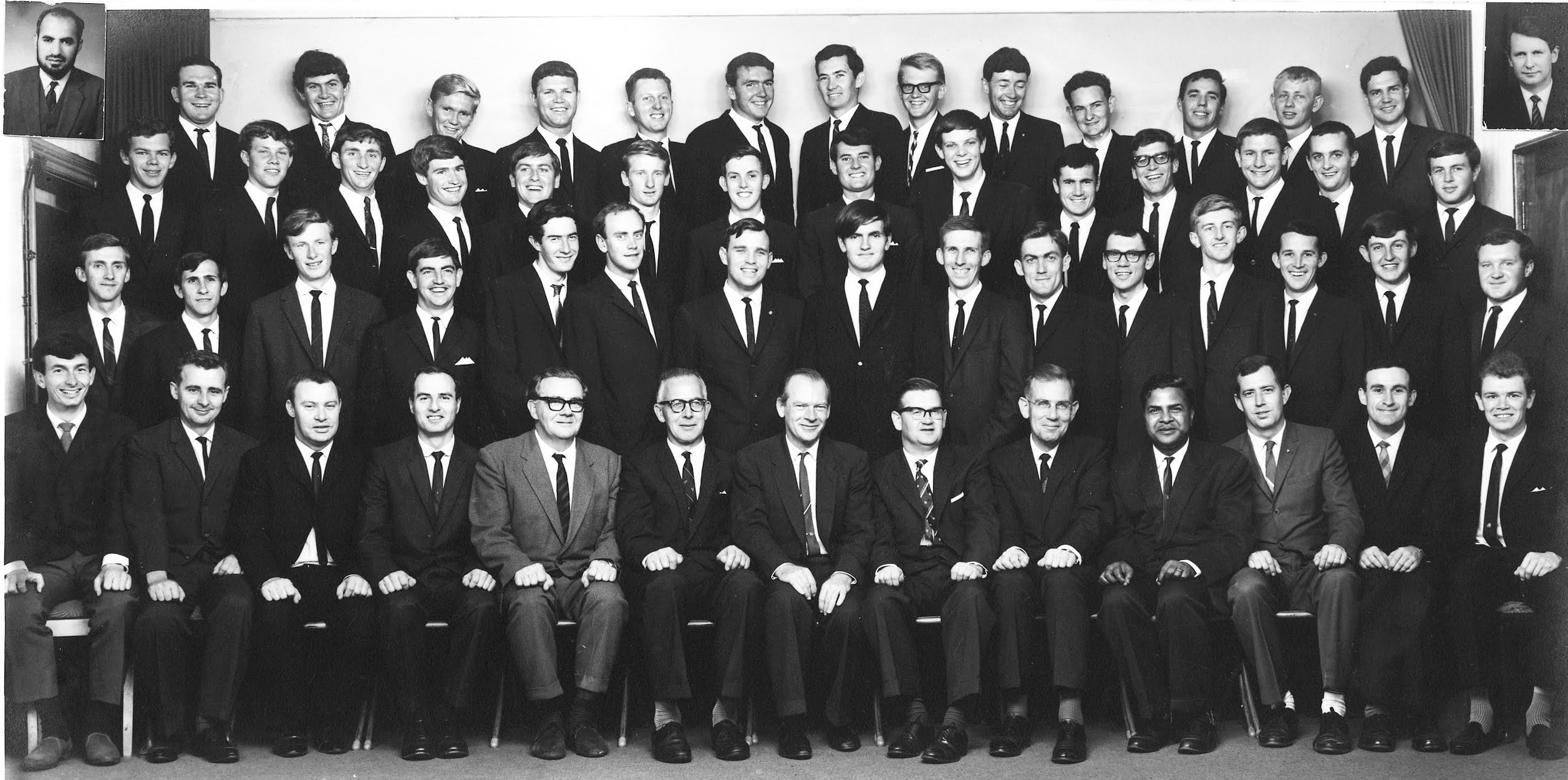
Final year photo 1967: Bill is 7th left on back row. 9th left is Don McKee who would be the JKMRC’s 2nd director, and 5th right front row is the 1st Director Alban Lynch

Then in 1968 Bill had the chance of undertaking an Honours Year Thesis with Alban Lynch (MEI Blog 11th August 2014). This was to be an investigation of the effect of various chemical variables in laboratory flotation of Mount Isa copper ore and Prof. Lynch planned to arrange for vacation work in the mineral processing laboratory at Mount Isa at the end of 1967/start of 1968. The research in 1968 would have to be in metallurgy. A problem was that Bill was not eligible for this option because he only had a minor in metallurgy, however the Dean of Science was very supportive of inter-disciplinary study and supported the plan strongly. The study under Alban Lynch occurred as planned and in 1968 Bill graduated with a first class honours degree in Metallurgy, after which he received a PhD in metallurgy in 1972 from the same university. His PhD work included a 5 and a half month spell at the Philex Mining Corporation in the Philippines for plant data collection, the most important outcome from the data being the relevance of the entrainment mechanism for hydrophilic minerals.

Bill says of Alban Lynch “Alban provided very clear lectures. He was very earnest but also approachable. It was clear from comments during lectures that he had well developed links to industry which were needed for his research group and the style of research he was employing – the use of industrial plants as the “laboratory” for data collection. He was entering the stage of research work on flotation in addition to grinding and classification."

After working for ASARCO in Arizona until 1976, he lectured at the University of Melbourne. He joined the CSIRO Division of Mineral Engineering in 1978 where research on the Lead/Zinc concentrator at Mount Isa Mines Limited was his main project and in 1982, he moved to Mount Isa where he continued applied research on the difficult ore treated in the Lead/Zinc Concentrator and other plants and ores of MIM Holdings, becoming the Minerals Processing Research Manager (1989-1997) of the laboratory and pilot plant facilities at the operating site in Mount Isa.

Several members of the Mount Isa Minerals Processing Research group with staff from
operations and engineering: Peter Williams, Lee Burton, Brett Gold, Bruce Mullan, Dave Fouhy,
Joe Pease, Kim Fisher, Bill Johnson, Ben Cronin, Brigitte Lacouture, Wally Onton and Mark Duffy
A major aspect of research at Mount Isa when Bill was Minerals Processing Research Manager was the development of the commercial viability of mining the McArthur River zinc-lead-silver deposit in the Northern Territory, 40 years after its discovery in 1955. It had long been recognised that the complexity of the McArthur River ore demanded a new approach to grinding and regrinding to produce commercial concentrates. Regrinding to a P80 of 7µm was required but there were no commercially available mills suitable for this task in the base metal industry.

Bill had been aware of the possibility of reopening work on the McArthur River ore for a couple of years before it happened. He had been reading and rereading papers from Prof. Klaus Schonert over a couple of years to try to ensure that he always had processing options if a project did commence on the difficult ore. A paradigm shift in mineral processing came about via Bill's attendance at the 7th European Symposium on Comminution in Ljubljana, Yugoslavia in 1990, where grinding methods in a wide range of industries were showcased. Bill saw the potential for large-scale adaptation and development of advanced stirred milling for the ultra-fine regrinding required by the McArthur River ores. This technology was unknown to the mining industry, being used only for small volumes of high value products, mainly in the food, chemicals and cosmetics industries. In the following months, Bill struck associations with a number of specialist firms, eventually settling with German manufacturer Netzsch for ongoing R&D.

A small laboratory sized Netzsch batch mill was purchased and installed at Mount Isa and after promising results work moved from the laboratory to the pilot plant in 1991. A continuous standard Netzsch mill (100 litres) was purchased for the pilot plant. This was the second largest mill in the Netzsch range at that time, the largest being a 500 litre mill. From the pilot plant experience, it was found that the regrinding technology could achieve the regrinding target of P80 of 7 microns but significant internal modifications were required for continuous operation in a real plant in the base metal mineral industry. Various options for the modifications were conceived and tested by the project staff at the Mount lsa site and the implementation of the findings into the design was facilitated by a partnership with Netzsch.

The next step involved trials of the modifications in the largest Netzsch mill (500 litres) which was tested in a small Lead/Zinc Concentrator at the Hilton operation close to Mount lsa. After further testing with a larger prototype in 1994, the go-ahead for the full-scale regrinding mills (3000 litres) at Mount lsa and McArthur River was given later in the year - the world's first application of the technology to base metal mining.

Bill conceived the idea for producing a viable concentrate and developed a pool of competent people to carry it forward. An expanded research team of 20 people, led by John Andreatidis and assisted by Michael Young (pictured below), worked under Dr. Johnson. Project Metallurgist John Andreatidis worked on the laboratory phase, the pilot plant phase, and the design modification phase and then moved to McArthur River Mining, a subsidiary responsible for the new operation. Mechanical Engineer Peter Woodall played a very important role in the pilot plant phase, the design modification phase and in numerous later activities with the mill. Kam Leung worked on data collection for the design of the primary grinding circuit and became the Metallurgical Manager for McArthur River Mining, with John Andreatidis in his team, when the new operation was approved and under development. The new operation commenced in May 1995 with four lsaMills in the regrinding duty.

John Andreatidis, Bill Johnson and Michael Young with McArthur River ore

The research also delivered increased metal recoveries at Mount Isa, the work being strongly supported by management and the Isamine R&D manager Jim Fewings. The Lead/Zinc Concentrator manager at that time was Joe Pease, who said that the team delivered the first significant breakthrough in fine grinding in 50 years, and the most significant development since SAG milling. The IsaMill technology which is marketed by Glencore Technology has spread into other duties in mineral processing and larger models have been developed, resulting in a large number operating in industry. 

IsaMill at Ernest Henry Mine, Australia

Bill left Mount Isa in December 1997 for the University of Queensland, but was available to the company for a specified number of days each year for the initial years at the university. From 1990-1997, he had visited the university each year to deliver a significant portion of one of the final year subjects in mineral processing. He gave undergraduate courses at the university until the middle of 2005 and was involved with the redesign and unitisation of the degree (1998-1999), AusIMM accreditation in 1999 and Institution of Engineers, Australia accreditation in 2002. He also organised “hands-on” field trips in the second and third years of the degree and the creation of two “hands-on” practicals at a coal washery near Brisbane. 

In conjunction with Mineralurgy (now Mineralis), Bill has delivered a large number of courses, usually at mine sites, on mineral recovery – size analysis, mineral recovery–size–liberation analysis and analysis of non-sized separation data. This 3 day course has been delivered 38 times with the vast majority being since 2005. Some of these were delivered overseas, in South Africa, New Zealand, Canada, USA, Mexico and Laos. He has also delivered a 2-day sulphide flotation chemistry course on 8 occasions, the largest number of courses being presented in 2015.

Consulting through Mineralurgy (now Mineralis) has provided Bill with projects on a wide range of topics and ores. During the consulting period, other highlights were the preparation of a flotation chapter in the SME Mineral Processing and Extractive Metallurgy Handbook (2019), three chapters in Process Mineralogy (2016) produced by SMI-JKMRC, a major portion of a chapter in History of Flotation (2010), and an updated version of a chapter (written and published in 2010) for the second edition of Flotation Plant Optimisation (2019), produced by the AusIMM.

A major highlight was being awarded the 2015 G.D. Delprat Distinguished Lecture for the Metallurgical Society of the AusIMM. This involved its preparation and delivery at eight locations in Australia. In 2017 MEI was honoured to have Bill as a keynote lecturer at Flotation '17 in Cape Town. 

Bill with MEI’s Jon Wills at Flotation ‘17

With such a busy professional life, it is good to see that Bill sets time for relaxation. He plays tennis weekly, exercises regularly and takes an interest in the results of various sports. He also has a keen interest in current affairs and history. He and his wife have travelled overseas as tourists six times from 2006 to 2017, with each trip lasting 4 to 5 weeks and taking particular interest in the many historical sites that were visited. In addition he regularly attends a small French conversation group, as his son has a French wife. Bill and his wife look after their 3 year old granddaughter each week.  

Bill and his wife Francyn and sons David and Alexander in 2005

Bill and Francyn with granddaughter Freya and son Alexander
Bill Johnson has played a huge part in the evolution of comminution, so my final question to him was how does he view the future of comminution, particularly with the increasing use of stirred mills?

He said "The impetus for the use of medium and high speed stirred mills was to obtain an economic means for reaching, in regrinding, product P80 values in the 5 to 10 µm range. However, at present, only a small minority of ores require regrinding into this region. To obtain substantial sale numbers, the technology has relied on its energy efficiency and its suitability for provision of a “clean” size reduction environment for the minerals, the latter being important for the flotation process. The application of the technology has spread into the normal regrinding range and into grinding stages along rougher banks and its use has been demonstrated in the final stage of primary grinding.

In general, the technology has the capability to regrind to product P80 values in the 1 to 5 µm range. This capability may be required for some future ores. The economic case for such regrinding will be made more readily if only a small portion of the ore requires such very fine regrinding. To achieve this outcome, it becomes necessary for the progressive liberation properties of the valuable mineral in the ore to be understood and for the design of the separation circuit to provide the necessary matching progressive recovery stages for the valuable mineral. There is also scope for the mills to become larger in volume and installed power, subject to the mechanical engineering constraints for each design.  

The chemical environment which can be created inside a stirred mill can be altered to suit the type of separation which is being sought in the following flotation process. However, the desirable chemical environment inside the mill, demonstrated at small scale, must be retained in any larger scale version of the process. In the future, the avoidance of process surprises because of unintended differences in the chemical environment in the stirred mill at various scales for the process (e.g. laboratory, pilot plant and industrial) will be important.

The connection between the ore texture and the most relevant size reduction mechanism requires better understanding. The attrition mechanism in stirred mills may be beneficial in achieving liberation with some ore textures but this may not be the case for other textures in achieving liberation of the key minerals".  

It has been a pleasure and a privilege to interview Bill Johnson for MEI. He is an inspiration to all mineral processors.

More Conversations

@barrywills

Monday, 15 July 2019

In conversation with Janusz Laskowski

Janusz Laskowski
I first met Prof. Janusz Laskowski at the 1988 IMPC in Stockholm, and have caught up with him at every IMPC, apart from Moscow, since then, as well as occasional SMEs, and at MEI’s flotation conferences; he was a keynote speaker at Flotation ’15 in Cape Town.
Janusz is Professor Emeritus of mineral processing at the University of British Columbia, Canada, and obtained all his degrees, including Ph.D., from the Silesian University of Technology in Poland.
In 1984 he founded “Coal Preparation” international journal and was its editor-in-chief until 2004.
An acknowledged expert on the surface chemistry of flotation, Prof. Laskowski was awarded the Lifetime Achievement Award of the International Mineral Processing Council at the 24th International Mineral Processing Congress in Beijing (2008), and is a recipient of the SME’s Antoine Gaudin Award (2011).
Young Janusz with his grandfather
and father before WW2
Janusz Stanislaw Laskowski was born in 1936 in Pszow, Upper Silesia. His father was a graduate of the Technical University of Mining and Metallurgy in Krakow, and was a deputy director of the Rymer Coal Mine. On the first day of World War II in 1939 he ended up, as did most Polish engineers, doctors and lawyers in Upper Silesia, in a German Concentration Camp.  He survived the war, and was the first General Director of the newly organized Central Research Mining Institute in Katowice (later he became president of the Silesian University of Technology). 
The young Janusz spent the next five years with his mother’s family in a small village, Posadza, near Krakow. He was nine years old when in a beautiful sunny winter of 1945 Marshal Koniev’s Southwest Front of the Red Army started surging towards Krakow.  He said that “a dull rumble slowly dominated everywhere. The family quickly moved into the fortified cellar.  One day the war stopped for three intense days in my village and a young German sergeant dug out a position for his heavy machine gun behind my uncle’s barn. “My war” ended when Russian T-34 tanks appeared and the German sergeant, who was shooting to the last cartridge, forced his way to our cellar where all the family was hiding. He was immediately followed by Red Army soldiers who shot him on the spot. Over the next few days the snow-white fields were tainted by the dead bodies of German and Russian soldiers”. 
A few months later he was back in Upper Silesia, in Katowice, and was admitted to the third year primary school to complete his education. 
Janusz graduated with a B.Sc. in chemistry from the Silesian University of Technology in 1956, obtained an M.Sc. degree in chemical engineering in 1958, and Ph.D. degree in mineral processing in 1963.  
Janusz and his wife Barbara, a successful dentist,
after the official ceremony for his award of PhD in 1963.
Barbara and Janusz are with Janusz’s parents, his father being University Rector
In 1961/62, his international career began when he spent one year in Prof. P.A. Rehbinder’s Department of Colloid Chemistry, Lomonosov University, Moscow, as a postgraduate student, and was involved in research under the supervision of Professor V.I. Klassen at the Mining Institute of the USSR Academy of Sciences in Moscow. Janusz said “in the early stages of my professional career I was very much inspired by Professor Klassen, and the topic of my PhD project, coal salt flotation, was a result of this influence”. In 1966 he translated Klassen’s monograph, Coal Flotation (V.I. Klassen, Wyd. Slask, Katowice, 1966; Polish text). After translating Klassen’s monograph he started working on his own book on coal flotation which was finally published by Elsevier in 2001 (Coal Flotation and Fine Coal Utilization). The book was dedicated to “my professors: Tadeusz Laskowski, Willy Ivanowich Klassen and Joseph A. Kitchener.”
As assistant professor at the Silesian University of Technology in 1966, he organised the 1st Seminar on Physicochemical Problems of Mineral Processing which with time evolved into a regular annual event and regularly published journal. 
Gliwice, 1964, Prof. Willy Ivanowich Klassen (3rd from left) with
Prof. Andrzej Waksmundzki (left) and Janusz’s father Prof. Tadeusz Laskowski (far right),
at the conference organized by the Silesian University of Technology when the
Slask Publishing office invited Klassen to visit Poland to publish
the Polish translation of Klassen’s “Coal Flotation” monograph.
Janusz with his wife Barbara and Prof. Klassen at the stop in Krakow on
the way from Gliwice to Zakopane to show Klassen the Tatra Mountain ski resort
He was chairman of the organising committee of these annual conferences until 1980, and, when he left Poland, the Symposia were taken over by his previous Ph.D. students and research associates (Dr. J. Lekki, Dr. A. Luszczkiewicz, Dr. J. Drzymala, Dr. Z. Sadowski). Since then he has been a member of the Editorial Board. Issue no.4, Volume 54, of Physicochemical Problems of Mineral Processing was published to honour him on his 82nd birthday. 
Janusz (2nd left) at the 2014 IMPC in Santiago with Polish colleagues
Tomasz Chmielewski, Przem Kowalczuk and Jan Drzymala
In 1967, Dr. Laskowski obtained a Leverhulme Trust Post-Doctoral Fellowship and in 1967/68 spent one year as a post-doctoral fellow with Dr. Joseph Kitchener at the Department of Mineral Technology, Imperial College, London. When Kitchener retired he edited jointly with Prof. John Ralston the volume Colloid Chemistry in Mineral Processing in his honour. The book was published by Elsevier in 1992.
Dr. Laskowski was an associate professor of mineral processing at the Silesian University of Technology until 1973 when he was appointed professor of mineral processing at the Wroclaw Technical University, Wroclaw, Poland.
In 1971/72, he was a visiting professor and taught several courses at the University of Chile in Santiago, and was invited by Prof. Fernando Concha to spend a month with the University of Concepcion, where he updated his own book, which had been published in Poland in 1969. The book was translated into Spanish, and published by the University of Concepcion in 1974 (Fundamentos Fisicoquimios de la Mineralurgia). Collaboration established with several Chilean researchers has survived up to this time.     
             Janusz and Fernando Concha relaxing in Concepcion during the
          3rd Latin-American Congress on Froth Flotation, November, 1994
Janusz attended his first International Mineral Processing Congress (IMPC) in Prague in 1970, and has attended every one since then. 
IMPC reception in Prague in 1970.
Janusz and Barbara Laskowski with Douglas Fuerstenau’s wife, Peggy
In 1979, he chaired the 13th IMPC in Warsaw, the last IMPC run with simultaneous translation into four official languages (English, French, German and Russian). It was at this Congress that he first met Prof. Jan Miller, of the University of Utah, who writes: “…my first meeting with Janusz and his wife, Barbara, was the occasion of the 1979 IMPC, the first and only IMPC held in Poland.  In those days international travel, especially to Poland, was not so easy, but the meeting was a great success. After the meeting Janusz had invited me to visit for a couple of days at his institute in Wroclaw, and so I did, traveling by train from Warsaw.  There we met with Professor Franciszek Letowski and Professor Fathi Habashi. 
In front of the Institute of Inorganic Chemistry and Metallurgy of Rare Earth Elements,
Wroclaw Technical University, 1979, Janusz (right) with
Franciszek Letowski, Fathi Habashi and Jan Miller
As is usually the case with Janusz, we had interesting discussions, both technical discussions and political discussions, during the visit.  Because of the visit to the institute, I was unaware that my visa to Poland had expired, making me a bit anxious.  We had to appear before the authorities to explain my naiveté and that there was no subversive intent.  Finally, only with Janusz’s typical persuasion did the authorities grant a visa extension and my return to the U.S. seemed possible.  Departure from Wroclaw, however, was not without one additional experience.  Arrangements had been made to put me on a night train to Warsaw, a sleeper car to be shared with three others.  Little did I know that the three other occupants would be three babuszkas, one of whom snored all night as I tried to sleep on my way to Warsaw.  So, my first meeting with Janusz was an interesting experience for a young man attending his first IMPC”. 
Prof. Miller continued “This first meeting was followed by many other occasions when I had the pleasure to enjoy the company of Janusz and Barbara, frequently at IMPC meetings such as the meeting at Dresden in 1991 and the IXth Balkan Mineral Processing Congress at Istanbul in 2001.  Of course, the Istanbul meeting was memorable.   Our wives, Barbara and Patricia, enjoyed shopping at the Grand Bazaar with Nanette, Cyril O’Connor’s wife, until we learned of the horrendous terrorist attacks, especially the World Trade Center complex in New York, and the corresponding devastation.  Of course, all Delta flights were cancelled and return to the U.S. was delayed for 3 days, only then being able to return to JFK airport on Turkish Airlines”.
In the 80’s Prof. Douglas Fuerstenau moved into the area of fine coal beneficiation and in 1981 he invited Janusz to join him as a visiting professor at the University of California, Berkeley. Doug’s invitation came in a critical period of Polish history when military government silenced the Solidarity Trade Union. As a result, after one year with Berkeley University, Janusz moved north to Canada, where in 1982 he was appointed Professor of Mineral Processing in the Department of Mining and Mineral Process Engineering, University of British Columbia in Vancouver. Through this appointment, he joined forces with Profs. Jan Leja, George Poling, and Andrew Mular and created one of the world’s strongest mineral processing and coal preparation programs. When Professor Leja retired after 20 years with the University of British Columbia, he edited a volume Frothing in Flotation in his honour (published by Gordon and Breach in 1989). This book turned out to be the first volume in a series of publications; Frothing in Flotation II, edited jointly with E.T. Woodburn, which was published by Gordon and Breach in 1998; Frothing in Flotation III, edited jointly with C.T. O’Connor and J.P. Franzidis, appeared as a special issue of International Journal of Mineral Processing, Vol. 64, Nos. 2-3 (2002).
The two sabbatical leaves from the University of British Columbia he spent with Prof. Jean Cases’s Surface Chemistry Group at Ecole Nationale Superieure de Geologie, Nancy, France in 1987/88, and with the Department of Chemical Engineering of the University of Cape Town in 1996. 
Celebration of Janusz’s 60th birthday on Cape of Good Hope during his
6-month sabbatical with UCT in 1996.
Cyril and Nanette O’Connor (left), J-P and Ross Franzidis, Barbara and Janusz
Janusz and Barbara testing South African wines on Cape Town beaches in 1996
Farewell to Cape Town in 1996; Janusz, Ross and J-P. Franzidis,Barbara, and Dee Bradshaw
In 1995, he initiated a new series of UBC-McGill international symposia on Fundamentals of Mineral Processing and chaired the first Symposium on Processing of Hydrophobic Minerals and Fine Coal, in Vancouver. He chaired the 3rd and 5th Symposia and edited the Proceedings, and then in 2006, the Metallurgical Society of Canadian Institution of Mining organized the 6th UBC-McGill-University of Alberta international symposium on Interfacial Phenomena in Fine Particle Technology in his honour and this led to publication of a special issue of the Canadian Metallurgical Quarterly, Vol. 46, No. 3, 2007.
With Prof. David Boger he co-chaired the Engineering Foundation Conference on Rheology in the Mineral Industry in San Diego, in February, 1997 and co-chaired the 2nd conference in the series in Hawaii in March, 1999.
Along with Dr. J. Drelich, Janusz co-chaired the Symposium Apparent and Microscopic Contact Angles held in conjunction with the 216th National American Chemical Society Meeting, Boston, in 1998, and jointly with J. Drelich and K.J. Mittal edited the conference volume, published by VSP in 2000. His monograph on Coal Flotation and Fine Coal Utilization was published by Elsevier in 2001. 
21st IMPC in Rome in 2000. Janusz and Barbara with their Chilean friends: Sergio Castro (left) and his wife,
and Osvaldo Bascur (right) with his wife
At the Centenary of Flotation conference in Brisbane in 2005,
with Profs. Kari Heiskanen and Douglas Fuerstenau
Prof. Laskowski retired from the University of British Columbia in 2001. He has been a huge contributor to our profession and in 2008 he received the highest accolade of the IMPC’s Lifetime Achievement Award, at the Beijing IMPC and in 2011, the SME’s Antoine Gaudin Memorial Award.
Janusz with Profs. Cyril O’Connor, Jacques Astier, Douglas Fuerstenau and Eric Forssberg
after being awarded the Lifetime Achievement Award in Beijing, 2008

With Prof. Roe-Hoan Yoon in Denver in 2011 with his Gaudin Award

Flotation ’15, Cape Town, with fellow Gaudin Award winners Profs. Nag Nagaraj, Graeme Jameson and Jim Finch
Janusz has been involved in flotation research for over 50 years and he feels that the most important developments in flotation technology have been:
  • The development of xanthates as collectors in flotation of sulfides;
  • Introduction of flotation as a main beneficiation process for processing of non-sulfide ores (e.g. phosphate ores, iron ores, coal, potash ores etc.);
  • Development of the concept of critical coalescence concentration to characterize the flotation properties of frothers;
  • The development of flotation columns;
  • The development of fluidised-bed flotation technology.
As to the future of flotation, in his opinion the most important areas that should be targeted are the processing of rare earth ores and flotation in seawater.

I have mentioned retirement to Janusz many times, but he is emphatic that he will never fully retire from a profession that he loves. He is a very fit man who visits a fitness centre daily, and he swims and cycles. He is a proud family man, he and Barbara having two sons, Kornel, who has a PhD from Carnegie Mellon University in Pittsburgh, and his younger brother Cyprian, who has a PhD from the University of Edinburgh.
Barbara and Janusz with sons Cyprian (left) and Kornel
It has been fascinating talking to Janusz about his long life and career, and hopefully he will continue to be a major player in mineral processing for many more years to come.

Thursday, 8 March 2018

International Women’s Day- celebrating one of our community's finest: Professor Dee Bradshaw

This guest blog is by MEI Rising Star Dr. Anita Parbhakar-Fox, of the University of Tasmania, who recently interviewed one of mineral processing's leading ladies, Prof. Dee Bradshaw.

Today is International Women’s Day which was formally adopted by the United Nations in 1975 (though was celebrated as early as 1909). It is regarded as an opportunity to celebrate the social, economic, cultural and political achievements of women. It is also a time to show future generations who our champions are to inspire them to strive for excellence in their own careers.
With that in mind, there is no more deserving woman to acknowledge today than Professor Dee Bradshaw. I had the chance to catch up with Dee to learn more about her career and to get her top tips for young professionals starting out in the minerals industry.  Dee's career has taken her on a pathway which recently saw the launch of the book ‘Green Mining, Beyond the Myth’ which addresses the social, economic, cultural and political issues surrounding sustainable mining, and explores pathways to a better future for the mining industry.  For many graduates and early career researchers, Dee has been a mentor encouraging them in their research endeavours with such infectious enthusiasm whilst always reminding them to consider the ‘philosophy’ component of their research. Her outstanding efforts were acknowledged by the University of Queensland in 2013 where she received an award for Excellence in Research Higher Degree Supervision (MEI Blog).

Dee obtained her PhD in 1997 in Chemical Engineering from the University of Cape Town (UCT) and went on to be a research officer and associate professor at UCT until 2008. In her last year, she took sabbatical leave and worked for 8 months with Rio Tinto (Centre of Technical Excellence, Bundoora, Australia and Kennecott Utah Copper Corporation, Salt Lake City, USA) and 4 months at the Sustainable Minerals Institute (SMI) in Brisbane. Dee enjoyed her time in Brisbane so much that she stayed on for the next seven years working at the SMI and JKMRC. Here she had several professorial roles including as theme leader within the AMIRA P9 and P843A projects and also as a Visiting Professor at the Mining Engineering Department Hacettepe University, Ankara. In 2016, Dee came full circle and returned to her alma mater where she was appointed as the South African Research Chair in Minerals Beneficiation and the Director of the Mineral to Metal Initiative.
Dee is internationally renowned as an expert in the field of flotation with her reputation for excellence developed over four decades.
When asked what sparked her interest in chemical engineering Dee explained more about her early education. She grew up in a small town in Zimbabwe where she had access to a good public education where maths and science were taught to a high standard. Having got a good grounding in these subjects, she won a place to study at UCT where she enrolled in a science degree. After her first year, she found her passion for chemical engineering grew as she was drawn to the problem-solving nature of this discipline. Dee found herself fascinated with the processing flowsheet, examining the inputs and outputs and pondering on what processes were occurring in between (what were the intermediate products and rate determining factors?). She enjoyed the challenge of taking messy processes and trying to introduce barriers and constraints to better understand and control them. Dee recognises that chemical engineering is a discipline that focuses on solving complex problems, and suggests that females in particular are well suited to this, so much so that enrolments (at UCT) have increased to the point where it is colloquially known as ‘Femme-Eng’. But I rather suspect this trend also reflects the fact that undergraduates are inspired by Dee and her departmental colleagues to read this subject.  
For many postgraduates, deciding what the next step in their career should be (after submitting a thesis) is a very difficult decision to make. I asked Dee when she first realised that she wanted to continue into an academic career beyond her PhD.  She described herself as an ‘accidental academic’. Having started a family young, she had contacted her former (BSc) supervisor to seek part-time work. She was encouraged to start a PhD examining surfaces and flotation (synergistic effects between thiol collectors used in the flotation of pyrite). This equipped her with technical skills to apply as a researcher and lecturer during the platinum boom (which commenced around the time she completed her thesis) where many processing challenges were encountered and there was an abundance of research funding available to solve them.
Honours poster session discussion with De Beers students, 2000
Dee realised she had a passion for working with people, solving problems and answering research questions, so academia became quite a natural fit. Dee describes her passion for applied science, she is very happy to collaborate with scientists working on the fundamental problems and developing new knowledge but she has always thrived where she can apply this knowledge to solve problems faced in the minerals industry. 
Dee is a true doctor of philosophy; she is an avid reader (mostly non-fiction) and is keen to explore the meaning of everything she encounters. This very nature, combined with supervising the PhD research undertaken by Megan Becker, sparked Dee’s desire to become more proficient in mineralogy. So, in the pursuit of upskilling, Dee spent a portion of her sabbatical working with Brett Triffett, Greg Wilkie and Dewitia Latti  at Kennecott, which coincidentally was at the time of the mining supercycle. She described warmly the privileged way in which she was able to learn, immersed in this hands-on environment, with Greg also providing one-on-one tuition. 
For many working in the minerals industry, moving around the globe is a part of what we do. I asked Dee what made her want to go to Australia on sabbatical and to stay on there for several years after. She described that when she approached Don McKee about a role for her sabbatical, instead of placing her in the chemical engineering department or the JKMRC, he pushed her out of her comfort zone. Don tasked Dee with the development of the EnviroGem project (a spin-off to the AMIRA P843 GeM project) where she worked with a completely new team of researchers who very much were looking at very familiar mineral species but with a very different interest and perspective. It was here that I met Dee, and she became so proficient in this realm that she gave several conference papers on our work together. That is one of the key qualities Dee has, she is simply not satisfied to stop learning, she is always interested in new ideas and projects and has an infectious thirst to gain new knowledge and collaborators. 
With Julie Hunt undertaking field work as part of the AMIRA P843A project
at Prominent Hill, South Australia in 2009
Dee had an epiphany moment about 20 years into her career where she realised that whilst she had loved the technical aspects of working in mineral processing and chemical engineering, she actually loved the interaction with people and the development of their talent more.
Working with former student Craig Sweet at KUCC, 2007
This sparked her deep passion for research supervision which she continued to develop during her time in Brisbane. Dee recognises that postgraduate students are in a space of transformation, they are performing research that will ultimately transform a society whilst transforming their own minds, values and beliefs, preparing for future leadership in various capacities. Dee is keen to learn all about her  students (I’ve never met a supervisor or mentor who has suggested I do an MBTI as homework from our first meeting!) she likes to understand how they function and then develop her supervisory style accordingly to get the best out of them. This approach really underlies her ‘living gold’ concept for which she was awarded by the University of Queensland.
After more visiting professor roles, Dee moved back to UCT, but had now found herself in a very different role to that when she left. Now her career had evolved and she reconnected with many people from her past which enabled her to effectively collaborate. Whilst before she had been in the technical role, now she had to learn to trust others in these position to support her as she adopted the role as leader. The pinnacle of her work is the publication of the ‘Green Mining: Beyond the Myth’ book for which she is a co-editor.  The book was conceived following the workshop (on this topic) she conceptualised and co-organised in August 2017. Dee recognised the importance of organising this workshop, as in South Africa mining plays a pivotal role in society with many positive and negative outcomes (socially, environmentally and politically) stemming from it. Dee and her team realise that now that the global conversation has focused seriously on sustainability issues, the mining industry has an opportunity to learn from mistakes made in the past and change practices to lead them onto a cleaner and greener pathway to the future. She is keen for this book to be a catalyst for change and for the mining industry to get it right when it comes to sustainability and waste management issues.
Dee has managed to balance a very successful academic career with a family, I asked her how she navigated this. She recognises that being in academia is a privilege in that you can balance your workload such that if you have to be at a school sports day function, you can be, and can make this time up by burning the midnight oil. She says it requires flexibility and commitment, but acknowledges there are not many jobs which can enable one to have it all in this context. Plus, it helps to have an understanding spouse!
I’ve always admired Dee’s confidence and leadership style. At a time where there is support and a desire for more women to step up in to leadership roles, I asked her about how she approaches leadership, particularly in an industry which is male-dominated. She recognises that in general, men and women have distinct styles with men adopting a ‘command, control and compete’ mentality, whilst women have a more ‘connect, collaborate and communicate’ approach (which is well suited to the Millennials generation). Dee stresses the importance of having a strong mind, being self-confident in your own abilities, developing and listening to your own strong positive internal voice. From 2007, she really began to listen to her voice, and went from strength to strength ever since. I believe Dee is a great leader because she is so earnest in her desire to understand people, scientific problems and society.  Her passion is illuminating and inspires all around her and she truly is a woman to celebrate today for the massive contribution she has made to this industry.
Anita Parbhakar-Fox

More Conversations

Monday, 14 August 2017

In Conversation with Roe-Hoan Yoon

Prof. Roe-Hoan Yoon is one of the world’s most distinguished flotation scientists, and the holder of many coveted awards, including the IMPC’s Lifetime Achievement Award. We are privileged to have him give a keynote lecture at this year’s Flotation ’17 in Cape Town, and I was honoured when he accepted my invitation to take part in one of the MEI Interviews. In the event he made my task very easy: I asked him many questions and he did not merely reply, but put together a fascinating mini-autobiography of his life from humble origins in South Korea to his position now as one of the world’s top scientists in his field, and his story should be an inspiration to all young scientists embarking on their careers. I publish it below as received.
Prof. Yoon with the Lifetime Achievement Award at IMPC 2014
 "I recall a high school chemistry class, in which a teacher drew a micelle on a blackboard to explain how detergency works. It fascinated a young mind. As is well known, micellization is a hydrophobic interaction in molecular scale. In college, I was fascinated again to learn how air bubbles selectively collect hydrophobic particles from water, which I now teach students as a hydrophobic interaction in macroscopic scale. Despite the large difference length scales, both are driven by the water molecules striving to maximize H-bonding in the vicinity of hydrophobic surfaces.  
Prof. Yunshik Kim of Seoul National University was my first flotation teacher. After completing his Master’s degree program under Iwao Iwasaki at the University of Minnesota, he returned to his alma mater to teach. Upon graduation in 1967, I worked briefly at the Korea Institute of Science and Technology (KIST), where I learned how to measure ζ-potentials to determine the points of zero charge (pzc) of minerals. Drs. Jae-Hyun Oh and Hyung-Sup Choi were my supervisors. After I left Korea for my graduate training at McGll University, the latter became the Minister of Science and Technology, who is credited for laying the foundation for R&D and economic development.
With Tal Salman in a flotation laboratory
at McGill in 1968
At McGill, I studied under Prof. Talat Salman to recover copper and cobalt ions from solution by ion and precipitate flotation. He earned his Ph.D. in gas-phase adsorption and was an expert in gold extraction and mineral flotation. After receiving my MS degree, I continued to work essentially on the same project for my dissertation. With a fellowship from the National Research Council (NRC) of Canada, I had a degree of freedom to do more fundamental research. One aspect of my work was to study the thermodynamics of adsorption, which included building a micro-calorimeter to measure enthalpy changes. It was a frustrating experience to build a major piece of equipment; however, it gave me an opportunity to learn instrumentation and thermodynamics, which was helpful later when I studied hydrophobic interactions. Both my Master’s and Ph.D. theses work were rated ‘excellent,’ for which I graduated with Dean’s Honor. Tal Salman was a nice person, and I got along with him well. His wife Alba occasionally visited our home in Ottawa, Ontario, when I was working at CANMET as a Research Scientist.

With Maurice Fuerstenau after my Richard Award lecture
at the 2007 SME meeting
McGill used to offer short courses annually for industry personnel, which created opportunities for students like me to visit with famous speakers such as George Pauling, who used infrared spectroscopy to identify the xanthate species adsorbing on surfaces; Vern Plitt who developed an excellent hydrocyclone model; and Maurie Fuerstenau, who was one of the most productive researchers at the time. I particularly enjoyed a seminar by Vern on the first bitumen extraction plant built in Alberta. I also discussed with Maurice my fractional charge model, which served as a basis for my points of zero charge (pzc) model. I got to know him better when I took a job at Virginia Tech. I also visited his department at University of Nevada to give a seminar on hydrophobic interactions. Shortly after my visit, he nominated me for some major national awards, for which I am grateful to this date. One day, he confided to me about him becoming 80 years old in the next year. Not long after that conversation, I heard the sad news that he died of pneumonia, which started as a common cold. I was saddened by his loss and continue to miss him a great deal.
From McGill, I went to work for CANMET, Ottawa, in 1976. I took this job over another in the U.S. in order to gain a working experience in sulfide flotation. Having studied the chemistry of oxide flotation at McGill, I was anxious to learn something different. CANMET had a long history of base metals flotation research, including extensive pilot-scale testing and field trips. I thought that sulfide flotation was both dynamic, in the sense that its chemistry changes continuously due to oxidation, and complex, as the collector adsorption mechanisms are controlled by multiple variables, e.g., Eh, pH, galvanic contacts, semiconducting properties, etc. My first project there was to construct mass-balanced Eh-pH diagrams for common sulfide minerals in the presence of xanthate collectors so that I could predict flotation from thermodynamic data readily available in literature.
I had planned to validate my thermodynamic predictions against a set of micro-flotation data conducted on pure minerals, but I immediately ran into a problem. The pure mineral samples I prepared were hydrophobic before any xanthate treatment. I had treated the samples using sodium sulfide and pyridine to remove surface oxidation products. I observed the same phenomenon with actual ore samples in a flotation cell. As soon as I reported these observations under the heading ‘collectorless flotation,’ it attracted a lot of attention and the subject matter became a controversy. Another project I started at CANMET was fine particle flotation, which was probably the most popular research topic at the time. I recall reading a paper written by Graeme Jameson on the hydrodynamics of bubble-particle collision, which inspired me to do something on it.
With Prof. Graeme Jameson at Flotation '11 in Cape Town
I took-up a faculty position at Virginia Tech in 1979, so that I could do more fundamental research. During the first year, I submitted four research proposals, all of which were funded – a feat I have since never repeated. So, I had a good start, which I would attribute to Dick Lucas and Paul Torgersen, who hired me and nurtured my career. I am thankful to them to this date. Knowing that I came from a minerals school, Dick suggested I develop a coal project to serve the local mining industry and introduced me to some of his friends in industry. One day, a U.S. Congressman, Rick Boucher, walked into to my lab without warning with a TV crew following behind him. I saw myself on a local evening news that night.
One day the Congressman invited me to a dinner meeting with coal company executives. After the meal, he stood at a corner of the room and gave a speech on what he did in Washington, D.C., and asked what he should be doing for the next three months. For a young oriental man who grew up under dictatorships all his life, it was a revelation. For the first time I witnessed at close range how democracy works for the first time. In later years, Rep. Boucher gave me opportunities to testify at Congressional hearings in a panel of experts whom I had seen only on TV. It was a humbling experience indeed. I do not think I did a good job, as I was nervous.  
Following Dick’s advice, I soon developed two coal projects: one was on the salt flotation of coal and the other was on fine coal flotation using small air bubbles (or microbubbles). Although I did not realize its significance at the time, the Kitchener’s group at Imperial College, London, invoked the term hydrophobic force for the first time in 1972 to explain the salt flotation phenomenon, which may be referred to as collectorless flotation of naturally hydrophobic materials. The graduate student who worked on the project (John Sabey) went on to work for Vern Degner of Wemco – a well-known flotation expert.
Bbuilding a pilot-scale microbubble flotation column
with Jerry Luttrell
Knowing that smaller air bubbles can give higher collision frequencies and hence higher flotation rates, I approached Al Deurbrouck, Director of Coal Preparation, DOE, who gave me an Oakridge Summer Faculty fellowship. I worked with Ken Miller, in-house flotation specialist, to demonstrate that the concept of microbubble flotation works well for fine coal. In fact, it worked so well with usual flotation feeds finer than 100 mesh that Ken and I ball mill-ground coal samples to obtain micron-size feeds. We then found that the product coal became much cleaner with finer coal, which was of course due to improved liberation. After my return to Virginia Tech, I wrote a proposal to DOE and received a small grant from the University Coal Research Program, which continues to this day.
This project led us to successive research projects involving scale-up, pilot-plant testing, and eventual commercialization under the trade name Microcel. During the course of this successful project, eight graduate students were trained on flotation, many becoming leaders in industry and academia.
Some years later, I competed for a large ($16 million) DOE project and lost. Its objective was to produce premium fuels, defined as the coal-water slurries prepared from super-clean coals with < 2-3% ash. Despite the loss, we received a subcontract for fine coal dewatering, which led us to the development of a series of advanced technologies such as dewatering aids, hyperbaric centrifuge, and dewatering by displacement (DbD). The first two have been commercialized, with the third one being in the process of commercialization. The DbD process has been developed further to a new process known as hydrophobic-hydrophilic separation (HHS), which is capable of recovering and simultaneously dewatering ultrafine particles. Both of these processes appear to be independent of particle size.
When I first arrived in Blacksburg from Canada, I was unsure if I could survive as a tenure-track faculty without a single degree received in the U.S. One phone call helped me overcome this fear. It was probably during the  first quarter of my teaching job at Virginia Tech, when Prof. Doug Fuerstenau of Berkeley called to inform me that Prof. George Parks of Stanford University was coming to give a departmental seminar on my work just published. It was my model for predicting pzc’s of minerals from crystallographic information, and was an improved version of George Park’s original model. I simply incorporated the charge neutrality principle of Linus Pauling into Park’s model and achieved a better fit between model predictions and experimental data.
Doug helped me in many other ways during my career at Virginia Tech. He came to visit with us in Blacksburg a couple of times. His first visit was in June, 1982, when I organized a flotation symposium as part of the 56th Colloid and Surface Science Symposium. It was very nice of Prof. Jim Wightman, Conference Chair, to ask me to organize the symposium. It gave me an opportunity to bring many famous flotation scientists to Blacksburg and show my laboratories and ongoing research.
Attendees for the flotation symposium in Blacksburg:
Fuerstenau, Yen, Wakamatsu, name unknown, Yoon, Mukerjie of NSF, Iwasaki
Of the many flotation scientists who attended the flotation symposium in Blacksburg were Bill Trahar and Ron Woods both from CSIRO. Bill was famous for identifying the upper and lower particle limits of flotation. He took much of his data from operating plants, which made his work particularly meaningful. Based on his basic training in electrochemistry, Ron consolidated the mixed potential theory for xanthate adsorption, for which he received the 2016 A.M. Gaudin Award and the 2017 Victoria Order. Bill had received the Gaudin award earlier in 1989. I was happy to see them attending the symposium I had organized. On the other hand, I was scared to see them as two of the world’s foremost leaders in sulfide flotation opposed my view on the origin of the collectorless flotation. I thought that sulfide minerals become hydrophobic when the sulfoxy oxidation products are removed, while both Bill and Ron suggested that it was the elemental sulfur formed during the initial stages of oxidation. I contended that elemental sulfur is unstable in alkaline media where I did all of my experiments, and that we could not detect the elemental sulfur by mass spectroscopy. For these reasons, we proposed that the hydrophobic species responsible for the collectorless flotation may be polysilfides rather than the elemental sulfur. The debate went on for more than a decade involving many other scientists, which I enjoyed. Despite the opposing views, we kept our friendships unspoiled for a long time.
With Ron Woods
Following his first visit, Ron Woods came to Blacksburg to do cooperative research for 14 consecutive years. He always came with his wife Elspeth. We had a great time together including my wife Myungshin. In the laboratory, we went beyond the controversies on collectorless flotation and worked together to better understand the mechanisms of xanthate adsorption on sulfide minerals and precious metals. Courtney Young and Mark Pritzker constructed mass-balanced Eh-pH diagrams in the presence of xanthate, while Ron helped us validate the thermodynamic predictions. Cesar Basilio and Dongsoo Kim carried out electrochemical experiments, while Jersey Mielczarski and Jaakko Leppinen conducted spectroscopic analyses using XPS and in-situ FTIR spectroscopic methods. In general, we were pleased to see the results obtained from the electrochemistry, spectroscopy, thermodynamics corroborate well with each other. We were using mainframe computers to handle the overflow and underflow problems associated with solving high-order polynomial equations. Nowadays, the same job can be done using laptop computers. Looking back, it was probably the most productive period of my career, and all of us in my group appreciated the teachings from Ron on electrochemistry.
Ron’s regular visit to our group attracted some of the best-known sulfide flotation chemists such as Paul Richardson and Norm Finkelstein to Blacksburg. We also attracted significant funding from industry (Cytec, Cominco, Inco, Phosphate Research Center, etc.) and government agencies (USBM and DOE). Companies came to us for help with problems concerning poor selectivity and the difficulties with fine particle recoveries. We helped the former by minimizing the inadvertent activation of sphalerite by potential control and using complexing agents. I was intrigued with the role of DETA as a pyrrhotite depressant. We suggested that the reagent desorbs heavy metal cations by forming water-soluble complexes. The problem of fines recovery was solved by installing better bubble generators.
With some of the best names in one place, I used to joke amongst ourselves that we ought to come up with a major new discovery. In retrospect, it is difficult to say what it was. If nothing at all, we trained many young talents, who became leaders in industry and academia.
In flotation, particles collide with air bubbles and form wetting films in between the two macroscopic surfaces. The thin liquid films (TLF) of water formed on hydrophobic surfaces drain and thin fast and eventually rupture, forming contact angles. The TLFs formed on hydrophilic particles, on the other hand, thin more slowly and never rupture. These differences serve as the basis for flotation separation.
In 1969, Janus Laskowski and Joseph Kitchener analyzed the process of contact angle formation using the Frumkin-Derjaguin isotherm and concluded that one must consider the role of “hydrophobic influence” to explain the contact angle formation. Three years later, Blake and Kitchener used the term “hydrophobic force” instead to explain the phenomenon of film rupture on a methylated silica surface at a high concentration of inorganic electrolyte solution. They thought that the hydrophobic force, which was considered a short-range attractive force, was masked under the influence of the long-range repulsive double-layer force. When the double-layer was compressed at a high concentration of inorganic salt, however, the hydrophobic force emerged as a surface force not considered previously in the classical DLVO theory. The authors thought that this mechanism had a bearing on the salt flotation of inherently hydrophobic materials such as bituminous coal.
With Janus and Barbara Laskowski, and Myungshin at a dinner
I read Janus’s paper when I was a graduate student at McGill and was fascinated. However, I did not quite comprehend its significance until I dug into it recently when we started measuring the hydrophobic forces in wetting films. I was also intrigued by Janus’ other work showing that the ζ-potentials of silica particles do not diminish significantly by methylation. I attributed this observation as a supporting evidence for my fractional charge model discussed above.
 In 1982, Jacob Israelachvili and William Pashley of Australian National University reported the first direct measurement of the hydrophobic force, confirming the suggestion made by Kitchener’s group during late 1960s and early 70s. The measurement was conducted using the surface force apparatus (SFA) by approaching curved mica surfaces to each other in a cationic surfactant solution. Many follow-up papers confirmed Jacob and Bill’s measurement; however, many others were skeptical. The controversy went on for more than a generation. My research group at Virginia Tech has been actively involved in the debate for over 25 years, which I enjoyed immensely. My background in flotation helped me a great deal in the debate. 
Some years ago, I met Jan Christer Eriksson, a thermodynamicist retired from the Royal Institute of Technology, at a surface force symposium in Stockholm. We hit it off with each other instantly as both of us believed in hydrophobic force and thought that it had something to do with water structure. Since the DLVO theory was derived by treating water as a continuum, it cannot address the structural changes associated with film thinning. Derjaguin wrote several papers addressing this issue and called the hydrophobic force a ‘structural force.’

With Kristina and Jan C. Eriksson in Blacksburg
I invited Prof. Eriksson to Blacksburg to work with us to study the thermodynamics of macroscopic hydrophobic interaction. We used an atomic force microscope (AFM) to measure the surface forces between thiol-coated gold surfaces. The measurements were conducted at several different temperatures to determine thermodynamic functions. We were surprised with the results; the interaction was enthalpic, that is, the free energy changes were dominated by enthalpy rather than entropy. This new finding was contrary to what had been known for the hydrophobic interactions at molecular-scale such as self-assembly of hydrocarbon chains.
Our thermodynamic data indicated that the water confined between hydrophobic surfaces becomes increasingly structured with decreasing film thickness. This conclusion was supported by the recent sum frequency generation (SFG) spectroscopic studies showing that the water at the hydrophobic surface/water interfaces forms strongly H-bonded structures, which are often referred to as “ice-like.”
The difference between the macroscopic- and molecular-scale hydrophobic interactions arises from the difference in the curvatures of the hydrophobic surfaces involved, which in turn affect the vicinal water structure. 
We also measured attractive surface forces in ethanol, which we called “solvophobic forces.” Both ethanol and water are H-bonded liquids and hence behave similarly in the TLFs confined between hydrophobic surfaces. In effect, hydrophobic force is a solvophobic force, which arises from the antipathy between the H-bonding molecules in the vicinity of surfaces that cannot support H-bonds.
On a little more practical side, we developed a theoretical model for hydrophobic coagulation by adding a hydrophobic force term to the classical DLVO theory. Gaudin in his textbook on flotation showed that the flotation rate of galena decreased with decreasing particle size but stayed constant below around 5 microns, which may be attributed to the hydrophobic coagulation. Scientists considered this work, which was carried out by Zhenghe Xu as part of his thesis work, provided an indirect evidence for the presence of hydrophobic force in colloid films. After many years of his successful career in Alberta, Zhenghe has accepted the deanship at the Southern University of Science and Technology in China.
With Zhenghe Xu
Encouraged by Zhenghe’s work, I decided to get involved in direct force measurement and bought an SFA from ANU. I was pleased to learn how well the results corroborate with the information available in flotation literature. We found also that hydrophobic force increased with water contact angle, which convinced me of its existence and role in flotation. We also used the SFA to measure the forces between bitumen-coated mica surfaces. At the time, most people thought that the surface chemistry of bitumen droplets in water was controlled by the naturally occurring surfactant, e.g., fatty acids, exposed on the surface. Our SFA data showed for the first time that it was asphaltene, rather than fatty acids, controlling the colloid chemistry of bitumen, which has far-reaching implications in bitumen extraction from oil sands. We then started using the atomic force apparatus (AFM) to measure surface forces, mainly because we were interested in force measurement with opaque minerals such as copper sulfide and precious metals.
We also used the extended DLVO theory that was used to model hydrophobic coagulation to explain the stability of foams and froth. However, our work drew criticisms from some well-known foam specialists in Europe, who had been measuring surface forces in foam films using the thin-film pressure balance (TFPB) technique of Scheludko. If the Hamaker constants are known, one can use the DLVO theory to back-calculate the ζ-potentials at the air/water interface. We found that this approach worked rather well at high surfactant concentrations but not so at lower concentrations. The back-calculated ζ-potentials were substantially lower than calculated using the Gibbs adsorption isotherm or measured experimentally. We suggested that the hydrophobic force not considered in the DLVO theory may account for the discrepancy.
Thus, the idea of air bubbles being hydrophobic was born. If one accepts that air bubbles are hydrophobic, flotation may then be considered a hydrophobic interaction. That air bubbles in water are most hydrophobic in pristine water is consistent with the high interfacial tensions at the air/water interface. When I wrote a book chapter summarizing our work, a letter-to-the-editor apposing our views appeared in Langmuir, to which I responded.
Having spent more than 25 years trying to convince myself of the existence of hydrophobic forces in both colloid and foam films, my next target is the flotation (or wetting) films. I knew that it would be a challenge, as many investigators had troubles coping with bubble deformation, which made it difficult to determine the exact separation distances between the two macroscopic surfaces, i.e., mineral and air bubble. To my surprise, however, it did not take too long for a Master’s degree student (Lei Pan, who now teaches at Michigan Tech) to quickly modify the TFPB that I had for foam film studies, so that it could also be used for studying wetting films. One thing we realized was that wetting films thinned much faster than foam films. Therefore, we used a high-speed camera to capture the fast-evolving optical fringes, which can then be analyzed offline to construct spatiotemporal film profiles. By analyzing the spatiotemporal film profiles, we were able to determine the kinetics of bubble deformation, which in turn could be analyzed to determine the hydrophobic disjoining pressure using the Reynolds lubrication theory and the extended DLVO theory. We found that hydrophobic forces increased with increasing xanthate concentration as reported in Faraday Discussions in 2010.
As part of his thesis work, Lei Pan carried out more theoretical studies, in which both hydrodynamic and surface forces were determined by analyzing the spatiotemporal film profiles with the help of a fluid mechanist (Dr. Sungwhan Jung) at Virginia Tech. We had no problems detecting the presence of the long-range hydrophobic force on a xanthate-coated gold surface. Analysis of the data using the Frumkin-Derjagiun isotherm suggested, however, that a short-range hydrophobic force must also be present in the film to account for the faster (nearly invisible) film thinning and de-wetting steps during the last stages of a bubble-particle interaction. We, therefore, wrote that the long-range hydrophobic force was responsible for film thinning, while the short-range force was responsible for film rupture in a JCIS paper published in 2011. In effect, we developed a method of using an air bubble as a sensor for the measurement of both the hydrodynamic and surface forces involved in bubble-particle interactions.
Lei Pan with the FADS he designed and constructed
I then challenged Lei Pan to validate the forces calculated by analyzing the spatiotemporal film profiles using direct force measurements. He met the challenge by designing and constructing a new instrument named the “force apparatus for deformable surfaces (FADS).” This new apparatus allows an air bubble to move toward the undersurface of a cantilever spring by means of a piezo crystal, while monitoring spring deflection using a fiber optic sensor. Before the measurement, the spring had been treated by gold and subsequently by xanthate coatings. Detailed methods of determining both the short- and long-range hydrophobic forces and validating them by direct force measurement have been described in our 2016 Minerals Engineering paper.
It seems that we have come full circle since 1969, when my good friend Janus Laskowski suggested that contact angle formation cannot be explained without considering the presence of the hydrophobic force (or influence) in a flotation film. He and Kitchener also wrote: “There is no theory leading to even approximate calculation of negative disjoining pressures on hydrophobic surfaces.” Of course, the negative disjoining pressure arises from the hydrophobic force in wetting films, which in turn arises from a collector coating. By virtue of many researchers’ hard work and vision, we now know how to determine the hydrophobic force using an air bubble as a sensor.
I was given a special honor to present a plenary lecture at the XVII IMPC meeting in Dresden, Germany, in 1991. The title of my lecture was “Hydrodynamic and Surface Forces in Bubble-Particle Interactions.” I was humbled to be at the same plenary panel as Nicolay Churaev, who was the world leader in wetting films. I had been reading his papers, but it was the first time I met him in person. I met him again in the Frumkin Institute in Moscow some years later. At the IMPC, both of us addressed the importance of hydrophobic force in flotation, which was a coincidence but was not surprising. 
At the plenary lecture panel, 1991 XVII IMPC meeting in Dresden:
Schubert, Yoon, Churaev, and Schoenert
It was very nice of Professor Heinrich Schubert, who gave a relatively young unknown investigator an opportunity to present a plenary lecture at the most prestigious meeting in minerals processing. I knew that he liked our work on microbubble flotation, which was intended to improve collision efficiency by reducing bubble size. In my Dresden lecture, I proposed a bubble-particle attachment model, which was in the same form as the Arrhenius equation. In effect, the model suggested that the efficiency of attachment should be a function of both energy barrier, which is determined by the surface forces in wetting films and the kinetic energy of attachment, which should be a function of hydrodynamic forces. As such, the attachment model was the first to link the surface and hydrodynamic forces in one equation, which served as a basis for my flotation model. Since the model has been derived from first principles, it has predictive and diagnostic capabilities, as shown in the special issue of IJMP published to honor Professor Schubert for his 90th birthday. It should be noted here also that of the various surface forces, hydrophobic force is the driving force for bubble-particle attachment and hence flotation.
In retrospect, I advocated the control of bubble size to improve flotation during the early part of my career. During the later stages, I advocated the control of hydrophobic force. I am not certain if I have a proper training to explore the origin of the hydrophobic force. Nevertheless, I will do my best with my graduate students and other colleagues.
I came a long way from a humble origin. I was lucky to have an opportunity to study at McGill, which has grown to become one of the best-known minerals processing schools largely due to the leadership of James Finch – my classmate. I was lucky also that my adviser allowed me to carry out fundamental research while teaching me to do something useful for the industry. I was also lucky that CANMET and Virginia Tech gave me the opportunities to do what I believed was important. This is my 39th year at the university, which is a long time. I was fortunate to have so many good people pass through my laboratory. The most fun part of my job has been to stand around a whiteboard and discuss problems with students, which is a learning experience. I feel that I have not left school because I still have so much to learn. I say to my students that teaching is the best job in the world. And both of our children became teachers like many of my former graduate students".

Once again I thank Prof. Yoon for taking some considerable time out of his very active life to provide for MEI the story of his journey through life, and I look forward to seeing him in Cape Town in November for what will be his second MEI Conference. I am sure that all who read this account will agree that he was a very worthy recipient of the IMPC's Lifetime Achievement Award.

References to all the research projects reported above can be found by contacting Prof. Yoon at ryoon@vt.edu