Showing posts with label Devon. Show all posts

Thursday, 23 September 2021

A journey through deep time on the Jurassic Coast

We are lucky in Falmouth in having two stretches of coastline nearby which have UNESCO World Heritage status. Thirty miles to the west is the region of Cornwall's submarine mines, while travelling 100 miles east by car or train is the magnificent Jurassic Coast, a 96 mile stretch from Exmouth in Devon, to Studland in Dorset.

Although famous as the Jurassic Coast, it would perhaps have been more appropriately named the Mesozoic Coast, as the exposed cliffs are the sediments of the Triassic, Jurassic and Cretaceous Periods. There are no igneous or metamorphic rocks and what makes this coastline so fascinating is that a slight tilting east during the Mesozoic, and erosion during the Mesozoic and Quaternary eras, has left continuous outcrops representing 185 million years of the earth's history from the Triassic to the Cretaceous. These sediments are regarded as one of the world’s best stratigraphic sequences from the Mesozoic Era, which lasted from 252 million to 66 million years ago and was distinguished by a rapid diversification of life as well as several major extinctions, notably that of the dinosaurs.

In the Triassic, this area was an arid iron-rich Pangean desert, and in our first short venture out of Cornwall during the pandemic Barbara and I last year walked the first 5 miles of this stretch, from Exmouth to Budleigh Salterton, where the cliffs are composed of New Red Sandstones, the sediments from the tropical desert of around 250 million years ago.

"Britain" (red) during the Triassic, 225 million years ago
Source: Open University

Triassic New Red Sandstone cliffs at Budleigh Salterton, Devon

The Triassic sediments were later covered by shallow Jurassic and Cretaceous seas and the basal rocks were overlain by a middle sequence of Jurassic to Lower Cretaceous marine mudstones, sandstones and limestones, that accumulated as the basin deepened in response to the rifting of Pangea, and an uppermost group primarily composed of Upper Cretaceous to Paleogene chalks. In the mid-Cretaceous, tectonic activity gently tilted the Mesozoic sedimentary layers down to the east. Then the sea level rose and Upper Cretaceous chalks, sands and clays accumulated over the inclined layers,the contact between the top of the tilted section and these Upper Cretaceous layers forming a geological unconformity. The time gap is larger to the west, where the underlying rocks are older than those to the east, so that walking from Exmouth is a journey through 185 million years of Earth history.

The modern landscape formed by quaternary erosion

The coast takes its name from the beautiful Jurassic limestones in the Lyme Bay area and a couple of weeks ago we stayed in Lyme Regis, a world famous haven for fossil hunters, including Mary Anning, who was born in Lyme Regis in 1799, and overcame her low social status, lack of formal education and poverty to become one of England’s greatest fossil hunters. 

Lyme Regis

Mary Anning has been credited with the first discovery of ichthyosaur fossils and helped discover the first specimen of Ichthyosaurus to be known by the scientific community of London. This specimen was probably discovered sometime between 1809 and 1811, when Mary was only 10 to 12 years old. Apart from the ichthyosaurus perhaps her most important find, from a scientific point of view, was her discovery of the first plesiosaur in 1823. These early discoveries shook the scientific community, and challenged the religious thinking of the time, as it was obvious that these fossilised remains, buried deep within sediments, were of a bygone world of many thousands of years ago. Many believed the teachings of the Rev. James Usher, whose chronological research of the Bible established that the creation took place around 6pm on the night preceding Sunday 23rd October 4004 BC. Imagine if they had known that the ichthyosaurus died around 195 million years ago!

Mary Annings humble dwelling in the centre of Lyme Regis is now the Lyme Regis Museum, and an essential stop for anyone visiting this bustling seaside town. Mary, one of the great pioneering paleontologists, was only 47 when she died from breast cancer and she is buried with her elder brother Joseph, who helped her unearth the first ichthyosaurus, in the churchyard of St. Michael the Archangel overlooking the Jurassic cliffs where she toiled for much of her life.

Lyme Regis Museum- the site of Mary Anning's home and fossil shop
Kate Winslet as Mary Anning in the 2020 biopic Ammonite
The grave of Mary Anning and her brother Joseph

Lyme Regis hugs the English Channel coast and to the west the harbour is sheltered by the Cobb, a long curling sea wall, and to the east the cliffs tower over the surrounding landscape, dominated by Golden Cap, at 626 feet, the south coast's highest sea cliff (posting of 9th September).

Barbara on the Cobb
The Jurassic cliffs east of Lyme Regis with Golden Cap on the right

East of the Cobb is Monmouth Beach, and between Lyme Regis and Golden Cap is Charmouth Beach, a mecca for fossil hunters, as locked in the layers of Jurassic shale and limestone, known as the blue lias, are the remains of creatures who once inhabited a vast primeval tropical ocean.

The rapidly eroding blue lias cliffs between Lyme Regis and Charmouth

A short bus ride west into east Devon from Lyme Regis took us into the Triassic at Seaton from where after a short walk we encountered striking white cliffs nestling among the red rocks of the coast to either side. These cliffs, in the village of Beer, offer the last glimpse of chalk for anyone travelling west. The Cretaceous chalk is much younger than the Triassic red mudstone and sandstone that dominate the East Devon coast, and would originally have been laid down on top of them. But at Beer the rocks have been folded downwards, bringing the higher layers of chalk into a snug geological hollow called a syncline, where they were preserved from the millions of years of erosion that stripped the rest of the chalk from the surrounding landscape.

The New Red Sandstone Triassic cliffs of Seaton beach
give way to the Cretaceous chalk of the Beer syncline
Beer

The furthest east we got on this trip was to the resort of Weymouth, and hopefully in a future visit we will travel further east to the Jurassic-Cretaceous stratigraphic transition near Lulworth. In the meantime I can thoroughly recommend a visit to this fabulous area, and our wonderful base at Lyme Regis. And you will enjoy it even more if you take with you a little knowledge of the incredible geology of this coast.

Looking across the Jurassic beach at Weymouth to the
Cretaceous chalk cliffs of White Nothe in the east

@barrywills

Wednesday, 30 September 2020

September: the inevitable arrival of the second wave

It is just over 6 months ago that a pandemic was declared, and countries around the world had different ways of dealing with the virus. Italy, then the worst affected European country, was the first to go into complete lock-down. 

The UK government’s controversial strategy at that time was to minimise the impact of Covid-19 by allowing the virus to pass through much of the population, to produce herd immunity, but at a much delayed speed so that those who suffered the most acute symptoms would be able to receive the medical support needed, and such that the health service would not be overwhelmed and crushed by the sheer number of cases at any one time. The initial advice was to avoid public places, such as pubs and restaurants, but days afterwards the decision was made to go into lockdown.

Sweden was the only European country not to impose tough lockdown procedures and was vilified in many quarters for doing this. But now, as cases surge again across Europe, leading to new restrictions such as the mandatory wearing of masks in many public areas, the infection rate in Sweden is the one of the lowest in Europe, maybe vindicating its decision to aim for herd immunity.

On the 2nd day of the month children in UK returned to school for the first time in 6 months, a week later students returned to Universities, and the exodus of tourists from Cornwall slowly began. Falmouth also said farewell to the luxury residential cruise ship The World, which had been a feature of the harbour for almost 4 months. Due to the pandemic the vessel was taken out of service on March 17, and all residents, guests and non-essential crew were disembarked by March 20.

The World in Falmouth Harbour
Falmouth says farewell to The World

Hospital cases in UK have been low, as the majority of those testing positive are young people with only minor symptoms, but who do, of course, have the potential to pass the virus on to the more vulnerable. Not unexpectedly due to earlier relaxation of restrictions and people interacting with each other again the infection rate increased rapidly around the middle of the month and tighter restrictions introduced for group meetings meant that the Cornish Mining Sundowner had to be cancelled, and for the foreseeable future, and inevitable outbreaks at Universities led to the quarantine of many students in Halls of Residence.

The "rule of six", the limit on group gatherings of a maximum of six came with little warning, and was highly contentious, as it had not been debated in Parliament, and only a little earlier Boris Johnson had been urging people to get back to work rather than work from home. In further restrictions imposed last week Boris urged people to work from home rather than get back to work! A 10 pm curfew on pubs and restaurants was also imposed with little thought to the consequences, such as people gathering in homes and supermarkets once bars closed. Unfortunately the public are becoming increasingly confused and sceptical by repeated stop-start initiatives and U-turns leading to inevitable ridicule and disobedience.

Peter Brookes, The Times, September 23rd

The future is still very uncertain and although I have sat in a few webinars, I certainly miss the face to face international meetings, the last being over 7 months ago. The photo below was taken on the morning of Wednesday 26th February at the SME Annual Meeting in Phoenix. 

At the Mining Media booth with Carly Leonida and Dan Fitts

Little did I know at the time that it would be the last conference photo for a considerably long time.  I left Phoenix on that day looking forward to the next major event, Comminution '20, but two weeks later we had to postpone this until 2021 due to the rapid development of the pandemic. Six months later the SME Annual Meeting became the latest Coronavirus casualty, the planned event next March now being a virtual event. 

And finally a little light relief from the pandemic. After 7 months confined to Cornwall, Barbara and I escaped last weekend for a few days across the border in East Devon.

We stayed in Exmouth, the beginning of the 96 mile length of coastline known as the Jurassic Coast, a World Heritage Site which would perhaps have been more appropriately named the Mesozoic Coast, as the exposed cliffs are the sediments of the Triassic, Jurassic and Cretaceous Periods. 

In the Triassic, this area was an arid iron-rich Pangean desert, which was later covered by shallow Jurassic and Cretaceous seas. The coast takes its name from the beautiful Jurassic limestones, particularly around the Lyme Regis and Charmouth area in Dorset, a world famous haven for fossil hunters.

What makes this coastline so fascinating is that a slight tilting east during the Mesozoic, and erosion during the Mesozoic and Quaternary eras, has left continuous outcrops representing 185 million years of the earth's history from the Triassic to the Cretaceous.

We walked the first 5 miles of this stretch, from Exmouth to Budleigh Salterton, where the cliffs are composed of New Red Sandstones, the sediments from the tropical desert of around 250 million years ago.

The oldest rocks on the Jurassic Coast, the red sandstone cliffs at Orcombe Point, Exmouth
Sandy Bay, half way between Exmouth and Budleigh Salterton
The Triassic pebble beach at Budleigh Salterton
Back into Cornwall, for goodness knows how long!

@barrywills

Thursday, 10 August 2017

The beautiful River Dart and an invention which changed the world

During last week's visit to South Devon, we spent a couple of days around the estuary of the River Dart near Kingswear.
Looking down on the coast path just beyond the Dart estuary
Coleton Fishacre, 1920s country retreat of the D'Oyly Carte family
Greenway, holiday home of Agatha Christie and her family

Views of the River Dart from the Greenway Estate
A short ferry ride across the Dart from Kingswear took us to the historic naval town of Dartmouth, where residing in the Visitors' Centre is one of the world's most important inventions.
Dartmouth
I have claimed many times that froth flotation is one of the world's most important technological inventions, certainly since the industrial revolution, but without the invention of the steam engine there would have been no industrial revolution.
The inventor of the first practical steam engine was born in Dartmouth in 1664. Thomas Newcomen will be a name unknown to many but his atmospheric engine allowed water to be pumped from deep below ground, allowing miners to go deeper to access coal and minerals to feed the new industrialised world. Hundreds of Newcomen Engines were constructed through the 18th century.
One of the original Newcomen Engines, at Dartmouth
The engine operated by condensing steam drawn into the cylinder, which was mounted directly on top of the boiler. Steam from the boiler filled the cylinder, replacing the air. The steam was then condensed by injecting cold water into the cylinder, the resulting vacuum then allowing the pressure of the surrounding air to force the piston down to complete the working stroke. On completion of the stroke the weight of the pump rods drew the piston back up the cylinder, ready for the next stroke.
Although the thermal efficiency was only around 0.75% the engine was so sound in principle that it laid a solid foundation on which later engines could be built, as well as performing unchanged in basic concept for over 150 years.
James Watt's later engine design in 1776 was an improved version of the Newcomen engine that roughly doubled fuel efficiency. Many atmospheric engines were converted to the Watt design, for a price based on a fraction of the savings in fuel. As a result, Watt is today better known than Newcomen in relation to the origin of the steam engine. He later realised that Newcomen engine designs wasted a great deal of energy by repeatedly cooling and reheating the cylinder and introduced a design enhancement, the separate condenser, which avoided this waste of energy and radically improved the power, efficiency, and cost-effectiveness of steam engines. In the early 19th century Cornishman Richard Trevithick (posting of 25th April 2015) increased thermal efficiency to around 9% with the high pressure steam engine.
So let's salute these great inventors and remember that steam is still used to generate most of the electrical energy that we use today, whether it be from fossil fuel or nuclear power stations.
Twitter @barrywills

Saturday, 5 August 2017

Contrasting geology in South Devon

Devon is the only English county which shares a border with Cornwall, and the only county which gives its name to a geological epoch.
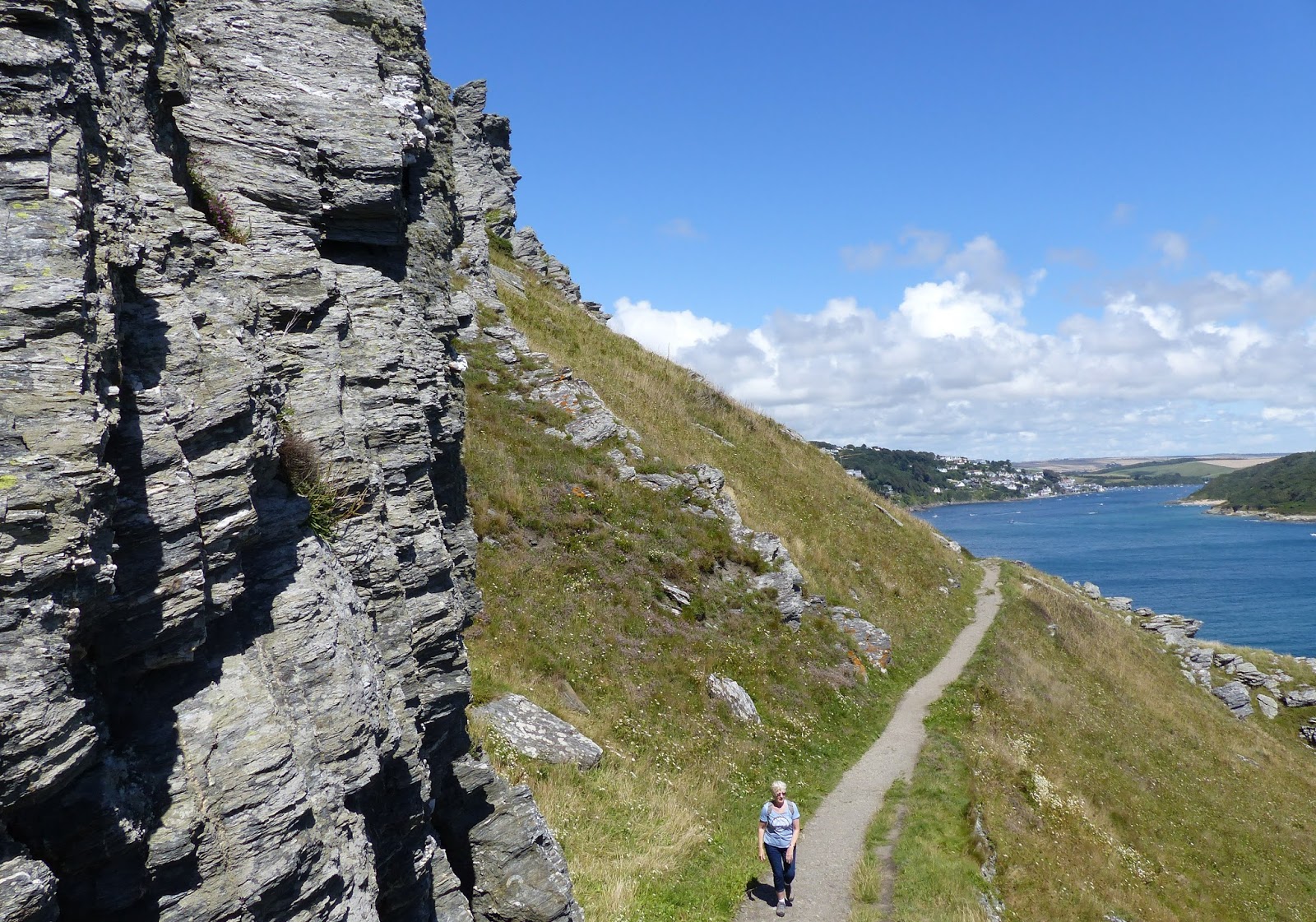
Barbara and I have just returned from a week in South Devon, the highlight of which was a short but spectacular coast path walk in the South Hams, from the Kingsbridge estuary, near Salcombe, to Sharp Tor, an area of jagged Devonian schist outcrops.
Kingsbridge estuary near Salcombe
 
Unfortunately we based ourselves further north in the relatively unattractive town of Paignton in the centre of the "English Riviera" between Brixham and Torquay.
This stretch of coast, up to Dawlish, is very different from that of Cornwall, or of Devon's South Hams. It is dominated by New Red Sandstone sediments, which give rise to the distinctive red cliffs and beaches of this region.
Red sandstone beach at Paignton
The area most familiar with visitors travelling to Cornwall by train will be that near Dawlish, where Brunel's Victorian rail tracks (posting of 10 December 2012) cut dramatically through the red cliffs, formed from aeolian (wind-blown) sand which was laid down in the Permian period around  250 million years ago.
The Penzance to London Paddington mainline train passing by the sandstone cliffs at Dawlish
 

Thursday, 10 July 2014

Drakelands, Britain's first new metal mine in over 40 years, prepares to open

During the late 1970s I was marginally involved with work carried out at the Camborne School of Mines (CSM) pilot plant into the feasibility of opening up the historic Hemerdon tungsten mine, situated on the edge of Dartmoor National Park near Plymouth. The work was undertaken by international mining company AMAX, under the supervision of Dr. Simon Meik and Dr. Gillian Hall. Simon, who I last met 4 years ago at Precious Metals '10, is now with Dundee Precious Metals, Bulgaria, and Gillian is with FLSmidth in Cornwall.
During this period at Camborne, a shy young man named Charlie Northfield was just commencing a honours degree course in Mineral Processing Technology. He graduated in 1980 and then commenced a very colourful career, which included, apart from working in tungsten mines in Thailand and Zimbabwe, imprisonment in Gambia under 'trumped up charges' and a daring escape into Senegal across a swollen river (MEI Online 2008).
Now Charlie is Process Plant Manager at Hemerdon (now known as Drakelands Mine), owned by Australian company Wolf Minerals. The mine is scheduled to open in September next year, 32 years after the end of the AMAX study, and 71 years after the mine's last closure at the end of World War 2. The collapse of the tungsten and tin prices in the mid-80s meant that the mine never made it into production despite the favourable feasibility study.
Now the time, and prices, are right and this will be Britain's first new metal mine for more than 40 years, exploiting the world's fourth-largest deposit of tungsten, and projected to be the world's largest producer of tungsten concentrate at about 3,450 tonnes of WO3 per year, amounting to 3-4 % of global tungsten production, compared with the 80% produced by China, which has dictated supply to the rest of the world. Drakelands will provide security of supply for tungsten and valuable export revenue for the UK.
The mine contains 23.5Mt of proven reserves grading 0.15% W as wolframite and 0.03% Sn as cassiterite. Saleable tungsten concentrate, grading 62-65% WO3 will be produced, as well as around 460 tonnes of tin concentrate per year, containing 40-60% Sn.
As this region of Dartmoor has been mined for well over 100 years and the local community is here because of that, the overwhelming reaction from the local community has been supportive, as this will bring around 200 much needed jobs, ranging from geologists, engineers and mining surveyors to truck drivers, to the area.
Yesterday I travelled the 75 miles from Falmouth to meet up with Charlie, and to see how things are progressing, and I was surprised and pleased to find so many CSM graduates involved with the operation.
With CSM graduates Nick Hall (Mining 2014), Andy Bond (Geology 1984 and Mining 1988),
Barnaby Hudson (Environmental 2002), Henry Chalcraft (Mining 2009),
Charlie Northfield (Mineral Processing 1980), Simon Holland (Mining 1987) and David Howourth (Mining 1984)
Drakeslands tungsten mine
The processing plant site with the open pit in the background
The site is a hive of activity, the foundations are in place, and the equipment is on site ready for installation. It will be an interesting flowsheet, commencing with primary and secondary crushing in Sandvik hybrid toothed roll crushers, and tertiary cone crushing. Gravity concentration is the main method of beneficiation, by dense medium cyclones after crushing, and spirals and Holman-Wilfley shaking tables (MEI Online) for the finer fractions. Grinding is by ball mills in closed circuit with Derrick screens rather than hydrocyclones, to minimise overgrinding of the heavy minerals.
Drakeslands tungsten mine
Charlie Northfield at the mill site
The flowsheet also includes flotation, in Outotec cells, to remove arsenopyrite and other sulphides from the gravity concentrates, high temperature reduction of hematite to magnetite, which will then be removed by low intensity magnetic separators, and high intensity magnetic separation to separate the final wolframite from cassiterite. The magnetic separators have been supplied by Eriez Europe.
I look forward to returning in a couple of years time when the mine will be in full operation, but in the meantime Charlie is hoping to present an overview of the operation at Physical Separation '15 next June in Falmouth.

Monday, 2 June 2014

A section of the Devon coast with a tragic history

Barbara and I have just returned from a few days spent walking the Start Bay coastal path between Dartmouth and Start Point in South Devon. This is a section of the 912 km South West Way, a beautiful part of which MEI Conference delegates will experience next week in Falmouth. The area has also been the scene of two tragic events over the past 100 years.

Hallsands near Start Point is a small village which has always been a fishing community. The old village was built on a narrow rock ledge overlooking the shingle beach, the villagers feeling safe in the lee of the prevailing SW wind, and the advent of the Royal Navy reducing the threat of piracy. In the late 19th century a decision was made to extend the Devonport Dockyard, and rather than use expensive crushed stone, shingle was dredged in the area of Start Bay around Hallsands. This affected the natural defences and a series of high seas began to erode the sea walls, the final disaster striking in 1917, when a combination of easterly gales and exceptionally high tides breached the defences. By the end of that year only one house remained habitable. The ruined village is still an extraordinary sight, although with each winter storm more of it disappears.

Hallsands with Start Point in the background
Walking northwards brought us to Torcross, situated by Devon's largest freshwater lake, Slapton Ley, which runs parallel to the long shingle beach known as Slapton Sands.

Torcross
Torcross between Slapton Ley and Slapton Sands
During World War 2 this steeply shelving beach was deemed to be an ideal site to practice the D-Day landings, and the nearby villagers were evacuated to make room for thousands of American servicemen who were destined for the Utah and Omaha beaches in Normandy.

Slapton Sands
Slapton Sands
Exercise Tiger proved to be a disaster however. German reconnaissance planes reported intense allied action in the area and a convoy positioning itself for the landing was attacked by nine E-boats of the German Navy on April 28th, 1944, resulting in the deaths of 946 American servicemen. The incident was under the strictest secrecy at the time due to the impending invasion, and was only nominally reported afterwards. A Sherman tank that was sunk in this action has been recovered and now stands on the road behind the beach at Torcross.


North of Slapton Sands a tough 6 mile hike took us to the estuary of the River Dart and into Dartmouth, a town with a long maritime tradition, and which was the departure point for the 2nd and 3rd Crusades.

Approaching the River Dart estuary
The River Dart, with Dartmouth on the left and Kingswear on the right
 

Sunday, 26 January 2014

Weekend on Dartmoor

Cornwall is a unique area of England. Situated in the remote South West it has changed little over the centuries. Even today it has retained its early Celtic roots, being almost untouched by invasions from Romans, Saxons, Vikings and Normans, who moulded the history and culture of the rest of England.

It's hard for today's traveller to appreciate how difficult travel to and from the county was before modern road and rail transport. Two inhospitable moors guard the entrance to Cornwall, the main A30 trunk road passing directly across the formidable Bodmin Moor, but the larger obstacle lies in neighbouring Devon - the vast wilderness of Dartmoor.

Barbara and I have just spent the weekend in the eastern area of the National Park, in the village of Ilsington, and as in our previous visit (posting of 28 August 2009) enjoyed the contrast between walking the wild and desolate open moorland with its famous granite tors, and the gentler woodland walks, as in yesterday's 9km circular walk from Bovey Tracey to Lustleigh.


Haytor

Moorland walking


Woodland walking, River Bovey
 
Lustleigh
The A30 skirts the northern section of the park near Okehampton, so if you are travelling to an MEI Conference in Falmouth by car, I would highly recommend a couple of nights in this wild and beautiful area. You may even catch a glimpse of The Hound!