The inaugural Mill Circuits '24 was held at the Vineyard Hotel, Cape Town from June 13-14, 2024 and was attended by 51 delegates from 15 countries.

Following is a very brief summary of the presentations made over the two days. This summary is intended to guide you to the extended abstracts associated with the presentations, most of which are available online as open-access. Unfortunately not all presenters responded to requests for drafts, but for those that did their names are linked directly to their papers in the online Proceedings.
The drafts have not been refereed, but all the presenters have been invited to submit their final papers for peer-review to a virtual special issue of Minerals Engineering.
Thursday June 13th
Technical Session 1
Following my morning welcome and an introduction to the evolution of mill circuits from the industrial revolution to the present day, the sessions got underway with a keynote lecture from Dariusz Lelinski, of FLSmidth, USA, "Evolution to revolution? How can innovation in flotation technology deliver sustainable productivity, now and into the future?", exploring how different flotation technologies can improve both productivity and sustainability performance. Dariusz is a regular contributor to MEI's flotation conferences and was the keynote speaker at Flotation’13. He has been working in flotation for 33 years, the first 8 years in academia, and the last 25 years for three different FLSmidth group companies (EIMCO, FFE Minerals and FLSmidth Minerals). His flotation experience covers a wide range of subjects, from basic flotation research, through CFD analysis, scale-up methodology, to industrial process and mechanical flotation machine design.
 |
| Dariusz Lelinski (centre) and the FLSmidth team with Kevin Galvin (right), the inventor of the Reflux Flotation cell |
Technical Session 1
Following the morning coffee break, Rajiv Chandramohan, of Ausenco, Canada, asked "what would a fully autonomous mineral processing circuit look like"?. Rajiv is Global Technical Director for Operations and Optimisation at Ausenco and has spearheaded the development of numerous innovative technologies tailored to the mining sector, contributing significantly to its advancement.
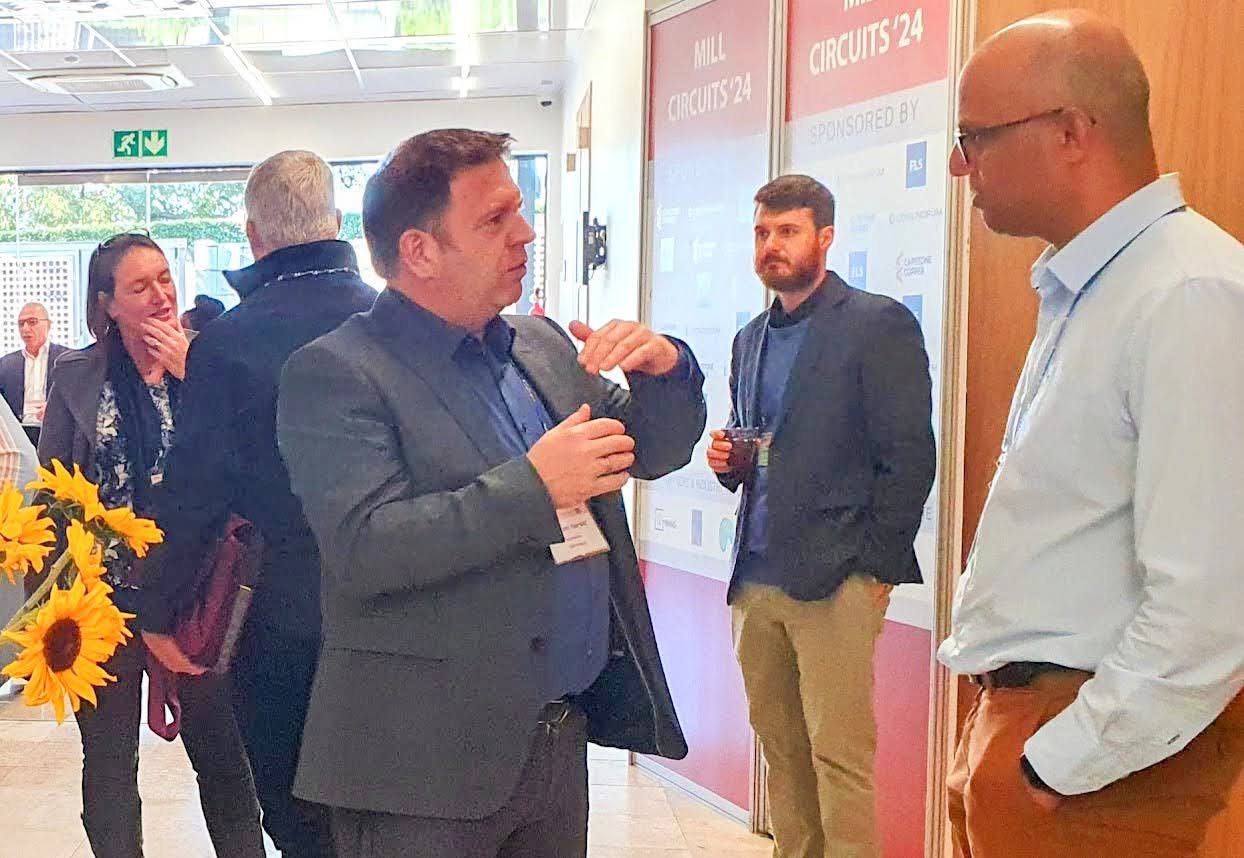 |
| Rajiv Chandramohan (right) with Carsten Gerold of Loesche, Germany |
Alan Varghese, of Metso Australia discussed optimisation of mill circuit pump reliability, detailing a comprehensive approach for pump selection, design and continuous improvement. Alan is currently undertaking a PhD in Digitalisation of Centrifugal Slurry Pumps at the University of Western Australia, while serving as the Product Head of Pumps Digital at Metso.
 |
| Alan Varghese (right) at registration |
Martial Sorgho is the Process Manager for the Orezone Gold Corporation Bombore Gold Mine in Burkina Faso and he described the commissioning, optimisation and continuous improvement of the mill circuit.
 |
| Martial Sorgho (2nd right) and his colleague Mohamed Ilboudo with the MEI team |
WEMCO flotation cell technology was first developed in the 1930s, updated in 1968 and has been the same ever since. Although this robust and impressive design has been a technology standard for many decades, the WEMCO II with improved rotor and stator configuration boosts metallurgical performance along with improved hydrodynamics and kinetics. Riddhika Jain, regional flotation manager with FLSmidth, USA, discussed the development and performance of the energy efficient WEMCO II at pilot scale as compared with the traditional WEMCO, followed by consecutive trials at industrial scale.
 |
| Riddhika Jain with FLSmidth colleagues at the conference dinner at Groot Constantia |
Technical Session 2
Following the lunch break Lev Filippov, Professor at the National Engineering School of Geology and Head of the Minerals engineering team of the GeoRessources Laboratory of the University of Lorraine, France, described the development of alternative processing circuits to recover critical metals such as Li, Nb, Ta and Sn from the Beauvoir rare metal granite in Allier, France.
In 2022 FLSmidth launched the Lithium Shake Up Study, focused on developing a spodumene concentrator flowsheet to reduce communication energy, improve recoveries and reduce water usage. The FLS Shake Up flowsheet has a clear potential for energy reduction in the comminution circuit, reducing water use and reducing climate change impacts. The detailed outcomes of the comminution part of the study paint a hopeful picture of a more sustainable future for the metal supply chain, as described by Jaco Labuschagne, a Senior Lead Process Engineer MissionZero at FLSmidth, USA.
 |
| Jaco Labuschagne (centre) with FLSmidth colleagues |
Due to the declining higher-grade hematite ore and increased demand for iron ore, magnetite-rich tailings from previously processed ore deposits are increasingly being exploited. Niyoshaka Lameck, head of the comminution group at Mintek, South Africa, explored an alternative flowsheet to that used for processing magnetite-rich ore for the recovery of magnetite from magnetite rich tailings.
 |
| Niyoshaka Lameck with Carsten Gerold and Christian Schmitz of Loesche, Germany |
Another paper from Mintek brought the day's technical sessions to a close. Taswald Moodley is a Principal Engineer within Mintek's Mineral Processing Division, and concurrently holds an honorary research fellow position at the University of Kwazulu-Natal, South Africa. He discussed the unravelling of steady state dynamics in comminution circuits through Principal Component Analysis and Pareto Fronts.
 |
| Taswald Moodley with Peer Druephake of Argo IPS, Germany |
Friday June 14th
Technical Session 3
Comminution was the theme of the final morning of the conference.
Victor Portnov is the CPO and founder of conference sponsor Conundrum AI, a technology company that provides a software platform for implementing, deploying, and running AI process control in the mining industry, discussed the integration and application of a new generation of process control models, combining fuzzy logic and model predictive control for improving the performance of SAG/AG mills.
The Vertical Roller Mill (VRM) is an established technology in cement and slag grinding applications. Adam McElroy, a specialist development engineer at Boliden Mineral AB described pilot and lab scale test work on three ores to demonstrate the potential for this technology to develop in the minerals processing industry.
 |
| Adam McElroy and Victor Portnov with Jenni Sweet of Mine3, South Africa |
Carston Gerold of Loesche GmbH, Germany, compared the company's VRM milling with wet milling and HPGR alternatives, showing the power and water benefits of dry VRM milling on a magnetite ore.
 |
| Carsten Gerold (2nd left) at Groot Constantia |
 |
| Sandile Nkwanyana |
Wound-rotor induction motors (WRIM) have long served large power applications, including SAG and ball mills, but despite the historical preference for WRIM, advancements in this technology have stagnated over recent years, said Mario Calvo, Managing Director of Electrodrives, Spain. In contrast, medium-voltage variable frequency drives (MV VFDs) have become increasingly sophisticated and cost-effective, positioning them as a competitive choice for both fixed and variable speed mills. Building upon the foundational technology of WRIM, Mario described the development of the FlexStarter LRS, a technical solution designed to bridge the gap between traditional WRIM setups and the newer MV VFDs, providing enhanced speed and torque control.
 |
| Mario Calvo (centre) at Groot Constantia |
Sandile Nkwanyana was back on the podium for the final technical presentation of the conference, discussing surface abrasion, a key mechanism of size reduction of rocks in autogenous mills. He showed how rock surface abrasion tests can provide information on the suitability of the coarse rocks in the feed to allow operation of a mill at reasonable volumetric filling degrees.
A final thanks to all concerned in making this a great conference, the sponsors, exhibitors, chairpersons, presenters and delegates, and last but not least the wonderful staff at the Vineyard Hotel. We would greatly appreciate your comments on this posting.
A reminder also that the next conference in the series, with a modified title, Mineral Processing Circuits '24, will be held at the Vineyard from April 24th to 25th, 2026.