Showing posts with label Reagents. Show all posts

Thursday, 9 January 2025

Green Flotation Depressants

Depression is used to increase the selectivity of flotation by rendering certain minerals hydrophilic, thus preventing their flotation. They are key to the economic flotation of many ores. They are generally classed as inorganics, small organics, and organic polymers. The use of polymeric depressants has the attraction of being less hazardous than the more widely used inorganic depressants, such as cyanide, which are widely used in sulphide systems. 

Biodegradable depressants are becoming more important due to environmental concerns and the need for environmentally friendly processes. They can replace or assist inorganic and toxic reagents in various flotation conditions.

Green Flotation Depressants, authored by Saeed Chehreh Chelgani et al, is a new publication on biodegradable depressants, delving deep into their performance, intricate structures, and adsorption mechanisms. The book describes diverse minerals and materials where these depressants have been used for their upgrading. Encompassing the entirety of current research, it is aimed at industry professionals and researchers in the field, especially on courses centered around froth flotation and recycling. From starch-based solutions to the diverse array of gums and the intriguing polyaspartate and tripolyphosphates each section unfolds a rich tapestry of knowledge, providing a holistic understanding of biodegradable depressants and their pivotal role in mineral processing.

Monday, 24 September 2018

International chemical company Clariant to sponsor Flotation '19

Good to hear that Clariant, a world leader in specialty chemicals, is sponsoring Flotation '19, as their representatives always have something interesting to say.
At Flotation '15 Jacques Bezuidenhout of Clariant Germany, showed how Clariant collectors can be used as alternatives to xanthate collectors in traditional sulphide flotation applications. Xanthates, first used in flotation in 1924, are reported to be the most widely used of the thiol collectors. They are therefore widely considered to be the most important collectors for sulphide mineral flotation applications. It is nevertheless Clariant’s experience that there is an increasingly strong push against using xanthate collectors in both new and existing flotation plants. Clariant Mining Solutions, in order to address this unmet need, therefore developed a series of liquid collectors, soluble in water, which are able to completely replace various xanthate collector types in practice.
At Flotation '17 Linda Mahlangu, of Clariant Southern Africa, reviewed the potential of phosphoric acid esters for the flotation of oxidised copper minerals. Low grade oxide copper mineral flotation dates back almost 70 years. In the 1960’s the process involved 2 basic flotation methods (i) fatty acid flotation of oxide copper minerals and (ii) sulphidization of oxide copper minerals followed by flotation using sulphydryl collectors such as xanthates. Over the years the use of fatty acids to concentrate the copper oxides lost its popularity, with most operations preferring the controlled potential sulphidisation method. Linda showed how phosphoric acid esters, which have proven effective in selectively floating carbonates in the reverse flotation of phosphates, can be used as alternative collectors for oxide copper mineral flotation, particularly for carbonates such as malachite.
I'm sure that we can look forward to more innovative solutions at Flotation '19.
Current Flotation '19 sponsors
The latest conference updates can be found at #Flotation19.
Twitter @barrywills

Saturday, 16 May 2015

Nickel Processing '15 Conference Diary

Nickel Processing '15 was held at the St. Michael's Hotel, Falmouth, Cornwall, from May 13-14 2015, and immediately followed Precious Metals '15 at the same venue.

Nickel's roller-coaster ride over the past 3 years
Source metalprices.com
There is a current surplus of nickel at the moment, as demand for stainless steel has slowed, especially from China. Nickel prices have therefore suffered greatly recently, so this, always the smallest of MEI conferences, was attended by a small group of specialists, 27 in number from 12 countries, compared with 35 delegates at Nickel Processing '12 in Cape Town. In all there were representatives from Australia, Belgium, Canada, France, Greece, Finland, Philippines, South Africa, Sweden, Turkey, UK and USA.
Those that did attend the conference were treated to a fine programme of papers and I thank International Mining for their media support.
 
Wednesday May 13th
Jon welcomed the delegates to Cornwall this morning and then introduced Anne Oxley of Brazilian Nickel Ltd, UK, who chaired the morning session. This opened with an excellent keynote lecture from one of my old CSM students, Andrew Mitchell of Wood Mackenzie, UK, who set the scene for the next 2 days by looking at the future of nickel production, particularly in relation to the outlook for nickel sulphide and laterite resource development (see posting of 8th December 2014). He forecast that nickel stocks should move into deficit by the end of the year, which will push prices higher, and that there is no question that the future of nickel supply will depend on laterites.
Jon with Andrew Mitchell and Anne Oxley
First Quantum’s Kevitsa Mine is located in northern Finland and mines a large, low grade, polymetallic orebody. Payable metals include nickel, copper, gold and PGM group metals. Profitability, at high volume, low grade operations like Kevitsa, is highly geared to metal prices and process improvements. Since the operation commenced there has been a focus on maximising the separation process so as to improve the Cu-Ni process profitability. Ishmael Muzinda of First Quantum outlined a number of these process improvements, their introduction and efficacy with a focus on the work to improve fines flotation recovery.
Ishmael Muzinda with Barry Lumsden of Ausmetec, Australia
The post-coffee break session was chaired by Neil Snyders of the University of Stellenbosch, South Africa. Nickel is the predominant product at the Nkomati mine in South Africa. High grade nickel mineral ores (2%) from the Massive Sulphide Body have been depleted leaving those of low grade (0.3%). Consequently, the beneficiation of this nickel ore presents a challenge to the minerals processing industry. In response, Westhein Maree of the Cape Peninsula University of Technology showed how batch froth flotation tests were used to explore the effects of mixtures of potassium amyl xanthate and Senkol 700 on the recoveries and grades of nickel. In the mixtures, the xanthate accounted for 95.5, 90, 85 and 80 mole% respectively. This approach has a potential for enhanced recovery and subsequent grade of nickel and will have significant positive economic effects.
Westhein Maree (right) takes a break with Turkish delegates Cihan Ozdilek and Ersin Ozarslan
Akira Otsuki of the Université de Lorraine, France presented work on a study aimed at investigating the sulphidisation-flotation of nickel oxide, the major nickel form available in nickel laterite. Sulphidisation was conducted before flotation to convert the surface of nickel oxide to nickel sulphide.
It was good to have Nevill Rice at the conference. He was at the University of Leeds for 32 years and retired in 2002. Still keeping in touch with the industry by reviewing papers for journals, and meeting up with old colleagues, he gave a presentation on a hydrochloric acid process route for nickeliferous laterites.
Nevill Rice (right) relaxing in the sunshine with Cihan Ozdilek of Esan, Turkey,
John Forster of Queen's University, Canada and Ian Townsend of Outotec, UK
The short afternoon session was chaired by Barry Lumsden of Ausmetec Pty Ltd, Australia. In the first paper Paul Norris of Camborne School of Mines discussed the continuous processing of nickel/copper concentrates in bioreactors at high temperature. Inhibition of the thermophiles at high mineral pulp densities in primary reactors and the length of residence times for efficient copper extraction have been among the factors considered in continuous process development.
Paul Norris (left) with Andrew Mitchell and Graham Brock
The final paper of the day was presented by Keisuke Shibayama who presented the commissioning and operation status of the Taganito HPAL Plant Project in the Philippines. This project will produce 30,000 Ni-tons and 2,600 Co-tons per year as mixed sulfide for export to the SMM Nickel Refinery in Japan. The plant commissioning was completed on June 2014 and the operation has been running smoothly and has reached monthly production corresponding to its nameplate capacity.
Keisuke Shibayama (right) with Antione Dissaux, of Eramet, France, James Vaughan and Anne Oxley
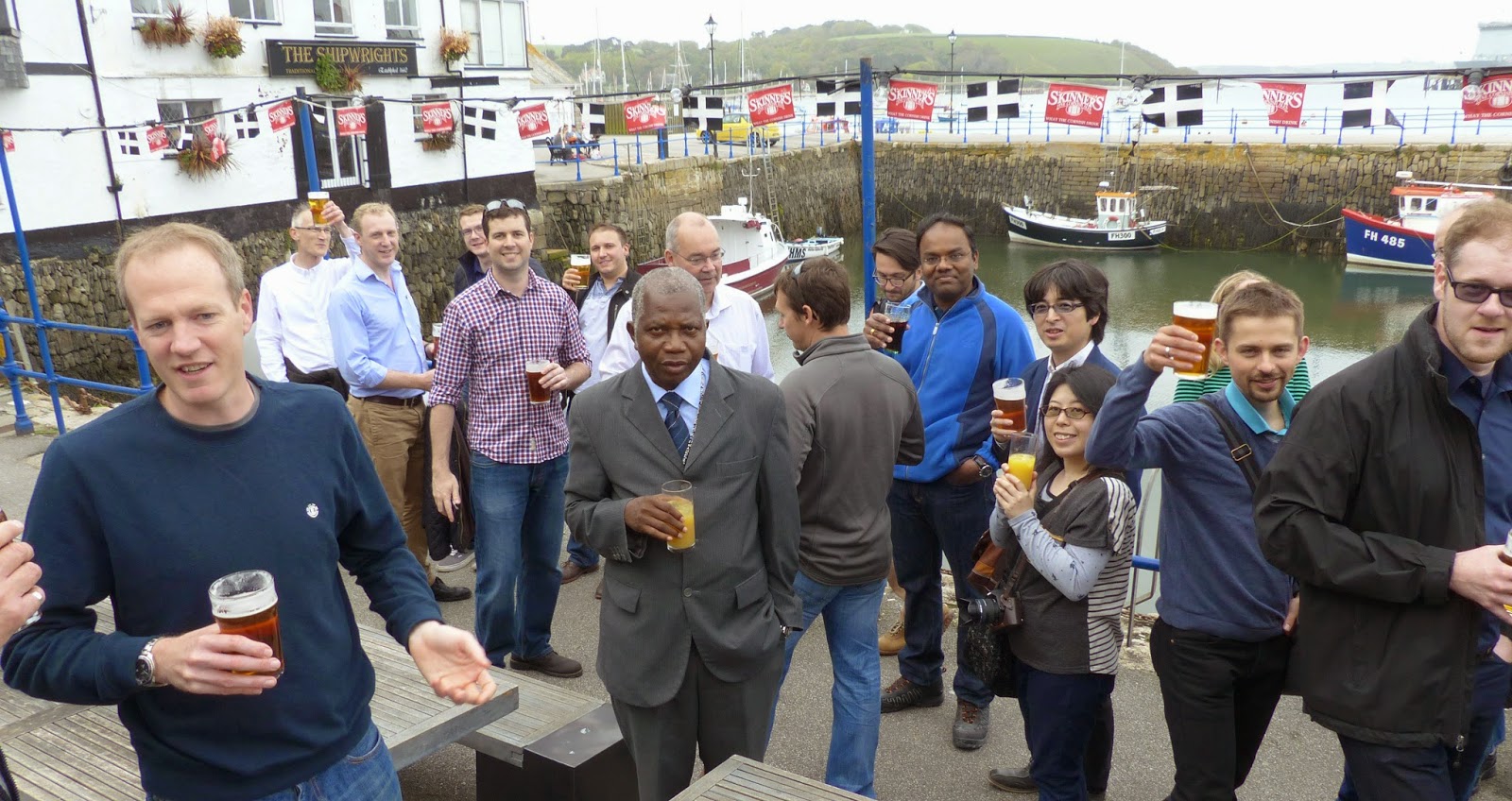
After a great first day of papers, I led the usual three and a half mile walk into old Falmouth, where we met up with other delegates for good Cornish ale in the 17th century Chain Locker pub (see also posting of 14th May).

On the chilly Pendennis headland overlooking the Fal estuary

Welcome drinks at the Chain Locker

 
Thursday May 14th
There were some very interesting papers in this morning's session, chaired by Nevill Rice and Camborne School of Mines' Chris Bryan.
Graham Brock of Direct Nickel Projects, Australia described "breakthrough technology" which leaches the full nickel laterite profile in nitric acid giving significant reductions in capital and operating costs compared to current technologies (see also MEI Online, December 3rd 2014). Graham effectively retired from Direct Nickel at the end of 2014 but now continues as a non-executive director and as a consultant.
Chris Bryan with Graham Brock and Nevill Rice
Following this interesting presentation, Anne Oxley, of Brazilian Nickel Ltd, UK) asked "why heap leach nickel laterites?" With the majority of nickel naturally occurring in laterite ores but the majority of production still in sulphides, she argued that it is high time there was a standalone commercial nickel laterite heap leach operation. The broad success of heap leaching of other metals has allowed hitherto uneconomic deposits to undergo successful economic exploitation, and heap leaching now accounts for between 25% and 40% of global copper and gold production. Nickel laterites are no different, every major and several junior nickel miners have evaluated nickel laterite heap leaching over the past decade and shown projects to have robust economics, with much lower capital costs than alternative hydrometallurgical options which have in general been dismal failures, both technically and commercially. Nickel Laterite Heap leaching is simple and flexible, and can be applied to the many laterite deposits that currently have no realistic path to production.
This set the scene for another interesting paper on laterite heap leaching. Akira Otsuki of the Université de Lorraine, France, explained the development of a characterisation method for partiallysaturated agglomerate beds in relation to nickel heap leaching operations.
Georgios Bartzas prepares for his presentation
The final paper of the morning was given by Georgios Bartzas of the National Technical University of Athens, who presented a case study on the life cycle assessment of FeNi production in Greece. Ferronickel (FeNi) is predominantly produced from nickeliferous laterite ores which are converted into a product with a nickel content of around 20%. With increasing emphasis being put on energy efficiency and global climate change, it is important for the nickel industry to understand in depth the energy use and to evaluate a number of potential opportunities for reducing the greenhouse gas footprint of primary FeNi production.
 
Akira Otsuki chaired the final session of the conference, which contained 4 presentations, from Australia, Canada and Sweden.
James Vaughan of the University of Queensland discussed the properties of a commercial solvent impregnated cation exchange resin for cobalt-nickel separations. The hydrometallurgical processing of nickel ore typically involves precipitation of a mixed nickel-cobalt intermediate precipitate, as selective separation of these two elements by sulphide or hydroxide precipitation is not feasible. However this is not necessarily required; for example “direct” two-stage solvent extraction was practiced at the Bulong refinery where a Cyanex 272 containing organic liquid was used to separate Co, Cu, Zn and Mn from Ni. Complexities associated with this process include the requirement of a flammable organic diluent, phase separation equipment as well as the risk of organic cross-contamination. He described an ion exchange resin process whereby the value metals Ni and Co are both loaded onto the cation exchange resin and separated in the elution stage. As nickel is preferentially loaded, a larger volume of resin is required translating to a significant capital cost for the resin inventory. Solvent impregnated resin offers the engineering advantages of ion exchange resin and the chemical selectivity of the solvent extraction process.
Nickel laterites are more difficult to process compared to sulphide ores due to their complex mineralogy and as a result, current industrial processes are energy intensive and costly to operate. Novel pyrometallurgical processes regarding the upgrading of nickel laterites are also being continuously investigated through laboratory research and pilot plant testing and Richard Elliott, of Queen's University, Canada, reviewed the current state of the art and discussed the potential applications of developing processes.
In a further paper from Queen's, John Forster presented results on the microwave carbothermic reduction processing of a silicate nickel laterite ore. The effects of processing time, microwave power, and charcoal and pyrite additions were investigated. The reduction process was followed by magnetic separation and optimum nickel grades of about 9% and recoveries of about 90% were achieved.
John Forster and Richard Elliott of Queen's University Canada.
This was their first visit to Europe, so Falmouth was a pretty good choice!
Srinivasan Suresh of Sweden's Luleå University presented the final paper of the conference, a study of the reduction of nickel oxide by hydrogen under microwave irradiation. He showed that reaction rates were significantly improved for microwave experiments under all conditions when compared to conventional heating. Therefore, it was concluded that microwave heating would significantly reduce processing time and enhance reaction kinetics and it has a potential to overcome several rate controlling steps involved in conventional processes.
Srinivasan Suresh with session chairman Akira Otsuki
Amanda then closed the conference, and invited delegates to attend Nickel Processing '17 in Falmouth in 2 years' time, when hopefully Andrew Mitchell's forecast of increasing nickel prices will boost this small but important sector of the base metals industry.
 
The papers from the conference, in unrefereed form, are available from MEI, and authors have been invited to submit their final papers for peer-review, for possible publication in a special issue of Minerals Engineering.

Friday, 15 May 2015

Precious Metals '15 Conference Diary

Precious Metals '15 was held at the St. Michael's Hotel, Falmouth, Cornwall from May 11-12 2015.

Precious metals have fallen on hard times recently, with low prices exacerbated by rising production costs, so it was always inevitable that Precious Metals '15, the 5th in the MEI series of highly focused conferences, would be small (see also posting of 11th May). This year's delegate list comprised 29 delegates, representing 12 countries, compared with 51 delegates at Precious Metals '12 in Cape Town, and 55 at the last Falmouth conference in 2010.

Gold and PGM prices over past 3 years
Source: metalprices.com
Those that did attend were treated to 2 days of high quality papers on the recovery of gold and PGMs from primary and secondary sources, and I thank ZEISS for recognising the importance of this small conference by providing corporate support, and to International Mining for their media support.

Monday May 11th

Jacques Eksteen (right) with Dave Dreisinger and Corby Anderson
I welcomed the delegates to Falmouth this morning before introducing the first session chairpersons, Al Cropp of sponsor ZEISS, and Marian Tredoux of South Africa's University of the Free State. The conference then got off to a fine start with the keynote lecture, given by Jacques Eksteen of Curtin University, Australia, who reviewed recent innovations in the processing of difficult and low grade gold ores (see posting of 30 June 2014), such as the need to reject valueless gangue early in the process by jigging or electronic sorting, which will be reviewed in more depth in next month's Physical Separation '15 conference.

There are of course intense social pressures on the use of traditional cyanide leaching and there is an urgent need to find viable alternative lixiviants. Potential alternatives are environmentally friendly amino-acids which Jacques discussed in some depth. He also mentioned the use of alkaline sulphide leaching, which was discussed more fully by Corby Anderson of Colorado School of Mines, the other CSM, his paper dealing with many of the fundamental concepts behind this selective gold leaching and recovery system.

Following coffee Akira Otsuki of Université de Lorraine, France, showed how coal-oil gold agglomeration could be used to assist flotation to recover gold from refractory ores.

Steve Flatman, of Maelgwyn Mineral Services, UK then described the development of the Aachen Reactor high shear mass transfer device from its original concept twenty years ago to its acceptance in 2014 as an important unit process in one of the world’s newest large gold processing plants, producing over 1 million ounces of gold per year, where nineteen Reactors are installed in various applications. It is now possibly one of the most significant advances in gold processing since the introduction of the carbon-in-pulp process in the late 1970’s.

Akira Otsuki, Marian Tredoux, Steve Flatman and Neil Snyders
Sustainable development is a major focus of worldwide research in the gold mining industry. An alternative gold processing method which is more environmentally friendly than cyanidation and amalgamation is, therefore, imperative. This is the thrust for the work described by John Ajayi of the Federal University of Technology, Nigeria, who showed that the alkaline salts of groundnut and palm kernel are potential flotation reagent substitutes for the conventional synthetic reagents.

With Corby Anderson and John Ajayi
Though the pronounced effect of the caustic cyanide pre-treatment step for the AARL gold elution process has been widely investigated, research into the reaction kinetics of this step are lacking and a set industry standard is yet to be determined with regards to pre-treatment time and reactor conditions. Neil Snyders of the University of Stellenbosch, South Africa presented results on a study of the effects of the pre-treatment temperature, contact time and agitation on the gold elution recovery and in light of these results, proposed pre-treatment mechanisms were reviewed and discussed.

Dave Dreisinger prepares for his talk
Dave Dreisinger of the University of British Columbia presented the first paper of the afternoon session, chaired by James Vaughan of the University of Queensland, on the dissolution of gold during the pyrite oxidation reaction. Although numerous papers discuss the mechanism of alkaline oxidation of pyrite there is limited information available describing the actual kinetics of the pyrite sulphide to thiosulphate reaction. A previous investigation in this series determined the rate of sulphide sulphur oxidation and thiosulphate yield in the reaction of pyrite with sodium hydroxide under various testing conditions. The goal of the current study was to validate these rates using two different gold-containing pyrite concentrates, a further objective being to investigate the simultaneous dissolution of gold with in situ formed thiosulphate during pyrite oxidation.

Jacques Eksteen of Curtin University, presented his second paper of the day, on gold extraction from a gold-copper concentrate in solutions containing caustic soda and low free cyanide. Copper-gold ores containing significant amounts of cyanide-soluble copper with gold can lead to high cyanide consumption with low gold extraction in the cyanidation process of gold. Cyanide should be destroyed before the discharge of tailings containing metal-cyanide complexes. This significantly increases the cost to the gold mining companies to cover both the cyanide consumption in the leaching stage and the additional cost of the required reagents for cyanide destruction. Results on the selective cyanide leaching process of gold over copper from a copper-gold concentrate were presented.

Gawen Jenkin (left) with James Vaughan
Gawen Jenkin of the University of Leicester, UK, presented an interesting paper showing how ionometallurgy could offer a new set of environmentally benign tools for metallurgists to augment existing techniques. Ionic liquids are anhydrous salts that are liquid at low temperature. They are powerful solvents and electrolytes with potential for high selectivity in both dissolution and recovery. Those pioneered at Leicester are deep eutectic solvents (DES), which are environmentally benign, chemically stable and the components are already produced in bulk at low cost. Gold (electrum), tellurium, galena and chalcopyrite, as well as tellurobismuthite (Bi2Te3), are soluble in DES by oxidation at 45-50°C at very favourable rates compared to bio-oxidation or high-temperature hydrometallurgy. Gold can be recovered from solution by electrodeposition. Pyrite is notably insoluble under the same conditions, but pyrite, arsenopyrite, and indeed any sulphide, can be selectively dissolved by electrolytic reduction in a DES, thus suggesting a protocol whereby gold inclusions can be liberated by reduction and then dissolved by oxidation.

The final paper of the day was presented by Seija Kurki, of Outotec, Finland. She introduced the new Outotec® Hydrometallurgical Precious Metals Process, which enables cost-efficient fully hydrometallurgical precious metals recovery from copper electrorefining anode slimes. The process is based on leaching of copper, selenium, silver and tellurium in sequential H2SO4 leaching steps, ensuring high recovery rate and high purity of the precious metals and saleable side products. H2SO4 solutions can also partly be recycled back to electrolysis or electrolytic solution purification.

Seija Kurki and Kristian Lillkung of Outotec with James Vaughan (left)
The majority of the delegates joined me in the late afternoon for the usual MEI conference walk along the coast to old Falmouth, and a chance for everyone to get to know each other over drinks at the 17th century Chain Locker pub by the inner harbour (see more photos on the 12th May posting).


At the 16th century Pendennis Castle

Beers at the Chain Locker


Tuesday May 12th
A later start than scheduled due to a speaker withdrawing at the very last hour, which was disappointing as two of the co-authors are based at the nearby Camborne School of Mines. The morning session was chaired by two of yesterday's speakers, Corby Anderson and Dave Dreisinger.

Neil Snyders, of the University of Stellenbosch, South Africa, showed how several individual gold cyanidation processing techniques were combined into different flowsheets to recover platinum group metals (PGMs) from dilute cyanide leach solutions. Four flowsheets were developed, consisting of a SART (sulphidization, acidification, recycling, and thickening) process, precious metal recovery by either adsorption onto activated carbon or ion exchange resins, followed by elution, and final metal recovery through thermal hydrolysis and/or electrowinning. These flowsheets were simulated in combination with economic analyses to determine the option that yields high PGM recoveries with maximum net present value (NPV). Ion exchange resin technology was found to be best, with a NPV significantly higher than for the carbon-based flowsheets. The best flowsheet option utilized the strong-base Amberlite PWA 5 ion exchange resin and elution with zinc cyanide. The proposed final metal recovery was by means of thermal hydrolysis and electrowinning. This option requires low capital and operating costs, while achieving high PGM recoveries.

There has been a steady increase in the amount of Precious Metals (PM) and Platinum Group Metals (PGM) being recovered from secondary sources in recent years, driven in large part by high commodity prices and a rapid growth in automotive catalyst recycling. The increasing costs and complexities associated with the primary extraction of PM/PGM and the lower costs and environmental impacts of recycling-based extraction have provided added incentives for this growing trend. As a result, the last few years have also seen a substantial uptake in PM/PGM recovery using Tetronics’ DC plasma smelting technology, particularly for the recovery of PM and PGM from automotive catalysts, chemical catalysts and electronics waste as a result of the ability of Tetronics’ plasma smelting technology to achieve high recovery rates from a range of materials. Saeed Ismail, of Tetronics International, UK discussed Tetronics’ plasma smelting technology and gave details of plant performance in the recovery of PM/PGM from catalysts and other materials. The range of metals applicable to this technology were also discussed and results from a number of secondary sources provided.

Ancuta Musina and Saeed Ismail prepare their presentations
The ZEISS Mineralogic Mining was showcased at Process Mineralogy '14 . The release of ZEISS Mineralogic Mining has provided an extra dimension to the world of Automated Mineralogy (AM) through the utilization of a fully quantitative Energy Dispersive Spectroscopy (EDS) mineral classification system and advanced image analysis capabilities. Unlike the current AM techniques, the mineralogy is classified by using the wt% contribution of the elements present, and thus, the minerals stoichiometry. This method provides the operator a more accurate, flexible and efficient method for generating mineral classifications. ZEISS have developed the capability to correlate Light Microscope (LM), Scanning Electron Microscope (SEM) and AM coloured mineral maps for more efficient and seamless analysis between these techniques in order to make the most of the information each technique provides. Shaun Graham of ZEISS presented an example of correlating these techniques for locating and identifying Base Metal Sulphides (BMS) and Platinum Group Minerals (PGM) from PGE-bearing chromitite from the Berit ophiolite, Turkey, showing how ZEISS is able to provide a fully automated and correlated analysis across LM - SEM - AM techniques.

With Ben Tordoff, Shaun Graham and Al Cropp of ZEISS
Ancuta Musina of Magpie Polymers, France, presented results on the recovery of PGMs from industrial effluents by an innovative process involving sorption on a functional polymer, MP-101, containing aminophosphine groups. Sorption performances and mechanisms onto MP-101 were investigated and compared to other commercial PGM sorbents with a targeted metal, the Pd. The results showed higher sorption capacities of MP-101 because of the high phosphine groups content, giving it potential applications in refining and mining industries. Separation of metals loaded MP-101 from effluents was achieved by flocculation-decantation processes and PGMs were recovered in metallic form by incineration. This process combining sorption and decantation was successfully applied on two industrial solutions from mining and recycling industries, highlighting the selectivity of MP-101 toward precious metals.

Ancuta Musina (right) with Marian Tredoux
The Bushveld Igneous Complex (BIC) situated in Northern South Africa is the largest deposit of platinum group elements (PGE) in the world. Froth flotation is used to beneficiate these PGE ores in the BIC due to their close association with the base metal sulphides. The performance of the froth flotation process is largely dependent on the chemical additives used in the process. Consequently, chemicals, especially collectors, have been used in mixtures to combine the individual properties of the respective chemicals. Westhein Maree of the Cape Peninsula University of Technology, South Africa, reported on the concentrate grades and recoveries achieved in batch flotation tests using various molar mixture ratios of thiol collectors on a Merensky Reef platinum ore. Collector mixtures of a xanthate (SIBX) with a dithiophosphate and a dithiocarbamate at 20, 40, 60 and 80 mole% ratios were considered.

The final session of the conference, chaired by Saeed Ismail of Tetronics International, commenced with a presentation by Ryo Kasuya of the National Institute of Advanced Industrial Science and Technology, Japan, who discussed the dissolution of platinum in catalyst materials. Currently PGMs are recovered after dissolution in strong acids that contain toxic oxidizing agents such as aqua regia. To avoid the use of such toxic agents a route to dissolve PGMs in hydrochloric acid via complex oxides was proposed. The Pt complex oxides were prepared by calcining mixtures of Pt/Al2O3 and alkali metal salts at 600-800°C in air and they were then dissolved in HCl. The results showed that Pt in the calcined samples easily dissolved in HCl, and the Pt solubility recorded over 80% after dissolution at 80°C, so the process is probably applicable to the Pt catalysts after refining.

Processing of platinum-group element (PGE) ores is based on the assumption that the primary association of these elements is with sulphide, i.e. covalent bonding between PGE cations and S2- anions. In order to explain the tenor of the PGE in economically viable ores, the PGE must favour such bonds 105 times over either remaining in solution in the magma or entering co-precipitating silicates (olivine, pyroxene, plagioclase) and oxides (chromite). Experimental work presented by Marian Tredoux of the University of the Free State, South Africa, has not confirmed this, and led the authors of the paper to speculate that a more primary association might be involved, i.e. that the formation of PGE minerals are preceded by nano-entities. The presentation reported on an experiment which proved that nano-association of Pt and As does occur at magmatic temperatures long before sperrylite can stabilise. The results could have profound influence on the design of future PGE beneficiation plants.

Direct electrowinning (EMEW) is an emerging technology within the precious metal extraction sector with a number of applications including silver recovery. In the final presentation of the conference Arun Vathavooran, of Tetratech Minining & Minerals, UK, discussed the testing and scale up of the EMEW technology for a high grade, low throughput silver deposit in Yukatia. The testwork and the analysis has indicated that the EMEW technology can be effectively utilized for selective silver recovery from polymetalic ores with potential operating cost savings for silver head grades as low as 150g/t.

Ryo Kasuya with Arun Vathavooran
Amanda closed the conference and invited delegates to attend Precious Metals '17 in Falmouth in two years time, when hopefully the market situation will have improved. We have thoroughly enjoyed the two days of Precious Metals '15 with a great group of people, who all seemed to appreciate the small focussed conference format.

The papers from the conference, in unrefereed form, are available from MEI, and authors have been invited to submit their final papers for peer-review, for possible publication in a special issue of Minerals Engineering.

High resolution image of all photos in the blog can be obtained by clicking on the image.


Monday, 27 October 2014

XXVII International Mineral Processing Congress - Conference Diary

This year's International Mineral Processing Congress was held for the first time in Chile, at the Sheraton Hotel and Conference Centre in Santiago, from October 20th-24th.  Local organisers were Gecamin, Universidad de Chile, Universidad de Concepcion, Colegio de Ingenieros de Chile, and Universidad Tecnica Federico Santa Maria, under the chairmanship of Prof. Juan Yianatos of the latter University.

Santiago from the Sheraton Hotel and Conference Centre
This was my 11th IMPC, my debut being in Stockholm in 1988, the only one I missed since then being Rome in 2000, where Amanda represented MEI. MEI has been a media partner to all Congresses since 2003. The Cape Town conference in my opinion ushered in the 'modern era' of IMPCs. Prior to 2003 they had been rather stiff, formal affairs, but Cape Town showed that conferences could also be fun and that networking with people was just as, if not more, important than formal presentations. Congresses since then have been memorable events- who could forget the spectacular gala dinner in Beijing in 2008 (see posting of 20 March 2010).

So I look forward to the week with great anticipation and, as always with my conference diaries, these are my personal experiences of the event. As around 500 papers from 50 counties are to be presented it is obviously impossible to report on the technical programme, although I will dip into a few presentations when time allows. Hopefully my report will capture the atmosphere of the IMPC and its people, rather than the technical content, and I very much welcome comments from others.

Monday 20th
Last night's welcoming cocktail reception (see posting of 20th October) preceded this morning's opening ceremony. Around 1100 delegates are present, making this Gecamin's biggest ever undertaking.


One of the congress's major sponsors is Outotec and appropriately, as the company is noted for its green policies (posting of 12th February 2014), Jaako Leppinen of Outotec presented the first of the plenaries, reviewing how sustainability challenges of future concentrators might be overcome. There is a demand for more energy efficient technologies, particularly in comminution, and there is also an increasing awareness that more intelligent water management is required for reduction of fresh water consumption and for mastering the impacts of process water recycling on performance. This was a good introduction to one of the two other plenaries this morning, which dealt with sustainable mining at Antofagasta Minerals in Chile.

The sessions then split into parallel sessions, with the usual unavoidable clashes, such as Flotation Fundamentals running alongside Non-Sulfide Flotation. I did not get to any of the papers in these sessions, so would be interested in comments and highlights from those who attended, and this will apply to the sessions of each day.

The exhibition is much smaller than at recent IMPCs due to space limitations at the hotel, and only corporate sponsors have booths, spread over two floors.


During the coffee break in the exhibition area I caught up with a few old friends, including Jennie Wiese, Kari Heiskanen and Dee Bradshaw.

Jennie Wiese, Kari Heiskanen and Dee Bradshaw
Jennie and Dee I have known since they were post-grad students at the University of Cape Town.  Jennie is still at UCT, involved with flotation research, and Dee is now a Professor at the JKMRC in Australia, having just completed a sabbatical at Hacettepe University in Turkey.  Kari will become Emeritus Professor on his retirement from Aalto University, Finland, next month. He will then divide his time between mentoring young people and assessing innovations with Outotec, and undertaking teaching and research at the University of Cape Town.

John Starkey and friends
At the ALS booth

John Russell (centre) at the Russell Mineral Equipment booth
I spent some time this morning with Prof. Jim Finch of McGill University, Canada, who will be chair of the next IMPC in Quebec City in 2016. Jim and I discussed a project that we have been working on for the past 2 years. He and his team from McGill, and others, have been producing a major update of Mineral Process Technology. This 8th edition will be published in late 2015 and launched at Flotation '15 next November.

With Jim Finch

After a good buffet lunch in the poolside restaurant there were 6 more parallel sessions.


One of these was a special session on the future of mass mining and concentrators. As Alban Lynch had recommended that I attend the presentation by Gideon Chitombo of the University of Queensland, I did just that. Gideon discussed how mass mining methods, particularly block caving, as well as open pit methods, must evolve as mines go deeper and this will affect processing, but unfortunately he did not get as far as elaborating on this!

This was followed by a paper by MEI Young Persons Award winner Peter Amelunxen, of AminPro, Peru, who asked whether bigger processing equipment is better, the overall conclusion being not always!

After a long day, the sessions finished with a well attended poster session.


This was followed by the Official Welcome Cocktail, which gave delegates and their partners a relaxing hour of socialising (posting of 20th October).

Chilean entertainment at the welcoming function

Tuesday 21st October
A major thrust of flotation research in the not too distant past was the flotation of ultrafine particles, but with the current awareness of the need to reduce energy consumption in concentrators, there has been a noticeable switch in emphasis towards floating particles in as coarse a state as possible. Coarse flotation is often inhibited by the inability of flotation machines to deal with particles as large as 300 microns, but fluidised bed flotation technology can give high recoveries at coarse particle sizes, as shown by Graeme Jameson, of University of Newcastle, Australia in this morning's first plenary lecture. Calculations show that reductions in the running costs of a mine and associated concentrator of the order of 10-20% could be achieved, the major effect being the reduction of mass flow to ball milling.

IMPC sponsor Cytec, a leading manufacturer  of reagents, is also developing innovative technologies for floating coarser particles with formulated collectors, and encouraging results have been achieved with their AEROFLOAT MX-500 product series.  Cytec has also made significant advances in partially replacing the NaHS used in Cu-Mo separation with the user friendly polymeric product AERO 7260.

At the Cytec booth
In the second plenary lecture, Bert Huls of Goldcorp, USA discussed the drivers that will change the design and operation of future processing plants. These drivers include water and energy conservation requirements, a larger demand for metals as a result of a rising population, and the increasing demand from the population in general to have influence over what type of operations will be developed where. These social issues are increasingly recognised as significant inhibitors to mineral development projects, as discussed by Marcello Veiga of the University of British Columbia, Canada in the 3rd plenary lecture.

Plenary lecturers Graeme Jameson, Bert Huls and Marcello Veiga
Comminution '16 sponsors Arkedy Senchenko and Anna Dergacheva, of TOMS.
and John Starkey of Starkey & Associates
Barbara and I had an excellent lunch by the hotel pool with IMPC Chairman Cyril O'Connor, IMPC Proceedings Executive Editor Alex Doll, and guests Roger and Elizabeth Kelley. I worked with Roger in Zambia a lifetime ago, so it was good to reminisce.

With Alex Doll, Cyril O'Connor and Roger & Elizabeth Kelley
Biohydrometallurgy has never been a major feature of IMPCs but an afternoon keynote by Tomas Vargas of Universidad de Chile asked whether bioleaching of sulphide ores will ever replace the traditional flotation-smelting route. Heap bioleaching has enabled the treatment of secondary copper sulphide ores and low grade ores, but extension of this to primary copper ores has been limited until now by the nature of chalcopyrite, which is very refractory to leaching. However important improvements are expected by using improved designs that enable operation at high temperature ranges where copper is leached faster under the catalytic action of thermophile organisms (see also Biohydromet '14).

The CiDRA booth

Delegates from Peru

A long day finished with the IMPC Open Forum, where it was announced that the IMPC in 2018 will be held in Moscow. Bids have been invited for 2020 from Poland, South Africa and USA. The final decision will be announced at the next IMPC in Quebec City in 2016. Details of all IMPC matters can now be found on the new website.

Then a complete change of scene, a transfer by coach to nearby Santa Lucia Hill for cocktails at Castle Hidalgo followed by an evening of culture (posting of 22nd October).

Cocktails at Castle Hidalgo

Wednesday 22nd October
The day started with 3 plenary lectures from eminent speakers.

In an effort to offset the many challenges facing the mining industry, leaders are now starting to adopt comprehensive information strategies to improve operational efficiency and business performance. Osvaldo Bascur of OSIsoft, USA, gave examples of how mineral processors have adopted new strategies such as self-serve business intelligence, data mining, cloud computing and internal/external collaboration.

With Osvaldo Bascur and Sergio Castro
Doug Fuerstenau of University of California discussed how comminution research can assess energy efficiency, grindability and HPGR technology, which was followed by a completely different approach to research, given by Jannie van Deventer of the University of Melbourne.

I admire people who ask provocative questions and are prepared to think out of the box. Jannie is such a person, and I recently published a very controversial paper of his in Minerals Engineering, which was vigorously debated on the blog (posting of 12th August 2013). He alluded to this and his 'invisible gold' ideas today in his plenary lecture, as well as emphasising the need to think laterally in order to drive innovation in mineral processing. Mines of the future will need such innovation and vision, as was discussed by Robin Batterham in his paper on progress towards the sustainable mine of the future, an update on the presentation that he gave at the 2003 IMPC in Cape Town.

With Pradip, Doug Fuerstenau and Juan Yianatos
I am not sure how many delegates from China are at the Congress, but it is a lot, as can be seen from the photo that I took of all the delegates from that country. Compare this with the four delegates representing the UK and the conclusions speak for themselves.


As highlighted by Han Long of BGRIMM, Chinese research capabilities and resources have grown rapidly with the Chinese economy in the past three decades. There are now 33 Universities and colleges teaching mineral processing, and more than 20 research institutes dedicated to mineral processing, with the largest number of students, teachers and researchers in the world, so there are great opportunities for international collaboration.

 It is also good to see so many Chinese companies exhibiting, a trend that we are now seeing at many conferences.

Haiwang Technology Group

Changsha Research Institute of Mining and Metallurgy

Shandong Huate Magnet Technology

Longi Magnetic Technology

In contrast to China, most of the minerals engineering programmes in western universities have died or are dying, while the technical challenges of designing and operating effective process plants are increasing, such that the ability to run efficient mineral processing operations has been severely compromised.  Diana Drinkwater of JKTech, Australia, proposed that well designed professional development can help to recover this situation easily and cheaply. The workplace is the best environment for such skills development. Professional development training should be integrated with normal duties throughout the early years of a graduate's service (and probably beyond) and the cost should be regarded as non-discretionary expenditure for the business.

Diana Drinkwater (8th left back row) with JK alumni

After a very long day, we were off to Casa Piedra for the Gala Dinner, particularly memorable for me and Roe-Hoan Yoon, recipients of the IMPC Distinguished Service and Lifetime Achievement Awards respectively, and the young researchers awarded for their presentations, but also for the wonderful Chilean entertainment provided (posting of 23rd October).

The Awards ceremony, with Profs. Laskowski, Fuerstenau, Forssberg, Yoon, Yianatos and O'Connor

The Young Authors Awards winners take to the stage......

....followed by some great Chilean entertainment

Thursday 23rd October
Probably due to last night's Chilean wine, I arrived a little later than usual for today's programme. The highlight this morning was the Lifetime Achievement Award lecture from Prof. Yoon. Entitled "From basic science to flotation design" I'm afraid the maths was beyond me, so I will leave it to others to comment on the presentation.

Odair Lima of AkzoNobel Surface Chemistry, presented a paper this morning proving a new anionic collector for phosphate ore meets all the requirements for flotation efficiency and sustainability.  At its booth,  AkzoNobel displayed its extensive range of optimized flotation collectors and technologies.  Odair said that when developing new surfactants for the mining industry, sustainability encompasses not only the environmental profile of the surfactants, but the use of renewable, easily available raw materials; minimal energy consumption and waste, and highly efficient performance.

Odair Lima, 2nd right, in the AkzoNobel booth


In closing the conference, IMPC chairman Prof. Cyril O'Connor remarked that the Congress had lived up to all expectations and thanked, on behalf of all delegates, chairman Prof. Juan Yianatos and his excellent team, particularly conference manager Romke Kuyvenhoven and the very professional Gecamin organisation.

Before inviting delegates to a farewell party by the pool (posting of 23rd October) Prof. Yianatos handed over the chairmanship baton to Prof. Jim Finch, chairman of the next IMPC in Quebec City in 2016.

Jim Finch and Juan Yianatos
The abstracts of the papers presented are available from Gecamin in 2 volumes ISBN 978-956-9393-15-0) which include a password protected link to the full papers. In 6 months time all papers will be available on SME's OneMine.

For obvious reasons this will always be a memorable IMPC for me, but I would also like to thank the organisers for providing a great forum for networking. I now invite feedback and comments.