This was the 4th in the series of conferences previously known as
Sustainability, Resource Conservation and Recycling (SRCR), and was held at the St. Michael's Hotel Falmouth, Cornwall, immediately following
Biohydromet '16 at the same venue. The 2-day event was sponsored by
Genesys International,
Zeiss and
Outotec, with media partners
Industrial Minerals and
International Mining. MEI consultant was
Prof. Markus Reuter, Director of the Helmholtz Institute Freiberg for Resource Technology, Germany.
Thursday June 23rd
I opened the conference this morning, welcoming the
48 delegates from 15 countries.
We have been priviledged to recruit a very eminent keynote speaker to start the conference.
Prof. Robin Batterham, Kernot Professor of Engineering at the University of Melbourne, was, until recently, Group Chief Scientist, Rio Tinto Limited, President of the Australian Academy of Technological Sciences and Engineering and Chairman of the International Energy Agency Expert Group on Science for Energy. Robin was Chief Scientist to the Australian Federal Government from 1999 to 2005. His keynote lecture "The mine of the future - even more sustainable" showed how sustainability is something that is ever important but not necessarily easy to progress. His presentation reflected his own sustainability journey of many years with a focus on the massive changes seen in the mining industry. Despite all the progress, many would see sustainable mining as an impossibility and this issue was addressed head on. He stressed that we will need mining for at least the next 50 years so we may as well be as sustainable as possible. The realities are that moving to higher levels of sustainability requires dedicated leadership, an understanding of the four pillars of sustainability and, interestingly, a willingness to take risks and innovate. He concluded by saying that mining in the future would be much different than today, and to a large extent invisible, with increased use of
in-situ leaching of a wide range of minerals.
Despite the economic downturn in the mining industry, technological innovations and emerging technologies are becoming increasingly available for rapid mineralogical and textural analysis of rock samples and drill core. Accurate mineralogical identification and systematic documentation can enhance deposit knowledge across the mining chain. From the earliest stages of mine-life, accurate mineralogical identification can also enhance environmental characterisation which traditionally utilises a range of wet chemical tests to predict acid generation and acid neutralisation. An enhanced understanding of both the ore and gangue mineralogy allows accurate prediction of the geoenvironmental characteristics of future waste materials. Nathan Fox of the University of Tasmania, Australia, presented examples of hyperspectral data for acid neutralisation capacity domaining from volcanic hosted massive sulphide and porphyry deposits.
 |
| Nathan Fox, with his wife Anita Parbhakar-Fox (centre) and Elaine Govender-Opitz |
Cornish company Petrolab Ltd is a sponsor of MEI's next conference,
Process Mineralogy '17, and
Chris Brough showed how liberation analysis by automated environmental mineralogy can be used in the simulation of accelerated weathering, in order to predict, via humidity cell testwork, the long-term behaviour of future mine waste material.
 |
| Chris Brough with Fannie Lessard, Fernanda Vilasbôas and Stoyan Gaydardzhiev |
Resource efficiency is a policy concept that aims to maximize the supply of resource materials that can be drawn from a mineral resource with minimum waste production. It has become one of the major policy concepts to enable responsible development in mining. Following the coffee break
Sebastian Spuerk, of RWTH Aachen University, Germany introduced a new method for multi-criteria evaluation of resource efficiency in mining operations and measures that consider intensities in land, water, energy and mineral deposit consumption. These resource intensities have been assessed for over twenty major copper mines.
 |
| Sebastian Spuerk (2nd right) with Tobias Braun, Bernd Lottermoser and Hao Ma |
The use of metals is growing exponentially and
Theo Henckens, of Utrecht University, The Netherlands asked whether this continuing growth of metal usage is sustainable in the long term. He concluded that the extraction of eight metal ores should be reduced by more than 50% compared to the present extraction rate in order to be sustainable.
Mining legacies are often dominated by large waste facilities and their associated environmental impact: heavy metals and acid leakage via acid mine drainage. Interestingly, the toxicity of this leakage is partly due to the presence of valuable metals in the waste deposits and this paper shows that there is only a thin line between waste and ore. Eleonore Lebre of the Sustainable Minerals Institute, University of Queensland, Australia, discussed sustainable practices in the management of mining waste, focusing on prevention.
The coal processing industry in South Africa produces large tonnages of ultrafine waste each year, which poses a local pollution risk and represents a loss of coal resources. Sue Harrison, of the University of Cape Town (UCT), presented an environmental performance assessment of froth flotation for coal recovery and sulfur removal from fine coal waste.
 |
With the South African delegates, six from UCT: Palesa Diale, Alexander Opitz, Rob Huddy, Sue Harrison, me,
Mali Manono (of Vaal University of Technology), Dee Bradshaw and Elaine Govender-Opitz |
Acid rock drainage poses a severe environmental risk, contributing to the non-sustainable nature of mining activities. While the quantification of the “worst case” risk for acid generation is relatively quick and inexpensive, investigating the time-frame of onset of acid generation and the potential for metal deportment and elevated salinity levels necessitate extended experimental durations of months to years. In a further paper from University of Cape Town, Alex Opitz described a study highlighting the effectiveness of using sequential chemical extraction geochemistry tests to identify the deleterious elements within a gold waste sample which has the potential for environmental risk. Furthermore, the amalgamation of test results with detailed sample mineralogy allows for identification of the host minerals and the potential conditions under which the identified environmental risk may be realised. The ability to gain this information over a short time period will inform the development of ARD mitigation and treatment strategies.
Conference consultant
Markus Reuter, of Helmholtz Institute for Resource Technology, Germany, discussed how the EU has recently adopted an ambitious Circular Economy (CE) package. This CE plan covers the whole cycle from production and consumption to waste management and the market for secondary raw materials. The action plan aims at "closing the loop" of product lifecycles through greater recycling and re-use, and envisages bringing benefits for both the environment and the economy. Recycling forms the heart of the CE system. Ultimately all products will have to be recycled at their End-of-Life (EoL). For these reasons, finding ways to maximise the recovery of materials from EoL products while at the same time lowering the environmental footprint of our collective existence and therefore lowering greenhouse gas emissions is a vital priority to a CE.
 |
| Anna Kaksonen and Rosa Verburg during the lunch break |
Following the lunch break,
Sue Harrison, of the University of Cape Town, explored the opportunities for soil-related applications of fine coal processing wastes in South Africa, where it is estimated that the coal processing industry produces more than 14 million tons of fine coal waste per year. As society moves towards a circular economy with a closed resources cycle, the importance of re-using and re-purposing large volume wastes is becoming increasingly recognised, and Sue discussed the potential applications of fine coal waste as raw material for constructed soils or as an additive to existing soils in the South African context.
Rare earth elements are used in a range of renewable energy technologies, from wind turbines, to batteries, catalysts and electric cars, improving the performance and efficiency of these technologies. There are a range of geological settings that can form economic deposits of rare earth elements, and these have widely varying properties. To date there has been limited quantitative data comparing the environmental performance of these deposits during the exploration, construction and mining stages, through to the physical and chemical beneficiation, and the processing steps. Robert Pell, of the University of Exeter, UK, showed how a Life Cycle Assessment approach allows for a direct comparison between deposit types at each stage of the life cycle, highlighting differences and indicating whether sourcing rare earth elements from certain deposit types is innately more environmentally friendly.
 |
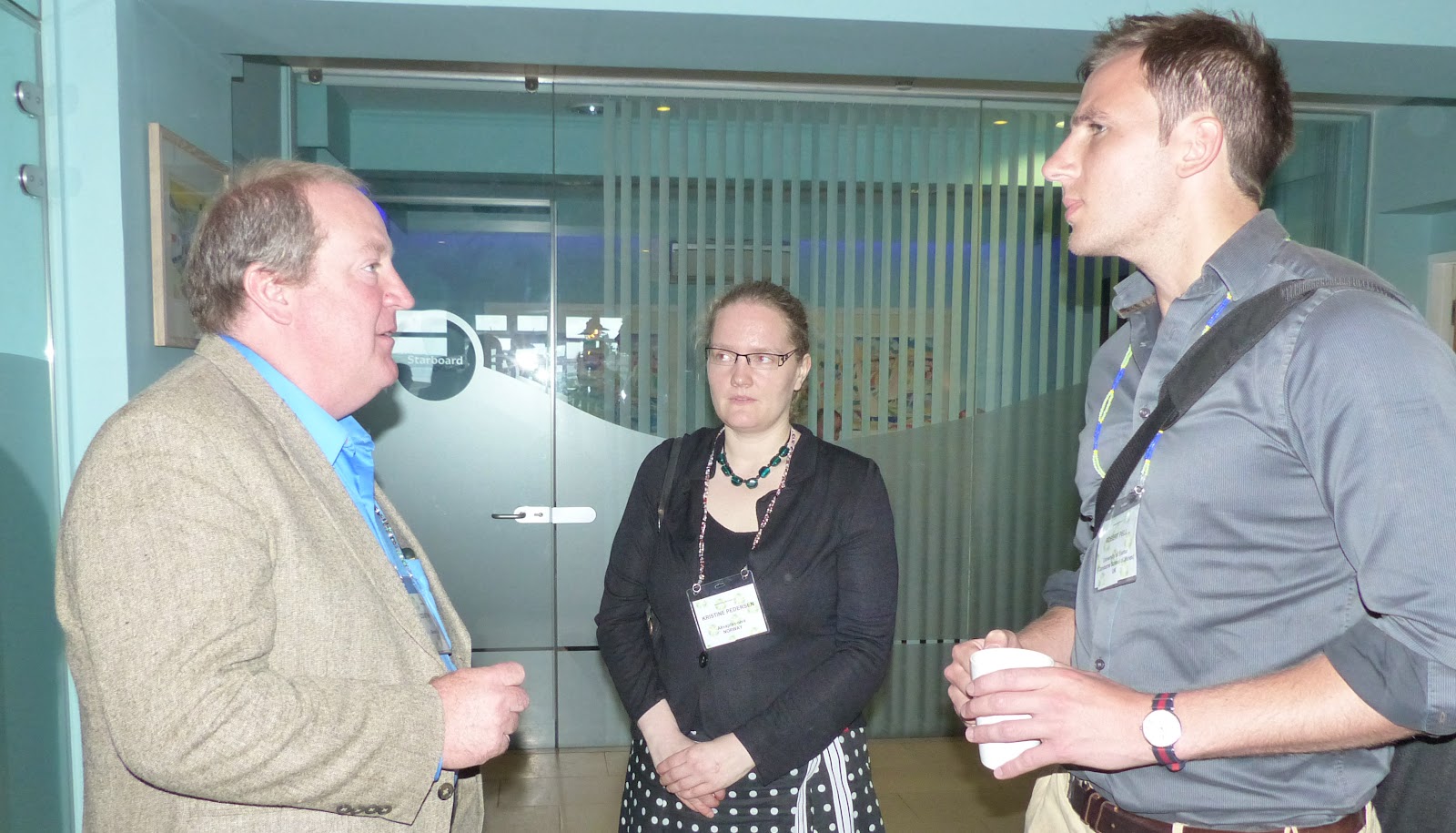
| Robert Pell (right) with Courtney Young and Kristine Pedersen |
While mineral resources are not given explicit mention in the United Nations` Sustainable Development Goals (SDG), they are important in underpinning many of the targets. Minerals are vital to sustainable development, as both providers of the material infrastructure of society and as an important sector of the economy in many resource-rich nations.
Ben McLellan, of Kyoto University, Japan, examined the historical and future mineral requirements and implications for sustainable development in scenarios that aim to achieve the SDG`s targets.
 |
| Ben McLellan with Guzide Kalyoncu Erguler and Eleonore Lebre |
Genesys International Ltd, UK is a new entry into the MEI fold, and we welcome their sponsorship of the conference. Genesys is an industry leader in the development and manufacture of speciality antiscalant and cleaning chemicals for Reverse Osmosis, Nano-Filtration and Ultra-Filtration membrane systems (
posting of 14th March). Membrane technology has become widely used in various industries in recent years, but has been slow to be adopted in the ever conservative mining industry. One of the main advantages of membrane technology is that it works without the addition of chemicals and with relatively low energy use.
Stephen Chesters of Genesys identified over 300 mines with potential to use membrane technology. There are sixty-one operational membrane plants and fifty-one of these have been commissioned in the last ten years, 65% of which are in gold and copper mines. In precious metal mines, waste water can be concentrated using membrane plant so additional metals can be recovered from barren liquor. Acid mine drainage is increasingly treated and then reused or sent off site as a potable supply to the surrounding communities.
Waste electrical and electronic equipment (WEEE), including spent batteries, contain significant quantities of metals that can be recycled. Naomi Boxall, of Australia's CSIRO, described a study aimed at developing a novel process for recovering metals from spent lithium ion batteries using electrochemically produced acidic anolyte.
Acid mine drainage (AMD) is often treated using active lime treatment, which generates a significant amount of sludge that contains mainly metal hydroxide precipitates, gypsum, and unreacted lime. Previous work has shown that sludge may have interesting geotechnical and geochemical properties, to be used, in combination with a silty soil, as a part of covers (oxygen barriers) to prevent AMD generation from waste rocks and tailings impoundments. In the final paper of the day Isabelle Demers, of Université du Québec en Abitibi-Témiscamingue, Canada, showed that the reuse of sludge can reduce the volume of natural soil required for site reclamation and that the soil-sludge mixture is an efficient oxygen barrier.
 |
| Isabelle Demers with Tobias Braun and Mostafa Benzaazoua |
Following coffee, the usual coast path walk took us to a special evening at the Chain Locker pub in old Falmouth, where we were joined by the regulars of the monthly Cornish Mining Sundowner (more photos on
posting of 23rd June).
 |
| Overlooking the Fal estuary |
 |
| At the gates of the 16th century Pendennis Castle |
 |
| Relaxing at the Chain Locker pub |
Friday June 24th
We awoke this morning to a country polarised by the EU Referendum result, and there was a sombre mood at the conference, as most scientists appreciated the advantages of remaining in Europe. To say that interesting times are ahead is very much an understatement.
Mike Battersby of Maelgwyn Mineral Services Ltd, UK, is a familiar face at
MEI Conferences, and as a Director of the Coalition for Eco-Efficient Comminution (CEEC) it was a pleasure to invite him to give a keynote lecture to start off the final day. Mineral processing consumes up to 50% of the electrical energy on a mine site and optimised energy use is crucial to sustainable mineral processing. The CEEC has initiated a global study to benchmark comminution energy consumption across different mine sites that guaranteed anonymity of this comprehensive and previously undocumented mine-specific data. The comminution energy per unit metal produced is benchmarked and presented in a graphical form similar to a cost curve. The energy curve highlights the benefits of efficient energy utilisation as a cost saving by moving “down the curve” into more cost-efficient operating regimes. Application of the curves to sustainability in mineral processing were presented in Mike's talk, together with case studies.
 |
| Mike Battersby (centre) with MEI's Amanda and Jon Wills |
The end-of-life (EoL) electric and electronic equipment (EEE) or e-waste has been a problem for almost two decades. The global rates for formal e-waste treatment are estimated to be below the 20% mark, with the majority of EoL devices still ending up in landfills or processed in a rudimentary way, causing serious environmental and human health issues. A paper from
Glen Corder of the Sustainable Minerals Institute, University of Queensland, Australia, critically reviewed the existing situation with e-waste in Australia. An investigation into material content in e-waste shows that metals account for about 50 wt%, with the major value associated with steel (41%), gold (23%), copper (19%), and aluminium (7%) which is over USD400 million in total.
 |
| Glen Corder (right) and Markus Reuter |
In Kvalsund, Northern Norway, a permit for submarine mine tailings disposal in the fjord, Repparfjorden was recently issued for a copper mine with expected operation from 2019. A copper mine was active in the same area in the 1970s and also deposited mine tailings in the fjord. Investigations of the metal binding in the historic and new mine tailings (produced from bedrock in the area) has been undertaken in a study described by
Kristine Pedersen of Akvaplan-niva AS, Norway, which indicates that there is potential for extracting more Cu from the new mine tailings.
As acid mine drainage is such a severe environmental problem, Guzide Kalyoncu Erguler of the Mineral Research & Exploration General Directorate, Turkey, argued that, in order to provide sufficient representative data for developing restoration techniques, this time-dependent geochemical process should be investigated based on kinetic principles.
The oxidation reactions of some sulphide mineral mixtures can generate self-heating which, if not controlled, can lead to workplace disruptions, creation of hazardous environments, and potential risk to infrastructure and human safety. Effectively reducing or delaying the oxidation process is one approach for dealing with these risks. In the first paper after the coffee break, Frank Rosenblum, of McGill University, Canada, discussed a study which focused on identifying and testing chemical treatments which have the potential to supress or block the chemical reactions which lead to self-heating.
 |
| Frank Rosenblum (right) with Dee Bradshaw and Kristian Waters |
The use of selective comminution is often an essential requirement for pre-concentration processes, as early upstream separation has proved to be most efficient.
Stoyan Gaydardzhiev showed how comparative comminution tests involving classical shredding and Electro Dynamic Fragmentation (EDF) technology have been carried out with the aim of evaluating the liberation degree of EoL printed wiring boards. Grinding by shredder did not bring selective fragmentation in the sense that the fractures induced in the material showed virtually no correlation with the underlying texture. A natural tendency towards liberation along material boundaries is more pronounced when EDF is applied with the purpose of delaminating the multi-level structures.
Movement of raw materials can be one of the most challenging tasks in open pit mining, with truck transportation representing the largest factor in mining costs and resulting in major greenhouse gas (GHG) emissions. In a study presented by Tobias Braun of RWTH Aachen University, Germany, the transportation methods of bulk materials within German hard-rock open pit mines were investigated. The results showed that 90% of the operations use truck-based transportation methods, with the remainder relying partly or completely on continuous conveyor-based systems. The installation of continuous conveyors compared to trucks represents a real alternative because of reduced dead load, increased safety, reduced GHG emissions and in many cases even reduced costs. Thus, sustainable technology substitutions exist for in-pit haulage in quarries that are yet to be adopted by the German quarrying industry.
Slags produced from copper smelting are siliceous containing valuable metals such as Cu and Fe as well as deleterious elements such as As and Sb. Courtney Young, of Montana Tech, USA, described a carbothermal recovery process which has been developed to separate the valuables from the silicates thereby producing value-added products and simultaneously reducing environmental concerns.
Raglan mine ore is treated for beneficiation of Ni using the flotation process. The concentrator produces acid generating tailings containing pyrrhotite closely-coupled to a serpentine gangue. Tailings are filtered before deposition at the surface with the objective of integrating the material in the permafrost. Mostafa Benzaazoua of Université du Québec en Abitibi-Témiscamingue, Canada, showed how partial desulphurization of total tailings produced at the end-circuit was investigated to assess the option of using desulphurized material as a component of a cover to control AMD generation. The effectiveness of the cover was the subject of one of the conference's associated poster presentations.
The mining industry is globally criticized for generating large amounts of solid wastes often with a potential environmental impact. Yassine Taha, of Université du Québec en Abitibi-Témiscamingue, Canada, presented the first paper of the final session, with a study on the recycling into clay bricks of different types of mine wastes, from calamine processing, coal and phosphates industries.
 |
| Yassine Taha (right) with Palesa Diale and Naomi Boxall |
Process water from mineral processing plants may contain a significant amount of dissolved metal ions, which may be recycled as process water, or discharged into the environment as effluent. If they are discharged into the environment they may cause significant problems for the local flora and fauna.
Hao Ma, of McGill University, Canada, described one method of removing metal ions from aqueous systems which has generated considerable interest over recent years, the emulsion liquid membrane technique, which incorporates solvent extraction and stripping.
Gold mining had a prominent place in the South African economy for over 120 years and its fall in production and imminent resource exhaustion has come with extensive environmental problems. The disruption of land to allow for extraction of valuable minerals has caused hydrological pollution side-effects such as acid mine drainage (AMD). Palesa Diale, of the University of the Witwatersrand, showed that iron (Fe (II)) was found to be the most dominant dissolved heavy metal in the West Witwatersrand Basin where extensive gold mining takes place. Effective removal of Fe (II) will be important in controlling the consequence AMD contaminating water streams. Indigenous microalgae is a potential long term, sustainable and environmentally friendly remediation solution, due to its significant influence on AMD. It not only can actively remove toxic heavy metals from contaminated water streams and improve its pH levels, but also non-toxic sludge is not formed. The study therefore looked at the efficacy of using immobilized green microalgae (Desmodesmus sp.) with the key focus on the mechanism, equilibrium and kinetics in achieving the removal of Fe (II) from aqueous solutions.
The most common acid rock drainage (ARD) remediation strategies result in neutralization of the waste water, precipitation of the majority of heavy metals and the reduction of the sulphate load. However, the residual sulphate concentration still exceeds the discharge specifications. In a further paper from South Africa, Rob Huddy, of the University of Cape Town, discussed the biological sulphate reduction process as an alternative and potentially more sustainable option to reduce the high sulphate load, precipitate heavy metals and neutralise the treated ARD effluents.
 |
| Rob Huddy (2nd right) with Phil Morton, Danny Procter and Lewis Baker |
A significant portion of the electrical and electronic waste (WEEE) generated is disposed into landfill sites or incinerated. Considering the annual 5% increase in global ewaste production projected from 41.8 million tonnes in 2014, the extraction and recovery of valuable metals from WEEE is necessary to contribute to the circular economy while minimizing the environmental burden. In the final paper of the conference,
Elaine Govender-Opitz, of the University of Cape Town, showed that biohydrometallurgy can play a key role in the recovery of base metals from WEEE and its preparation for further recovery of gold and PGMs.
Elaine's presentation concluded what has been a fine conference. University of Cape Town's Prof. Dee Bradshaw felt that the quality of young person's presentations had been outstanding, which gave her great hope for the future.
MEI Consultant Markus Reuter summarised what had been achieved over the two days and what should be discussed at the next conference, emphasising the strengthening link between this and the preceding Biohydrometallurgy conference. More details on this will be published in a few weeks' time.
MEI's
Amanda Wills then closed the conference, thanking the sponsors, and all delegates, particularly the chairmen and presenters (
see timetable), and then invited everyone to
Sustainable Minerals '18, which is hoped to be held in Windhoek, Namibia, in June 2018 in conjunction with
Biohydromet '18.
The conference draft papers are
available from MEI and authors have been invited to submit their final papers to
Minerals Engineering, for a special Sustainable Minerals issue which will be published early next year. A full set of conference photos is also
available from MEI.
Twitter @barrywills




.jpg)