Showing posts with label Visitors Book. Show all posts

Thursday, 14 May 2015

Relaxing with old friends

After four days of conferences, it was good to relax this evening with Ian and Pat Townsend, and Corby Anderson. Ian attended Nickel Processing '15 and Corby contributed a great deal to both conferences this week.

With Corby Anderson and Pat and Ian Townsend at MEI HQ
Ian and Pat we have known for many years; I think we met for the first time in Bulawayo at Complex Ores '97. Ian was then with Larox, which was assimilated into Outotec, and he retires from Outotec in a few months time, but will still have an involvement with the minerals industry.

Corby is a Professor at the Colorado School of Mines, and we meet up each year at the SME Annual Meeting. He is a past Chairman of the Mineral Processing Division of SME and only this week received the news that he has been made a Distinguished Member of SME. He is also the recent recipient of the Junichiro Tanaka Distinguished Achievement Award sponsored by the Tanaka Memorial Foundation in recognition of his important career contributions to the advancement of the precious metals industry.

A great evening to round off a great week, but I am now looking forward to an alcohol-free day tomorrow!

Thursday, 18 December 2014

FEI's Alan Butcher calls in

My old friend Dr. Alan Butcher, Principal Petrologist at FEI, called in today during a break from meetings at nearby Camborne School of Mines. The University has just invested in a high resolution scanning electron microscope for environmental research.


Alan was a colleague of mine at CSM. He left 16 years ago to take up a position at CSIRO in Australia, then was a leading player with Intellection until it went into receivership. Now he is FEI's most experienced mineralogist, and is looking for new areas for the commercial exploitation of rocks, particularly on the basis of their mineralogy and textures.

FEI originally specialised in automated mineralogy for mineral processing, and has always been a major sponsor of MEI's process mineralogy conferences, including last month's Process Mineralogy '14. Due to the increasing competitiveness of the minerals market, FEI has expanded into other areas, such as rocks holding oil and gas, and also into the increasingly important area of micro-computed tomography, of which Prof. Jan Miller has been a pioneer in the mineral processing sector.  We look forward to the company's sustained involvement with MEI and to news of interesting applications at Process Mineralogy '17.

Friday, 3 October 2014

Progress on Biohydromet '16

A welcome visitor this morning was Dr. Chris Bryan, lecturer in sustainable mining and mineral resources at nearby Camborne School of Mines (CSM). Chris, one of MEI's biohydrometallurgy consultants, called in for coffee with me and Jon to discuss progress on Biohydromet '16 and the possibility of a tour of CSM's facilities during the conference.

Chris Bryan with Jon and me
Chris is working with Dr. Paul Norris, honorary research fellow of the Environment and Sustainability Institute of the University of Exeter, on the bioleaching of nickel concentrates and they will be presenting a paper on the high temperature bioleaching of pentlandite and pyrrhotite at Nickel Processing '15 in May.

They are also working on the use of Selfrag's electrical pulse fragmentation to improve bioleaching efficiency, and the remediation of water from the old Wheal Jane tin mine using algae.

During the panel discussion at Biohydromet '14 Dr. Norris stressed that academics should continue to search for more useful microorganisms, as there are areas in which those currently available are inadequate for industrial use, solids tolerance in stirred tanks being a notable area, particularly at high temperature. This has stimulated the appointment of a PhD student to bioprospect Cornish mining waste dumps to seek potentially better organisms.

Interesting work and much to look forward to at Biohydromet '16.

Wednesday, 13 August 2014

News of South-West England minerals people

Nick and Felicity (Flee) Wilshaw of Truro-based Grinding Solutions Ltd joined us for lunch today. Offering technical, marketing and investment consultancy, as well as laboratory testing facilities, to all fields of mineral processing, their company is particularly recognised throughout the industry as a leader in ultra-fine grinding. As such Grinding Solutions was a sponsor and exhibitor earlier this year at Comminution '14.

With Nick and Flee at MEI
Now they are seeking to broaden their flotation capabilities, and this week Jon's partner Dr. Kathryn Hadler, formally with Imperial College, joined the company to strengthen the expertise in this area.
Kathryn with IMPC Chairman Cyril O'Connor, Cape Town 2011
A very good friend of Nick and Flee is Charlie Northfield, Process Plant Manager at the new tungsten mine, Drakelands, in Devon. Charlie and Nick graduated from Camborne School of Mines with degrees in Mineral Processing Technology in 1980. Following on the success of the monthly Cornish Mining Sundowners in Falmouth, Charlie has initiated a Devon Sundowner, and has sent me the photo below, taken at the inaugural sundowner on 1st August, attended by Wolf Minerals employees, with guest of honour Andrew Sarosi, former Chief Metallurgist, Hemerdon Project, AMAX Exploration UK.
1st Devon Mining Sundowner. Andrew Sarosi 2nd left, Charlie Northfield 2nd right
The Sundowners are planned to be held on the first Friday of every month from 5pm at the Miner’s Arms, Hemerdon. Anyone involved in mining and related industries is welcome.

Thursday, 17 July 2014

Selfrag's KP van der Wielen calls in

Dr. Klaas van der Wielen, of Selfrag, Switzerland, called in at MEI this morning. He is in Cornwall for his stag celebrations, prior to his wedding next month in The Netherlands.


With Klaas at MEI
We last saw him in Cape Town in April, where he presented an interesting paper at Comminution '14 on electro- fragmentation of particles, a technology which has consistently been demonstrated at batch scale but which has yet to be proven on a commercial basis for large scale continuous processing. There are exciting times ahead, however. Work is progressing on the pilot plant to prove the viability of the technology and there are many potential projects in the pipeline, including copper-gold ores, iron ores, as well as comminution of incinerator slags and silicon ingots.

A full description of the technology can be found on MEI Online and we look forward to updates at Comminution '16.

Wednesday, 14 May 2014

Tuesday was Process Mineralogy day in Falmouth

We had a brief visit yesterday from MinAssist's Dr. Will Goodall and Al Cropp. I first met them when they were involved with Australian company Intellection, which went into receivership in 2008, its QEMSCAN automated mineralogy system assets being acquired by the FEI company (MEI Online). 
Jon with Will Goodall and Al Cropp at MEI
MinAssist Pty Ltd, based in Melbourne, is a progressive young company offering services to the minerals industry in the interpretation of mineralogical information for metallurgical applications. Utilising the expertise of Dr Goodall, founder and Principal Consultant, MinAssist specializes in the characterisation and optimisation of precious metals ores, the current climate of increasingly complex ore reserves making proper understanding of the mineralogy and metal deportment vitally important. This is particularly apparent in the gold mining industry where easily recoverable free-milling deposits are being exhausted and increasingly complex, refractory gold deposits are replacing them.
 Despite being on other sides of the world, Will works closely with consultant Al Cropp, who is based in Cornwall.  Al divides his time between MinAssist and his duties as a Research Fellow at CSM. He is a geologist who has been involved with automated mineralogy for over 7 years. As a student in Industrial Geology at CSM, Al first became involved with CSIRO and the QEMSCAN technology during his honours thesis.   Following the success of his project work, a series of papers were published on the techniques, and Al moved to Brisbane, Australia to aid in the establishment of Intellection by CSIRO, to commercialise the QEMSCAN technology. 
 Will is hoping to present work at Process Mineralogy '14 in November, and we will no doubt see Al at Precious Metals '15, which is being held in Falmouth in 12 months time.

In the early evening I called at the Chain Locker pub (again!) to meet up with Prof. Pertti Lamberg of Lulea University of Technology, Sweden, who was down here briefly to act as external examiner for a PhD thesis on geometallurgy from CSM student Kelvin Anderson, who will soon be returning to Sierra Leone to take up an appointment at the University. Pictured below are Kelvin's supervisor, geologist Dr. Charlie Moon, Kelvin, Pertti, internal examiner Dr. Ben Williamson, and me.


I am pleased to announce that Pertti has agreed to present a keynote lecture at Process Mineralogy '14, and this is an opportune time to remind everyone that the deadline for submission of abstracts, 31st May, is fast approaching.

Tuesday, 11 March 2014

Terry Veasey a welcome visitor to MEI

It was good to see my old pal Terry Veasey in Falmouth today. He and his wife Pauline are down here on holiday in Penzance and called in yesterday for a meal with us and to catch up on the latest mineral processing news!

With Terry in the MEI Office
Terry presenting keynote lecture at
Complex Ores' 97 in Bulawayo

During my time at CSM Terry was a senior lecturer at the University of Birmingham, and we worked together exploring the potential of thermally assisted liberation.  Many of you will also remember him from his time as UNESCO Professor of Chemical Engineering at the National University of Technology, Bulawayo, Zimbabwe from 1995-1997.

He regularly reads the blog, so if you would like to get in touch with him, just leave a comment.

Friday, 17 January 2014

A welcome visitor from Australia

Jon, Amanda and I had an excellent pub lunch today with Diana Drinkwater, the Technical Programme Manager for the JKTech, Brisbane. and the first woman to be elected to the International Mineral Processing Council (posting of 16th October).

Amanda, Diana and Jon in Falmouth
Diana had travelled all the way from Brisbane to Falmouth for a 2-day meeting at Camborne School of Mines. She was representing the JKTech on the Sandwik SIMS programme. In this post-graduate programme Sandwik provides academic support for over 20 research projects per year, developing a cohort of high performing key staff with effective networking and shared technical skills. The aim is to provide participants with a well founded academic and job oriented specialisation and intensified education in the field of raw materials extraction and all associated scientific disciplines with regard to international standards and practices.

The course is addressed especially to engineers who are interested in getting an additional qualification in the field of raw materials extraction with regard to national and international practices in raw materials industries including related fields in the economics and social environment of this industry.

For this purpose the course is organised in cooperation with the following institutes

  • University of New South Wales, Australia
  • Colorado School of Mines, USA
  • University of the Witwatersrand, South Africa
  • LuleĆ„ University of Technology, Sweden
  • University of Exeter, Camborne School of Mines, UK
  • JKTech, Australia
  • University of Leoben, Austria
The course consists of five modules and lasts two years. It is completed with a project work and a thesis presentation and awarded with 62 ECTS points.  After the successful completion of this course the participants are granted the academic postgraduate degree of an "International Mining and Construction Engineer".

More information can be found on the SIMS website.

Sunday, 6 October 2013

Golden Memories of Leeds University

It is exactly 50 years ago this week since I started my undergraduate course in metallurgy at Leeds University and over the weekend we had very special visitors to Falmouth. Bob Schofield and his wife Jean, and Graham and Sheila Neate were friends throughout our undergraduate days, and Bob and Jean we only made contact with again earlier this year. 
Kynance Cove
At Kynance Cove with Bob and Jean Schofield and Graham and Sheila Neate
We naturally reminisced over many things, and had a laugh at a few of the old photos, including our 1966 graduation photo below. What is really noticeable now is the fact that all the graduates were male, and in all our 6 years, as under- and then post-graduates, we never saw a female student in the Houldsworth Faculty of Technology.
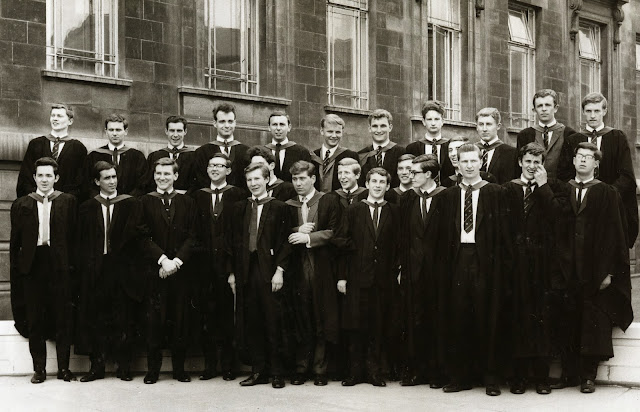
Leeds University Metallurgy Graduation 1966
Graduation day 1966. I am back row far right, Graham 3rd left and Bob 6th left
And the lecturers were without exception male. They were also, with a few exceptions, not particularly inspiring. It was fairly obvious that to be a good, inspirational lecturer required a combination of enthusiasm, confidence and deep knowledge of the subject.  Pat Kelly had these qualities in abundance. He taught crystallography, a subject which could have been made very tedious, but he brought his subject to life, as did the very eminent head of department, Prof. Jack Nutting, later my PhD supervisor, who impressed me by lecturing without notes, often wandering off on tangents but all the time communing with the class.

Other lecturers occupied the other end of the spectrum.  Apart from the specialist lectures in metallurgy, we also had lectures on the basics- physics, chemistry and maths. Unfortunately not just we metallurgists, but engineers, fuel technologists, ceramicists etc (all male!) and classes were held en masse in a huge tiered lecture theatre. I don't know how it was decided who would get the short-straw in terms of teaching these subjects, but it was a very short straw indeed.
Chemistry 2T was taken by a ruddy Scot who quite obviously wished that he were somewhere else, anywhere else.  As his lecture commenced, paper aeroplanes would begin to glide towards the blackboard, and the decibels would start to rise as the students discussed their weekend affairs and future plans. All the time his ruddy face would become ruddier until eventually, when the noise had reached cacophony levels he would suddenly stop and below at the top of his voice "FOR GOD'S SAKE, SHUT UP".  There would then be a brief respite before the slow build up of noise levels again.
This, however, did in no way compare with Maths 2T.   A multitude of aeroplanes filled the air, some drifting lazily, others spiraling wildly towards their target, a hapless, young be-gowned lecturer, whose working life must have been a nightmare.  Whenever he turned to write an equation on the blackboard, the aerial assault would be supplemented by an artillery bombardment of rolled up paper and even coins.  While all this was happening, a register was being passed around the lecture theatre. We were required to show our presence by writing our names on the sheet, but of course if a friend was absent someone would sign in for him. It was also evident when the sheet arrived that there were a considerable number of people signed in who were patently not part of the course, Emma Royds, R. Sole etc.  Surely he did not go away after the lecture and log all of these names in some kind of meaningless ledger? 
I found all this hard to believe.  My working class background had taught me to respect my elders and betters, and school had imposed discipline by the cane, the slipper and the Bunsen burner hose. These people were University Lecturers for goodness sake, second only to High Court judges and Conservative MPs in commanding respect!
I have to wonder why I was so enthusiastic about becoming a lecturer, when I joined Camborne School of Mines in 1973!! The students at CSM were also all male, and the first female graduated in 1984, 96 years after the School's foundation. When I left CSM in 1996 there had never been a female lecturer, now the Director is a woman and female graduates in mining and minerals engineering are commonplace around the world. How things have progressed and improved over the past few decades.

With Murdoch University students at Metplant '11


Leeds University postgrads at ESCC '13

Thursday, 15 August 2013

In brief

In brief is a new thread to the blog which I hope will be a regular feature. Its success will be dependent on the inflow of news and photos from blog readers, so if you have any news of events etc, accompanied by photos, please send directly to me at bwills@min-eng.com.

Eco Efficient Comminution Workshop
The JKTech’s Diana Drinkwater tells me that the Eco Efficient Comminution workshop, which was run immediately after Metplant ’13 in Perth, went very well, with 16 delegates divided pretty evenly between engineers, vendors and operators. Following on from a theme that emerged during the conference, one of the presenters, Ben Murphy, coined the term “flotatinution” and there was some interesting discussion in the workshop about different ways of designing flotation circuits to minimise comminution energy.

Mick Rogers (Outotec), Alan Faulkner (Donhad),
Danica Clarke (Rio Tinto) and Steve Liddell (BHP Billiton)
Diana continues “We got great feedback from the participants and should definitely do it the same way again, with a few refinements.  Maybe we can make a case for taking something to Flotation’13, with a focus on the “flotatinution” aspect (I promise we will call it something else!).”

Good news on the progress of Jan Miller and Xuming Wang
 As you all know, Prof. Jan Miller and Dr. Xuming Wang of the University of Utah were seriously injured in a recent horrific car accident in Tibet. So it was great to receive this email from Xuming:

“Thanks so much for all the support you have given in prayer and messages.  Every day I am getting better. Now I can walk around freely, and start to read and reply to email.  Barry, your MEI blog is so amazing. Many friends in the mineral processing community knew about the accident. We received a lot of phone calls and messages when we were in China.  They said they knew the news from your blog and their support, prayer and help were really a big encouragement for us at that difficult time.  Dr. Miller is getting stronger. He can walk a little bit every day with a walker.  Many thanks to our friends in our community for their support, prayer, and encouragement. I am sure soon we will be able to serve our community again and make contribution.”
On behalf of everyone in the industry we wish you both speedy and full recoveries.

Our first visitor to the new MEI Office
We moved premises a month ago, and testerday welcomed our first visitor, Tony Clarke, who will be well known to anyone who passed through Camborne School of Mines between 1973 and 1998, when he looked after the mineral processing laboratories and mill. He now researches the evolution of Cornish mineral dressing, and is an enthusiastic volunteer at the excellent King Edward Mine Museum.
  
Tony Clarke with me and Jon
If you are ever in the area do call in and see us. We are only a couple of miles from Camborne School of Mines in Penryn. Our new address is 1 Freeman Collins Drive, Falmouth TR11 2GA.

Thursday, 17 January 2013

Memories of Bulawayo and the Veaseys

Terry opening Complex Ores '97
It is three and a half years since I last caught up with my old friend Terry Veasey (see posting of 21 August 2009). Terry was a popular lecturer at Birmingham University and also for a short period at the National University of Science & Technology in Zimbabwe. It was as a result of a short visit to see Terry and his wife Pauline in Bulawayo that we set up the very enjoyable Complex Ores’ 97 conference. A couple of photos from that event in Bulawayo are shown below.

With the Veaseys and John Hope
Lunch in the Matopos Hills with Frank Crundwell and Yaw Asamoah-Bekoe
This morning Barbara and I took the ferry across the River Fal to the little village of St. Mawes, for a pub lunch with Terry and Pauline, who are relaxing for a few days in Cornwall. Terry is still very much involved with the greyhound racing scene, but also spends a lot of time these days on philately and the restoration of  cast iron artifacts.

Lunch today at the Victory Inn, St. Mawes

Thursday, 1 March 2012

International visitors to Falmouth

Barbara and I had a lovely meal last night at Falmouth’s excellent Samphire Restaurant, with Kirsty Hollis and Ted Bearman. Ted and Kirsty had just spent an interesting day at the nearby Camborne School of Mines (CSM). They have been in the UK for two weeks to visit a number of Universities across the country. Researchers at these universities are working on innovative new technologies which may change the face of mineral processing.

Ted, of Bear Rock Solutions, in Australia, is a graduate of CSM and received his PhD in rock engineering from Camborne in the 80s. He is well known in the field of comminution, and will be presenting a keynote lecture at next month’s Comminution ’12 in Cape Town.

Kirsty is with Newmont Mining Corporation, in Denver, USA, who are sponsoring November’s Precious Metals ’12 in Cape Town. Her role is to look into innovative technology as she and Newmont believe that these will play a key role in the future of both the company and the minerals industry in general.

Wednesday, 7 September 2011

Erik Spiller in Falmouth

With Erik Spiller at MEI
A welcome visitor to MEI today was my old friend Erik Spiller, who I have known for many years, since his early days with Hazen Research.

He is now a research professor at the Colorado School of Mines, and Vice President of Tetra Tech, Colorado.  Erik has been in Cornwall as a consultant to the proposed polymetallic mine in Camborne. Progress is still being made with this venture and extensive mineralogical testwork is currently being carried out, utilising the Camborne School of Mines' extensive QEM-SEM and QEM-SCAN facilities.  More news on this soon hopefully.

Thursday, 30 September 2010

Will Goodall calls in

Welcome visitors to Cornwall yesterday were Will Goodall and his wife Casey, all the way from Australia.

Formerly with Intellection, and a regular presenter at MEI Conferences, Will is now Senior Technical Consultant at Bright Phase Pty Ltd and Managing Director & Process mineralogy/metallurgy consultant at MinAssist.

He is involved with many things at the moment, including geometallurgical ore characterisation and development of more effective gold deportment characterisation methodologies.

Jon took them on the grand tour, and they are pictured below at St. Ives.

Wednesday, 28 July 2010

A welcome visitor to Falmouth- Bob White


We had a surprise visitor yesterday- Dr. Bob White and family.  Bob, now retired, was a lecturer in mineral processing during the 1980s at the University of Leeds and the University of Guyana.  If any of you blog-readers were taught by Bob, please let me know and I will pass a message on to him.

Bob and I go back a long way. We graduated in metallurgy from the University of Leeds in 1966 and then stayed on to do PhDs. The photo below was taken at the Leeds University Houldsworth Ball in 1968. Bob is on the right on the back row, Barbara is on the far right, and the fool at the top is me.  Apart from Bob (and Barbara), I have totally lost contact with the others in the photo, so it would be good to hear from you if you see this.

Wednesday, 9 September 2009

Lunch with Keith Atkinson


Barbara and I had a very pleasant lunch today with Keith and Maureen Atkinson. Keith was Director of Camborne School of Mines and, until his retirement last year, Provost of the University of Cornwall.
Those who attended the first three Minerals Engineering conferences in Singapore in 1991, Vancouver in 1992 and Cape Town in 1993 may remember that Keith opened the conferences, representing CSM.
The picture on the right was taken at Minerals Engineering '93 in Cape Town. Left to right: Ian Jackson, Richard Pascoe, Kirsty Walker, Gareth Brown, BW, Paul Hodgskinson, Keith Atkinson, Gaynor Yorath and Chris Martin.

Friday, 21 August 2009

Terry Veasey in Falmouth

My old friend Dr. Terry Veasey, and his wife Pauline, have been staying with us over the past few days.

Terry left the minerals engineering group at Birmingham University in 2004, and is now an eminent consultant to the Greyhound Board of Great Britain, advising on track surfaces, and writing articles for the Greyhound Star.

He was UNESCO Professor of Chemical Engineering at the National University of Science & Technology, Bulawayo, Zimbabwe from 1995-1997 and in the early 1990s was a familiar face at the early Minerals Engineering conferences. The picture below was taken at Minerals Engineering '92 in Vancouver, and shows Terry and me with Byron Knelson of Knelson Concentrators.

Terry would be interested in hearing from any of his past students- just contact me and I will supply his email address.