Thursday, 9 July 2020

Minerals Engineering soars ahead with a record high Impact Factor

The 2019 journal Impact Factors (IF) are now available, and I am pleased that Minerals Engineering has recorded its highest ever IF, 3.795, up from 3.315 in 2018. The world's leading minerals industry journals, ranked by IF are:
Minerals Engineering  3.795
Hydrometallurgy 3.338
Mineral Processing & Extractive Metallurgy Review 2.785
Minerals 2.380
International Journal of Minerals Metallurgy & Materials 1.713
Canadian Metallurgical Quarterly 1.456
Physicochemical  Problems of Mineral Processing 1.256
Minerals and Metallurgical Processing 1.020
Impact Factor is a measure of the frequency with which the 'average article' in a journal has been cited in a particular year. The website of Minerals Engineering lists the most cited articles over the past three years, the most cited being New approaches for extracting and recovering metals from mine tailings by Falagán, C., Grail, B.M., Johnson, D.B., in Volume 106 (2017). This paper was part of a virtual special issue of papers presented at MEI's Biohydrometallurgy '16 in Falmouth.
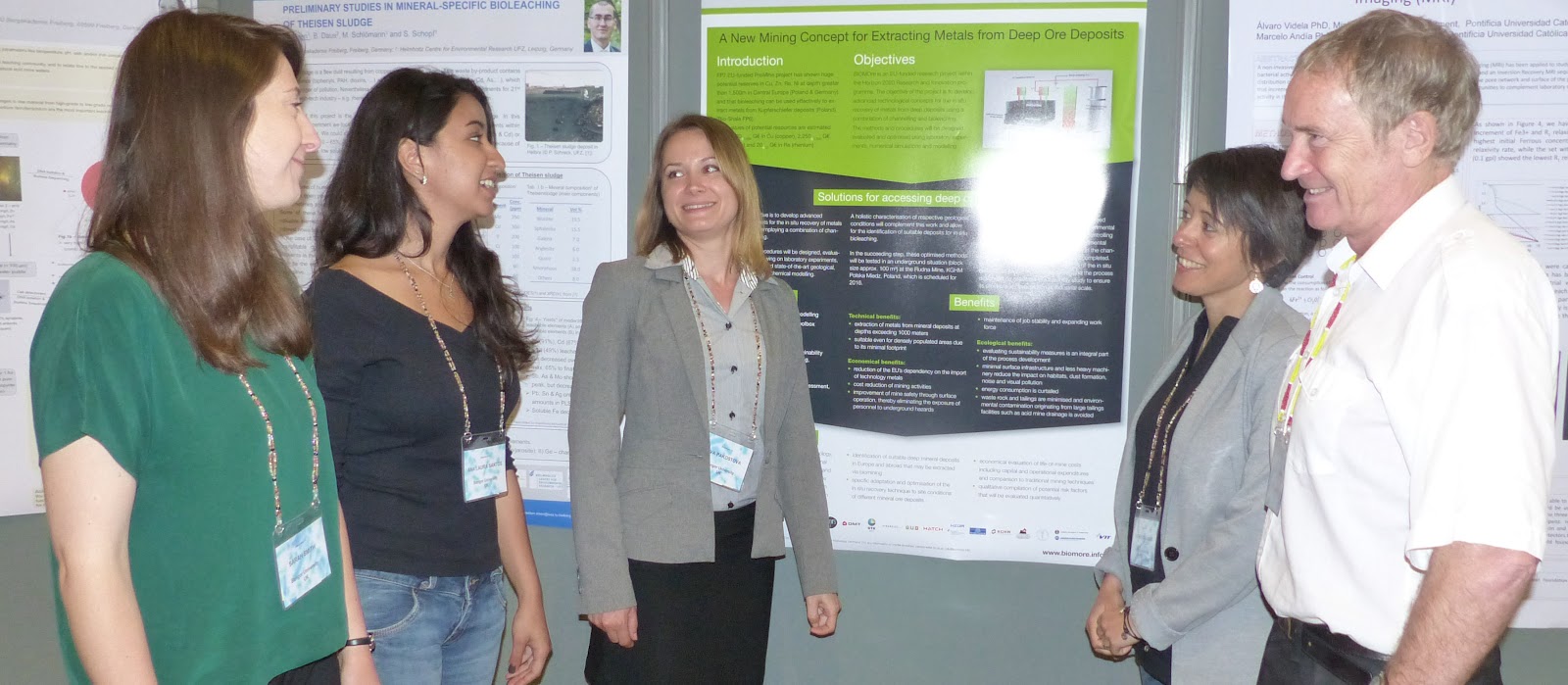
Carmen Falagán and Barrie Johnson (right) with other members of the
Bangor University Research Group at Biohydrometallurgy '16

Authors publishing in Elsevier journals such as Minerals Engineering and Hydrometallurgy also have the added bonus of their manuscripts appearing on the world's largest on-line platform, ScienceDirect, from where papers are available for download. Last year well over 600,000 Minerals Engineering downloads were made, the highly cited Falagán et al paper having been downloaded over 19,000 times since its publication. Currently the record for the highest number of overall downloads, a whopping +47,300, is held by Feng Xie, Ting An Zhang, David Dreisinger and Fiona Doyle for their Volume 56 (2014) paper A critical review on solvent extraction of rare earths from aqueous solutions.  The most downloaded papers over the past 90 days are listed on the journal website. It is interesting to see that China accounts for around a third of all downloads from ScienceDirect.

The success of a journal is dependent on the quality and relevance of its papers, and I must thank and congratulate all the researchers who have endured the sometimes long and challenging peer-review process before final acceptance. Last year 1294 manuscripts were submitted and of these 28.7% were finally accepted, highlighting how rigorous the evaluations can be.
Having been involved with the journal since its inception 32 years ago, I am, of course, proud of how it has evolved over the years, and there are many people who I have to thank for this. I have been involved with many Elsevier Publishing Managers since 1988, the longest association being with Dean Eastbury, who will be well known to many MEI Conference delegates. It was a great pleasure to work with Dean, who is now retired in Cornwall, and it is now a pleasure to work with his successor in Oxford, Joshua Bayliss.
I am particularly indebted to the regular issue editors, Dr. Pablo Brito-Parada and Dr. Kristian Waters, and their team of six bright young assistant editors, and also to the members of the Editorial Board, a group of highly experienced professionals, who offer advice when needed. A full listing of the journal's Editorial team can be found on the website.
And last, but definitely by no means least, a massive thanks to the hundreds of researchers worldwide who give up their time to take part in the all important peer-review system, without which there would be no journal. The reviewers participate anonymously, although I do thank recent reviewers by listing them in the hard copies of each journal issue. I would like to remind all reviewers that in appreciation of your efforts, you can access your profile page online and collect your rewards, download your review certificates, and view your annual overview.

Monday, 6 July 2020

From the Archives- Mauritius, Réunion and Madagascar

It's fair to say that MEI is just ticking over at the moment, waiting to move up through the gears next year as we enter the strange new world of the 'new normal'. Our life basically revolves around international conferences, not only MEI Conferences, but reporting on other events around the world. Next month, for instance, Jon would have been in Australia, reporting on the AusIMM's Mill Ops conference, and I would have been presenting a lunchtime lecture at the Conference of Metallurgists in Toronto.
Although many conferences have opted to go online, we have avoided that for the foreseeable future, preferring to postpone events, biding our time until the days when people are free to travel again, albeit probably in a more restricted manner. Digital conferences are fine, but in my opinion they are a poor substitute for the real thing - face to face meetings, and socialising with the uncertainty of what serendipity might have to offer. The reaction to my posting We'll Meet Again last month suggests that other professionals are also looking forward to getting together again.
Apart from meeting people, we are much aware of how privileged we are to have a life in the minerals industry, and the opportunity that it gives us of travelling the world to see amazing things, and to experience different cultures. So while real travel is on hold, I thought I might delve into the archives and reminisce about some of the great places that we have visited before or after conferences. 
Our next MEI Conference is likely to be Comminution '21 next April, running parallel with the IMPC, both in Cape Town, so a good place to start delving is the first Cape Town conference that I was involved with, 27 years ago, Minerals Engineering '93, organised with CSM Associates, a few years before MEI was even thought of (see also MEI Blog 27 October 2010).  
Visiting Rhodes Memorial, Cape Town, after Minerals Engineering '93,
with Kirsty Walker, Terry & Pauline Veasey and Rob Wilson,
delegates from University of Birmingham
Barbara at Cape Town Waterfront with Ann Ralston, Sabina Crozier,
Carmel Beniuk and Pauline Veasey
Barbara and I knew little of the Western Cape at that time, so opted for a holiday on the Indian Ocean island of Mauritius after the event, as this was only a few hours flight from Johannesburg. Mauritius is the oldest of the three volcanic Mascarene Islands, being formed between 7 and 10 million years ago.  It is a beautiful tropical island but probably particularly attractive to those who enjoy watersports.

Mauritius
In 2014, after Process Mineralogy '14, we spent a week on Réunion, a French island about 200 kilometres southwest of Mauritius (MEI Blog 30 November 2014). The largest of the Mascarene islands, Réunion was formed less than 3 million years ago. The landscape of the south-east is dominated by lava fields from many eruptions, some very recent, from the highly active volcano Piton de la Fournaise, which is over 530,000 years old. It is one of the world's most active volcanoes, with over 150 recorded eruptions since the 17th century, the most recent being only 6 years ago. 
Like Mauritius, Réunion is also a beautiful island, catering for watersports, but with some great hiking in the cooler interior. We spent three nights at Cilaos, a town situated in one of the calderas of the massive Piton de Neiges dormant volcano with impressive trails in its interior.
St. Gilles des Baines coral beach and reef
The long and winding road to the island's interior
Cilaos, situated in one of the calderas of the massive dormant volcano, Piton de Neiges
Hiking in the Cilaos caldera
A comparison of Mauritius and Réunion must, of course, be very subjective, but for those who like to sizzle in a hot tropical sun, Mauritius might be the better place for you, with its superior beaches, food and water sports facilities. But if hard hiking is your thing, then Réunion could well be added to your list of places to visit. The massive Piton de Neiges forms two thirds of the island and there are very many hiking trails within its three Cirques. We visited only one of these, and only scratched the surface of the hiking available, so it is not surprising that many people repeatedly return to this fascinating volcanic island.
But my recommendation by far would go to Madagascar, between mainland Africa and the Mascarenes, where we spent a wonderful week after Flotation '11. Madagascar is the 4th largest island in the world, and we visited four of its small islands, Nosy Sakatia, Nosy Be, Nosy Komba and Nosy Iranja.
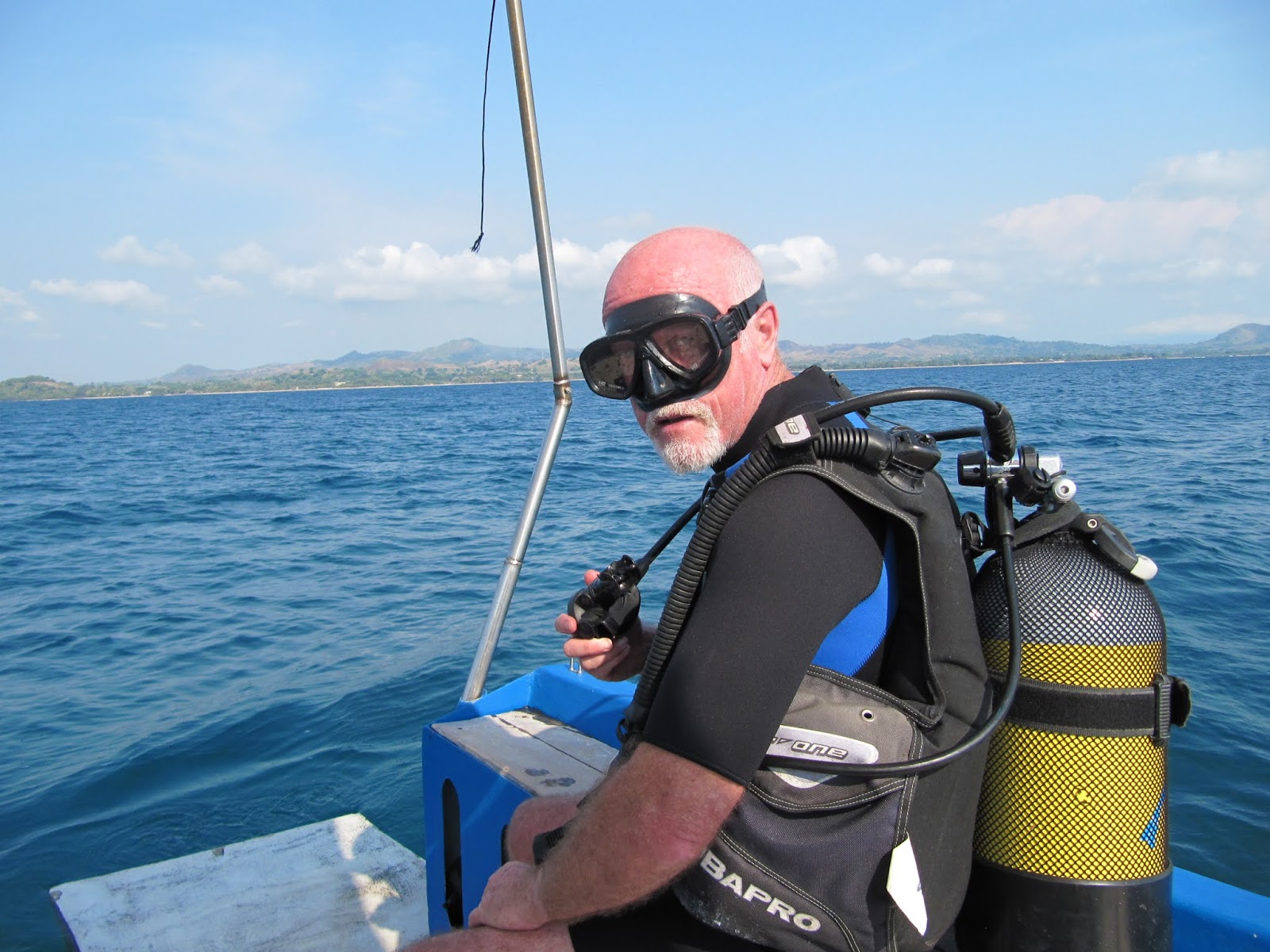
Our first 4 nights were at Sakatia, known for its orchids and splendid diving on its coral reefs. 
From Sakatia we visited neighbouring islands Nosy Komba and Nosy Be.
Nosy Be

Nosy Komba
Nosy Komba is particularly famous for its population of lemurs, which are protected as they are considered sacred by the island’s inhabitants. 
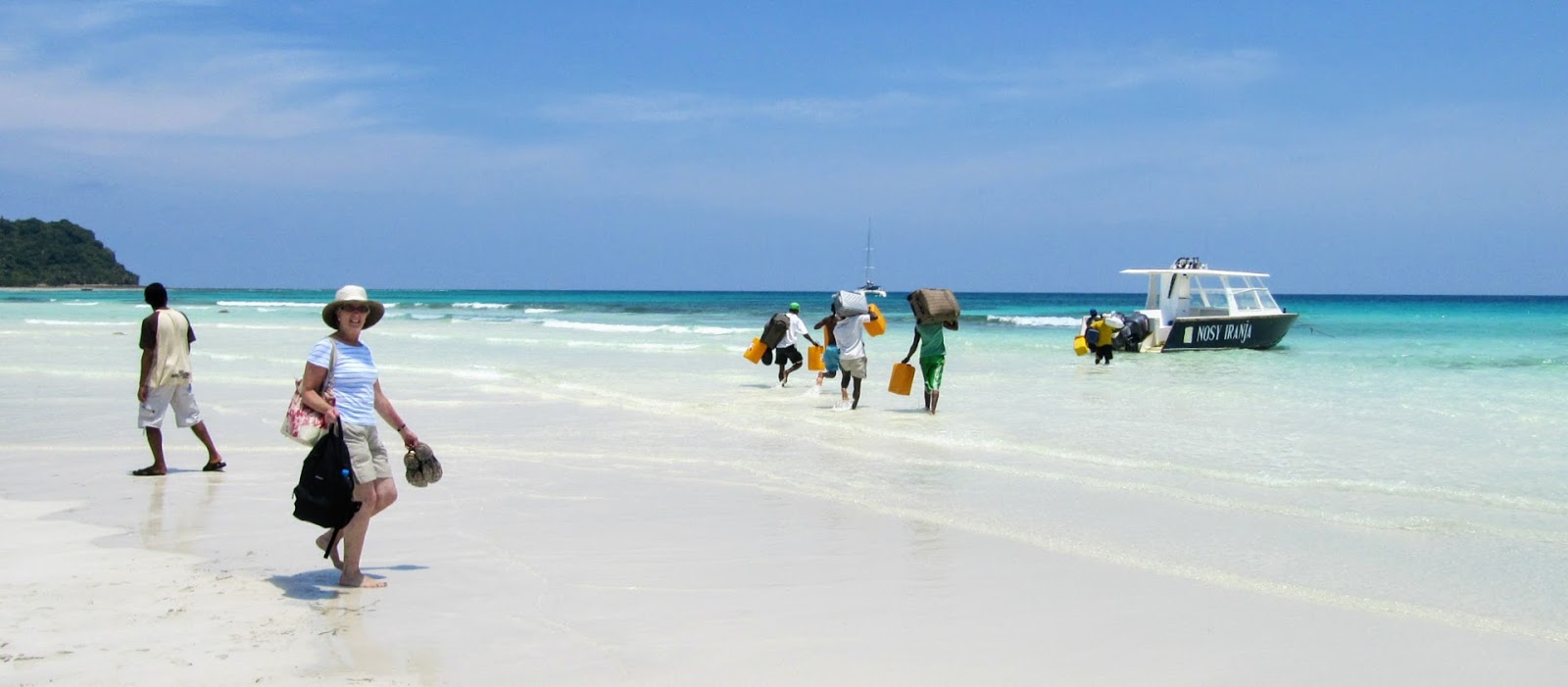
Our final 2 nights were spent at Nosy Iranja, two small coral islands connected by a sand bar at low tide. This tropical paradise is home to the luxurious Iranja Lodge and boasts absolute tranquility- during our stay around 30 staff attended to us and one other couple!
Nosy Iranja is famed for its Hawksbill Turtles, which come ashore to lay their eggs in the sand, and we were lucky to see the tiny turtles hatch then race off to the sea (YouTube).
Our two days at Iranja flew by, and our exceptional brief visit to Madagascar ended with a one and a half hour speedboat trip back to Nosy Be, and our flight back to Johannesburg.

We strongly recommend Madagascar as a great place to unwind after an MEI Conference in Cape Town. Our itinerary was arranged by our South African agent Rene Simpson, who can arrange a seamless holiday for you (simpsontours@gmail.com).

Wednesday, 1 July 2020

Announcing Metso Outotec, a major new company in the minerals industry

Metso and Outotec have been two of the most well known major international companies serving the equipment and services needs of the minerals industry. They have represented MEI Conferences over the years, both as sponsors and exhibitors.
Jimmy Loucas and Angie Voges (right) of Outotec, with MEI's Amanda Wills at Comminution '18
Pauline Choshane and MEI's Jon seal agreement on Metso's sponsorship of Comminution '21 at Flotation'19
After a partial demerger Metso Outotec, a unique new company with leadership in sustainable minerals and metals processing and recycling technologies begins its operations today. Headquartered in Finland, Metso Outotec employs over 15,000 professionals in more than 50 countries. After the partial demerger Metso Flow Control becomes a focused standalone flow control company, Neles Corporation.
More details on the merger can be found here, and we look forward to welcoming Metso Outotec to future MEI Conferences.

Tuesday, 30 June 2020

June- the beginning of the 'new normal'?

The UK lockdown was eased even further on June 1st, to try to stimulate the economy, which shrank by a record 20.4% in April, and it was hard to believe scenes likes this on Falmouth's Gyllyngvase Beach after those of only 2 months ago.
Falmouth's Gyllyngvase beach, June 1st.....
....and in April

Only 5 days into the month the UK's Coronavirus death toll exceeded 40,000, only the 2nd country, after the USA with 108,000 deaths, to pass this tragic milestone.
A report earlier in the month claimed that the mining industry pushed governments to declare them “essential” and that many continue to operate throughout the pandemic leaving workers and nearby communities at grave risk.  Mining sites around the world have become hotspots for the spread of coronavirus, and approximately 4,000 mine workers in 18 countries had tested positive, according to the report, by an international coalition of non-profit groups, who called mining “one of the most polluting, deadly, and destructive industries”, rejecting the claim that mining represents an essential service.  Well, as I said in my posting of 21st May, not everyone will be happy with the reopening of mines but it is surprising how many are unaware of its crucial importance.

There was little evidence of social distancing at many of the Black Lives Matter anti-racism protests across the UK on the first Sunday of the month. The protests were sparked by the death of George Floyd in police custody in Minneapolis, USA, and, although largely peaceful, in Bristol a statue of a prominent 17th century slave trader was ripped down and dumped into the harbour. This led to calls from around the world for statues of fascists, slave traders and owners to be removed.
The following day would have been the start of MEI's conferences in Falmouth, beginning with Biomining '20 (posting of 8th June), and it was also the first day of the UK's highly controversial quarantining of arrivals into the country, requiring them to self-isolate for 14 days. The following week saw the reopening of non-essential shops, and Falmouth town centre slowly came back to life.
With pubs and restaurants now set to reopen on July 4th, who knows we may have a July sundowner after all! July could well be a critical month.
They think it's all over....
Sources: Peter Brookes, The Times, June 24th

Monday, 29 June 2020

Calls for Abstracts: Physical Separation '21 and Integration, Optimisation & Design of Mineral Processing Circuits '21

This is now postponed to June 2022

Beautiful Falmouth

We look forward to welcoming you to beautiful Falmouth next June, for two conferences running back to back, one a popular established event, the other a brand new exciting conference. Both will be held at Falmouth's National Maritime Museum.
The National Maritime Museum by Falmouth harbour

Physical Separation '19 was the first event to be held in the Maritime Museum, and was so successful that Physical Separation '21 has been assigned three days, June 7-9, to include a conference dinner at the Greenbank Hotel, with its stunning views over the Penryn River and Falmouth harbour. I also look forward to showing delegates some of the historic mining sites of Cornwall on the final afternoon.

The Greenbank Hotel on the bank of the Penryn River
Camborne mining district, a UNESCO World Heritage Site
Physical Separation '21 will be MEI's 7th physical separation conference and abstracts are invited from those with interests in 
  • Gravity concentration methods - single and multi-G separators and dense medium separation
  • Classification techniques - hydrocyclones, air classifiers etc.
  • Solid-Liquid Separation - thickeners, clarifiers etc.
  • Electronic Sorting
  • Magnetic and electrostatic separation
  • Microwave technology. There are many aspects of mineral processing where the use of microwaves has potential and papers dealing with the enhancement of physical processes by microwaves are encouraged.

We are please to announce our early sponsor, Bunting, media partners International Mining and Imformed, and industry associates the Coalition for Eco-Efficient Comminution (CEEC) and the Cornwall Mining Alliance.
International Mining and Cornwall Mining Alliance are also media partner and industry associate respectively for our new conference, IntegratedMinPro '21, and we welcome as our first sponsor Promet 101.
As the demand for resources continues to increase, and amidst growing challenges of processing complex ores while minimising energy and environmental impact, we are entering an exciting time for innovation in mineral processing. Innovation in individual unit operations is complemented by innovative approaches to the entire mineral processing flowsheet, from rearrangement of an existing circuit to a new approach for a greenfield development.
This two-day conference (June 10-11) invites papers on new approaches to mineral processing circuits, whether through design, modelling, optimisation or operation. This includes optimisation and integration of unit operations (e.g. comminution and flotation), novel flowsheets that incorporate new equipment and new approaches to optimising circuit design.
As with all MEI Conferences, the first day at both events will end with a chance to unwind with a guided walk along the coast path via Henry VIII's 16th century Tudor Castle, for refreshments in Falmouth's 16th century Chain Locker pub.
Physical Separation '17 delegates on the Falmouth coastal path
The famous Chain Locker pub
If you would like to present papers at either, or both, of these events, please submit your short abstracts by the end of December (full details on the conference websites). If accepted, draft papers will be required. These will form the unrefereed Proceedings, which will be available to delegates at the conference. Copyright on these papers belongs to the individual authors, and not to MEI.
Authors will be invited to submit final papers as soon as possible after the conference. These will be refereed, and, if accepted, published immediately in the first available regular issue of Minerals Engineering, and included in the Virtual Special Issue of the conference on ScienceDirect. This is an ideal opportunity to present your work to an international audience and have your paper published in a refereed journal of high repute.
Updates on each conference can be found at #PhysicalSeparation21 and #IntegratedMinPro21.

Thursday, 25 June 2020

Recent Comments

There have been comments on the following postings since the last update:

Memories of Malaysia: Penang and the Kinta Valley
Return to Chingola
Why good technical English is essential for journal papers
2019 MEI Young Person's Award to Nikhil Dhawan
Memories of our first journey to Cape Town in 1969
Comminution: developments and thoughts over the past decade
AusIMM Honorary Fellowships to Tim Napier-Munn and John Ralston
Is the reopening of mines creating boundless joy?
Is mining facing its second existential crisis?
We'll meet again....
40 years of Mineral Processing Technology
In search of Dolcoath, Cornwall's greatest mine
Should we be reducing our alcohol consumption?
St. Ives to Zennor: one of the classic Cornish coastal path walks

We welcome and encourage your comments on blog postings (see also the posting of 2nd April 2019). If you do not have a Google account, the simplest way to add a comment is by selecting 'anonymous' as your profile, but please leave your name and affiliation in the comment. Alternatively, email your comment directly to bwills@min-eng.com.

Last month there were over 19,000 page views, so interacting with the blog enhances your international presence by providing you, and your company or Institute, with valuable exposure.

If you are in Web View (mobile users can access this by scrolling down to the bottom of the screen) you can also check various things in the right hand column:
  • The latest MEI tweets from @barrywills
  • The most viewed posts in the last 7 days, month and year
  • Dates of blog posts (click on the black arrows to open up individual months and postings)
  • Labels, or categories
You can also subscribe to blog alerts by email, and access MEI's Facebook page and MEI Online via links in this column.