Thursday, 7 March 2024

Is physical separation still relevant in 2024?

Not only is physical separation relevant in 2024, James Agenbag, of Mineral Technologies, South Africa, will argue in his keynote lecture at Physical Separation '24 that it is of critical importance.

James will show how, as the world transitions into the fourth Industrial Revolution, weening ourselves away from our dependence on fossil fuels and towards a more sustainable future, we will have to mine and process minerals at a scale never seen in human history. This time, we will be mining not to consume and burn, but to build and to recycle.

To fuel a technology-driven, power-hungry world through renewable energies, we need a new power generation infrastructure, with solar panels, wind turbines,batteries and motors requiring enormous quantities of copper, lithium, uranium,manganese, rare earths and other so-called critical minerals. 

Because these elements occur in small quantities in the earth’s crust, we will need to dig up many,many, many millions of tons of dirt to extract these critical elements. But today’s world will not allow us to dig things up in the way we have in the past hundred years. We cannot continue to rely on energy-intensive and polluting bruteforce mining and processing methods, milling everything to dust, before floating or leaching. Our processing methods will have to use less power and water, to create the minimum environmental disturbance.

Physical separation is the most energy-efficient, chemical-free means of sorting and upgrading minerals. It is already, but will become an even more vital first-stage in future flow sheets. In addition, physical separation will also become a critical step in the recycling of batteries, cables, cell-phones and other electronics as we start to close the metal loop and start to re-use more and mine less.

The future world needs metals. Metals (unless recycled) come from minerals, which need to be processed from low-grade ores. Many of those processes involve and will require physical separation to be efficient and cost effective. So the future world needs mineral processing and it needs physical separation. 

James Agenbag is the Regional Sales Manager - Africa at Mineral Technologies where he leads the African team by designing strategies, building high-performance teams, and strengthening relationships with key and new customers. He has commissioned mineral separation plants in South Africa, Botswana, Ghana, Indonesia and Australia.

Physical Separation '24 will be the 8th in this popular MEI conference series and is sponsored by Steinert, Comex Group, Conundrum, and Capstone Copper. Our Media Partners are International Mining and Minerals Engineering, and our Industry Advocates are the Critical Minerals Association. The provisional programme will be published very soon, so it is not too late to submit abstracts if you are involved in any aspect of physical separation.

#PhysicalSeparation24

New Book: Critical Materials and Sustainability Transition

The growing demand for critical minerals is primarily driven by the energy transition and the rapid expansion of technologies such as smartphones, electric vehicles, wind turbines, and solar panels. As societies transition towards cleaner and more sustainable energy solutions, the need for these minerals has intensified. However, the extraction and processing of many critical minerals often involve complex geological conditions, high environmental impact, and challenges in terms of supply chain reliability.

As the demand for critical minerals increases, so do concerns about their environmental and social impact. The extraction of these minerals often involves practices that can harm ecosystems and local communities. Efforts are being made to develop more sustainable mining techniques and recycling processes to mitigate these impacts.

MEI's Critical Minerals '24 in Cape Town in November will explore innovative methods and flowsheets for processing critical minerals from primary and secondary sources and by recycling, particularly from waste electrical and electronic equipment, the most challenging aspect in aiming for a circular economy.

The importance of critical minerals is highlighted in a new book Critical Materials and Sustainability Transition, edited by Arda Işıldar, Eric D. van Hullebusch and Donald Huisingh, which investigates various aspects of critical mineral governance in the context of sustainability transition. Perspectives around the critical metal requirements of sustainability transition in a forward-looking manner are given and the following questions are discussed:

  • What role do the critical raw materials play in the transition to a sustainable economy and energy systems transformation?
  • What are the bottlenecks in achieving a sustainable critical material supply?
  • How do the critical minerals enable renewable energy transition and sustainable development? What is their role in the sustainability transition?
  • How is mineral criticality assessed? And how critical are minerals? What are some regional differences in terms of critical mineral availability, processing capacity, and the supply chain?
  • What strategy should be followed in deciding between primary raw materials and secondary raw materials in supplying critical raw materials for the transition to a sustainable economy?
  • What is the (known) critical material budget, and how does it fit with the climate pledges?

The authors of the chapters of this book take a multi-perspective approach and provide insights from industrial ecology, environmental engineering, and sustainable management of natural resources. The information provided will help readers to understand critical metal requirements of present and future key technologies and will help societies to develop and implement sustainable supply strategies.

#CriticalMinerals24

Monday, 4 March 2024

Major sorting company Steinert is the latest sponsor of Physical Separation '24

Sensor-based sorting has proved to be one of the most important developments in mineral processing, as a versatile pre-concentration process, reducing overall energy and water consumption and pushing the more limited and complex heavy medium separation circuits towards obsolescence.

Sensor-based sorting separates valuable ore from waste material based on the physical properties of the rocks or particles being processed. It involves the use of sensors and sophisticated sorting algorithms to identify and segregate different materials based on their characteristics such as colour, density, shape, size, or composition. Various sensors, such as near-infrared, X-ray transmission, laser, or optical sensors, scan the material as it moves along the conveyor belt, analysing the physical properties of the particles in real-time. 

By accurately sorting and segregating different ore grades, sensor-based sorting helps maintain consistent feed grades to downstream processing plants. This ensures that the final product meets quality specifications and maximizes the value of the extracted minerals. Overall the technology plays a crucial role in modern mining operations by enabling efficient, cost-effective, and sustainable extraction of valuable minerals from ore deposits.

Sorting will feature in the technical programme for Physical Separation '24 in Cape Town in June and we welcome to the conference, as a sponsor and exhibitor, Steinert, a leading provider of advanced sorting and separation solutions for various industries, including recycling, mining, and industrial processing. We are pleased that Priscila Esteves, head of the Lab at Steinert Latinoamericana, Brazil, will be presenting one of the papers in the session on sorting.

Steinert joins the Comex Group, Conundrum, and Capstone Copper as conference sponsors.

#PhysicalSeparation24

Thursday, 29 February 2024

The Society of Mining, Metallurgy and Exploration Awards Reception, Phoenix

The SME Annual Meeting, MINEXCHANGE 2024, ended yesterday afternoon with the SME Awards Celebration. For the first time this was open to all registered delegates so there was a great turnout at the Sheraton Phoenix Downtown, where a multimedia awards presentation was followed by a final networking reception.

Among all the award winners I was particularly pleased that Peter Amelunxen was the recipient of the prestigious Antoine M. Gaudin Award, Peter was the first winner of the MEI Young Person's Award in 2011. He is now Senior Vice President Technical Services at Capstone Copper, Canada, sponsors of the next six MEI Conferences. Peter tells me that his Antoine Gaudin Award nomination was for work published in three papers given at MEI's Flotation '13 and Flotation '17 conferences in Cape Town and subsequently published in Minerals Engineering

With Peter and his 2011 and 2024 awards

Peter joins some great mineral processors who have been past recipients of this award, including MEI flotation consultant Prof. Jim Finch (1997) and Prof. Doug Fuerstenau (1977), the only person to have been awarded the International Mineral Processing Council's Lifetime Achievement Award and the Distinguished Service Award. Prof. Fuerstenau was a student of Antoine Gaudin, who died in 1974, and later a colleague.

Doug Fuerstenau (right) with his brother Maurice (left) and Antoine Gaudin,
shortly before Prof. Gaudin's death in 1974

Prof. Fuerstenau was also the recipient of the Frank F. Aplan Award in 1990, and his brother Maurice in 1999. I was extremely pleased to receive an email from Prof. Fuerstenau when he heard that I would be this year's recipient, and after congratulating me he said "Frank Aplan was a close friend dating back to 1947 at the South Dakota School of Mines and Technology, where we both majored in metallurgical engineering, he class of 1948 and I class of 1949. Frank was five years older than me, and as a result he spent the first half of the 1940s in the US Army. Our careers were intertwined in relation to Montana School of Mines, MIT, Union Carbide, and even Penn State.  He would have been more than pleased to know that you are a recipient of the Aplan Award"

Prof. Aplan died in 2020 at the age of 97 and I met him only once, when he attended Minerals Engineering '94 in Lake Tahoe (posting of 26 September 2014).

I was nominated for the Frank F. Aplan Award by Dr. Rob Dunne, semi-retired consultant and former adjunct Professor at both the University of Queensland and Curtin University, Australia. Thanks are also due to those who supported the nomination: Prof. Tim Napier-Munn, former director of the JKMRC, Australia, Prof. Cyril O'Connor, of the University of Cape Town and former Chairman of the IMPC, Dr. Ronel Kappes, of Newmont Corp., USA and Prof. Corby Anderson, of Colorado School of Mines, USA. Rob, Tim and Cyril were unable to be in Phoenix, but I was pleased to be able to thank Corby earlier in the week and Ronel at the awards celebration.

Thanking Corby and Ronel for their support

I have to admit to being overwhelmed by the response that I got at the networking session where the awards were displayed on tables and winners were encouraged to spend a portion of the evening at their assigned table to receive people who wished to offer congratulations. All that was missing was the presence of Barbara, Amanda and Jon, who couldn't make the long journey to Phoenix, but without whom I wouldn't have been at the celebration last night.

With John Marsden, chairman of the forthcoming IMPC,
and Courtney Young, a former Antoine Gaudin Award winner

With former Antoine Gaudin Award winner Osvaldo Bascur

Looking at the list of previous recipients of this award, with its citation "for his extraordinary contributions to the art and practice of mineral engineering over his professional lifetime" I felt humbled. There are many famous names there, including my old Camborne School of Mines colleague Dr. Dave Osborne, who really kick-started my career by inspiring the writing of Mineral Processing Technology, which led to Minerals Engineering journal and eventually MEI (an interesting story documented in the posting of 10th August 2015).

Many thanks to all those who came to speak to me last night at the awards celebration, which brought to an end a fine week in Phoenix. The report on my personal experiences at the SME Meeting will be published on March 10th.

Tuesday, 27 February 2024

Is the world's best Cornish pasty in downtown Phoenix Arizona?

I have lived in Cornwall for almost 50 years and have probably eaten on average one Cornish pasty per week. So around 2500 pasties, of varying quality, some excellent, some not so good, especially those from outside Cornwall where the staple ingredients of the traditional pasty - steak, potatoes, swede and onions - are often supplemented by carrots and even sweetcorn. 

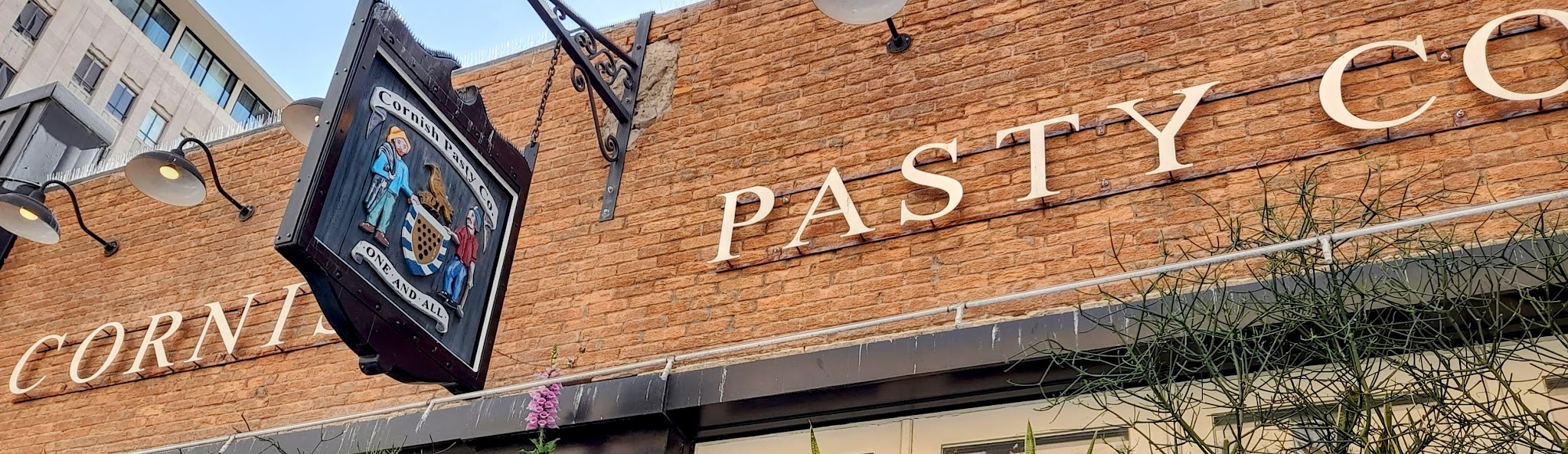
A couple of days ago I was in my Phoenix 'local' Seamus McCaffrey's Irish Pub, not in the least tempted by the pub opposite, the Cornish Pasty Company

But yesterday after a long day at the Convention Centre I fancied a quick snack, so strolled down Monroe Street to sample an Arizona pasty, preparing for a friendly smirk.

The pub itself was empty and the decor very basic, but I chose a pint of local ale, from a bewildering array of brews, which turned out to be very drinkable, so I ordered a traditional pasty, the latent smirk beginning to develop.

Soon I was joined by two young metallurgists from FLSmidth, Gaurav Soni from Colorado and Himesh Patel from Utah. Gaurav was in Falmouth for Physical Separation '17 but didn't try a pasty and Himesh, prior to joining FLSmidth, had worked with Freeport-McMoRan, whose impressive HQ could be seen from the pub. He said that he had been a regular in the pub as the pasties were excellent. He then proceeded to order a chicken tikka masala pasty. A chicken tikka masala Cornish pasty! My smirk was preparing to erupt.

My traditional pasty arrived. It looked very good so I took a bite and my dormant smirk immediately dissipated. The previous two and a half thousand pasties paled into insignificance as this was without doubt the best that I have ever tasted! And over 5000 miles from Cornwall! However I did discover that the pub was opened in 2005 by a Cornishman.

The moment of revelation with Gaurav and Himesh

I am at last warming to Phoenix, particularly Monroe Street with its two (at least) excellent pubs, Sean McCaffrey's Irish pub, and immediately opposite, the Cornish Pasty Company. I'm looking forward to being back again in four years time!

Sunday, 25 February 2024

Sunday in Phoenix

I arrived in Phoenix last night after an 11 hour flight from London. For once everything went to schedule including, remarkably, the trains from Falmouth to Heathrow.

Due to the seven hour time difference I was up very early this morning and after breakfast ventured out into a very balmy downtown, the temperature similar to a good summer day in Cornwall.

The short walk from my hotel took me to the Phoenix Convention Centre, where not surprisingly at 7.30 in the morning the registration area for MINEXCHANGE2024 was very quiet.

After completing registration I called in at the SME Bookshop to say hello to Theo Warrior and Melissa Serdinky and to see what the latest mineral processing offerings are this year.

Melissa and Theo

Tailings Case Studies: Real-World Lessons in Tailings is edited by Kimberly Finke Morrison, Senior Director for Global Tailings Management at Newmont Corporation, USA.

Basic Cyanide Chemistry: a simple guide for gold and silver leaching by Michael Botz equips readers with basic knowledge about cyanide's interactions with gold, silver, and other metals, enhancing understanding of these processes and their influence on leach solutions and ore processing.

Leaving the convention centre I strolled around downtown passing by Heritage Centre, an historic site anchored by the Rosson House, a fully-restored 1895 Queen Anne Victorian house, now a museum which interprets the history of Phoenix. 

Passing by the convention centre again I had coffee with Kriss Waters and Alex Doll. Kriss is the Canadian Editor for Minerals Engineering and Alex, Principal Consultant with Alex G Doll Consulting Ltd, has agreed in principle to present a keynote lecture at Comminution '25 in Cape Town next year.

With Kriss and Alex
I met up with Kriss again a couple of hours later for lunch at the ever excellent Seamus McCaffrey's Irish Pub on Monroe Street, not in the least being tempted by the restaurant opposite!

Then it was back to the hotel, a quick change and back to the convention centre for the opening reception for the exhibition, the start of MINEXCHANGE2024.