Thursday, 4 April 2019

We welcome Outotec to Comminution '20

It is good to have Outotec as a sponsor once more of our comminution series of conferences. They are sponsoring for the 4th time since Comminution '14, and now become the 16th company sponsoring next year's Comminution '20 in Cape Town.
Current Comminution '20 sponsors
We are proud to be associated with Outotec, which, at the beginning of 2019, was ranked 12th in the Global 100 Index of the most sustainable companies in the world, being included in the Index for the seventh consecutive year. The giant international company is also a sponsor for Physical Separation '19 in Falmouth, and Flotation '19 in Cape Town.
Updates on these events are at #PhysicalSeparation19, #Flotation19 and #Comminution20.
Twitter @barrywills

Monday, 1 April 2019

Strange happenings in East Cornwall

Reports are coming in of a strange illness which is affecting a number of people in the Bodmin area of East Cornwall. The symptoms, of loss of energy, insomnia and pallor, are apparently similar to those of acute anaemia, which is usually associated with heavy blood loss. However one theory is that it may be due to release of a pocket of radon gas from one of the many old mine workings in the area.
Radon is a chemical element with symbol Rn and atomic number 86. It is a radioactive, colourless, odourless, tasteless gas. It occurs naturally in minute quantities as an intermediate step in the normal radioactive decay chains through which thorium and uranium slowly decay into lead and various other short-lived radioactive elements; radon itself is the immediate decay product of radium. Its most stable isotope, 222Rn, has a half-life of only 3.8 days, making it one of the rarest elements since it decays away so quickly. However, since thorium and uranium are two of the most common radioactive elements on Earth, and they have three isotopes with very long half-lives, in the order of several billions of years, radon will be present on Earth long into the future in spite of its short half-life, as it is continually being generated. The decay of radon produces many other short-lived nuclides known as radon daughters, ending at stable isotopes of lead.
Unlike all the other intermediate elements in these decay chains, radon is, under normal conditions, gaseous and easily inhaled and is considered a health hazard. It is often the single largest contributor to an individual's background radiation dose, but due to local differences in geology, the level of the radon-gas hazard differs from location to location. It is known to occur at a relatively high level in parts of Cornwall due to the relatively high amount of uranium in the granite which underlies the whole county at various depths.
But could radon gas account for the strange symptoms suddenly manifesting themselves in this locality? I sought the opinion of Dr. Richard Head, the Director of the nearby Bodmin Institute, but unfortunately he was not available. His secretary told me that, since returning from a recent geological trip to the Carpathian Mountains in Romania, he has not been seen during office hours, and has been working in his office through the night on a large soil sample which was delivered in what she described as a long and narrow rectangular box.
So I spoke to my brother, Bartholomew, who is back at the Bodmin Institute after a brief spell with MEI. He is as much perplexed by this outbreak as others, but tells me that a specialist consultant from Denmark, Prof. Elvan Singh, who apparently has had experience of similar outbreaks, will be coming over to Cornwall soon to investigate. Meanwhile Bartholomew appeals to anyone reading the blog who might be able to shed light on this very strange occurrence.

Sunday, 31 March 2019

A great buzz about Cornwall at the CSM Annual Dinner

Around 350 Camborne School of Mines old boys and girls, current students, and a few past and present members of staff attended last night's Camborne School of Mines (CSM) Annual Dinner at the Falmouth Hotel.
I'm always amazed at how many of the alumni travel from as far away as Australia to be at this event, a testament to the pride and loyalty that they have for CSM. I wonder if alumni from other great mining schools have the same sense of allegiance? I certainly feel nothing like this for my alma mater, Leeds University. 
Last night there was a general buzz about the resurgence of the mining industry, particularly regarding the renaissance which is taking place in this great old mining province of Cornwall. The guest speaker was Vancouver-based Richard Williams, CEO of Strongbow's South Crofty Project. He spoke not only of the reopening of the old South Crofty tin mine, but also the great potential of the Redmoor Sn-W-Cu project, and Cornish Lithium's search for lithium in the hot geothermal brines lying deep within and around the Cornish granite (more in the posting of 27th February). Richard highlighted that tin has now become "the glue which holds the hi-tech world together".  He is photographed below with Nick Clarke (CSM graduate 1974), and Nick Wilshaw (1980).
Nick Clarke, Nick Wilshaw, Richard Williams and me
There are now some dynamic mineral processing companies in Cornwall, and none more so than Nick Wilshaw's rapidly expanding Grinding Solutions Ltd (GSL). Now familiar faces at all MEI Conferences - they are regular sponsors of the comminution series-  Managing Director Nick and his wife Flee, a fellow Director of GSL, are actively involved in all areas of mineral processing. In the last few months they have added to an already extensive leaching capability and commissioned a new versatile comminution rig which can be used for a range of tests including the DRA Grindmill Test. Flash flotation and further gravity separation kit are also arriving soon. Nick was recently appointed as a Director of Australian-based Coalition for Eco-Efficient Comminution, an industry advocate for MEI's Comminution '20 conference in Cape Town and the Cornwall-based Physical Separation '19 and Sustainable Minerals '20 conferences.
It was also great to see Peter Hackett last night. He was Principal of CSM for most of my 22 years at the School, and he is photographed below with GSL's Flee Wilshaw and past graduate Pete Taylor.
As always, a wonderful evening, and many thanks to Chris Kitchen of the CSM Association for outstanding organisation.
Twitter @barrywills

Thursday, 28 March 2019

MEI joins forces with IMFORMED

We are pleased to announce a collaborative initiative with IMFORMED, a UK company providing, like MEI, a source of information, research, and networking events for the industrial minerals business, which includes mineral processing as a major sector.
Four years ago Mike O’Driscoll, former Editor, then Global Head of Research, at Industrial Minerals magazine, launched IMFORMED with Ismene Clarke, former Head of Sales at Industrial Minerals magazine. Very much like MEI, IMFORMED also organises international conferences and the collaborative media partnership will actively promote the respective conferences.
MEI is currently acting as media partner for IMFORMED's Rendezvous 2019 conference, while IMFORMED is a media partner for Physical Separation '19, Flotation '19 and Comminution '20.

Sunday, 24 March 2019

Summer and winter hiking in Switzerland's Jungfrau Region

We are back in Cornwall after a great week hiking in Switzerland's Jungfrau Region. We have been there a number of times, skiing in winter and hiking in summer, but this was our first time hiking in winter, and ironically it was a lot harder than skiing, which we have given up due to wear and tear!
So beautiful is this region that it has inspired me to write a short travelogue for the benefit of blog readers who might wish to visit this area, a jewel in the Swiss Alps, but a very expensive one- expect to pay roughly twice the price you would pay in UK for drinks, meals etc.
We made full use of our non-ski passes, which gave us unlimited access to the major cable cars and the superb Wengernalp mountain railway, which runs between the villages of Lauterbrunnen and Grindelwald, via Wengen and the Kleine Scheidegg, a mountain pass between the Lauberhorn and the Eiger. This must surely rank as one of the world's greatest short rail journeys, despite the train being 3 seconds late one day!
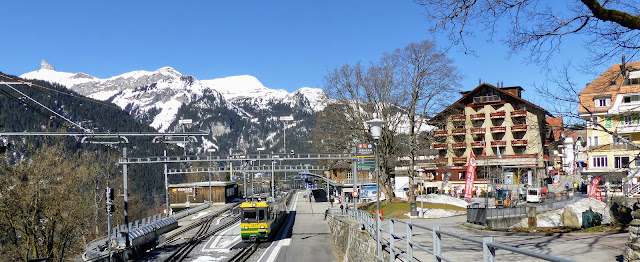
Wengen Train Station
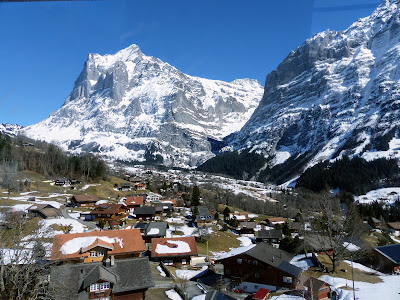
We were based in Wengen, famous for its views of the  4158m Jungfrau, and for the Lauberhorn, the longest of the World Cup downhill skiing events.
Wengen, Switzerland, Bernese Oberland
Wengen, with the Jungfrau on the left
 
If you are into hiking, then these are our favourites of the many routes available, with photos taken last week and also on our summer visits.
Mannlichen to the Kleine Scheidegg pass
The cable car in the centre of Wengen (1274m) whisked us up to Mannlichen (2343m) and the start of a wonderful 6km hike to the Kleine Scheidegg (2061m), which took us two and a half hours last week in the snow along the well-groomed walking trail. The mountain views are spectacular, and arriving at Kleine Scheidegg, a cold beer at the 19th century Hotel Bellevue des Alpes, at the foot of the north face of the Eiger, was more than welcome.
Mannlichen to Kleine Scheidegg, Bernese Oberland, Switzerland
Kleine Scheidegg, Bernese Oberland, Switzerland
Kleine Scheidegg
Skiing, 1961
From Kleine Scheidegg you can travel by an amazing rail journey through a tunnel cut in the early 1900s through the Eiger and Monch to Jungfraujoch,  a saddle at 3466 m connecting the highest peaks in the region, the Monch and the Jungfrau. The railway station is the highest in Europe, and it was at Jungfraujoch that I firsted skied, in 1961, during my school's visit to nearby Interlaken. It would be 29 years before I skied again!
The first station en route from Kleine Scheidegg to Jungfraujoch, Eigergletscher, is the beginning of the famous Eiger trail, open in the summer months, a moderately difficult 6km hike along the base of the north face of the Eiger.
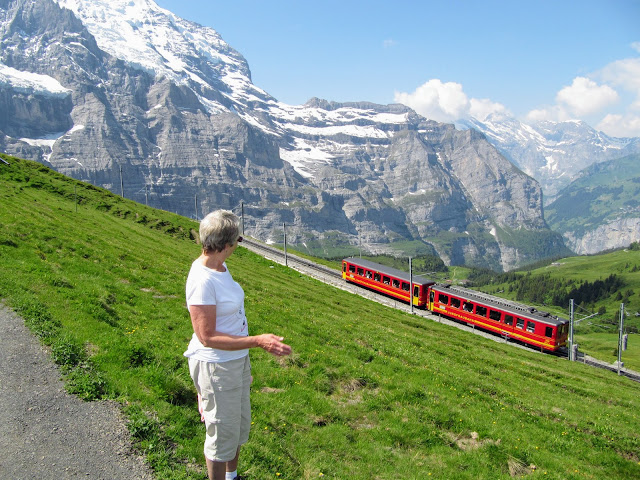
Jungfraujoch train, Bernese Oberland
En route to Eigergletscher, summer 2010
Eiger trail, Bernese Oberland, Jungfrau region, Switzerland
Eiger trail, 2010
Eiger trail, Bernese Oberland, Jungfrau region, Switzerland
Eiger Trail, 2010
Although Mannlichen to Kleine Scheidegg is not a long walk, it was quite tough in the snow, and ski poles are recommended in winter. We decided to take the train back to Wengen, rather than the long walk back which we did in the summer of 2010: 
Kleine Scheidegg to Wengen walk, Bernese Oberland, Switzerland
The Wasserstation tunnel, one of the most frightening parts of the World Cup Lauberhorn ski run,
where the racers pass under the tunnel at around 100 km/h
 
Above Grindelwald
Grindelwald, Bernese Oberland, Switzerland
Grindelwald
The village of Grindelwald is, at 1034m, the terminus on the train line from Lauterbrunnen. In the summer of 2010 we took the cable car to Pfingstegg, then had a gruelling 2 hour walk to Baregg, with its great views of the rapidly receding Schreckhorn glacier. 
Last week we took the long gondola ride to First (2167 m), and then the undulating 6km hike to Lake Bachalpsee, an easy walk in summer, but a bit more demanding in the winter snow, especially in the downhill sections. 
First to Lake Bachalpsee, Grindelwald
There is little evidence of a lake in winter, but in summer this is one of the most photographed lakes in the alps, with its backdrop of the sharp jagged peaks of the Wetterhorn, Schreckhorn and Finsteraarhorn.
By the shore of Lake Bachalpsee
Lake Bachalpsee, Switzerland
From the lake the path leads to the Faulhorn (2681m) and then on to Schynige Platte. Unfortunately the 16km trail from First to Schynige Platte, one of the great alpine hikes, is only open in summer as the cog railway from Schynige Platte down to Wilderswil does not operate in winter. 
Schynige Platte, Switzerland
Looking down on Lake Brienz from Schynige Platte, 2010

Lauterbrunnen and Murren
The cogs on the cog railway really come into play on the steep descent from Wengen to the little village of Lauterbrunnen, but when snow free there is also an easy 1km walk down to the village. 
Walking from Wengen to Lauterbrunnen, 2002

Lauterbrunnen, Bernese Oberland, Switzerland
Lauterbrunnen
The Lauterbrunnen Valley is a geologists dream. Thick beds of Jurassic limestone were deposited as calcareous mud around 140 million years ago, and the Alps began to form about 35 million years ago, when the African tectonic plate forced its way into the more stable tectonic plates of Europe and Asia. These mighty tectonic forces twisted and contorted the rocks, which have been exposed in the steep walls of the valley, which were carved out by glacial action during the last ice age.
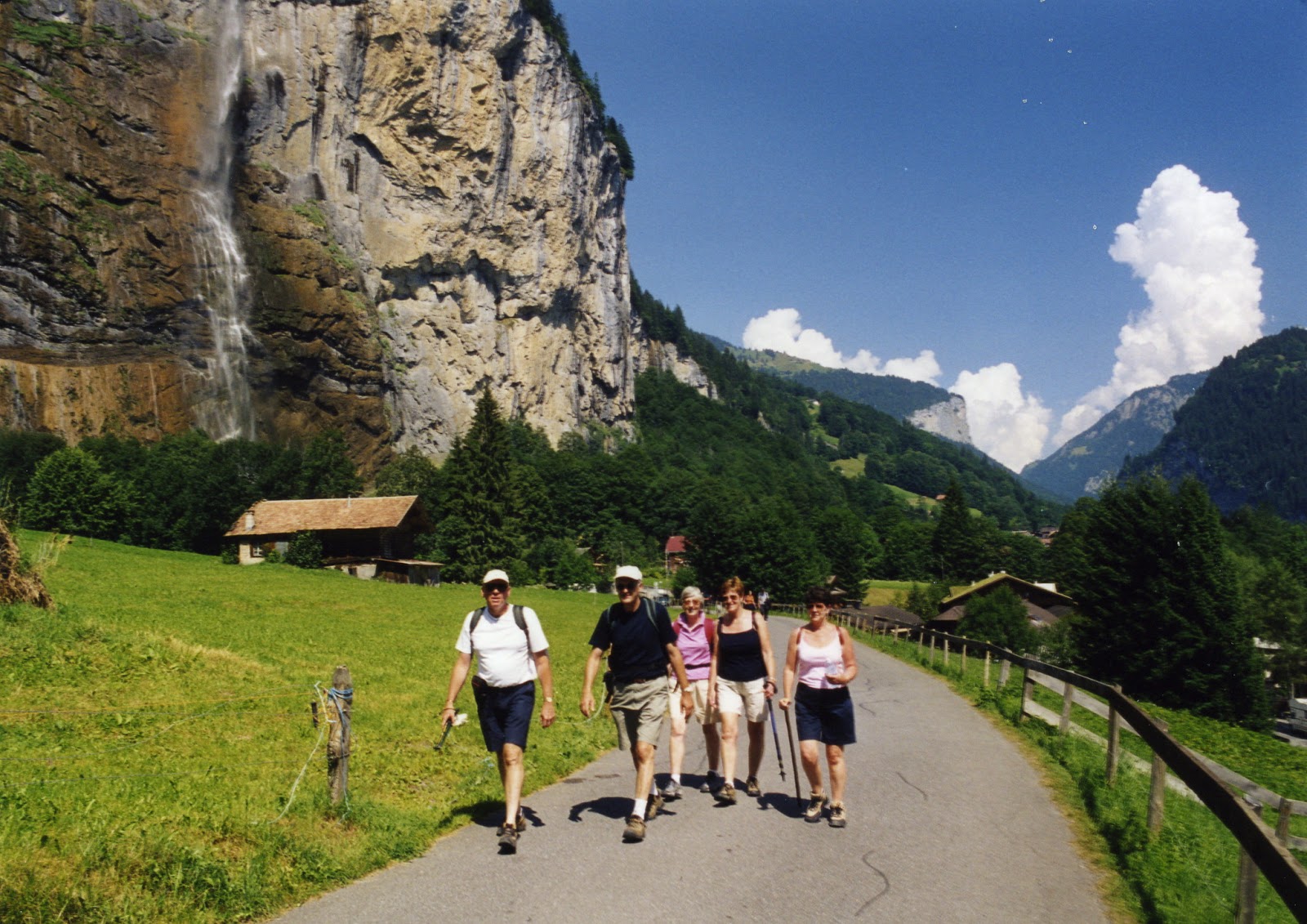
The walk through the valley to the Trummelbach falls is an easy 3km in summer and winter. It is a valley of 72 waterfalls, falling from the 450m walls, the most famous being the Trummelbach Falls, which are fed by glacial waterfalls inside the mountain. The Trummelbach drains the glaciers of the Eiger, Monch and Jungfrau mountains and carries 20,200 tonnes of eroded sediment per year. Trummelbach is a series of ten waterfalls inside the mountain made accessible by a tunnel-funicular and stairs, built 1913, which is open only in the summer months. 
Walking in the Lauterbrunnen Valley, 2002
The Trummelbach Falls
Just opposite Lauterbrunnen station is the cable car up to Grutschalp, which is 6.5 km from Murren, either by a regular mountain train, or via an easy walking trail affording spectacular views of the Eiger, Monch and Jungfrau.
Grutschalp to Murren, Bernese Oberland, Swizerland


Grutschalp to Murren, Bernese Oberland, Swizerland
Grutschalp to Murren
Murren, Bernese Oberland, Swizerland
Murren
The tiny village of Murren is within touching distance of the Jungfrau, but is famous for being at the foot of the Schilthorn (2970m), the location for the 1969 James Bond film On Her Majesty's Secret Service. If you are a Bond fan then you may wish to join the long queues for the two cable cars which take you up to the summit, and Piz Gloria, the revolving restaurant which, during its construction in 1968 was used as the HQ of the evil SPECTRE organisation in the movie.
Piz Gloria, Schilthorn
Apart from the spectacular views there is also an exhibition of the making of the movie, and the impact that it had on the small Murren community.
Schilthorn, Murren, Switzerland
Panoramic views from the Schilthorn
Interlaken
The town of Interlaken is the gateway to the Jungfrau region, and it is worth spending a few hours in this town of elegant Victorian hotels, situated between two large lakes, Thun to the west and Brienz in the east. On our final afternoon last Friday, we took the train from Lauterbrunnen to Interlaken Ost, and then strolled along the bank of the River Aare, which separates the two lakes. 
And then back to Wengen to enjoy the last view of sunset on the Jungfrau. 
In summary, although the winter hiking is good it does not compare with that in summer, where there are more options available, such as walking down wide alpine meadows, many of which are winter ski runs. 
So for any MEI Conference delegate wishing to do something special in Europe after, hopefully, spending some time in Cornwall, I would thoroughly recommend June or July in Switzerland's Jungfrau region of the Bernese Oberland.
There are many tour operators who can help you travel to the region. We chose the excellent Inghams. We travelled by train from Falmouth to Bristol (Temple Meads) and flew from Bristol to Geneva, where the Inghams coach transferred us to Lauterbrunnen, and the short train journey to Wengen. Our accommodation in Wengen was at the impressive Beauside Park Hotel, looking down on the village and the backdrop of the Jungfrau. Returning to Bristol, the train to Taunton will take you to the main line back to London.
If this posting persuades you to visit this wonderful German speaking area of Switzerland, please share your experiences via comments on this posting. Enjoy your visit. I'm sure you will.
Twitter @barrywills

Friday, 22 March 2019

Recent comments

There have been comments on the following postings since the last update:

The importance of mineral processing: the message just isn't getting through
Should journal reviewers be rewarded for their efforts?
Ying Gu, 1956-2019
The MEI Blog: 10 years old today
Chris Rule to present keynote lecture at Comminution '20
SME Annual Meeting 2019, Denver: mineral processing aspects
Cornwall's submarine mines
Prof. Frances Wall receives prestigious award
Froth Flotation. Why is it still so intensively researched?
In conversation with IMPC chairman Cyril O'Connor

We welcome your comments on blog postings. If you do not have a Google account, the simplest way to add a comment is by selecting 'anonymous' as your profile, but please leave your name and affiliation in the comment. Alternatively, email your comment directly to bwills@min-eng.com.

If you would like to be alerted to postings, submit your email address via the box in the right hand column of the blog.