Last year's Annual SME Meeting in Minneapolis was a fairly low-key SME event, with 5083 delegates. Many people forsook Minneapolis for various reasons, but last year I felt that the mining industry was waking from its long slumber, so that we might expect a record turnout this year in Denver, the home of the SME. I may have been a little premature, however, as the prices of base metals over the past 12 months attests (source InfoMine).

In 2017 there were 6300 delegates in Denver and in 2015 a record 7800. I looked forward to a larger than usual mineral processing presence this year due to the associated International Symposium to celebrate the 90th birthday of Prof. Douglas Fuerstenau. Because of this I did have a bit of an agenda this time, but for the most part I just wandered round the huge convention centre and exhibition, bumping into whoever appeared on the horizon.
It is impossible for an individual to produce a comprehensive report on an SME Annual Meeting, so the following is my diary of this major international minerals industry networking event, which took place February 24th to 27th at the Colorado Convention Centre, merely random snapshots of the many things taking place.

Sunday February 24th
Although various courses and committee meetings have been taking place since yesterday morning, the SME Meeting really began in earnest late afternoon today, when the exhibition hall was opened for a couple of hours. First impressions were encouraging, as there seems to be more people wandering around the huge number of booths than on previous Sunday afternoons.

Although Prof. Alban Lynch has been involved with hydrocyclones for very many years, in his conversation with me he said that "the way they are used now is an absolute nonsense, with circulating loads in some cases of well above 200%. The future is high frequency screens.....it is very clear that these screens are so much better than hydrocyclones."
By classifying by size-only, screens, compared to hydrocyclones, give a sharper separation with multidensity feeds and reduce overgrinding of the dense minerals. Derrick Corporation is the leader in this field and will be sponsoring an MEI Conference for the first time at Comminution '20, so it was good to drop by their booth to meet the USA team.
 |
| Baojie Zhang, David Perkins and Andrew Cavender, of Derrick Corporation, with Eric Ballinger of CSN, Brazil |
Canadian company Starkey & Associates is also a Comminution '20 sponsor, and John Starkey and his colleague, Spencer Reeves, are familiar faces at SME Meetings. Starkey & Associates Inc. is well known in the minerals industry, being a world leader in SAG mill design. Sacré-Davey Engineering is perhaps not so well known, the company having a high profile in mine design, but last year Sacré-Davey announced the expansion of its engineering and project management services by joining forces with Starkey & Associates, the Sacré-Davey team from Toronto moving to the Starkey & Associates Offices in Oakville, with John Starkey heading the office group as Chief Metallurgist for Sacré-Davey Engineering. I was pleased to call in at their booth to be introduced to Sacré-Davey representatives Alan Humber and James Scobbie, who were talking to Steven Bergounhon, of Lincoln Strategic, Canada.
 |
| Steven, Spencer, Alan, John and James |
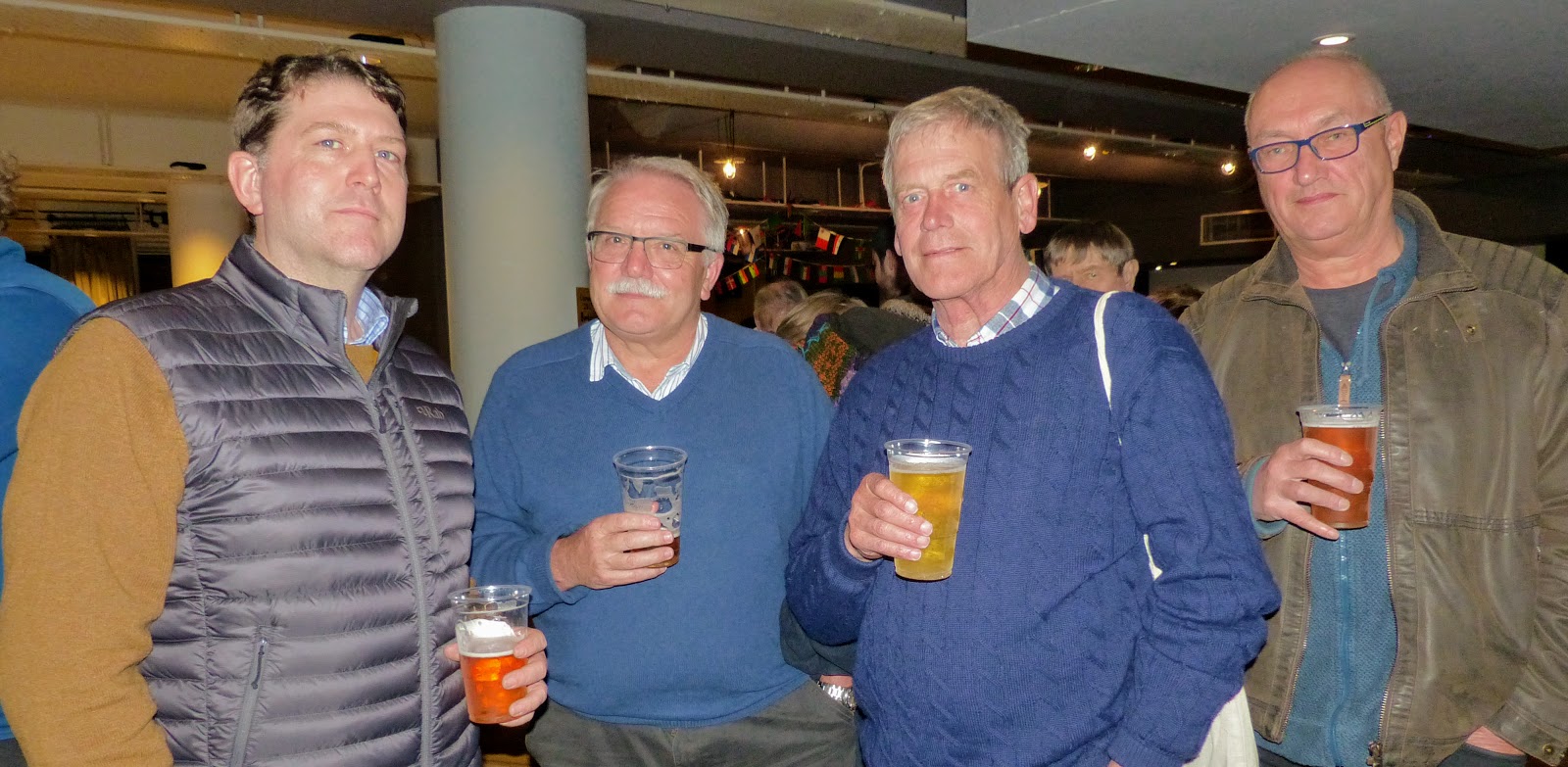
Nice to catch up with 5 delegates from UK, who were on the same BA flight as me yesterday. International Mining is a media partner for all MEI Conferences, and editor Paul Moore and his colleague Phil Playle are regulars at SME. This year they were joined for the first time by fellow editor Daniel Gleeson. I photographed them in the International Mining booth with Carly Leonida and Mike O'Driscoll.
Carly is currently Editor-in-Chief of Mining Magazine, but is leaving in April to go solo as a free-lance mining journalist. I look forward to following her progress on her blog, The Intelligent Miner.
Mike O’Driscoll was former Editor, then Global Head of Research, at Industrial Minerals magazine, and 4 years ago he and Ismene Clarke, former Head of Sales, at Industrial Minerals magazine, launched IMFORMED, a new source of information, research, and networking events for the industrial minerals business, which includes mineral processing as a major sector. Very much like MEI, they also organise international conferences and MEI is pleased to have entered into a collaborative media partnership with IMFORMED, where we actively promote the respective conferences.
 |
| Mike, Carly, Daniel, Paul and Phil |
Moving on, I was lucky to catch the Eriez team. Long time Eriez veteran, Jose Marin (3rd right) was in attendance and showcasing Eriez’ high-gradient dry vibrating magnetic filters, which are used extensively throughout the industry to generate high-purity mineral products such as silica or lithium. Also Mike Mankosa (2nd left) and Jaisen Kohmuench (left) were present and discussing the successful deployment of Eriez’ StackCell flotation technology into the non-coal mineral markets. Recently, a full-scale StackCell was installed in Western Australia for the recovery of nickel while another unit will be commissioned later this year for the recovery of rare earths. I look forward to hearing more on this in Cape Town in November, as Eriez Flotation Division is a sponsor of Flotation '19.

It was great to hear that Jaisen, Senior Director of Asia-Pacific Operations and Strategy, will be presented with the Frank F. Aplan Award at the SME banquet on Wednesday. Established in 1989, the Frank F. Aplan Award recognizes engineering or scientific contributions that further the understanding of the technology of coal and/or minerals engineering. According to SME Executive Director David L. Kanagy, Jaisen was selected as the 2018 recipient of this prestigious award based, in part, on his exceptional contributions to applied research, engineering development and commercial deployment of advanced flotation technologies.
Finally, on leaving the hall, I was pleased to be greeted by 5 delegates from the China University of Mining & Technology.
Finally, on leaving the hall, I was pleased to be greeted by 5 delegates from the China University of Mining & Technology.

Monday February 25th
Judging by the long queue at Registration this morning, this could well be a record attendance this year, and the exhibition area was also a hive of activity.


Many of the exhibitors have large teams this year, including Clariant, one of the sponsors of Flotation '19. Clariant has developed HOSTAFLOT collectors, as alternatives to conventional xanthates, with safer handling and disposal, as they are delivered in bulk liquid form, eliminating the need to dispose of contaminated packaging.

It was great to spot Cyril O'Connor, President of the International Mineral Processing Council (IMPC), who was with President-Elect Ralph Holmes, of CSIRO, Australia, and Janine Herzig, President of the AusIMM, and one of only two women to ever be AusIMM President since its formation in 1893. Ralph takes over from Cyril at next year's IMPC Congress in Cape Town.
 |
| Ralph, Janine and Cyril |
I then had a quick chat with Steve Fiscor, Publisher and Editor-in-Chief of Engineering & Mining Journal, and Regional Sales Manager Vic Matteucci.
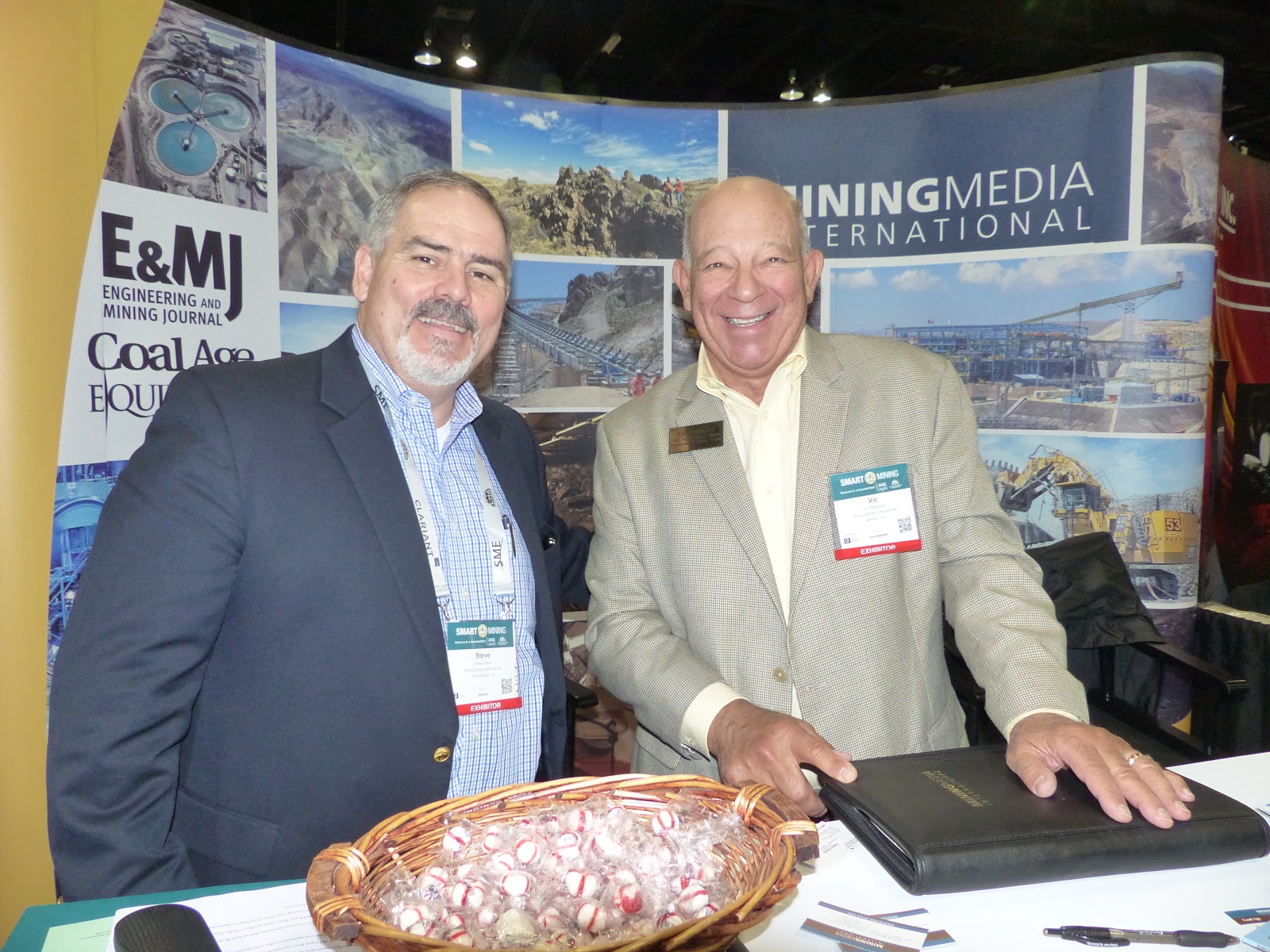 |
| Steve and Vic |
It's always good to call in at the RSG Inc booth, to talk to my old friend and fellow northerner Chris Martin, who was with Chris Bean of The Quartz Corp, USA.
Chris's RSG Inc is an Alabama based manufacturer of milling and classification equipment, which closed 2018 with record sales. Projects include ultrafine calcium carbonate, fly ash, zinc metal powder and wet quartz milling in a 90kW wet ball mill rated for 5 tph at 150 microns. Chis tells me that 2019 has started well, with orders for hydrated lime, kaolin clay and fly ash ultrafine products.
 |
| Chris Martin and Chris Bean |
Nouryon may be an unfamiliar name, but the well-known former AkzoNobel Specialty Chemicals was relaunched as Nouryon a few months ago. The move follows the acquisition of the business by The Carlyle Group and marks the company’s transition to becoming an independent, global specialty chemicals leader. We are pleased to have Nouryon as a sponsor of Flotation '19, and I called by their booth, where representatives were talking to Joshua Werner (3rd left) of the University of Kentucky, Osvaldo Bascur, of OSIsoft, USA and Hamid Manouchehri, of Sandvik, Sweden.

FLSmidth, a regular sponsor of MEI Conferences, recently entered into an agreement with AuTec Innovative Extractive Solutions, a subsidiary of Barrick Gold Corporation, for the purchase of the hydrometallurgical and mineral processing capabilities of AuTech by FLSmidth (MEI Online). Peter Flanagan of FLSmidth made a special announcement and presentation from the FLSmidth stand, aided by his colleague Kallen Konen, and Noelene Ahem of AuTec, Canada.
 |
| Kallen, Peter and Noelene |
In the large audience I spotted two well known mineralogists, Hanna Horsch, of Hazen Research, USA, and Paul Gottlieb, of Tescan USA Inc.

And then I headed straight for the Press Room for the official launch of the new SME journal Mining, Metallurgy & Exploration, which replaces and broadens the scope of the original Minerals & Metallurgical Processing (MMP). The new journal will be published by Springer Nature, and the first issue is dedicated to Prof. Douglas Fuerstenau on the occasion of his 90th birthday.
 |
| The new journal's Editorial team with Prof. Fuerstenau. L to R: Jim Gebhardt, Ronel Kappes, Douglas Fuerstenau, Barb Arnold (SME President), Mary Poulton, Chee Theng, Jurgen Brune, Virginia McLemore |
 |
| SME President Barb Arnold presents a commemorative plaque to Jim Gebhardt, the first edition guest editor |
Dr. Jaime Sepúlveda was the recipient of the Robert H. Richards Award, which was established in 1948 to recognise achievement in any form that unmistakably furthers the art of mineral beneficiation in any of its branches.
In 1986, Jaime joined Moly-Cop, where after 28 years, he reached the position of Global Technical Leader. In 2014, he created J-Consultants Ltd., specialising in the design and optimization of mineral comminution and concentration processes. Jaime’s award citation reads: “For contributions to the advancement of comminution, support of research and education, and development of open-access, industrially accepted simulation tools (Moly-Cop Tools) for improving and optimizing grinding circuit efficiency.”
Dr. Kathryn Sole was recipient of the Milton E. Wadsworth Award, which was established in 1992 to recognise distinguished contributions that advance our understanding of the science and technology of nonferrous chemical metallurgy. Kathy’s award citation reads: “Dr. Sole has made a significant impact on the development and practice of solvent extraction. Her academic contributions at the University of Arizona significantly improved the fundamental understanding of SX processes, and resulted in high impact publications.”
After gaining much valuable experience at Mintek and Anglo American in South Africa, Kathy now consults independently, mainly in the areas of solvent extraction, ion exchange, and electrowinning of base and precious metals for hydrometallurgical applications. She currently chairs the SAIMM's Copper Cobalt Africa conference series and serves on the editorial boards of two journals.
 |
| Kathy and Jaime |
After Jaime and Kathy had presented their awards lectures, Dr. Seyed Hassan Amini was presented with the Rong Yu Wan Dissertation Award, by Nick Gow, a member of the MPD Scholarship Award Committee. Hassan is a postdoctoral associate at Virginia Tech, and the award was for his dissertation on "Optimisation of mineral processing circuit design under uncertaincy."
 |
| Nick and Hassan |
Prof. Douglas W. Fuerstenau then presented a fascinating keynote lecture, as a prelude to the Special International Symposium to Honour his 90th Birthday, describing his “Seven Decades as a Mineral Engineer: From the Black Hills to Butte, Boston, Berkeley and Beyond,” and Barb Arnold, SME President, then presented him with a special plaque from SME and the International Mineral Processing Council to commemorate this event. Prof. Fuerstenau is one of the great names in mineral processing, and I had the pleasure of interviewing him in 2015 for MEI.

Prof. Cyril O’Connor, President of the IMPC, thanked the SME for giving him the opportunity to present personally award trophies and scrolls that the IMPC announced at the time of the 29th International Congress in Moscow last September, at which time unfortunately the recipients of these prestigious awards were unable to be in attendance due to problems associated with long-distance travel. These awards represent the very highest achievements that the IMPC recognises in terms of contributions to mineral processing.
The 2018 Distinguished Service Award (DSA) was presented to Prof. Douglas Fuerstenau. It is also noteworthy that he becomes the first person in the history of the IMPC Congresses, which go back to London in 1952, to be awarded both the Lifetime Achievement Award as well as the DSA. After the presentation I was honoured to be invited to join Cyril and Doug for a photo of the present and former recipients of this Award. Humbling to think that Doug and I are the only living recipients of the award.
 |
| Prof Fuerstenau and me, with IMPC President-Elect Ralph Holmes, and Cyril O'Connor |
The second award, the Lifetime Achievement Award (LAA), recognises a lifetime of distinguished achievement and outstanding contribution to the advancement of the art, science and industrial practice of mineral processing, together with participation in and contribution to IMPC Congresses. The 2018 LAA was presented to Prof. Jan Miller, of the University of Utah. His research achievements include outstanding contributions in the field of flotation and the surface chemistry associated with this process, particle/particle interactions and particle/bubble interactions, fine particle flotation, grinding/liberation analysis, the flotation chemistry of non-sulfide and fossil energy minerals, the application of X-ray microtomography to mineral liberation analysis, atomic force microscopy, the development of lithium-ion batteries, just to highlight a few aspects of his broad spectrum of research interests. Following the presentation there was another photo-call with former recipients of the LAA.
 |
| Ponisseril Somasundaran (2016), Graeme Jameson (2016), Cyril O'Connor (IMPC Chairman), Doug Fuerstenau (1995), R.-H. Yoon (2014), Jan Miller, Janusz Laskowski (2008) and Ralph Holmes (IMPC President-Elect) |
 |
| Profs. Miller and Fuerstenau with the beautiful awards donated by the Moscow IMPC Congress Committee |
It was good to see so many well known mineral processors from around the world in the audience, including Profs. Kari Heiskanen (Finland), Zhenghe Xu (China) and Jim Finch (Canada).

But it was particularly good to see Doug Fuerstenau with his wife Peggy and son Stephen.

And if all that wasn't enough excitement for one day, I then rushed off to the Hyatt Regency Hotel for the official launch of the new SME Mineral Processing Handbook.
This is the result of the endeavours of six years of intense work by the authors, reviewers, editors, and SME book publishing team, photographed below.
It is a truly mammoth effort, as the work is in two volumes of 2,312 pages, with 128 chapters. Each chapter is authored by an acknowledged expert, recruited by the editors, and each made an invaluable contribution. It was nice to know that two of my old Camborne School of Mines students contributed chapters. Dave Meadows, of Bechtel Mining & Metals, USA, I see at every SME, but Ted and Claire Bearman, of Bear Rock Solutions, Australia, I have not seen since Comminution '12, where Ted presented a keynote paper. He contributed three chapters on crushing to the new book.
 |
| Komar Kawatra, Jane Olivier, John Marsden, Diane Serafin, Rob Dunne, Karen Ehrmann, Terese Platten, Courtney Young |
 |
| Ted, me, Claire and Dave |
A relaxing day planned today, with no agenda other than to stroll around the exhibits and see what transpires. As always I will avoid the technical sessions. The Fuerstenau Symposium starts this morning but is in parallel with other MPD sessions, on Physical Separation, Plant Design, Hydrometallurgy and Flotation Chemistry. So it would be unfair of me to comment on any individual papers, but invite comments if you feel that any particular paper is worthy of note.
Adam Johnston, Chief Metallurgist at cancha, Peru, regularly contributes to discussions on the blog, so it was good to talk to him about cancha's geometallurgy software, an integrated solution for geomet sample selection, result interpretation, prediction modelling and reporting (MEI Online). We are photographed below with Stuart Smith of Metifex, Australia.
 Moving on I stopped to say hello to Nikhil Gupta and Serhat Keles, of Virginia Tech.

 |
| Nikhil and Serhat |

 |
| Eric, Swadhin and Steven |

Bill is pictured left on the photo below, with his colleagues Steve Stewart (2nd left) and Pat Cleaves (right). 3rd left is Peter Jansson, Technology Manager for Magnetic and Gravity Equipment at Outotec, USA. Outotec is a sponsor of Physical Separation '19, as well as Flotation '19.


Wednesday February 27th
Time for another short stroll around the exhibition, which closes at mid-day, before my flight back to London. It was vey quiet, as expected, but I did manage to catch up with a few people to say farewell, including the redoubtable Jane Oliver in the SME Bookstore.
Also good to see Nick Hazen, President of Hazen Research, USA, and some of his team. Hazen is an industrial research and development company, specialising in the mining, chemical, energy and environmental industries worldwide. The core business is performing and interpreting experimental work to provide design criteria and other technical information for new and existing processes. I'll bet that Nick doesn't remember that Hazen was the sole sponsor of Minerals Engineering '94 in Lake Tahoe a quarter of a century ago!
Last, but not least, I had a pleasant chat with Mining Engineering students from the "other CSM". Colorado School of Mines, situated in nearby Golden, was last year ranked world number 1 by the QS Rankings of Minerals & Mining Universities.
 |
| Nick Hazen (2nd left) with some of his team |


Last year there was optimism of a resurgence in the mining industry, but unfortunately it did not happen. This year there has been a strong general feeling that we are at the beginning of a revival, and recent base metal prices do indicate some signs of recovery, but only time will tell.
 |
| Last month's base metals prices (InfoMine) |
Twitter @barrywills