Saturday, 14 March 2015

Student reunion after 35 years

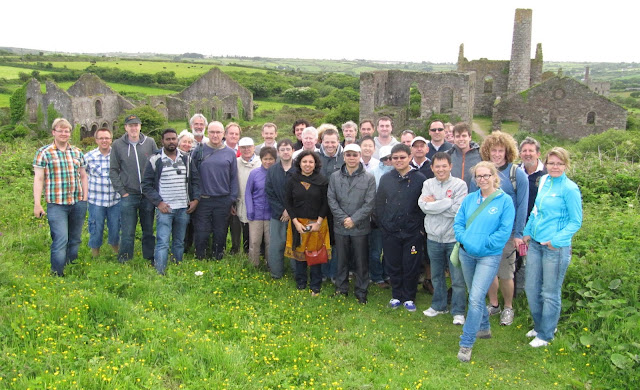
Barbara and I were privileged last night to be invited to the reunion of CSM's class of 1980, which was held at Falmouth's beautiful The Cove restaurant.

1980 was one of my favourite years at Camborne, as many of the graduates that year were involved with my sporting activities, particularly squash, cricket and sub-aqua. They were a fun bunch, and now 35 years later, with a few grey hairs, they still are, as was very evident last night. Many thanks must go to Felicity Wilshaw of Grinding Solutions, for organising the reunion dinner.


Sports stars of 1980
 

Friday, 13 March 2015

New Book: Mineral Processing Techniques - Basic and Related Issues

This book, by G.S. Ramakrishnarao, serves as a reference guide for students, young professionals, entrepreneurs and industrialists in the areas of Ore dressing, Metallurgy, Applied Geology, and Mining with a focus on Mineral Processing. It includes basic elements of current practices of ore processing adopted mostly in India on a commercial scale presented in a very simple and understandable way. It also includes the following application aspects:

•The reserves of each economic ore available in India.
•Scope of process flowsheet,  material balance flowsheet,  drawl of equipment specifications, equipment flowsheet,  etc.
•Milestones to be kept in mind   in execution of a commercial beneficiation plant.
•Estimation of water, power, site selection for a process plant.
•Basis for estimation of equipment and capital costs of the plant.
•Estimation of production costs and profitability.
•Environmental aspects affecting mining adversely.

The book is published from Zorba Publishers, and I invite your feedback on this new text.

Wednesday, 11 March 2015

10 good reasons to spend some time in Falmouth

If you are attending one of MEI's Falmouth conferences, you should seriously consider spending a few extra days in Cornwall, one of the world's most beautiful areas and of great historical interest to anyone connected with the mining industry.

Old tin mines on the Cornish coast
If you are travelling by car, then check out our Cornwall section, and you will be able to explore this stunning county, maybe using our suggestions as a guide.

If, however, you take our advice on travelling to Falmouth by train, then here are ten things which could keep you very occupied for a few days, with no need for a car.

1. Pendennis Castle

English history is colourful and bloody, and none more so than in the Tudor era. Falmouth lies on the estuary of the beautiful River Fal and perched on the headland only 15 minutes walk from the MEI conference venue is the Tudor fort Pendennis Castle, built around 1540 as one of a series of castles running along the south west coast of England on the orders of England’s most famous and grotesque kings, Henry VIII, who most people know had 6 wives, two of whom were executed, including Anne Boleyn, the mother of another famous monarch Elizabeth I. In order to marry Anne Boleyn, Henry had to renounce Catholicism in order to divorce his Spanish queen Catherine of Aragon, so the threat of invasion from catholic France and Spain was imminent.

The castle on Pendennis Headland, Falmouth
The castle is well worth a visit. Set high on the headland it offers panoramic views of Falmouth Bay, and looks across to its sister castle across the river at St. Mawes. See posting of 4th April 2012 for more information.

Looking across the Fal from the castle towards St. Mawes

2. Take the ferry to St. Mawes and the Roseland Peninsula

This whole day outing from Falmouth's Prince of Wales Pier will not disappoint you, as it offers some of the finest coastal scenery in the whole of the county. See posting of 20th September 2014 for full details.


Secluded beach on the Roseland Peninsula

3. St. Ives and Penzance

Another whole day outing, this time using the train from Falmouth to Penzance. Take the branch line from Falmouth to Truro and then the mainline express to Penzance. After an hour or so in this historic city, the birthplace of Sir Humphrey Davey, take the mainline train again, but alight at St. Erth and then hop on the branch line train to beautiful St. Ives. Full details on the posting of 26th May 2014.

St. Ives

4. Truro

You can take the branch line train (as in 3) to Cornwall's capital city Truro, but if the tides are right take the boat trip from Falmouth's Prince of Wales pier, up the River Fal to the city centre. It has an eclectic offer of art galleries, bars, restaurants, cathedral and the Royal Cornwall Museum. A city steeped in history and impressive architecture, there is plenty to see and do. Whether you are keen to shop, dine, visit the gardens or simply meander through the Georgian streets we are sure you will enjoy your visit to Truro.


5. Event Square

Falmouth's Event Square has some great restaurants, and is the home of the Maritime Museum. From here you can also take a dolphin and whale watching boat trip via Orca Sea Safari.

Event Square Restaurants

6. Trebah Gardens

Trebah Gardens

Cornwall is famous for its gardens, but Trebah on the Helford River is one of the best. Take the no.35 bus from Falmouth Moor, spend some time in the gardens, maybe have lunch in the restaurant then walk the beautiful stretch of coast path back to Falmouth. 

Coastal path walk with MEI Conference delegates
7. Helford River and Frenchman's Creek

Falmouth lies between two rivers, the Fal and the Helford, and boat trips to the beautiful Helford River and the Helford Village leave from the Prince of Wales Pier, and pass by Frenchman's Creek, made famous by Daphne du Maurier's eponymous book and the Hollywood film.

Helford River

8. Enjoy a round of golf

Falmouth golf course is stunningly located on the cliff top overlooking Swanpool Beach and Falmouth Bay, and the club house is about 20 minutes walk from Gyllyngvase Beach. If you have not brought clubs you may be able to rent at the club.


9. Watersports

If you are into watersports, then Falmouth Bay is an ideal location. It has some of the best scuba diving sites in the UK, particularly on the Manacles Reef (more info in the posting of 8th March 2012).

If you would like to hire a windsurfer, sailing dinghy, kayak or paddle board, then head to Swanpool Beach only a 10 minute walk from the main Gyllyngvase beach.

Swanpool Beach
10. Relax

If you just want to chill out and do very little, then Falmouth is also a great place to do this!  If the sun is shining, doze on one of the lovely sandy beaches. Or stroll into town and eat at one of the many fine restaurants offering a wide variety of ethnic dishes. Browse the many art galleries on the main street, and stop for refreshments in one of the many pubs.

Gyllyngvase Beach
The Chain Locker pub by the inner harbour
These 10 suggestions are obviously very subjective, based on my many years in Falmouth. I am sure that Amanda and Jon will have different ideas, so I look forward to hearing their views and those of any of you who have had experience of this beautiful part of the world.

Sunday, 8 March 2015

A century of innovation in flotation chemistry research

The history of mineral flotation is a record of over a century of impressive innovations, especially in the development of flotation chemistry and chemicals, the principles of their action, their manufacture and the role they play in sustaining efficiencies and productivities even as the quality of ores declines and the severity of the challenges increases.
One of the oldest manufacturers of flotation chemicals is Flotation '15 sponsor Cytec Industries, Inc. of USA, who celebrate their centenary this year. In 1915 Cytec, then American Cyanamid, entered into mining and introduced the AERO® brand, a technology to extract gold and silver from low‐grade ore. Since that time, Cytec has introduced hundreds of new technologies and has been granted on average 40 new patents per year.
Today, one of the key challenges facing the industry is improving the efficiency of metal and mineral separation and extraction in ores that have reduced metal content. Another challenge is the need for localization of plants and refineries across the globe. As the global awareness shifts and new mines get started in new countries, Cytec has increased its global presence by expanding plants in India and Canada and continue adding professionals across the world with unparalleled expertise in supply chain and local service requirements.
Perhaps the most well known member of the Cytec research team is Principal Research Fellow Prof. D.R. Nagaraj.  "Nag" as he is popularly known, started his career at Cyanamid in 1979 after his doctorate from Columbia University, and held various positions in Cyanamid/Cytec over the years, but never far from science, research, and education which are his passions. To commemorate Cytec's centenary, Nag will present a keynote lecture at Flotation '15: Evolution of Flotation Chemistry Research: A Century of Innovations and the Emerging Challenges. He and his co-author, Raymond Farinato will emphasize the major innovations that have directed progress on this subject, especially those innovations that have positively impacted industrial scale applications. An analysis will be given that organizes the evolution of flotation chemistry and reagents into four historical and one emerging period. As in many other technology areas, flotation chemistry research and development have reached a plateau in the face of mounting industry challenges related to water and energy consumption, decline in the ore quality, and environmental aspects.  Breaking out of this plateau will require several necessary steps, including more detailed, holistic understanding of practical systems, development of novel technologies and chemical schemes, and finally adoption by mineral processing practitioners. Success of developing novel technologies will be greatly improved when we can confront the chemical complexity in flotation systems. This in itself is one of the grand challenges in the emerging period. Nag and Raymond will outline some directions to achieve this goal.
Nag (3rd right) with some of the Cytec team at SME 2015


Thursday, 5 March 2015

Special Comminution issue of Minerals Engineering published

Now available on ScienceDirect is the special issue of comminution, containing 14 of the 71 papers presented at last year's Comminution '14, including Tim Napier-Munn's keynote Is progress in energy efficient comminution doomed?

Now we look towards the next event Comminution '16, which will be held in Cape Town again in April 2016.

A new feature at this conference will be a session devoted to short presentations (maximum 10 minutes) from operators, describing how innovative techniques have benefited their circuits. Although short abstracts will be required, we will not require the presenters to submit draft papers.

Two well known comminution experts will present keynote lectures at Comminution '16. The first keynote lecture "Improving Comminution Efficiency - Old Ideas and New Designs" will be given by Joe Pease, of Mineralurgy Pty Ltd, Australia (see posting of 15th January for details).

The second keynote lecture "Comminution modelling in the context of integrated process prediction" will be given by Prof. Malcolm Powell of the JKMRC, Australia. Malcolm specialises in mill liner design, charge motion and DEM modelling, SAG mill modelling, and classification, with a strong link into applying the research knowledge in extensive site work and consulting to industry. The work aims to link fundamental research into applied outputs through the development of practical and robust process models.

Current corporate support for Comminution '16
 

Monday, 2 March 2015

Physical Separation '15 shaping up to be a conference not to be missed

Physical Separation '15 in June is going to be a fine conference, with many cutting edge papers.

Ore sorting is poised to become one of the most important future separation technologies, particularly within the comminution circuit, where it can be used to scalp out unwanted hard, abrasive gangue thus reducing overall energy consumption. It is no surprise therefore that the two major sponsors of the conference, the German companies TOMRA Sorting Solutions and Steinert Elektromagnetbau are both international leaders in this technology. 

In his introductory keynote lecture, Rob Morrison, of Australia's JKMRC will discuss the various physical separation options for reducing energy consumption in comminution by doing much less of it. These ideas also lead to strategies which might reduce water consumption, the subject of the 2nd paper of the morning by TOMRA's Jens-Michael Bergmann. He will discuss how sensor-based sorting can drastically reduce the amount of water required in mineral processing plants. Joseph Lessard, of Orchard Material Technology, USA, will then discuss the economic impact of ore sorting on a mineral processing circuit. He will show why miners and plant operators are largely unaware of recent developments and the state-of-the-art technology in ore sorting, and how most importantly, a widespread understanding of how ore sorters can be implemented and their significant economic impacts is lacking. Steinert Elektromagnetbau, who, like TOMRA, provides state-of-the-art sorting equipment and sophisticated magnetic separation technology, is now working with Orchard Material Technology to generate a more complete picture of the economic ramifications (i.e. capital, operating, and maintenance costs) associated with bringing sorting to existing processes.

Dry separation techniques will also feature during the remainder of the first morning, with papers on electrostatic and triboelectric separation, and the use of microwaves.

Plant operations will be the main feature of the afternoon session, with Charlie Northfield, Process Plant Manager at Drakeland's describing progress on the tungsten-tin mine at Hemerdon, Devon, Britain's first new metal mine in over 40 years (posting of 10 July 2014). This will be followed by papers on new mineral sands and rare earth metals deposits, and the recovery of rare earth elements from WEEE. Then time to relax with the late afternoon coastal path walk, followed by pints of real Cornish Ale in Old Falmouth.

Welcome beers at the 17th century Chain Locker pub
The second day of the conference will highlight developments in conventional physical separation processes, gravity, magnetic, screening and solid-liquid separation, before a late afternoon visit to the Camborne-Redruth district, to take in the sites of this famous tin and copper mining region, the 'birthplace of modern mining'.
Physical Separation '13 delegates explore the old mining area
 So a conference to savour, and we look forward to seeing you in Falmouth in June.