Monday, 19 December 2022

Decarbonising pathways for cement and concrete: will innovation overcome industry resistance?

Portland cement (PC) production is the world’s largest emitter of CO2 at 8% of global emissions, equal to the global car fleet. Pressure from the community on the construction sector to decrease CO2 emissions results in green-washing from the industry, with no plan for radical change. Also, the prescriptive standards for construction materials and design codes based on PC act as a major obstacle to adopt low CO2 binders. 

We are proud to have at next year's Sustainable Minerals '23 Prof. Jannie Van Deventer, who was ranked #2 in the world in mining and metallurgy research (posting of 17 December 2020). With three doctorates in chemical engineering, mineral processing and business economics, Jannie has received several awards for his research and has been listed three times as one of Australia's most influential engineers. 

Prof. Van Deventer is CEO of Zeobond Pty Ltd and is an honorary professorial fellow at the University of Melbourne, where he was Dean of Engineering until 2007. He has a track record of commercialising technology in cement and mineral processing, and by analysing the interplay between technical and commercial factors, especially regarding concrete durability, a pathway will be proposed in his keynote lecture in Falmouth for the adoption of new technology to decarbonise cement and concrete.

New technology, including electrically-enhanced supersonic shockwave reactors, will produce low CO2 cements and supplementary cementitious materials (SCMs) from primary and secondary resources. Synthetic SCMs will create a new value chain by replacing the dwindling supplies of blast furnace slag and coal fly ash as the steel and energy sectors decarbonise.

We are very pleased to welcome Jannie back to Falmouth as a keynote speaker, his first time in Cornwall since SRCR 11.

Jannie (left) at the Chain Locker, Falmouth
and with Markus Reuter, Dean Eastbury, Kari Heiskanen and me
in one of Falmouth's many fine restaurants

#SustainableMinerals23

Friday, 16 December 2022

Christmas Cornish Mining Sundowner

Despite rail disruption and icy roads there was a good turn-out of around 25 at last night's ever popular Christmas sundowner at Tyacks Hotel in Camborne.

Christmas is always a time when departed friends are particularly missed, and this month our thoughts were particularly with the family of Tony Batchelor, who died in September and would certainly have been at the Tyacks sundowner. Tony had been at the heart of the geothermal industry for over 40 years both in the UK and internationally and was regarded as the ‘father of UK geothermal’ by many. There was some good news, however, as last month at the 9th UK Geothermal Symposium in London, Tony was given a Lifetime Achievement Award for his contribution to the industry, his passion, and his dedication, which was accepted on his behalf by his son James. Tony knew he was going to receive the award and he would have been delighted to discover that it contains cuttings from the deepest of the three Rosemanowes wells near Falmouth, that he was responsible for drilling in the 1980s.

And talking of drilling, the big news in UK mining this month is not from Cornwall, but from up country in Cumbria, where government approval has been granted for the first new UK coal mine in 30 years despite concern among Conservative MPs and experts about its climate impacts. The highly controversial mine will produce coking coal for steel production in the UK and across the world. Although the coal will not be used for power generation critics say the mine would undermine climate targets and the demand for coking coal is declining. However, supporters claim the mine will create jobs and reduce the need to import coal. British Steel, one of the country's remaining major steel producers, will not use the coal because of its high sulphur content, leaving only Tata Steel as a potential customer.

The fate of the West Cumbria Mining project had been hanging in the balance for two years after the local county council initially approved the mine in 2020 (see posting of 12 October 2020).

The next sundowner will be on Thursday January 19th, starting 5.30pm, at the County Arms, Truro. 

@barrywills

Monday, 12 December 2022

Comminution '23: a packed programme awaits delegates in Cape Town

We have had an amazing response to next April's Comminution '23, with a record number of abstracts submitted. The programme for the conference, which contains around 85 international presentations, in oral and poster presentations, is now available for viewing, and registration is now open.

The programme contains three keynote presentations from well known comminution specialists. Prof. Arno Kwade, Director of the Institute for Particle Technology at the Technical University of Braunschweig, Germany, will present "Modelling and optimisation of wet and dry fine grinding processes" and Prof. Aubrey Mainza, of the University of Cape Town "High steel load in SAG mills and the implications on energy efficiency of this growing design trend." (see the posting of 3rd October for more information).

Prof. Malcolm Powell is one of the world's most well known comminution specialists. He has applied fundamental comminution research to design and process improvement on over 60 mines worldwide during 30 years at Mintek, University of Cape Town, and the JKMRC. He developed the comminution group at UCT into a world renowned leader in the field, now headed by Prof. Aubrey Mainza, MEI's comminution consultant.

His professional objective is to maximise resource utilisation  through significantly decreasing  the energy and environmental footprint. To this end he leads three R&D companies and contributes to University research. Prof. Powell collaborates extensively, with close compatriots on 5 continents and he is the founder of the Global Comminution Collaborative.

GCC members Malcolm Powell, Arno Kwade, Magnus Evertsson,
Aubrey Mainza, Marcelo Tavares and Hakan Benzer at Comminution '14

So who better than Malcolm to open Comminution '23 with a keynote presentation on "Taking ownership of our future: the case for cooperative research and technology development in the mining industry."

Although we have a packed technical programme over the four days of the conference, we have left plenty of time for networking, with long coffee and lunch breaks in the exhibition area, evening sundowners in the Vineyard Hotel gardens, and an informal dinner at the Gold Museum in the centre of Cape Town.

There is much to look forward to in MEI's first comminution conference back in Cape Town since Comminution '18.

#Comminution23

Tega Industries and Promet101, the latest Comminution '23 sponsors

Comminution '23 is now only 4 months away and we have now announced a very fine technical programme. There is much anticipation regarding the conference, the first comminution conference live in Cape Town since 2018, and we have very strong corporate support from 21 sponsors, the latest being Tega Industries Ltd and Promet101.

Current Comminution '23 sponsors

Tega Industries Ltd is an Indian multinational corporation with operations spanning across 16 countries and employing 1600 people worldwide, and was founded in 1976 in Kolkata. It will be the first time that the company has been involved with an MEI conference.

Tega’s primary end-user customers are mineral processing sites involved in gold and copper ore mining. The company is the second-largest producer of polymer-based mill liners that are used for grinding and sizing mineral ores.

In contrast to Tega, ProMet101 has been a prolific sponsor of many MEI Conferences in recent years, including numerous flotation events, including next year's Flotation '23, IntegratedMinPro22, Process Mineralogy '22 and Sustainable Minerals '22. Promet101 will also be sponsoring next year's Sustainable Minerals '23 in Falmouth.

Promet101 consulting supports its clients from the initial conceptual stages of projects, right through to ongoing support in plant debottlenecking and optimisation, focusing on understanding the fundamental mineralogy, metallurgical response of the mineral resources to be treated, subsequent development of suitable metallurgical test programs, detailed metallurgical analysis combined with decades of experience in the design and optimisation of real world minerals processing plant.

CEO and founder Stuart Saich said "So why does a small company like ours continue to support MEI? Well if you think carefully about it, how much effort is put into developing a technical paper? 100 or 200 hours per paper? Then what about the costs involved? By supporting MEI you are supporting a platform for the advancement of our own industry by willing individuals to advance the scientific knowledge of the very industry we belong to. What is the inherent intellectual value or investment into the knowledge base of each conference at which say 100 technical papers are presented? I would say $1-2 million a piece. And from that investment springs further value growth as ideas advance and commercialisation grows. Why do we invest in supporting MEI every year, because it makes absolute sense! It is not about me, it is about our industry!"

Stuart Saich with Jon Wills at Flotation '19

#Comminution23

Thursday, 8 December 2022

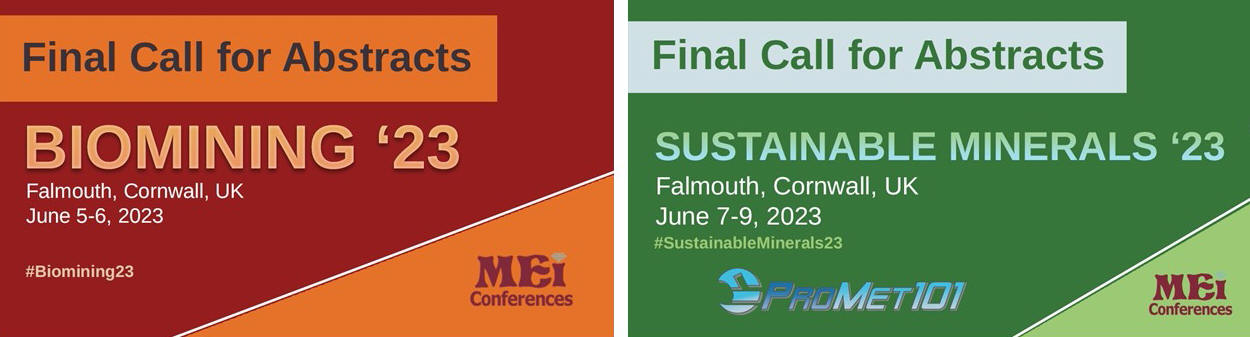
Biomining '23 and Sustainable Minerals '23: Final Calls for Abstracts

A reminder that if you would like to present papers at Biomining '23 and/or Sustainable Minerals '23, which will be run back to back in Falmouth next June, abstracts should be submitted via the respective websites by the end of this month.

There is more information on the conferences on the posting of 14th November, and we look forward to seeing you at Falmouth's National Maritime Museum next summer.


#Biomining23
#SustainableMinerals23

Wednesday, 7 December 2022

Prof. Noel Warner: 1932-2022

I heard rather belatedly a few days ago of the death of Prof. Noel Warner, on April 14th at the age of 90.

Noel Warner was Emeritus Professor of Minerals Engineering at the University of Birmingham, UK. I got to know this genial Australian very well in the late 80s and early 90s when he was external examiner for the mineral processing degree at Camborne School of Mines. He was President of the Institution of Mining and Metallurgy, 1992-3.

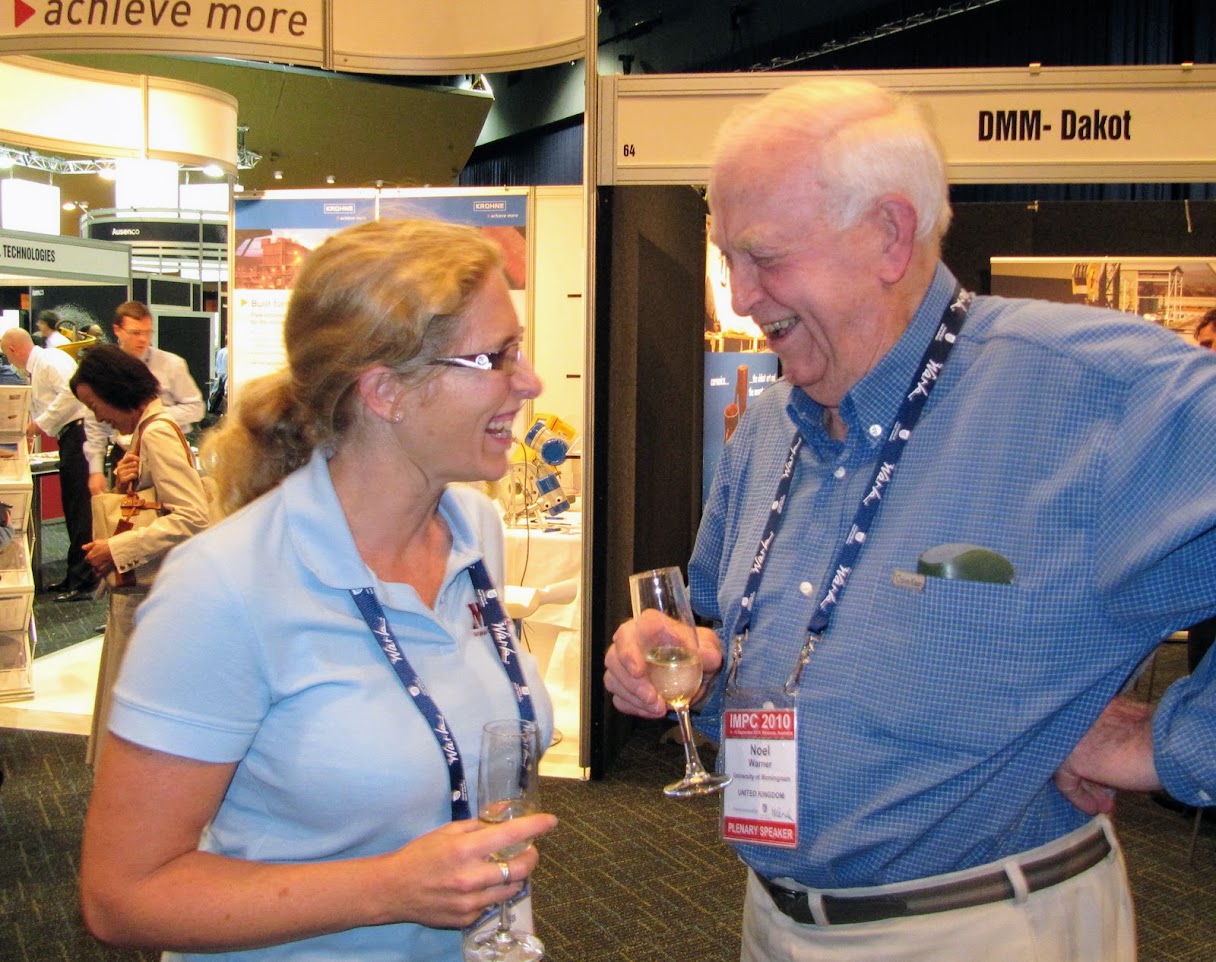
Amanda Wills with Noel Warner at the 2010 IMPC in Brisbane

He used to talk passionately of the process that he and his team at Birmingham were developing for the treatment of polymetallic massive sulphide deposits. The process was direct ore smelting. What was to become known as the Warner Process (Minerals Engineering Vol. 2 Number 1, 1989) was radical, in that the ore was smelted in a single furnace, the enormous amount of energy required to do this being recovered from the molten slag. Expensive comminution was avoided, apart from some preliminary crushing, and the inefficient flotation step was also by-passed. Pilot plant runs using McArthur River ore showed that zinc and lead recoveries could be well over 90% and with the adoption of innovative energy recovery technology, the thermal requirements could be satisfied by the inherent energy content of the ore itself. The Birmingham team showed that the energy requirements of direct ore smelting could be competitive with conventional mineral processing, particularly for ores containing sulphides.

Noel got a pilot plant built and operated at the University of Birmingham and demonstrated that the closed circuit could be worked on a big scale, and a number of people were attracted to come and see it, but enthusiasm was not overwhelming. Maybe it was too radical an innovation to be thrust on what was then a very conservative industry?

It's a shame that Prof. Warner never saw his process adopted commercially. It is certainly novel and operating at around 1000C the processing dynamics are very fast compared with flotation and electrowinning.

I have no doubt that comminution and concentration techniques will continue to evolve, but will there be a time when they lose the battle, when the remaining ores are so finely disseminated and intergrown that they can no longer be treated by physical methods? Is no mineral processing the future of mineral processing, and will the future be direct hydrometallurgical and pyrometallurgical routes? Maybe one day Prof. Noel Warner will be remembered for his unique invention.

@barrywills