Thursday, 5 May 2022

Integration, Optimisation & Design of Mineral Processing Circuits (IntegratedMinPro '22) programme now available

As the demand for resources continues to increase, and amidst growing challenges of processing complex ores while minimising energy and environmental impact, we are entering an exciting time for innovation in mineral processing. Innovation in individual unit operations is complemented by innovative approaches to the entire mineral processing flowsheet, from rearrangement of an existing circuit to a new approach for a greenfield development.

IntegratedMinPro '22 is a new conference from MEI, and is sponsored by Promet101 and Hudbay Minerals, with Media Partner International Mining, and Industry Advocates the Coalition for Eco-Efficient Comminution (CEEC), Cornwall Mining Alliance and the Critical Minerals Association.

Over two days, June 13-14, this online event will feature papers from around the world, on new approaches to mineral processing circuits, whether through design, modelling, optimisation or operation. This includes integration of unit operations (e.g. comminution and flotation), novel flowsheets that incorporate new equipment and new approaches to optimising circuit design. 

Included in the programme are two keynote presentations from well known figures in the industry. Elizabeth Lewis-Gray of Gekko Systems Integrated Mineral Processing, Australia, will discuss the critical need for accelerating innovation in the mining sector and Dr. Osvaldo Bascur, of OSB Digital LLC & SEEQ, USA, will discuss net metal production optimisation in the digital age.

On the final day there will be a 2-hour live panel discussion on the continuing evolution of mineral processing, chaired by Stuart Saich, of conference sponsor Promet 101.

The programme is now available for viewing and all presentations will be available on demand for 6 months after the event. Registration is open, and we look forward to your contribution to this important online conference.

#IntegratedMinPro22

Monday, 2 May 2022

April summary

The war in Ukraine dominated the news again last month, with ever worsening reports of atrocities. Boris Johnson visited the capital, Kyiv in the middle of the month, to pledge support, and a few days later was issued a fixed penalty notice, along with Chancellor Rishi Sunak and others, from the Metropolitan Police, for his part in the Downing Street lockdown parties. He thus became the first standing UK Prime Minister to be sanctioned for breaking the law, and despite having lied to Parliament about his partying he still refused to resign, one leading conservative saying that the fine ought to close this matter, as there is a war on and the Prime Minister, supported by the Chancellor, provides the leadership the nation needs. Many would argue about this, as the UK is not at war, and it must be noted that the UK changed its leadership during the first and second world wars, and during the Boer War, the Korean War, the Iraq War, and four times during the war in Afghanistan!

The Times, 29th April

The UK Government unveiled its future energy strategy at the beginning of the month, whereby up to 95% of the UK's electricity could come from low-carbon sources by 2030. The strategy, which aims to increase UK energy independence, includes plans to boost nuclear, wind and hydrogen power. There was no mention of geothermal energy in the mix, despite progress in Cornwall on the United Downs Deep Geothermal Power Project, the first geothermal power plant in the UK. The aim of the project is to produce power and heat from the hot granite rocks beneath Cornwall and two deep, directional wells have successfully been drilled; the production well to a depth of 5275m and the injection well to 2393m. Both wells have intersected the target Porthtowan Fault Zone located approximately 800m to the west of the site.

Nor was there a mention of the potential use of nuclear fusion, which Johnson enthused about at the Conservative Party Conference in October 2019, clarifying his position on this by saying "They (UK scientists) are on the verge of creating commercially viable miniature fusion reactors for sale around the world. "I know they have been on the verge for some time,” he continued, “It is a pretty spacious kind of verge.” But now, he assured his audience, “we are on the verge of the verge."

There is a big focus on offshore wind in the strategy, with a new target of producing up to 50 gigawatts (GW) of energy from this source by 2030 and Boris Johnson has called for a “colossal” floating wind farm in the Irish Sea. Just over 2 years ago he promised that Britain would become the "Saudi Arabia of wind".

A large wind turbine requires around 5 tonnes of copper, and at the recent 2022 CRU World Copper Conference held in Santiago, Chile, attendees heard the latest assessments on supply, demand, prices in the refined copper, concentrates and recycling markets. Erik Heimlich, head of base metals supply at CRU said that the world needs eight projects the size Escondida in Chile, the world’s largest copper mine, in the next eight years, the global copper industry needing to spend more than $100 billion to build mines able to close what could be an annual supply deficit of 4.7 million tonnes by 2030. The analyst said the supply gap for the next decade is estimated at six million tonnes per year, as the clean energy and electric vehicles sectors ramp up.

The big news from MEI last month was that Jon and his family are to shortly leave Cornwall for a new life in Luxembourg. Jon's partner, Dr Kathryn Hadler, formerly with Imperial College, London, and a regular at MEI's flotation and other conferences, has been appointed Director of the European Space Resources Innovation Centre at the Luxembourg Institute of Science and Technology as of 1 April 2022. Kathryn is currently commuting back to Cornwall at weekends, before Jon and the two children join her in Luxembourg in July.

Kathryn at Physical Separation '19 with Kristian Waters
Both former editors of IJMP, Kristian is now an editor with Minerals Engineering

And not a mention of Coronavirus this month, for the first time in 2 years. Has the pandemic gone away? It's easy to be fooled into thinking so, as life in UK now goes on as normal. But things have a habit of biting back so maybe we shouldn't be too complacent. I suppose at the moment there are more worrying things globally, such as Putin's escalation of the war in Ukraine and the possibility of it spilling onto a wider stage.

@barrywills

Thursday, 28 April 2022

Back to our roots in the industrial north

Barbara and I were both born and bred in the industrial north of England, in the cotton-mill town of Ashton-under-Lyne, 6 miles from the centre of Manchester, where we spent a few days last week for a nostalgic visit to the world of our youth. We found that Ashton has changed beyond recognition and appears to have lost its soul, but Manchester is now a dynamic thriving metropolis, where magnificent Victorian and modern architecture blend together in harmony. 

Manchester was the world's first industrialised city, brought on by a boom in textile manufacture during the Industrial Revolution, and it was the world's largest marketplace for cotton goods during the Victorian era. The dystopian city of the 19th century was a hellish place in which to live and work, and the conditions in the noisy, dangerous and unhealthy cotton mills are brought to life in the city's Science and Industry Museum, which is on the site of the world's first passenger railway station, Manchester Liverpool Road, which opened in 1830.
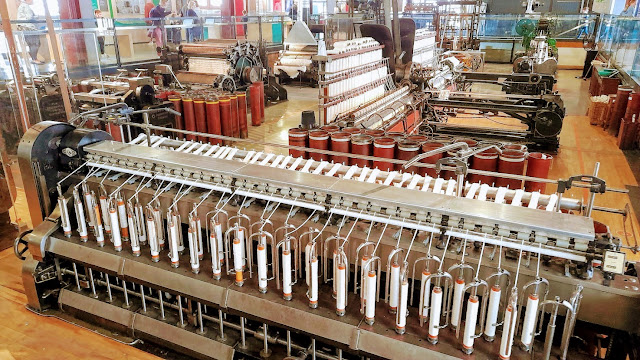
Cotton mill machinery in the Science and Industry Museum

By the mid-19th century Ashton-u-Lyne had emerged as an important mill town at a convergence of newly constructed canals and railways. As Cornwall has its ruined engine houses, so Ashton has its landscape of cotton mills, a reminder of its industrial past.

However, in all my 24 years in Ashton I had never realised its importance as a coal mining town during the industrial revolution, as it lay on the Lancashire coal fields which provided the fuel for the developing industries. Coal mining was not as important to the town as the textile industry, but in 1882 the Ashton Moss Colliery had the deepest mine shaft in the world at 870 metres (2,850 ft), surpassing that of Cornwall's Dolcoath Tin Mine at 660 metres (2160 ft), although Dolcoath eventually reached a depth of 1000 metres (3300 ft) by the end of the century (posting of 3 August 2015).

None of this I knew about in my early life, most of which was spent with my parents and sister in the Ashton Moss Council Estate, only a couple of miles from the Ashton Moss Colliery, then the town's only working coal mine, which eventually closed in 1959. It was known locally as the 'Snipe Pit' and I doubt if many residents now would be aware of its existence, the only reference to Snipe being the name of the retail park which stands on the original mine site, and the nearby pub, the Snipe Inn. Remarkably the deep mine was ventilated by a furnace half way down the pit, supplemented by a boiler fire at the bottom.

Coal was king in 1950s Britain and directly or indirectly fueled our homes. The coal was cheap, low grade and dirty, producing much ash and soot, the airborne particles contaminating buildings and people alike. The Victorian buildings of the industrial north had black facades, highlighting their Gothic gloominess, and it was only in later years, well after the Clean Air act of 1956 that their original sandstone surfaces were restored in all their glory.

Manchester University before and after cleaning
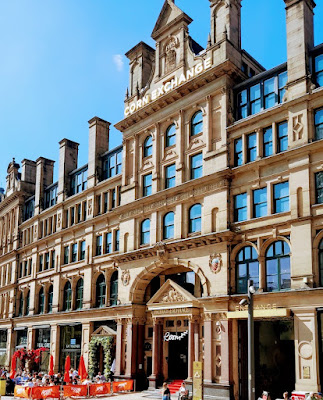
Manchester's Corn Exchange revealed in all its glory

Many homes, including ours, also had stoves and washing tubs fueled by coal gas (town gas). Ashton, like many industrial towns, had its own gas-works, where coal from the numerous collieries was heated to drive off the gas. The gas was collected in large reservoirs, or gasometers, from where it was piped to local industry and houses, and the residue was coke, a clean but expensive fuel.

The burning of coal in homes and industry produced another hazardous side-effect. Northern England is noted for its rainfall, and the subsequent high humidity provided ideal conditions for minimisation of the breakage of threads in the cotton mills. However humidity and cold winters often produce fog, which combined with the coal-contaminated atmosphere, produced that dreaded combination of smoke and fog known as smog, a noxious mix of particulate matter and gases such as sulphur dioxide and nitrogen dioxide. Often a sickly yellow-green colour, these ‘pea-soupers’ would sometimes totally shut down the activities of a town, but I remember vividly walking to and from school when the visibility was an acceptable metre, with car headlights appearing slowly and eerily out of the gloom.  Only towards the end of the 50s did the situation improve, with Clean Air Acts identifying ‘smokeless’ zones, where only smokeless fuels such as anthracite and coke could be burned.

The first four years of my life were spent with my parents and maternal grandparents, latterly in my grandparents back-street general store. Although mum and dad lived at the shop for only a few years, as primary school was only a couple of minutes walk away lunch (dinner!)was spent at the shop for the first few years of my schooling.

With friends at my grandparents shop, November 1949

Cobbled streets, back-yards, outside lavatories; these are some of my most vivid memories of life in the early 50s. The outside lavatory did not have a flushing system, and was operated by a ‘tippler’ system. Waste would remain in an open sewer until the tippler filled with the waste kitchen sink water; it would then tip, sending a couple of gallons of water through the system flushing the waste away. It was counterbalanced at the back so that it returned upright when empty. Using 'grey'water in this way sounds very environmentally friendly, but in reality is wasn't!

A regular visitor to our cobbled back streets was the rag-and-bone man, with his horse and cart rattling over the cobbles. He would collect old rags, for converting into fabric and paper, bones for making glue, scrap iron, old jam jars and other items in return for items of limited value. We children would often trade such items for goldfish and balloons, but the women of the district would eagerly await his supply of much-needed ‘donkey-stones’.

Donkey-stones were soft scouring stones, originally used in the textile mills to provide a non-slip surface on greasy staircases. The stone, which took its name from the hard work performed, was made from pulverised sandstone, cement, bleach powder and water. Working class women had hard lives of drudgery and routine, and the donkey-stoning ritual, which was unique to northern England, was an essential part of their weekly routine. One day of each week would be devoted to going down on hands and knees and donkey-stoning doorsteps, windowsills, the flagged kitchen floor, and most importantly, the paving stones, or ‘flags’, outside their terraced homes. “Sanding the flag” was an ideal occasion for neighbourly gossip, but women were proud of their donkey-stoning, and would feel that anyone whose step was not meticulously sanded would have let the street down.  

'Sanding the flags' in the 1950s

With such an upbringing it is not surprising that Barbara and I have always been avid viewers of the long-running 'soap opera' Coronation Street which has run continuously since 1960. The programme centres around an eponymous cobbled, terraced street in Weatherfield, a fictional town based on inner-city Salford, the home of Granada Studios, which we visited last week to explore the set.

A potential sundowner venue?

Barbara was also brought up in a working class family, the eldest of six children. Her father was a bus-conductor, and collected tickets on one of the local bus routes. One of his regular passengers was a shabbily dressed old man, who he befriended, and occasionally turned a blind eye to collecting his fare. The old man confided that he was a bit of an artist, and offered Barbara's dad one of his paintings, which he politely declined, as he did not wish to take anything in return for his kindness.  Later it was discovered that the old man was one of Manchester’s most famous sons, the artist L.S. Lowry, who died in 1976. His paintings of scenes of life in the industrial districts of northern England during the early 20th century now sell for fortunes, his ‘matchstick men’ figures have often been criticised as being naïve, but a large collection of his work is on permanent public display in a purpose built Manchester art gallery appropriately named The Lowry.

With my sister Pat at the Lowry Exhibition

Barbara and I spent most of our youth and childhood separated by about 2 miles, living unaware of each other until 1962 when we met at the local youth club.

1963: The first of many photos of Barbara and me; Barbara with my sister Pat;
and with friend Tony Marland en route to one of our many parties 

It was great to meet up last week with our oldest friends from that time, Tony and Nora Marland, and Eric and Pat Nield. We had lunch at one of our old watering holes, the Broadoak Hotel, once the site of another of Ashton's coal mines, the Broad Oak, which closed in 1901.

Tony, Pat, Barbara, Eric, Nora and me at the Broadoak Hotel, Ashton

Eric and I were at Grammar School together and were members of the junior football team.

Ashton Grammar Juniors 1958: Eric is back row 2nd left and I am centre, front row

Shortly after this picture was taken a weaselly litle history teacher caught me and others smoking in the showers after a match in Oldham, and, as captain, I was made an example of, and banned from playing football again for the school- I didn't play competitively again until 1967 at Leeds University! But football remained an important part of my life and I was a fanatical supporter of Manchester City, my dad taking me regularly to home fixtures at Maine Road, but indelibly etched in the memories of Mancunians of a certain age is the event of February 6th, 1958.  

I remember dad coming home for "tea" to inform us breathlessly that a plane carrying the Manchester United team had crashed after a European Cup tie, and there were many fatalities. United was, of course, the ‘other’ Manchester team and there was intense rivalry between local supporters. Feelings softened, however, when the whole of Manchester came together after the Munich air disaster, which claimed the lives of eight of the Manchester United team, and during the early sixties Barbara and our friends and I would often drop in at Old Trafford of an evening to watch the legendary threesome, George Best, Bobby Charlton (one of the survivors of the crash) and Denis Law in action. It is well over 50 years since I was last at the ground, so it was good to make a brief visit last week.

Another vivid memory is of a night at the youth club in late 1962, where the place was buzzing and the chatter was all about a new group from Liverpool which had been on local TV that night. They were called The Beatles and they had an immediate impact on us all and played a big part in our lives in the 60s, and we have been great fans ever since. Until last week I had only ever visited Liverpool once, for interview at the University in 1963 (I opted for Leeds), so we took the  train last week from Manchester to Liverpool Lime Street, for a 'Magical Mystery Tour' of the city.

It was a great week of nostalgia, and I would very much like to hear from you if you were also part of the industrial scene in the middle of last century.

@barrywills

Monday, 25 April 2022

New book: Mine Wastes and Water, Ecological Engineering and Metals Extraction

This recently published book, edited by Margarete Kalin-Seidenfaden and William N. Wheeler, reviews past and present mine waste management processes. It estimates global water consumption by major mining resources per annum. This consumption will lead land use resources (agriculture and water) to collide with mining interests in the near future. With the application of novel metal extraction processes and the adoption of ecological engineering as an approach to waste and water management, a reduction in water and land consumption can be achieved. Using these methodologies would make mining more sustainable. Together with ore and metal recycling, mining methods can be brought into the 21st century.

The book describes natural weathering processes and the microbiology of extreme environments, such as mine sites. The role of microbes in weathering and remediation is emphasized, along with case studies of the enhancement of various ecological processes which curtail weathering and transform pollutants, creating ore bodies of the future.

This book has been written as an extension to a contribution to the Oxford Research Encyclopedia. It adds depth and many examples from 40 years of multidisciplinary work with experts from geology, hydrogeology, geomicrobiology and algal physiology and chemistry, items too extensive for the Encyclopedia.

We hope to hear more of these topics at Sustainable Minerals '22 in July. The deadline for abstracts for this online conference is the end of this week

Thursday, 21 April 2022

Sustainable Minerals '22: Final Call for Abstracts

The rapid growth of the world economy is straining the sustainable use of the Earth’s natural resources due to modern society’s extensive use of metals, materials and products. An astute and conscious application and use of metals, materials and products supported by the reuse and recycling of these materials and end-of-life products is imperative to the preservation of the Earth’s resources. The realisation of the ambitions of sustainable use of metals, materials and resources demands that the different disciplines of the material and consumer product system are connected and harmonised and MEI's Sustainable Minerals '22 in July will discuss all aspects of material and metal usage. 

There is now a final call for abstracts for the conference, which should be submitted by the end of this month.  We are indebted to the support of our sponsors, ZEISS, Metso Outotec, Hudbay Minerals, Weir Minerals and Promet101, our media partner International Mining, and our Industry Advocates the Coalition for Eco-Efficient Comminution (CEEC), the Cornwall Mining Alliance and the Critical Minerals Association.

#SustainableMinerals22

Monday, 18 April 2022

Looking to the future : Physical Separation in 2030

Next month's Physical Separation '22, the 7th in the MEI series, and the first to be totally online, has a fine programme, covering gravity and magnetic separation, sorting and microwaves, classification and solid-liquid separation, and a highlight on the final session of day 3, a live panel discussion on the future of physical separation.

The scheduled 2-hour session will be chaired by Dr. Erin Bobicki of the University of Toronto, Canada, who will also be co-authoring work on the application of microwave imaging in sensor-based ore sorting on day 2 of the conference. Sensor-based sorting is rapidly developing into a major method of pre-concentration and representing conference sponsor Steinert on the panel will be Dr. Priscila Esteves, of Steinert Latinoamericana, Brazil. Priscila will also be presenting a paper on the development of a sensor-based sorting application for iron ore concentration, as well as co-authoring a presentation on sensor-based sorting technology to separate chromite lump from low grade rocks.

Prof. Neil Rowson, Emeritus Professor at the University of Birmingham and Laboratory Manager at Bunting-Redditch, UK, will be giving a keynote lecture at the conference on the role of magnetic separation in the development of critical and strategic metal recovery flowsheets, and will be the magnetic separation specialist on the panel.

Prof. Kevin Galvin, Laureate Professor at the University of Newcastle, Australia, is also a keynote speaker at the conference, his lecture being on new challenges for gravity concentration and classification of fine particles. Kevin is the inventor of the Reflux Classifier used in gravity separation of fine particles. With over 180 installations around the world, the technology has been used to beneficiate coal, iron ore, mineral sands, potash, chromite, and other base metal oxides. New innovative systems are emerging including the Graviton and the Reflux Flotation Cell through collaboration with FLSmidth. He has also been developing a novel agglomeration technology with Jord International. Among his many honours he has been the recipient of the SME's prestigious Antoine Gaudin Award.

Dr. Peter Amelunxen, of conference sponsor Hudbay Minerals, Canada, is an all-round mineral processor who chaired the panel discussion at last year's Flotation '21. He was the first recipient of MEI's Young Person's Award in 2011 and it is good to have him with us again on the panel.

There is no doubt that interesting things will come out of this panel discussion, as the panelists answer questions put to them by the delegates. The live presentation will also be recorded and available on demand after the conference.

#PhysicalSeparation22