Friday, 12 October 2018

The Environmental Applications of Biotechnology in Mining

Biotechnology is set to have an increasingly important role,  not only in the treatment of primary ores and concentrates, but in the quest for the circular economy, and is likely to have a major role in remediation, treatment of tailings, electronic and other wastes, and as a potential aid to processes such as flotation. In this respect MEI's Biomining conferences are now intimately linked to the Sustainable Minerals series, which was very evident in June in Namibia, where over 60% of the Biohydromet '18 delegates also attended Sustainable Minerals '18.
Biomining '20 and Sustainable Minerals '20 will run back to back in June 2020 in the beautiful Cornish town of Falmouth (more info on the posting of 2nd August). Dr. David Dew will present a keynote at Biomining '20 on the limitations to the commercial application of biohydrometallurgy for the treatment of base metal sulfide ores (posting of 20 August), and we are pleased to announce that Dr. Anna Kaksonen, of Australia's CSIRO, will present a keynote on the environmental applications of biotechnology in mining. This will complement the keynote lecture on the following day at Sustainable Minerals '20, when Dr. Anita Parbhakar-Fox, of the University of Tasmania, will discuss how the mining industry might respond to the 'war on waste' (posting of 25th September).

Anna and her co-workers have recently published a comprehensive review article on recent progress in biohydrometallurgy and microbial characterisation (Hydrometallurgy Volume 180, September 2018). Bioprocessing of low-grade ores and concentrates is well-established as a commercial-scale technology for extracting value from various base and precious metal minerals. Microorganisms are also increasingly being used for recovering value from mine wastes, such as tailings, slags and ashes, as well as urban mining of end-of-life consumer products such as batteries and electronic wastes. The capability of microbes to catalyse oxidative and reductive bioprocesses as well as degrade organic compounds has been utilised for the removal of various contaminants from hydrometallurgical process waters and the treatment of effluents prior to release into the environment. Biological iron oxidation, bioreduction of nitrate, selenate and sulfate, neutralisation of acidity with biogenic alkalinity and bioprecipitation of metals offer alternatives for chemical water treatment. Emerging technologies, such as bioelectrochemical systems and synthetic biology are also opening new avenues to mining companies for monitoring and mitigating environmental impacts. Dr. Kaksonen will review examples of recent developments in the environmental applications of biotechnology in mining.
Anna Kaksonen has about 20 years’ experience in various aspects of biomining, from bio-oxidising and bioleaching low-grade ores to treating waste streams and recovering resources. During her Doctor of Technology degree, she developed fluidized bed reactor processes for biotechnical mine water treatment at Tampere University of Technology (TUT) in Finland. As a Senior Researcher at TUT, she also contributed to the development of heap bioleaching for complex low-grade black schist ores, bioprocesses for excess iron and sulfate removal from barren leach liquors and metal recovery from various metallurgical wastes. In 2009 Anna joined Commonwealth Scientific and Industrial Research Organisation (CSIRO), Australia as a Team Leader of Environmental and Industrial Biotechnology (EIB). In 2017 she was appointed as a leader of CSIRO’s Biotechnology and Synthetic Biology Group which has three teams (EIB; Biocatalysis and Synthetic Biology; and Metabolomics and Proteomics) located in Perth, Canberra and Brisbane. She has delivered projects to many companies on base metal, precious metal and uranium bioleaching, as well as biotechnical removal of organic and inorganic impurities from hydrometallurgical process waters. She has also been active in urban mining, developing bioprocesses for the extraction of metals from electronic wastes.
The latest updates on Biomining '20 and Sustainable Minerals '20 can be found at #Biomining20 and #SustainableMinerals20 respectively.

Tuesday, 9 October 2018

Fathi Habashi- still going strong at 90 years of age

On behalf of us all at MEI, I would like to wish the very best to Prof. Fathi Habashi, who was born in Alexandria, Egypt, 90 years ago today.
Over very many years Fathi has been a well known figure at major mineral processing conferences, presenting keynote lectures and chairing sessions. Only two years ago he delivered two presentations at the XXVIII IMPC in Quebec City, where he and his wife Nadia kindly showed me and Barbara around the campus of Laval University, at which Fathi is an Emeritus Professor. He has been quoted as saying to young people "do not stay in what is called an “ivory tower”. Travelling and attending conferences have enormous, sometimes unexpected benefits.”
At Laval University, Canada, September 2016
With Nick Hazen and the late Maurice Fuerstenau in Seattle, February 2012
Fathi is a prolific author of textbooks on extractive metallurgy and its history, and this year published the 160 page e-book Success and Failure in the Canadian Metallurgical Industry and the 170 page e-book Friends, Colleagues, and Mentors Who Passed Away. Currently he is working on the biographies of people, mainly scientists, who have influenced his long professional career either directly or indirectly.
Fathi is an inspiration to all, and I am sure he will continue to be so during his 90s.
Twitter @barrywills

Saturday, 6 October 2018

A legendary steam engine passes through Cornwall

The steam engine is surely one of the greatest of all inventions. It kick-started the Industrial Revolution, and was crucial to Cornish Mining, the powerful steam-driven pumping engines allowing deep level mining of the copper and tin ores. So it was great to see a world-famous steam engine in action in Cornwall this morning.
As a young boy in Manchester in the 1950s I was, as were most boys at that time, a keen train-spotter, but never saw the Flying Scotsman, as it serviced the London and North Eastern Railway (LNER), whereas the Lancashire region came under London Midland Scottish (LMS).
This morning I saw this iconic engine for the first time, as it passed through Truro en route to Penzance.
The Flying Scotsman passes through Truro station
The locomotive, number 60103, built in 1923 and named after the Flying Scotsman service between London and Edinburgh, set two world records for steam traction, becoming the first steam locomotive to be officially authenticated at reaching 100 miles per hour (160.9 km/h) on 30 November 1934, and then setting a record for the longest non-stop run by a steam locomotive when it ran 422 miles (679 km) on 8 August 1989 while in Australia.
Twitter @barrywills

Thursday, 4 October 2018

Cornwall's Coast to Coast Mining Trail

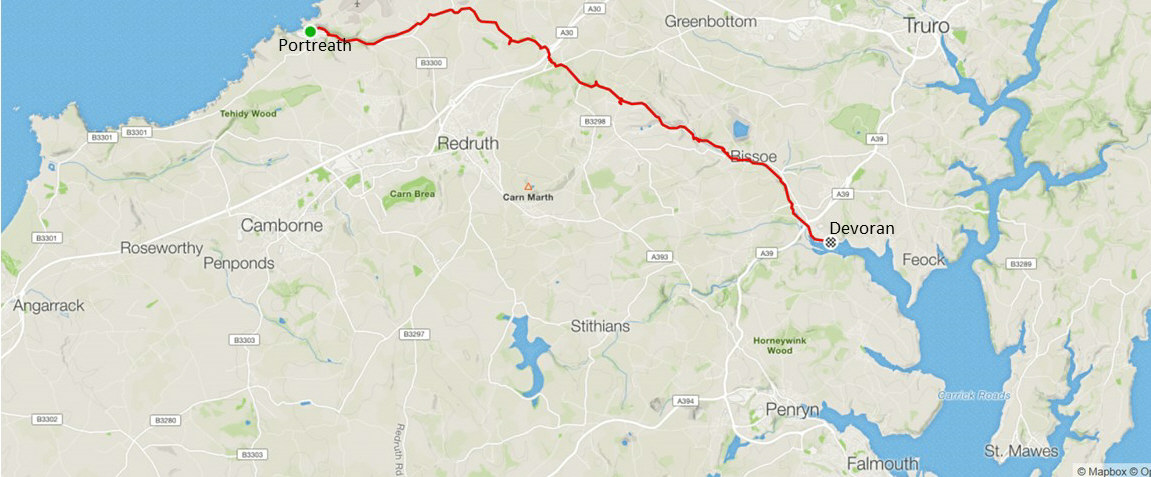
As well as perhaps the world's best coastal paths, Cornwall is also blessed with several interlinked inland mining heritage trails, the most well-known being the 12 mile long Coast to Coast (CC) trail (known locally as the Bissoe trail), linking what were, in the 19th century, two of the county's most important ports, Portreath on the north coast and Devoran on the south.  The Mineral Tramway Network of trails follows many of the old mining railways that connected copper and tin mines with these two busy ports, which handled imports of coal for the steam engines and the export of ore. The CC trail closely follows the horse-drawn Portreath tramroad which was opened in 1812, to service the mines in the Gwennap Parish, which were then the most important copper mines in the world. The Redruth and Chacewater Railway was built in 1825 and linked the mines around Gwennap, and those around Redruth, to the port of Devoran.
The coast to coast mining trail
For those of you spending a few days in Falmouth, before or after an MEI Conference, I have previously posted recommendations for what to do should you not have a car (posting of 11th March 2015), but if you do have a car, then there is a wealth of options in Cornwall, and if you have an interest in mining history,  then exploring the CC trail either on foot or by bicycle, is a fabulous day out.
You can park your car, have coffee or lunch, and rent a mountain bike and helmet at Elm Farm in the village of Cambrose, a couple of miles from Portreath, and from here you can either head back to the beginning of the trail at Portreath, or join the trail at Cambrose. A mountain bike, or hybrid, is advised, as the gravel and compacted earth surfaces are not really suited to road bikes, and around the intensively mined Poldice Valley the surface is hard and rocky. You will also need to keep your eyes open for the large granite route-markers, as in places the trail diverts briefly onto quiet country lanes, as well as a couple of major roads. If in doubt, wait a few minutes and you will see other cyclists who will point you in the right direction!

Portreath

So, here we go, and enjoy your day!:

Portreath to Twelveheads
The trail begins by the Portreath Arms pub, directly opposite the Portreath Bakery, where you might wish to sample one of their excellent pasties. The countryside trail to Elm Farm is a pleasant two and a half miles, running parallel with the main road to Redruth.

There are a couple of other trails linking to the coast to coast, but I would certainly recommend that you take the three quarter mile short detour to Wheal Peevor (posting of 1st July 2018). You will see the waymarker after about 4 miles and the route, mainly on country lanes, takes you to three of the finest preserved engine houses in Cornwall. Unfortunately direction signs disappear as soon as you take the path from the coast to coast trail, but luckily the area is favoured with dog walkers, so there are many people to aid you on your way, of if you have GoogleMaps, then just enter Wheal Peevor.
The stamps engine house at Wheal Peevor with Portreath on the horizon
Wheal Busy
Back on the CC trail I would recommend that you avoid the Wheal Busy loop at Wheal Rose Farm, which is an unpleasant diversion with little of value to justify the effort. There is little to see at Wheal Busy, a notable copper producer from the early 1720's, apart from the rather sad ruined pumping engine house.
After 5 miles, we reach the best place for getting lost! Look carefully for the waymarkers after crossing the bridge over the busy A30. The route takes you by the Crossroads House Care Home, after which you turn right through the Fox and Hounds car-park, and then cross the road to pick up the trail again for some pleasant cycling on the tramroad through Scorrier Woods and the outskirts of Unity Woods.

Scorrier Woods
At 6 miles the Wheal Busy loop joins the trail again and it is worth taking the track through the deep and dark Unity Woods to Killifreth Mine's Hawke's Shaft pumping engine house. Killifreth was a small copper mine, and the engine house at Hawke's Shaft operated between 1893-97, and then when the mine converted to arsenic processing a bigger engine was used from 1912-21, which necessitated raising the stack to its present level, the tallest chimney in Cornwall. Be advised though that, although it is only half a mile to the engine house, the trail through the woods is definitely suited only for mountain bikes, being steep, narrow and rocky.
Unity Woods with (right) Killifreth's Hawke's Shaft pumping engine house

One of the many capped mine shafts
I suggest that you avoid the Little Beeside loop a little further on and carry on to the Poldice Valley, once the most important copper mining area in the world. Over 3,000 shafts are known to have existed in the old Gwennap parish and although today most have been capped there may still be shafts which lie in wait for the unwary amongst the gorse and bracken of the old mining district, described in the early 19th century as the richest square mile on earth.

Now is the place to travel the short distance on the Little Beeside loop to the ruins of the Poldice Mine, which was originally a tin and copper mine, and by 1685 was employing between 800 to 1000 men and boys.  By 1702 it was the deepest mine in Cornwall, having reached a depth of 106 fathoms (636 feet) and by 1788 the output of copper exceeded that of tin. Water was always a problem, and in the early 1740s five Newcomen steam engines were employed for pumping water from the mine. The mine manager John Williams planned the construction of the Poldice Deep Adit to help drain the mine, work commencing in 1748. This eventually linked up with adits from over 60 mines in the Gwennap area, to become the Great County Adit (posting of 8th August). The Gwennap mines were a fair distance from both the north and south coasts, and as a result incurred high costs to transport timber, coal and ore. In 1812 it was John Williams who constructed the horse-drawn plateway from his mines at Poldice through Scorrier to the newly-constructed harbour at Portreath. In 1867 the mine closed for the first time in its history, but resumed work again in 1870 producing arsenic, in great demand especially for the expanding Lancashire cotton industry, which used it in pigments and dyes, but by the 1910s most of the activity was over and although small-scale mining continued into the 1920s, it closed in 1930, the ruins seen now being the relics from the first arsenic works.

In the foreground below are two buddles, a convex buddle in the centre and a concave buddle to the left. These were crude, but very widely used, devices to concentrate heavy minerals such as arsenopyrite. In the background are the remains of the calciners, which were used to roast and oxidise the arsenopyrite at high temperature.
The highly poisonous arsenic trioxide was condensed as a 'white soot' in long labyrinths, which were periodically cooled and dug out by hand to recover the oxide, surely one of the worst ever jobs in mining, although they did have safety equipment including cotton wool nose plugs, handkerchiefs for breathing through and arms smeared with clay!

19th century arsenic workers
Back on the trail we are now very obviously in mining country, with the waste from centuries of mining for copper, tin, tungsten, and arsenic on both sides of our route. There are many 'off-piste' mountain bike trails meandering through the old tailings dumps, many of which have been reworked for tin and arsenic in more recent times, and the trail is now much more rugged and rocky than encountered previously.
Tailings dumps in the Poldice Valley
But after about a mile green vegetation returns, the only obvious evidence of mining activity being a few capped mine shafts and isolated tailings dumps as we approach the hamlet of Twelveheads and the Bon Appetit cafe, a great place to stop for light refreshments. From here, follow the country road and then left onto the trail a couple of hundred yards on, opposite the Wheal Andrew Counthouse. Immediately to the right on the trail is a very narrow overgrown path leading down to the Carnon River and the portal to the Great County Adit, but there is little to be gained by walking down the track, as access to the portal is now securely blocked and hidden.
A little further on look back, and above the valley are the buildings for the concentrator of the Mount Wellington tin mine, which operated between 1976 and 1991.
Twelveheads to Devoran
Nine miles from Portreath we reach the Bike Chain Bissoe Bike Hire.  Another great place to stop for light refreshments, bikes can also be rented here should you be planning a trip starting at this end of the trail.
Point Mills Arsenic Refinery
Shortly after crossing the road and rejoining the trail the last evidence of mining activity is the ruin of the Point Mills arsenic refinery, which was operated for a century, ending with the outbreak of World War 2.
The last 3 miles to Devoran Quay is an easy ride through the Bissoe and Carnon Valleys, once one of the most intensively mined regions on earth, although little evidence now remains. The highlight of this last few miles is passing under the impressive Carnon Viaduct, part of the Truro to Falmouth branch line. The  nine-arch masonry viaduct replaces an earlier structure designed by Isambard Kingdom Brunel for the Cornwall Railway and opened in 1863. The present viaduct opened in June 1933, the timberwork of the original structure being dismantled and removed, but its masonry piers still stand beside the replacement viaduct. 
The final mile of the journey is through the pretty village of Devoran, to the end of the trail at Devoran Quay on the River Fal's Restronguet Quay. The demise of Devoran as a port occurred in 1876 when disastrous floods caused the neglected County Adit to release thousands of tons of water, carrying rubbish and silt down-river to Restronguet, blocking navigation to all but the lower quays.
The end of the trail, at Devoran Quay
Twitter @barrywills
More Cornish walks
More on Cornish Mining
More on Cornwall

Monday, 1 October 2018

Wolf Minerals will have a major involvement with Physical Separation '19

We are pleased to announce that Wolf Minerals is to sponsor an MEI Conference for the first time, and will have a major involvement in next year's Physical Separation '19 in Falmouth.
Wolf Minerals operates the Drakelands tungsten and tin mine at Hemerdon, bordering Dartmoor in Devon, and is one of the Western world's largest tungsten and tin resources. It officially opened three years ago (posting of 17th September 2015).
One of Wolf's senior metallurgists will be giving a presentation at the conference on the operation of the processing plant, which, due to the high density of wolframite and the by-product cassiterite, is dominated by gravity concentration, DMS cyclones, spirals and shaking tables (provided by conference sponsor Holman-Wilfley) producing a combined W-Sn concentrate, from which arsenopyrite is removed by froth flotation.
Wolf is kindly organising an optional tour for delegates on the morning of Saturday June 15th, which will include transport to and from Falmouth, refreshments and lunch.  Numbers will need to be capped at 30 and the tour will be approximately four hours in length, so if you would like to take part you must register your intent as soon as possible. There is no charge for this visit, nor for the optional tour to the 19th century Wheal Peevor mining trail on the Friday afternoon.
The latest updates on Physical Separation '19 can be found at #PhysicalSeparation19.
Current Physical Separation '19 sponsors


Friday, 28 September 2018

MEI Online Update #427

Hello Everyone,

In case you didn't see the last newsletter, here is a reminder of what's happened: Our subscriber list host, Topica, seems to have disappeared from the face of the internet with no warning. This means that we did not have time to retrieve our most current subscriber list from their servers.

Rather than risk spamming people who are on our old list, we have taken the decision to build up our subscriber list from scratch. If you wish to be added/re-added to the list, please email amanda@min-eng.com with the subject line: email list.

Whilst we build our list back up, the newsletter will be posted on the MEI BlogMEI's LinkedIn page and anywhere else I can find for it!

For those of you reading who weren't subscribers, MEI Online Update is produced every 2 weeks and contains links to every new item added to MEI Online since the last issue - apart from jobs, which are listed in a separate email.

And in other news, there have been new additions to the Process Mineralogy '18 and Hi-Tech Metals '18 programmes, and there are only 3 booths left at the Process Mineralogy '18 exhibition. Please email Jon@min-eng.com for more details.

I mentioned in the last newsletter that Wolf Minerals would be running a trip to their Drakelands Mine following Physical Separation '19, and am happy to say that Barry will be blogging the details on Monday.

Barry's Blog:
* The Opening of the Newly Expanded Mineral Processing Facilities at Wardell Armstrong
* ‘The war on waste’: How could the mining industry respond?
* International chemical company Clariant to sponsor Flotation '19
* Last of the summer sundowners
* Major IMPC Awards to two distinguished American Professors
* How were your first two days at the Moscow IMPC?
* Conference nostalgia: Minerals Engineering '98 in Edinburgh
* The Starkeys call in en route to Moscow
* Exploring Cornwall's mining heritage with the Julian Baring Scholarship Fund

Best regards,
Amanda
amanda@min-eng.com
http://www.linkedin.com/amandawills
http://www.facebook.com/MEIConferences
https://twitter.com/MEIchat

*********************************
* Call for Papers: Physical Separation '19
*********************************

Analytical Techniques & Applied Mineralogy
~~~~~~~~~~~~~~~~~~~~~~~~~~~~~

Technical Programme: Process Mineralogy '18

Register Now: Process Mineralogy '18

* Recently Refereed Publication:
Minerals Engineering Vol.125

Analytical Techniques & Applied Mineralogy is sponsored by FEI

Biotechnology
~~~~~~~~~

First Announcement: Biomining '20

Comminution
~~~~~~~~~

First Announcement: Comminution '20

* Recently Refereed Publications:
Minerals Engineering Vol.125
Powder Technology Vol.337

Comminution is sponsored by Russell Mineral Equipment

Computer Applications
~~~~~~~~~~~~~~~

First Announcement: Computational Modelling '19

* Recently Refereed Publications:
Minerals Engineering Vol.125
Powder Technology Vol.337

Environmental Issues
~~~~~~~~~~~~~~

Technical Programme: Hi-Tech Metals '18

Register Now: Hi-Tech Metals '18

* Recently Refereed Publication:
Minerals Engineering Vol.125

Froth Flotation
~~~~~~~~~~

First Announcement: Flotation '19

* Commencement of Flotation Commissioning at the Hellyer Polymetallic Project, Tasmania

* Recently Refereed Publication:
Minerals Engineering Vol.125

Froth Flotation is sponsored by FLSmidth

General Minerals Engineering
~~~~~~~~~~~~~~~~~~~

Technical Programme: Hi-Tech Metals '18

Register Now: Hi-Tech Metals '18

* Conference Report: 2nd Young Nonferrous Metals Scientists & Engineers Forum

* Recently Refereed Publication:
Minerals Engineering Vol.125

Gravity Concentration
~~~~~~~~~~~~~~

Call for Papers: Physical Separation '19

* Tempo Mineral Processing Offers DMS Cyclone Refurbishment Service

* Recently Refereed Publication:
Minerals Engineering Vol.125

Hydrometallurgy
~~~~~~~~~~~

First Announcement: Biomining '20

* Lithium Ion Exchange Provides a New Source for Battery Materials

* Recently Refereed Publications:
Minerals Engineering Vol.125
Chemical Engineering Science Vol.191
Journal of Cleaner Production Vol.197

Magnetic/Electrical Separation
~~~~~~~~~~~~~~~~~~~~

Call for Papers: Physical Separation '19

* Recently Refereed Publication:
Minerals Engineering Vol.125

Magnetic/Electrical Separation is sponsored by SLon Magnetic Separator

Reagents
~~~~~~

* Recently Refereed Publication:
Minerals Engineering Vol.125

Reagents is sponsored by Axis House

Sizing, Classification & Sorting
~~~~~~~~~~~~~~~~~~~~

Call for Papers: Physical Separation '19


Solid-Liquid Separation
~~~~~~~~~~~~~~~

Call for Papers: Physical Separation '19

Solid-Liquid Separation is sponsored by FLSmidth

Plant Operations
~~~~~~~~~~~

* China's Western Mining to Launch Qinghai Copper Smelter Next Month

Plant Operations News Australasia is sponsored by Magotteaux

Plant Operations News Europe is sponsored by Holman-Wilfley

People News
~~~~~~~~

* J. Burgess Winter 1933-2018

* Major IMPC Awards to Two Distinguished American Professors

* IMA Medal of Excellence in Mineralogical Services 2017 goes to Emil Makovicky

* John Van Nostrand Dorr joins the IM Technology Hall of Fame: Concentration

* Join the Minerals Engineers LinkedIn Group

People News Australia is sponsored by JKMRC & JKTech

Commodities
~~~~~~~~~

New items in:

* Calcium Carbonate - Refereed Publications

* Copper - News

* Copper - Refereed Publications

* Gold - News

* Gold - Refereed Publications

* Iron - Refereed Publications

* Kaolin - Refereed Publications

* Lithium - News

* Lithium - Refereed Publications

* Manganese - Refereed Publications

* Nickel - Refereed Publications

* Platinum Group Metals - Refereed Publications

* Quartz - Refereed Publications

* Rare Earths & Thorium - Refereed Publications

* Tungsten - Refereed Publications

* Vanadium - Refereed Publications

* Zinc - Refereed Publications

Cobalt, Copper, Rare Earths & Thorium sections are sponsored by Axis House

Minerals Engineering Conferences
~~~~~~~~~~~~~~~~~~~~~~

Technical Programme: Process Mineralogy '18

Register Now: Process Mineralogy '18

Technical Programme: Hi-Tech Metals '18

Register Now: Hi-Tech Metals '18

Call for Papers: Computational Modelling '19

Call for Papers: Physical Separation '19

First Announcement: Flotation '19

First Announcement: Comminution '20

First Announcement: Biomining '20