Tuesday, 18 September 2018

How were your first two days at the Moscow IMPC?

The XXIX International Mineral Processing Congress (IMPC) began on Monday at the Congress Center of World Trade Center Moscow, Russia. Although MEI was not represented, I have received a number of updates from various people, and I thank them for their input, and invite further comments.
Congress Chairman Valentin Chanturia and his wife Elena, with Maria Okhvat of
Congress Management Mako, and IMPC Council Chairman Cyril O'Connor and his wife Nanette
Although the Congress began on Monday, the exhibition opened on Sunday, and bizarrely closed Tuesday afternoon. Sunday started with a bus tour around Moscow, taking in Red Square and the Kremlin, the last stop being the exhibition centre. The exhibition is not very big, but there is a good range of suppliers, especially from Russia and Scandinavia. The reception consisted of a generous spread of wine and beer and finger food and entertainment, and was an opportunity for the suppliers to promote themselves.
Expo welcoming ceremony
Early updates on Monday were unfortunately not too positive, with reports of papers being rescheduled to other days, which is not good for people, particularly authors, who have planned their own agendas. One of Prof. Kristian Waters' students from McGill University had his paper moved from Thursday to Monday at the last minute, while his colleague was scheduled for the same presentation in two different time slots. Canada's John Starkey found that the paper he had submitted was dropped from the programme because the person doing the final programme could not find his manuscript write up! John managed to sort that out with the help of Arkady Senchenko of TOMS, but instead of speaking on the scheduled Tuesday, he will now present on Wednesday. 
However, later reports were more positive. Prof. Kevin Galvin, of University of Newcastle, Australia, said that things looked chaotic to begin with but once the conference settled down it worked quite well and everything "ran like clockwork". He said "the hotel/conference venue works. There are several key rooms close together and a couple a little further away - nothing too unusual. The WiFi is the best I have seen - the same code from your hotel room to the lobby to the conference venue - and it does not drop out. The big negative is that the exhibition is far removed from the activities of the delegates. We have the coffee, etc outside the conference rooms and the meals in the same area. I have not been back to the exhibition today".
The conference commenced in Russian with Chairman Prof. Valentin Chanturia, of the Russian Academy of Science, welcoming more than 800 delegates to Moscow, the first IMPC to take place in this city, and the second in Russia after 50 years, IMPC 1968 being held in Leningrad (now St. Petersburg). IMPC Council Chairman Prof. Cyril O’Connor praised in his opening remarks the Russian mining industry and especially the great achievements of Russian Scientists. He highlighted especially the polymath Mikhail Lomonosov, the father of physical chemistry and chemist Dmitri Ivanovich Mendeleev, the founder of the periodic table of elements.
Congress opening session
The Opening Ceremony was followed by a Plenary Lecture by Prof. Nikolay Bortnikov of the Russian Academy of Science. He presented perspectives of modern seafloor hydrothermal systems and the sustainable exploitation of massive sulfide deposits, discussing critically whether these could be future mineral resources or whether there are unjustified expectations.

Kevin Galvin felt that "they could have done more with the keynotes - some were good, others terrible - one only lasted 10 minutes out of the allocated 25 minutes and I think this area lacked forward thinking. Jinrong Zhang (FIPR) gave a nice keynote on the challenges of concentrating rare earth elements, and Martin Rudolph (Helmholtz-Institut Freiberg) gave an excellent impromptu talk on the atomic force characterisation of hydrophobic minerals. Francisco Reves, of Imperial College, gave an interesting talk on resolving the 2D interpretation of surface liberation via their X-Ray Microtomography. There were a good few talks on iron ore from the Russians and Chinese, and a couple of talks on scheelite beneficiation, including rare earth minerals. There is a good mix of delegates, with a good range of research leaders, so I have certainly enjoyed my time so far".

After a coffee break and poster session the delegates had to choose from seven lecture halls where on this first day 86 papers were presented in 7 parallel sessions covering the whole areas of mineral processing and extractive metallurgy. Monday ended with a cultural celebration with food, drink, and dancing and the food was said to be excellent.
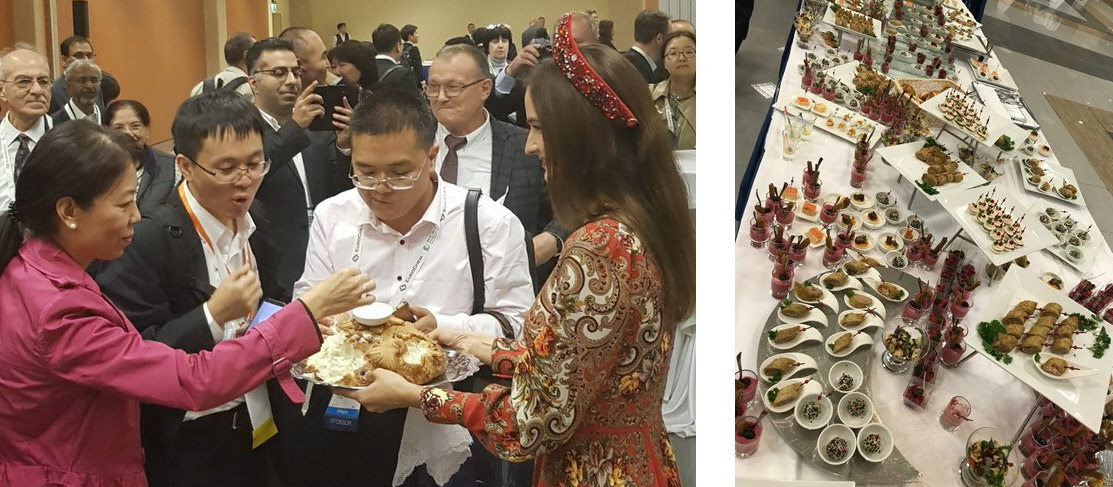
Tuesday was the final day of the Expo. It would appear that the IMPC in Quebec two years ago may have set a precedent for the exhibition to terminate half way through the Congress. I hope not, however, as the exhibition provides a focus for networking, and I hope this trend does not continue into the next Congress in Cape Town in 2020.
The Expo (photo Martin Rudolph)
At the main Congress, Kevin Galvin reported that fellow Australian "Prof. Robin Batterham gave an excellent plenary in the morning on the case for in-situ mining, pointing our that we are failing to discover new copper resources so will need to go deeper, coming to the conclusion that in-situ mining will, within the next 20 years, highly affect the field of mineral processing and replace processes such as flotation. Prof. Cyril O’Connor gave a nice talk on the application of Gibbs Excess as a parameter for describing hydrophobicity and hence contact angle. Prof. Janus Laskowski talked about flotation in sea water. So, many of the best talks came from those who have been significant contributors over past decades. We need some young people to come through for the future". In this respect it was great to hear that Dr. Pablo Brito-Parada, of Imperial College, UK, and one of the editors of Minerals Engineering was today elected to the IMPC Council. Well done Pablo!

It was also announced today that Australia will hold the IMPC in 2022 and USA in 2024, following Cape Town in 2020.

Many thanks to all those who have shared their experiences of the first two days in Moscow. I now invite all you others who are in Russia this week to also share your views on the Congress. The exhibition is now closed , and I would particularly like to know how you who have been exhibiting view the fact that the Expo was remote from the Congress, and that it all ended abruptly today.

Hopefully another update, on the final two days of IMPC later this week.

Twitter @barrywills
 

Sunday, 16 September 2018

Conference nostalgia: Minerals Engineering '98 in Edinburgh

The XXIXth International Mineral Processing Congress begins today in Moscow, and we wish them well.
Barbara and Amanda at registration
Twenty years ago today Minerals Engineering '98 drew to a close at the Stakis Grosvenor Hotel in Edinburgh, Scotland.   I organised this with CSM Associates, the consultancy wing of Camborne School of Mines, and it was also the first of these conferences attended by Amanda, who was working on her PhD at Birmingham University - 4 months later we formed MEI.
The 8th Minerals Engineering conference was sponsored by Eimco Process Equipment and Knelson Concentrators, now both merged with MEI's regular conference sponsor FLSmidth. The third sponsor was Australia's CSIRO. There were 123 registered delegates, representing 25 countries, and Prof. Jim Finch gave the opening keynote lecture on "Innovations and future trends in flotation cell design".
I am sure you will recognise many of the faces in the photos below, taken at the social events, which included a golf tournament at the St. Andrews Jubilee Course, and Highland Malt Whisky tasting at the Glenturret Distillery.
Peter Radziszewski, John & Cindy Herbst and Barbara
Dinner at Prestonfield House
Conference golf tournament at St. Andrews
With keynote lecturer Jim Finch
Hylke Glass, Mark Sampson, Amanda, Leon Lorenzen and Pauline Veasey at Falkland Palace
Visit to Scotland's oldest distillery, Glenturret
 
After the conference Barbara and I took a brief tour of this amazingly beautiful country:
Urquart Castle, Loch Ness
Glen Affric
Glen Affric
Glencoe
 

Friday, 14 September 2018

The Starkeys call in en route to Moscow

It's a long journey from Ontario to Moscow, and John and Donna Starkey, of Starkey & Associates Inc., wisely broke it up by spending a few days in Cornwall, and we were pleased to see them today to show them a little of Falmouth and to lunch at the Greenbank Hotel overlooking the Penryn River.

The MEI family with John and Donna Starkey
Starkey & Associates, sponsors of Comminution '20, recently joined forces with  Sacré-Davey Engineering (posting of 4th August), John now heading the office group as Chief Metallurgist.
John and Donna head back to London tomorrow to fly on to Moscow for the XXIXth International Mineral Processing Congress (IMPC). I attended my first IMPC in 1988 in Stockholm and have missed only one since then, the Rome IMPC in 2000, where MEI was represented by Amanda.

Moscow will be the first IMPC at which MEI is not represented. Unfortunately the Russian Embassy has made it very difficult (and expensive) to obtain visas, necessitating a long journey from Cornwall to the Embassy to be fingerprinted, and then a wait of up to several days for the visa to be processed. Basically it has not been worth the hassle, so we will rely on the 'grapevine' to feed us information on the progress of the week. If you are going to be there, and would like to share your thoughts, I would be very pleased to hear from you (bwills@min-eng.com), and if you are tweeting, please use #IMPC2018.

Thursday, 13 September 2018

Exploring Cornwall's mining heritage with the Julian Baring Scholarship Fund

Established in 2000, the Julian Baring Scholarship Fund was created in the name of well-known gold fund manager, Julian Baring, in celebration of his two great passions - mining and Africa.
The advisors to the fund, with the support of the industry and those in it, endow annual scholarships for talented, but financially disadvantaged, African students to continue their studies and pursue a career in the competitive mining industry.
The Fund has come a long way in the thirteen years since inception thanks to the hard work and support of both trustees and friends. In 2006, the Fund was given a major boost when it was generously awarded 1% of the initial equity in WitsGold. This has provided a fantastic base and security for the Fund’s future and means that it can begin to look at expanding its scope, both in terms of numbers of students supported and at different levels of their education and potentially its geographical spread.
The JBSF has undertaken several fundraising events since its inception in 2000. Some of these have involved the trustees and friends of the Scholarship putting their physical fitness to the test.  This week, over three days, and with the help of Cornish Lithium, the team is walking along the old tramways and coastal paths that cover the county made famous in the TV series of Poldark.

I took part in today's event, also sponsored by Strongbow Mining, who are reviving the famous South Crofty Mine, and who hosted a visit to their operations. South Crofty is a very old mine, which finally closed in 1998, but is scheduled to reopen and go into full production again in 2021. Well known as a deep tin mine, South Crofty was formerly worked in its shallower depths for copper, and we had a fascinating tour of the ancient stopes, some dating back to the 16th century. 

 
Up "to grass" today, and in the 1890s
Following lunch at South Crofty, the afternoon was spent walking part of the Great Flat Lode Trail. The Great Flat Lode is an enormous ore-body dipping at an angle of between 10 and 45 degrees, situated in the Camborne-Redruth area. The mines in this area, including South Crofty, helped to provide employment at a time when the rest of the Cornish mining industry was in decline. As the copper ores became exhausted in about 1870, the mine owners explored deeper, finding high quality tin concentrations underlying the copper. This gave the mines of the Great Flat Lode a new lease of life. After some of the companies amalgamated in the late 1890's the mines continued producing until about 1918. The Great Flat Lode Trail encompasses all the major mines of the Camborne-Redruth area, running in a 7.5 mile circular trail around the granite hill of Carn Brea. It includes the site of Cornwall's greatest mine, Dolcoath (posting of 3rd August 2015),  once the world's biggest producer of copper. As with most of the mines, in the late 19th century it became a tin mine, becoming, at 3000ft,  the world's deepest tin mine, but modern development has left little trace of this mighty operation.

At South Wheal Frances Marriot's shaft
It was sad to see the site of the West Basset Stamps almost impenetrable now due to recent years of neglect. This was always a favoured visit for MEI Conference delegates, but no more alas. Hopefully some local society might take it upon themselves to restore this site, probably one of Cornwall's most important archaeological sites.
Nature has virtually taken over the West Basset Stamps
West Basset Stamps a few years ago
Jeremy Wrathall and Richard Williams,
CEOs of Cornish Lithium and Strongbow Mining

After a great afternoon in the Cornish sunshine it was back to Falmouth to relax in the evening with dinner sponsored by Cornish Lithium at MEI's former conference venue, the St Michael’s Hotel. Many thanks from everyone to Cornish Lithium and Strongbow Mining for sponsoring an unforgettable day.

Twitter @barrywills

Tuesday, 11 September 2018

MEI Online Update #426 - the one where our subscriber list disappears

Hello Everyone,

Well, we've had a bit of a disaster here. Our subscriber list host, Topica, seems to have disappeared from the face of the internet with no warning. This means that we did not have time to retrieve our most current subscriber list from their servers.

Rather than risk spamming people who are on our old list, we have taken the decision to build up our subscriber list from scratch. If you wish to be added/re-added to the list, please email amanda@min-eng.com with the subject line: email list.

Whilst we build our list back up, the newsletter will be posted on the MEI Blog, MEI's LinkedIn page and anywhere else I can find for it!

For those of you reading who weren't subscribers, MEI Online Update is produced every 2 weeks and contains links to every new item added to MEI Online since the last issue - apart from jobs, which are listed in a separate email.

And in other news, we've picked up a few new sponsors. Clariant are sponsoring Flotation '19 for the 3rd time, and bring the number of sponsors of this event to 12.

We have two new sponsors for Physical Separation '19: Steinert are sponsoring for the 3rd time and Wolf Minerals are sponsoring for the first time.

Wolf Minerals will also be laying on a post-conference trip to their Drakelands Mine - we'll have more information on that for you shortly.

Barry's Blog:
* AusIMM Mill Operators' Conference- the final two days
* A short break in the Emerald Isle
* Norman Lotter's personal view of Extraction 2018
* Jack Holmes inducted into International Mining Technology Hall of Fame
* Cornish mining's bright future- a perspective from Malaysia
* Steve Morrell is inducted into the International Mining Technology Hall of Fame
* Day 1 at the AusIMM's MillOps 2018
* Steinert is on board once more, as a sponsor of Physical Separation '19
* AusIMM Mill Operators' Conference is only 5 days away
* Exploring Cornwall's rich mining heritage with the Ralstons
* Hi-Tech Metals '18. The option of making it a 3-day event
* Limitations to the commercial application of biohydrometallurgy for the treatment of base metal sulfide ores
* Falmouth Festival Week and a great Cornish Mining Sundowner
* Falmouth's beautiful North Helford region
* Tunnelling, then and now: Cornwall's Great County Adit and the London Super Sewer
* Richard Mozley's legacy lives on with the MGS
* Great news for Starkey & Associates
* First Announcement: Biomining '20 and Sustainable Minerals '20
* Announcing the merger of another important mineral processing journal

Best regards,
Amanda
amanda@min-eng.com
http://www.linkedin.com/amandawills
http://www.facebook.com/MEIConferences
https://twitter.com/MEIchat

******************************
* First Announcement: Flotation '19
******************************

Analytical Techniques & Applied Mineralogy
~~~~~~~~~~~~~~~~~~~~~~~~~~~~~

* Call for Papers: Process Mineralogy '18

* ZEISS-GSL Scholarship

* Recently Refereed Publication:
Minerals Engineering Vol.124

Analytical Techniques & Applied Mineralogy is sponsored by FEI

Biotechnology
~~~~~~~~~

* First Announcement: Biomining '20

Comminution
~~~~~~~~~

* First Announcement: Comminution '20

* CEEC welcomes Newmont as Sponsor of its Energy Efficiency Work in Mining

* Steve Morrell joins many comminution legends in the IM Technology Hall of Fame

* Recently Refereed Publications:
Minerals Engineering Vol.124
Powder Technology Vol. 335

Comminution is sponsored by Russell Mineral Equipment

Computer Applications
~~~~~~~~~~~~~~~

* First Announcement: Computational Modelling '19

* Recently Refereed Publications:
Chemical Engineering Journal Vol.350
Powder Technology Vol. 335

* Better SX Simulation, Better Plant Operation - Simula-SX

Control & Instrumentation
~~~~~~~~~~~~~~~~~

* Recently Refereed Publication:
Minerals Engineering Vol.124

Electrometallurgy
~~~~~~~~~~~~

* Recently Refereed Publication:
Separation and Purification Technology Vol.205

Environmental Issues
~~~~~~~~~~~~~~

* Call for Papers: Hi-Tech Metals '18

* Recently Refereed Publications:
Separation and Purification Technology Vol.205
Chemical Engineering Journal Vol.349
Minerals Engineering Vol.124

Froth Flotation
~~~~~~~~~~

* First Announcement: Flotation '19

* Recently Refereed Publications:
Colloids and Surfaces A: Physicochemical and Engineering Aspects Vol.554
Minerals Engineering Vol.124
Powder Technology Vol. 335

Froth Flotation is sponsored by FLSmidth

General Minerals Engineering
~~~~~~~~~~~~~~~~~~~

* Call for Papers: Hi-Tech Metals '18

* Newcrest and University of Queensland Formalise Education and Training Partnership

* Magotteaux Launch App for Mineral Processors

* CSM Laboratory Upgrade for new MSc Mineral Processing

Gravity Concentration
~~~~~~~~~~~~~~

* First Announcement: Physical Separation '19

* Recently Refereed Publication:
Minerals Engineering Vol.124

Hydrometallurgy
~~~~~~~~~~~

* First Announcement: Biomining '20

* Continuous Ion Exchange Technology Projects Achieve Milestones

* Better SX Simulation, Better Plant Operation - Simula-SX

* Recently Refereed Publications:
Chemical Engineering and Processing - Process Intensification Vol.130
Minerals Engineering Vol.124

Magnetic/Electrical Separation
~~~~~~~~~~~~~~~~~~~~

* First Announcement: Physical Separation '19

Magnetic/Electrical Separation is sponsored by SLon Magnetic Separator

Reagents
~~~~~~

* Recently Refereed Publication:
Minerals Engineering Vol.124

Reagents is sponsored by Axis House

Sizing, Classification & Sorting
~~~~~~~~~~~~~~~~~~~~

* First Announcement: Physical Separation '19

* Recently Refereed Publication:
Chemical Engineering Journal Vol.350

Solid-Liquid Separation
~~~~~~~~~~~~~~~

* First Announcement: Physical Separation '19

* Recently Refereed Publication:
Powder Technology Vol. 335

Solid-Liquid Separation is sponsored by FLSmidth

Plant Operations
~~~~~~~~~~~

* Start of Construction of Udokan Mining and Metallurgical Plant

Plant Operations News Australasia is sponsored by Magotteaux

Plant Operations News Europe is sponsored by Holman-Wilfley

People News
~~~~~~~~

* Steve Morrell joins many comminution legends in the IM Technology Hall of Fame

* Metallurgy induction for Jack Holmes in the International Mining Technology Hall of Fame

* David Pollard, 1945-2018

* Nick Wilshaw Appointed as a Director on the Board of the Coalition for Energy Efficient Comminution

* Join the Minerals Engineers LinkedIn Group

People News Australia is sponsored by JKMRC & JKTech

Journal News
~~~~~~~~~

* Springer adds new journal Mining, Metallurgy & Exploration to engineering portfolio

Commodities
~~~~~~~~~

New items in:

* Copper - News

* Copper - Refereed Publications

* Fluorspar - Refereed Publications

* Gold - Refereed Publications

* Iron - Refereed Publications

* Molybdenum - Refereed Publications

* Nickel - Refereed Publications

* Platinum Group Metals - Refereed Publications

* Rare Earths & Thorium - Refereed Publications

* Rhenium - Refereed Publications

Cobalt, Copper, Rare Earths & Thorium sections are sponsored by Axis House

Minerals Engineering Conferences
~~~~~~~~~~~~~~~~~~~~~~

* Technical Programme: Process Mineralogy '18

* Register Now: Process Mineralogy '18

* Technical Programme: Hi-Tech Metals '18

* Register Now: Hi-Tech Metals '18

* Call for Papers: Computational Modelling '19

* Call for Papers: Physical Separation '19

* First Announcement: Flotation '19

* First Announcement: Comminution '20

* First Announcement: Biomining '20


Monday, 10 September 2018

AusIMM Mill Operators' Conference- the final two days

I am deeply appreciative of the time spent by Dr. Kathryn Hadler, of Imperial College, in aiding MEI's Jon Wills in preparation of a report on MillOps 2018. Jon, Kathryn and family returned to UK last week, and their report on the final two days in Brisbane is below. Their report on Day 1 was published on 30th August.
The Brisbane Convention Centre
Thursday August 30th
Day two of the 14th Mill Operators’ Conference started with a plenary session focusing on education.  Neville Plint, director of the Sustainable Minerals Institute at the University of Queensland, gave a keynote talk on resourcing the mining industry, which included the interesting statistic that less than 1% of employees in the mining industry are metallurgists.  This statistic highlights the need for greater awareness of the work that metallurgists do, both within the industry and to the wider world.  Perhaps unsurprisingly, the number of graduates in mining engineering and metallurgy is predicted to drop to below 50 in Australia, underlining the reality of the much-discussed future skills shortage.  One of the big challenges for universities is that courses need to be financially viable, which means they need to attract critical numbers of students.  While the mining industry needs educated mining engineers and metallurgists, young people, particularly in countries such as Australia, are not attracted to the perceived dirty and polluting world of mining.  University courses, therefore, cease to run, and industry does not benefit from new graduates bringing new ideas.

To address this, rather gloomy, state of affairs, Neville suggested a raft of measures that could be taken, including more partnerships between universities and industry, and steps to increase undergraduate intake.  More importantly, he highlighted the changing expectations of students and graduates to an increased focus on entrepreneurship.  Many young people, he argued, are no longer interested in working in a big company as a small cog in a big wheel, but rather are motivated by setting up their own businesses, even with the high risk of failure.  Perhaps we should be reaching out to these groups of graduates and engaging differently with the new generation of engineers, scientists and innovators?

This keynote talk was followed by a panel discussion chaired by Diana Drinkwater of Mineralis, and chair of the IMPC’s Education Commission.  Diana presented the results from a survey of delegates, showing that over 75% thought that the work of metallurgists was critical to successful mining operation.  Although this might have been expected from a conference predominantly for metallurgists, it does show that this small but important sector should perhaps be shouting more loudly about the work that it does.  The following discussion covered many topics, but one recurring point was the lack of promotion of the mining industry as a viable and modern career option.

The exhibition hall was once again busy during day 2 where it was great to catch up with old faces and to meet some of the Australian branches of companies that regularly sponsor MEI Conferences.
Jon with Craig Brown of Resources Engineering & Management
Glencore Technology, sponsors of MEI's Flotation '19 and Comminution '20
John Russell of Comminution '20 sponsor Russell Mineral Equipment, with Randolph Pax
Comminution '20 sponsor King's Ceramics and Chemicals were represented by
Cathy He and Alex Wang
2017 MEI Young Person's Award Winner Grant Ballantyne of JKMRC (right)
with Outotec's Sherwin Morgan
The Metso booth
The FLSmidth booth
The Mill Ops conference dinner is always a grand affair with entertainment to suit. Dinner sponsors Glencore admitted that the usual sponsor talk isn’t something that people want to hear and so they instead went live to the Woodlawn mine site in New South Wales where the latest IsaMill had just been installed. This became the first IsaMill to be named after a person following a competition and this was revealed as the Cameron Brown IsaMill!
Instead of the usual comedian this year's entertainer was “The Unusalist” Raymond Crowe who performed magic, mime and shadow plays to the highest standard, while as usual, the wine and conversation flowed.
 Friday August 31st
Day 3 started with a keynote talk from Andrew Newell of RPMGlobal on metallurgical testwork, and on the importance of getting it right.  This was a thorough overview of all the areas that metallurgical testwork is used, and highlighted the importance of communication with and involvement of the testing lab through all stages of development.  Andrew gave some handy hints on how to select the most suitable lab for testwork, including past experience with the ore of interest, and suggested that one of the most common issues is insufficient sampling and/or testwork.  There was an interesting discussion on standards in testing, and whether there were any guidelines for labs, outside of the standards set by the JORC code.  This, it was discussed, would be very difficult to implement, since every ore is different.
There followed a session on emerging technologies, including the Albion Process and high voltage pulse comminution, at the end of which the CEEC medal was awarded by Alison Keogh, CEEC Chief Executive, to Sam Palaniandy, Hidemasa Ishikawa, Matthew Spagnolo, Huiwen Zhou and Rinto Halomoan for their paper presented at 2017’s MetPlant conference entitled ‘Fine grinding circuit process improvement at the Karara Mine concentrator’.
The conference was closed by Katie Barns, who awarded the prize for best paper to Dirk Baas of PanAust Ltd and Luke Mikhael Gurieff for their optimisation work entitled ‘Developing flotation circuit control and automation at the Phu Kham copper-gold concentrator’, while the best presentation prize was awarded to Thomas Waters and Amanda Rice of Newcrest Mining for their presentation ‘The evolution of the Cadia 40’ SAG mill to treat the Cadia East orebody – a case study of incremental change leading to operational stability’.  Congratulations to the winners!
The final comments from Katie included a tribute to the graduates entering the field, stating that they are motivated, engaged and bring new ideas to address old problems. 

The theme of Mill Ops 18 was “Back to Basics”, and this was the underlying message of many of the talks in this interesting and informative conference.  There was great interest in subjects that are often overlooked (e.g. tailings), which will continue to grow in significance in future, and in the new generation entering (or yet to enter) the industry.  
More views and comments at #MillOps2018.