Saturday, 9 December 2017

Wednesday, 6 December 2017

89th birthday greetings to Prof. Douglas Fuerstenau

Two years ago I had the enormous privilege of interviewing Prof. Doug Fuerstenau,  P. Malozemoff Professor Emeritus at the University of California, Berkeley, USA, for the MEI blog (posting of 20 July 2015). One of the all-time greats of mineral processing, Doug is 89 years old today, and we all wish him the very best as he enters his 90th year.
I am sure, however, that he and his wife of 64 years, Peggy, will want to put 2017 well behind them, as they were very much affected by the devastating fires that struck Napa and Sonoma Counties in Northern California in early October. Doug and Peggy live in a retirement village in Sonoma County and some 2000 homes were burned in Santa Rosa, but those in the Spring Lake Village where they live were spared.
The remains of Sarah and Scott's home
Doug and Peggy's daughter, Sarah, and son-in-law Scott, were not so fortunate, however, as their house in Glen Ellen, about 10 miles away, was completely incinerated, with everything in it. Doug and Peggy lost the storage building that had been constructed on Scott’s one-acre lot to store the many things that Doug had kept, related more or less to professional work.
Doug says that despite all this, they are thankful to be alive, as 44 people died in the fires. He said "one reads about disasters, but almost always the effects do not impinge on one personally.   Peg had two or three boxes with two complete sets of her very good china tableware plus antique goblets, etc. None survived.  Reprints of all my publications are ashes, including all of the original drawings of figures for theses and papers, reports, correspondence, some data files, very old books, Kodachrome slides, cameras, antique mining lamps, etc.  Whenever I think about looking  for something, I realize that it now has been burned to ashes or melted".
We wish Doug, Peggy and their family all the good fortune for 2018, and I am sure that if any of you have copies of Doug's publications and memorabilia, he would be very pleased to hear from you.

Monday, 4 December 2017

The rapidly evolving world of comminution is reflected in the Comminution '18 programme

Comminution '18 is the 11th in MEI's series of comminution conferences, and how the field has changed over the years. Prof. Alban Lynch, the first Director of Australia's JKMRC, said in 2003: "Comminution must be the key mineral processing technology during the next 50 years," and so it is without doubt. Last month at Flotation '17 in Cape Town I emphasised the crucial importance of flotation, "the world's most important technology", but flotation could not function without efficient comminution, which has had to evolve rapidly with the need to grind ores finer, and to do so with the minimum expenditure of energy. Worldwide the mining industry consumes around 2% of all electrical energy, and comminution is the major consumer, so great efforts are now made to reduce energy consumption, as well as water consumption, which is also critical.
Over 90 papers have been accepted for presentation at Comminution '18, and the provisional timetable is now available.
At the final panel discussion at Comminution '14 (posting of 5 May 2014), Prof. Tim Napier-Munn said that in terms of the future of comminution "we really have to get rid of tumbling mills". Four years on, there is no mention of rod mills in the programme- are these now finally obsolete? Ball mills would have dominated comminution conferences little over a decade ago, but they are mentioned only 5 times in the programme. SAG mills are still of major importance, but in his keynote lecture, Holger Lieberwirth, of TU Bergakademie Freiberg, Germany, will ask whether SAG mills will still be relevant in 50 years time.
The programme highlights that there are many new ideas out there,  new crusher developments, HPGRs, fine grinding devices and circuits, all offering new approaches and much hope for the future.
So, the Vineyard Hotel, in Cape Town's quiet suburb of Claremont, will be the place to be in April, not only for the fine, state-of-the-art technical programme, but for the many networking opportunities that will be available.
As always, lunches and coffee breaks will be in the exhibition and poster display area. If you are interested in exhibiting, you can view the display area here. Two of the cocktail functions, the Sunday welcoming pre-registration, and one of the afternoon 'sundowners' will be held in the exhibition area, the two other sundowners in the magnificent Vineyard gardens. The informal conference dinner will be at Lagoon Beach, with its iconic view of Table Mountain across the bay.
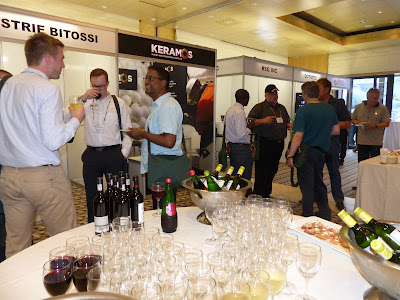
Vineyard scenes at Comminution '16
My report on Comminution '16 will give you some idea of what to expect. We expect more people next year, as the industry begins to pull itself out of the trough, and hopefully an increasing number of operators, which was good to see at last month's Flotation '17.
Finally, many thanks to our sponsors- we really do appreciate your support.
Current sponsors
Congratulations on a great conference [Comminution '16]. Good papers, made more powerful by a single stream which meant high attendance at each session, and good long breaks for informal discussions throughout the day, and meals in a spacious vendors area to encourage circulation. A great formula for a conference - quality over quantity, and time for discussion and networking and to keep the energy levels high. I wish all conferences could manage this balance so well."
Joe Pease, Mineralis Consulting, Chairman CEEC
More testimonials, and regular conference updates at #comminution18.
Twitter @barrywills


Saturday, 2 December 2017

Christmas is a-coming

Only a week after our last Camborne School of Mines Association event we were in Redruth today for the annual CSMA Christmas lunch.
Although fewer people than usual, it was really good to see Penda Diallo, the only current CSM staff member in attendance, who took up her duties at the School only 3 months ago. This was her second CSMA outing, and she tells me that she is really enjoying her new life in Cornwall. Below are a few photos taken at the Penventon Hotel today:
With Nick Wilshaw and Penda Diallo

Barbara with John Eyre, Steve Wilson and Nick Slade

Barbara with Phil and Joan Oliver and John Hills

Friday, 1 December 2017

TripAdvisor's Top 25 beaches in the world

TripAdvisor's list of the top 25 beaches in the world contains only one South African beach- Cape Town's Camps Bay, where Barbara and I spent 5 days last month after Flotation '17.
Camps Bay
Lists are always controversial; Camps Bay, with its backdrop of Table Mountain and the 'Twelve Apostles' is certainly lovely, but it is evident that relatively few of the TripAdvisor reviewers had visited the 'secret' places of Cornwall, which is a great pity (or maybe not!):
 
 So, what is your favourite beach in the world?

Thursday, 30 November 2017

Graeme Jameson in Germany

I have received this email from Dr. Martin Rudolph, Head of Department at Helmholtz Institute Freiberg for Resource Technology, Germany:
"... I would like to share impressions from Prof. Graeme Jameson’s visit to Dresden and Freiberg last week from Wednesday night until Friday morning. Noteworthy are his meetings with older flotation experts in Freiberg besides us from Helmholtz-Zentrum Dresden-Rossendorf showing him our recent flotation research topics at the Institute of Fluid Dynamics (Prof. Kerstin Eckert’s labs) in Dresden and the flotation labs at the Helmholtz Institute Freiberg (HIF). Below is a picture of Graeme (81) with Prof. Heinrich Schubert (91) at Schubert’s place. The other picture shows Graeme with Horst Plate, a former member of Dr. Hans Joachim Schulze’s group at the FIA in Freiberg. Graeme discussed theoretical aspects of detachment mechanisms with him after he was looking for some of his references in preparation of a review article.
Profs. Jameson and Schubert

Graeme with Horst Plate
It was great to have had him as our guests. We had him stay at a wonderful Dresden vineyard castle founded by British industrialists in the 19th century and enjoyed a great dinner at the famous Schiller Garten restaurant in Dresden. His approach to scientific and technical tasks including very philosophical mindset is a very impressing example of a personality to us. I feel very humbled to have the opportunity to learn from those people.
With that being said I also would like to thank you again for a wonderful Flotation conference in Cape Town. It would not have been possible for me with Flotation’13 and ‘15 to get to know the community that well and interact with the people, for until my PhD I have been active in an entirely different scientific community".
Thankyou for sharing this Martin. As I mentioned in my posting of 13th November, Graeme Jameson is truly inspirational; a great scientist who is also great company- the MEI team will always remember eating pizza with him a couple of weeks' ago in the Cavendish Mall close to the Vineyard Conference Centre!
Twitter @barrywills