Monday, 10 October 2016

Holman and Wilfley, well known names in mining, still going strong

The name Holman is well known to everyone in the mining industry, Holman Brothers Ltd. being a mining equipment manufacturer founded in 1801 and based in Camborne, Cornwall. The shaking table was one of its many products and together with Wilfley Tables, provided the backbone to gravity concentration circuits worldwide.
Now Holman-Wilfley Ltd is one of the world's most established and recognised suppliers of shaking tables and has been manufacturing gravity concentration equipment for the past 16 years. Originally set up on the Wheal Jane mine site in Cornwall in 1998 it relocated to larger premises in 2011 at Pool in Redruth next to South Crofty Mine. The company inherited the licensed OEM Holman and Wilfley technology from the original manufacturers, making them the only global company that still produces the well established, genuine premium brand gravity tables.
Both the Holman and Wilfley shaking tables have been in use for the best part of a century and Holman-Wilfley Ltd have been continuously developing the design, construction methods and materials to improve the product lines, and MEI is pleased to welcome the company as a sponsor of next year's Physical Separation '17 in Falmouth.
Earlier this week I dropped by their premises to talk to Managing Director Chris Bailey, who was one of my old CSM students, graduating in 1978, and to find out what the company has been up to lately.
With Engineering Technician Ben Thomas, Quality Assurance Manager Steve Thorne,
Managing Director Chris Bailey and Production Manager Adam Bailey
One of their largest recent supply contracts has been to Tronox Limited, Namakwa, South Africa, a total of 42 operating Holman units, as the final stage concentration of zircon recovered from a new tailings recovery project. This operation was successfully commissioned in early 2016.
Mineral Sands (zircon/rutile) continues as an active market, where Holman Tables are well proven, with further recent supply to Vietnam (Amigo Minerals), and to Industrial Minerals Corp., India.
In the environmental/recycling sector Wilfley and Holman machines are widely used, and machines have been recently despatched to UK and European destinations for recovery of non-ferrous metals from electronic and automotive recycling residues. Earlier this this year a new multiple installation of Holman units was commissioned as part of a contaminated soil washing plant in Switzerland.
With tin showing relative stability in demand and price, they are currently engaged in a large supply of Holman machines to a new tin project in Spain, and have been awarded a supply contract for machines to the Corporation Minera de Bolivia (COMIBOL), Colquiri Mine.
It's great to see succesful mining suppliers actively involved in Cornwall, and we thank Holman-Wilfley for their support of next year's conference.
Current Physical Separation '17 sponsors

Saturday, 8 October 2016

Portloe to Portholland

This is a short hike of just over 2 miles, but quite tough, due to its up and down nature and slimy surface when wet. 
Starting at Portloe, a quintissential tiny Cornish fishing village, once renowned as a base for smuggling French brandy, we walked the coast path to Portholland and then took the easier, but longer route back to Portloe via the narrow country lanes.
Portloe harbour
The scenery was attractive, if not dramatic, with good views of the approach to Dodman Point, and looking back to Falmouth Bay. 
Towards distant Dodman Point
Approaching West Portholland
 

Thursday, 6 October 2016

Jan Miller to review X-Ray Tomography for mineral processing at Process Mineralogy '17

An excellent programme is evolving for Process Mineralogy '17, which will be held in Cape Town in March. Already we have more papers than two years ago at Process Mineralogy '14. We will be drafting the provisional programme in 3 weeks' time, so it is not too late to submit an abstract!
This week we recruited a very distinguished specialist in X-ray tomography as a keynote lecturer. Prof. Jan Miller, of the University of Utah, will review X-ray tomography for mineral processing, with recent advances in X-ray tomography considered such as high speed scanning and image analysis procedures to describe particle size, shape, and composition. With these new 3D characterization tools, applications in mineral processing will be discussed for laboratory analysis including 1) particle damage state as a result of blasting/comminution, 2) liberation characterization to describe the efficiency of gravity separation, 3) exposed grain surface area analysis to explain the flotation of locked particles, and 4) floc size, shape, and water content for polymer-induced flocculation. Finally the possibility for plant-site X-ray tomographic analysis will be examined.
Jan Miller is the Ivor D. Thomas Distinguished Professor of Metallurgical Engineering at the University of Utah. He received his BS degree from Pennsylvania State University, and his MS and PhD degrees from the Colorado School of Mines. At the University of Utah Professor Miller has devoted over 40 years to undergraduate and graduate education. His research covers mainly the areas of mineral processing and hydrometallurgy, specializing in particle characterization, aqueous solution chemistry, and colloid and surface chemistry. He is a member of SME, TMS, and ACS. The recipient of numerous honors and awards, he was elected to the National Academy of Engineering in 1993.
Prof. Miller is one of three distinguished keynote lecturers at Process Mineralogy '17. Steve Williams of Pasinex Resources Ltd, Canada will discuss the benefits and tasks ahead for geometallurgy (posting of 24 February 2016) and Prof. Eric Pirard of the University of Liege, Belgium, will show how process mineralogy is an essential booster of the circular economy (7th March 2016).
Twitter #ProcessMineralogy17

Monday, 3 October 2016

A remarkable line-up at the IMPC in Quebec highlights the importance of flotation

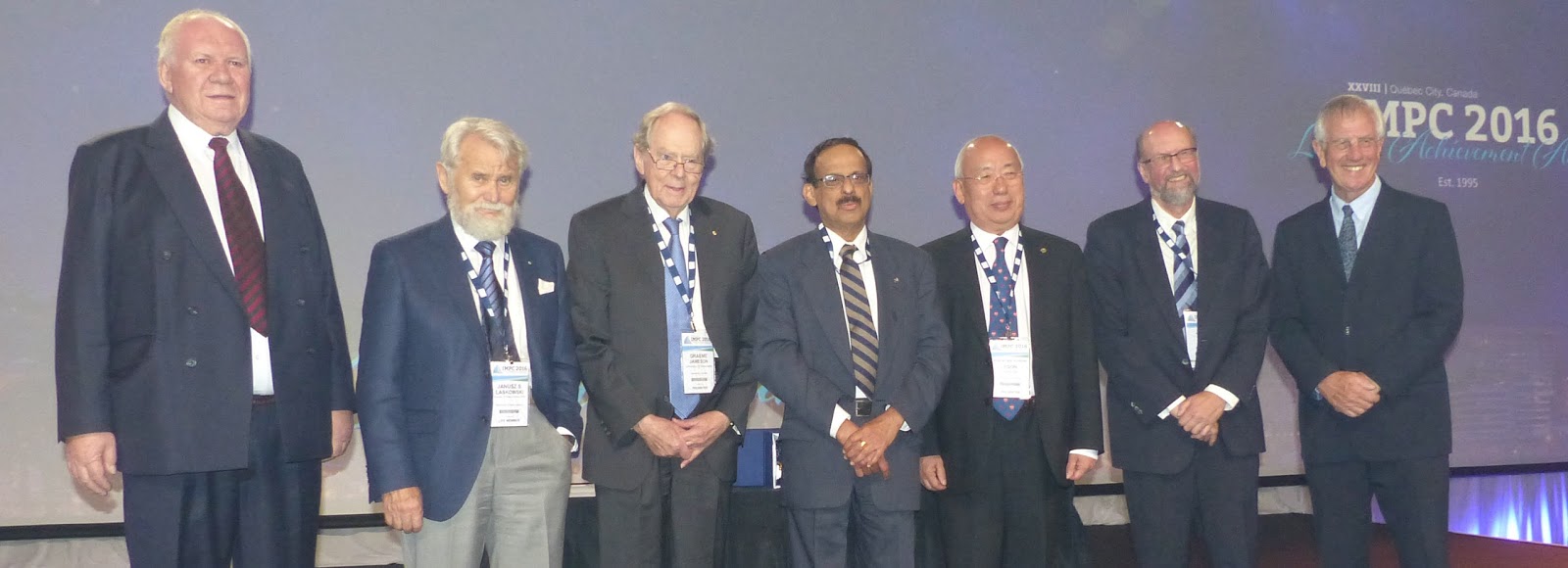
The photo below was taken at the Lifetime Achievement Awards (LTA) Banquet at last month's IMPC in Quebec. In the centre of the picture are four LTA Award Winners, Profs. Janusz Laskowski (2008), Graeme Jameson (2016), Ponisseril Somasundaran (2016) and Roe-Hoan Yoon (2014), flanked by the IMPC's Prof. Eric Forssberg (left) and on the right Profs. Jim Finch and Cyril O'Connor.
What is so remarkable about this line-up? Well, all the familiar figures in the photo are eminent flotation scientists, highlighting the importance of this technology not only to the minerals industry but to the world in general.
There was much talk at the IMPC about the lack of manpower in the mining industry and the need to recruit new blood (and hopefully to retain these people when times are bad!), but how can we attract young people into this industry, often perceived by the media and the general public to be dirty and environmentally unfriendly?
Well, maybe just by explaining what flotation is and why it is so important.
A good start is to explain why mining is the most important industry. The minerals industry serves society- without it society as we know it wouldn’t exist, as everything we use in our daily lives is either mined or grown. Ask any pre-University student what is the most important branch of technology, and the answers will probably be computer science, electronics, genetics etc. What needs to be impressed on them is that without the minerals industry these branches of science and technology would not exist- they are totally dependent on sophisticated electronic instruments which need metals of every description.
As ores become ever more complex and refractory it can be argued that the minerals engineer, whose job it is to economically extract these metals holds the key to sustaining and advancing modern society. Recycling also plays its part, but again it is the minerals engineer who has the key role, and recycling also presents immense technological problems- for instance how do we economically recover small amounts of elements such as lithium and germanium from used computers?
So although there was much talk, as always, at the IMPC about the need to attract young people into our industry, there is little evidence of direct action to do this.
During my time at Camborne School of Mines I spent a lot of time visiting schools, showing students how their fundamental science knowledge could be utilised in a challenging field such as mineral processing. I can honestly say that I recruited to CSM at least one student from every school that I visited, and it was flotation that really grabbed their attention. It is easy to explain why flotation, essential to producing the metals needed for civilisation, is probably the most important technological invention since the discovery of smelting, which catapulted man out of the stone age into the bronze age, and unlike, say, nuclear fission, is, in terms of its basics, a very easy process to explain- next time you call in at Buckingham Palace, I am sure that Her Majesty will explain the rudiments!
On every school visit I put a flotation cell in the boot of my car, and after describing the basics of flotation to the students I showed them a sample of a finely ground lead ore. All they could see was a white powder with a few flecks of black within it. This was then introduced to water in the Denver cell, and the looks of amazement when the air was switched on and those black flecks of galena formed a rich froth was something to behold- many of them were hooked!
Recruiting at a school in northern England in 1980
So, IMPC, Societies, Universities, if you want to attract students to our industry, let's become more proactive.
Twitter @barrywills

Sunday, 2 October 2016

Last month's most viewed posts

The 10 most popular blog postings in September can be seen below, together with the date of the posting and the total number of comments on the post.

XXVIIIth IMPC Conference Diary
19 September 2016 (16)
Are these WASET conferences just a scam?
28 April 2013 (79)
IMPC Lifetime Achievement Awards to Profs. Jameson and Somasundaran
15 September 2016 (4)
Special Froth Flotation issue of Minerals Engineering published
27 September 2016 (0)
Call for Papers: Computational Modelling '17 and Physical Separation '17
5 September 2016 (0)
An appreciation of JC Burrow- pioneering underground mining photographer
25 May 2015 (11)
IMPC 2016 gets underway
11 September 2016 (0)
Namibia- an exciting new venue for MEI Conferences
13 September 2016 (0)
Bill Johnson to present Flotation '17 keynote lecture on increasing metallurgical and energy efficiencies
15 August 2016 (2)
Laval's very impressive University Campus
10 September 2016 (1)

We encourage you to share your views by submitting your comments on blog postings. Last month there were over 20,000 page views, so interacting with the blog enhances your international presence by providing you, and your company or Institute, with valuable exposure.

If you are in Web View (mobile users can access this by scolling down to the bottom of the screen) you can also check various things in the right hand column:
  • The latest MEI tweets from @barrywills
  • The most viewed posts in the last 7 days
  • Dates of blog posts (click on the black arrows to open up individual months and postings)
  • Labels, or categories
You can also subscribe to blog alerts by email, and access MEI's Facebook page and MEI Online via links in this column.

Friday, 30 September 2016

New Book: Coal Processing and Utilization

This book is a direct outgrowth of classes that the authors, D.V. Subba Rao and T. Gouricharan, gave over a period of three decades to a university audience taking a Mineral Beneficiation course as a major that included coal processing and utilization. It is designed to be used as a student’s (or layman’s) first introduction to coal processing and utilization, motivating the concepts before illustrating them by means of concrete situations. As such, this book gives an integrated overview of coal processing and utilization along with clean coal technology, presenting all the basic principles, theory and practice in a systematic way. Every topic covered is dealt with in a self-explanatory manner so that any new reader may find this book interesting and easy to understand.