Monday, 18 September 2023

Memories of IMPC 2003 Cape Town: Pictures at the Exhibition

Following the welcome reception of 20 years ago this month (posting of 11th September) the 2003 IMPC was attended by approximately 620 delegates from 44 countries. The technical programme consisted of five plenary sessions and eight keynote presentations, each followed by three parallel sessions. In the plenary sessions Brian Gilbertson gave an in-depth analysis of globalisation in the mining industry, Jim Finch discussed the future of mineral processing education and Robin Batterham presented his views on the mine of the future. Richard Williams discussed the impact of fundamental research on future mineral processing operations and Jannie van Deventer discussed sustainability in the minerals industry.

Supplementing the technical sessions was a record number of exhibitors of equipment and services and some of the photos taken at the exhibition are shown below.

The MEI team
The JKMRC team
@barrywills

Monday, 11 September 2023

Memories of IMPC 2003 Cape Town: the welcoming reception

Those who attended the 22nd International Mineral Processing Congress, which was held at the Convention Centre in Cape Town 20 years ago this month will never forget it. The conference, the first, and so far the only, IMPC to be held in Africa was a watershed and ushered in the 'modern era' of IMPCs. Prior to 2003 they had been rather stiff, formal affairs, but Cape Town showed that conferences could also be fun and that networking with people was just as, if not more, important than formal presentations.

The Congress was attended by approximately 620 delegates from 44 countries. MEI has an archive of very many photos from this remarkable IMPC, so I will be posting a selection of photos from the various functions over the coming days, beginning with the welcome reception, which was sponsored by De Beers Consolidated Mines Ltd, an excellent 'ice-breaker' to begin the week. 

@barrywills

Wednesday, 6 September 2023

Prof. T.C. Rao: 1940-2023

There was very sad news from India yesterday of the death of Prof. Tadimety Chakrapani (TC) Rao at the age of 82. Regarded as the "Father of Indian Minerals Engineering" TC Rao's contribution to mineral processing has been considerable and the industry has lost a very distinguished gentleman.

Prof. Rao is probably best known for this collaboration with Prof. Alban Lynch (posting of 11th August 2014), whose names were synonymous in the late 1960s with the development of mathematical models of mineral processing systems, particularly hydrocyclones. They published their work on hydrocyclones in a number of seminal papers, and the models are still valid today, being used in many hydrocyclone manufacturers' performance curves. 

Under the guidance of Prof Lynch TC was the first international PhD student of mining engineering at The University of Queensland (UQ) and in 2016 UQ held its annual Courting the Greats Ceremony, recognising significant achievements by graduates (posting of 5th November 2016). Prof. Rao was recognised as the UQ International Alumnus of the Year and after many years was reunited with Prof Lynch five years before Alban's death at the age of 91 (posting of 18th September 2021).

Reunion in Brisbane

I was well aware of TC's reputation when he invited me to present a course of lectures at the Indian School of Mines (ISM) in Dhanbad in 1989. TC was Professor and Head of Mineral Engineering at ISM and had established a new four-year graduate programme (B.Tech) in Mineral Engineering, the only of its kind in India.

With TC at ISM in 1989
With ISM staff, TC is 4th from the right

Two years late TC was in Cornwall as a delegate at Reagents '91 at the Camborne School of Mines, and he is pictured below by the River Fal, with M.S. Prasad of the University of Minnesota, USA, Shouci Lu, of Wuhan Iron & Steel University, China and T. Wakamatsu of the University of Kyoto, Japan. 

Our last meeting was at the IMPC in New Delhi in 2012 (posting of 30th September 2012), where the chairman of his keynote lecture introduced him as "the Father of Indian Mineral Processing" and in 2014 it was my privilege to interview him for the blog (posting of 16th July 2014). I refer to this for full details of his life and achievements.

Delhi 2012

Prof. TC Rao will be sorely missed. He was a strong supporter of the MEI Blog and its most prolific commentator. His last comment was only six days ago (posting of 31st August) and I would  like to invite those who knew him to add your appreciations of a great man to this posting.

@barrywills

Monday, 4 September 2023

Memories of Hydrocyclones '03, Cape Town

Hydrocyclones '03 was MEI's 1st of only two hydrocyclones conferences, which were later incorporated into the Physical Separation series. It was held over three days at the Mount Nelson Hotel, Cape Town, 20 years ago this month. The conference was sponsored by Axsia Mozley and was attended by around 55 delegates.

The conference was timed to immediately precede the XXIIth International Mineral Processing Congress, which was also held in Cape Town, to give minerals industry delegates the opportunity of attending both meetings in this wonderful part of the world. Participants included industry representatives from the processing, oil production, and marine shipping industries, as well as scientists and engineers from universities and government institutions.

Papers from the conference were published in Volume 17 Number 5, a special Hydrocyclones issue of Minerals Engineering.

A selection of photos taken at Hydrocyclones '03 is shown below. Many of the delegates are familiar faces at current conferences, some, unfortunately, are no longer with us.

The MEI team
The AKW booth
The Axia Mozley booth
The Weir Minerals Booth
Lunch at the Mount Nelson
Wine tasting and dinner at the Groot Constantia wine estate
@barrywills

Thursday, 31 August 2023

August summary: world on fire and the Lionesses denied at the last hurdle

This month it was the turn of Hawaii to be devastated by wildfires, with hundreds killed on the island of Maui, the deadliest wildfire in modern American history. There were also major wildfires in other parts of the world, notably Canada's Northwest Territories and British Columbia. In addition to carbon dioxide emissions, Chinese scientists estimate that 110 million tonnes of nitrous oxide and methane equivalent were emitted from fires in Canada this year.

Canadian wildfires
Source: Reuters

Last month southern Europe was ravaged by fire and the devastation of the Greek island of Rhodes brought back memories of our visit to this beautiful island 50 years ago this month. Barbara, Amanda and I spent a few days there during a stopover in Greece on our return to the UK from our four year spell on the Zambian Copperbelt.

Barbara and Amanda in Athens and Rhodes, August 1973

Five years later I was back in Greece with a group of CSM students on an industrial tour and we visited the island of Evia, also ravaged by the July wildfires. We visited the magnesite processing plant at Manthoudi where we saw hand sorting of magnesite from serpentine on a moving conveyor by a team of female operators. I would guess this is now done by electronic sorters- has anyone any information?

Hand sorting at Manthoudi

In one of its worst recent summers the UK has fortunately missed the extreme heat and fire and in the middle of the month Falmouth was buzzing, with around 750 international captains and crew members in town for the start of the Magellan-Elcano Tall Ships race. But it was not to be, as the inclement weather forced the organisers to cancel the start in Falmouth, which would have been preceded by the spectacular Parade of Sail. Nevertheless the five Class A square-rigged ships moored in the docks were an impressive sight, with long queues of some of the 100,000 visitors who had flocked to the town to visit the ships. 

Meanwhile in Europe Jon and family holidayed in Austria and Slovenia, and I think I must add Lake Bled in Slovenia to my wish-list of places to visit:

There can be no more intense rivalry in international sport than the clashes between England and Australia. One of the greatest ever cricket Test Match series was played in England in July, with a final result a 2-2 draw, but with Australia retaining the "Ashes" trophy.  This month England's netball team lost to Australia in the World Cup Final in Cape Town, but England's honours were restored on the 16th of the month by the women's football team, beating Australia 3-1 in the semi-final of the World Cup, in front of a hostile home crowd in Sydney.

The fact that the "Lionesses" lost to Spain 1-0 in a hard fought final did not detract from beating the old enemy on their home turf. They were the first senior England football team to play in a World Cup final since 1966 and the only one ever to to do so on foreign soil.

Well done the Lionesses who have brought some light into the prevailing gloom of our summer and hard to believe that in 1921 the English Football Association announced a ban on women's football "The game of football is quite unsuitable for females and ought not to be encouraged". The ban was not lifted until 1970. How the women's game has come on since then, and I hope that the skill-levels shown by all the teams in the World Cup will inspire a new generation of women footballers to lift the game to ever increasing heights.
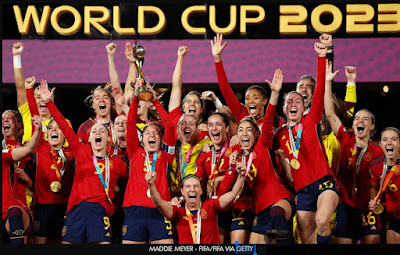
Despondent Lionesses and jubilant Spain, the better side on the night
Finally we must applaud India's scientists for landing the first ever spacecraft near the south pole of the moon, a completely unexplored region. Scientists believe the Moon's craters that are permanently in shadow may hold frozen water and India's third lunar mission came days after Russia's unmanned spacecraft span out of control and crashed into the Moon.

@barrywills

Monday, 28 August 2023

Capstone Copper to sponsor the next six MEI Conferences

At the beginning of the month the U.S. Department of Energy announced that it will add copper to its Critical Materials list. The US Energy Act of 2020 defines a Critical Material as "any non-fuel mineral, element, substance, or material that the Secretary of Energy determines has a high risk of supply chain disruption and serves an essential function in one or more energy technologies."

It is estimated that copper demand may double by 2050 but many of the proposed new copper projects are facing setbacks, and existing copper mines will eventually be exhausted as the world becomes increasingly reliant on green energy technologies. Copper is crucial for the energy transition and ensuring a steady supply to meet growing demand is a challenge as copper mining and extraction are resource-intensive processes, and finding new sources of high-grade copper ore can be difficult. Environmental concerns and the energy-intensive nature of mining also play a role in supply limitations.

So we are pleased to announce that Capstone Copper, which has a portfolio of long-life copper operations in Canada, USA, Mexico and Chile, with 11m+ tonnes of copper in measured and indicated mineral resources, is to sponsor the next six MEI conferences

Capstone is committed to continuous improvement in environmental, social and governance (ESG) performance. and the company's growing team of 7,900+ employees and contractors is well positioned to deliver the clean, ethical copper the world needs in the transition to a net-zero future. 

Senior Vice-President Peter Amelunxen said "We believe in giving back to the industry that has supported our growth, and the MEI conferences serve as a platform for experts, researchers, and industry professionals to share their technical knowledge and insights, fostering collaboration and innovation within the minerals engineering sector. By supporting these high-quality conferences, we actively participate in the advancement of the field, establish or enhance strategic partnerships, and contribute to the industry’s overall success.  We are a proud MEI supporter".

Many thanks Peter, we really do appreciate your continued support and confidence in MEI conferences, after having previously sponsored Sustainable Minerals '22 (online), Process Mineralogy '22 and Comminution '23.