A few weeks' ago UN chief Antonio Guterres said that a major new report on climate change is a "survival guide for humanity". The report from the Intergovernmental Panel on Climate Change, the scientific body that advises the UN on rising temperatures, was agreed on by all governments involved. At a meeting in Switzerland to agree their findings, climate scientists warned a key global temperature goal will likely be missed and their report lays out how rapid cuts to fossil fuels can avert the worst effects of climate change.
In response to the findings, Antonio Guterres said that all countries should bring forward their net zero plans by a decade, from the previously agreed deadline of 2050 (posting of 21 July 2019). Many who say this cannot be done argue that the reasons are essentially political, but forget, or are unaware, that mining is the most important industry for the eventual attainment of net zero, whether this be in 2040, 2050 or further in the future.
Many environmental groups have ludicrously called for a ban on mining altogether, as it is one of the world's greatest producers of CO2 and a massive consumer of energy, and indeed a number of new mining developments have had to cease recently due to environmental concerns.
Although many major mining companies are striving for net zero carbon, in many cases by up to 30-40% in the next 10-15 years, and to place themselves in a net-zero emissions position by 2050, it is true that the minerals industry is a major source of CO2 emissions. The cement industry alone is the source of about 8% of the world's CO2 emissions, and cement is the most widely used man-made material in existence, being second only to water as the most-consumed resource on the planet. But, while cement - the key ingredient in concrete - has shaped much of our built environment, its massive carbon footprint is such that, if the cement industry were a country, it would be the third largest emitter in the world, behind China and the US. It contributes more CO2 than aviation fuel (2.5%) and is not far behind the global agriculture business (12%). We look forward to Prof. Jannie van Deventer's keynote lecture at June's Sustainable Minerals '23, where he will propose a pathway for the adoption of new technology to decarbonise cement and concrete.
Despite the high carbon footprint of mining it is essential for the green transition, in the manufacture of renewable sources such as wind turbines and electric vehicles. Many metals and non-metals are essential in their manufacture and it must be remembered that huge amounts of energy are required just to mine and extract these materials so non-renewable sources of energy, either fossil fuels or nuclear, will be needed for some time in the transition.
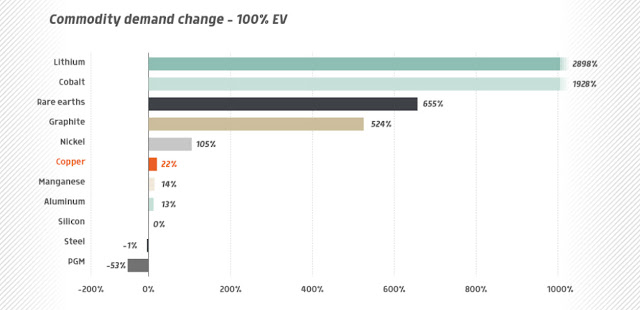
The lithium-ion battery is the heart of an EV and the figures below show estimates of the commodities in a typical battery pack, and how the demand on commodities would change if all cars became electric by 2050. In order for all vehicles to be electric, we will need around 400 extra graphite, Li, Ni, and Co mines by 2035, an EV requiring about six times the mineral content of a comparable international combustion engine vehicle.
 |
| Source: UBS estimates |
The most important metal in wind turbines and electric vehicles is copper, which is at the heart of either producing electricity or providing motive power. A large turbine requires around 4.5 tonnes of copper, and electric vehicles up to 100 kg. Average mined copper grades fell from 1.31% in 2000 to 0.94% in 2018, raising operating costs and slowing the enthusiasm to develop new mines, exacerbated by ESG concerns. Last month Chile, which accounts for a quarter of the world’s mined copper, posted its lowest monthly production in six years. Codelco said this will only get worse this year as it strives to tap new areas of its aging deposits after decades of under-investment.
When Cornwall was the world's biggest producer of copper in the mid 19th century, worldwide production was around 60,000 tonnes. Now it is well over 20 million tonnes of mined copper, even though Europe, for example, recycles around 50% of its copper.
In 2021 the world consumption of copper was over 25 million tonnes, and it is predicted that demand for copper could nearly double by 2050. The interesting graphic below shows that over the next 27 years the world will demand nearly twice the volume of copper that the world has produced over the last 3000 years!
So the minerals industry is crucial to achieving these goals, and mineral processing is at the forefront of the battle. What would we do without froth flotation, probably the world's most important technology, as without it the essential metals, such as copper, nickel, cobalt, manganese would be classed as precious metals. This is why we feel that our flotation series of conferences, such as November's Flotation '23 are of prime importance in helping ensure a plentiful supply of these and other metals and minerals as grades decline and ores become more complex.
It is ironic that in a few days time I will be on my way to Cape Town, for Comminution '23, which begins next Monday. In many hard-rock mine sites, comminution constitutes over 50% of the total energy consumption, and there are claims in published papers and the popular press that comminution in the mining industry may consume upwards of 7% of global electricity use, so I look forward to lively discussion on comminution and energy next week.
If it can't be grown it must be mined!
@barrywills