Friday, 31 August 2018

Steve Morrell is inducted into the International Mining Technology Hall of Fame

Great to hear that Dr. Steve Morrell has been inducted into International Mining's Hall of Fame (MEI Online). Steve was a Masters student at Australia's JKMRC around 30 years ago, and the founding Director of the JKMRC, Prof. Alban Lynch, was also inaugurated into the Hall of Fame five years ago (posting of 5th December 2013).
Steve has been a major contributor to MEI's comminution conferences, as a founder of CITIC SMCC Process Technology Pty Ltd, Australia, which provides independent technical services to various mining projects, mainly in the area of comminution circuit design, technology and equipment selection, and optimization of mineral processing plants. The company operates as an independent consulting company, and is ultimately owned by conference sponsor CITIC Heavy Industries, a market leader in China with equipment operating successfully in China and around the world, including Asia, Europe, America, Africa and Australia.
Steve is pictured below (centre) with Joe Pease, who was inducted into the Hall of Fame in 2016, and Chris Greet, at Comminution '16.
 

Thursday, 30 August 2018

Day 1 at the AusIMM's MillOps 2018

MEI's Jon and his partner Dr. Kathryn Hadler have sent this short report on the first day of the AusIMM's MillOps conference. Jon has attended a number of MillOps, but this was Kathryn's first, representing Imperial College, UK.:
This year's Mill Operators' conference is being held in Brisbane  on the 40th anniversary of the first event in Mount Isa. The opening session of the 14th AusIMM Mill Operators Conference, kicked off with Conference Chair Katie Barns welcoming a record number of 570 delegates from 27 countries.  Over 100 abstracts were submitted to the conference, of which 44 were accepted as presentations in this conference which as usual runs without parallel sessions.  Katie emphasised the theme of this year’s conference “Back to Basics”, and highlighted that all papers contained at least some plant data.  The conference continues with the restructure introduced at the last meeting in Perth in 2016, where talks in a session run without questions in between, instead allowing a panel-type discussion at the end of the session.  This has been followed up by the introduction of a conference app that gives an online programme and the ability to contact delegates (providing they are also using the app!); an innovation that is surely the future for conferences.
Neville Plint, Director of the Sustainable Minerals Institute at the University of Queensland, followed this introduction with the news that, in lieu of gifts to keynote speakers, the AusIMM had instead made donations to the newly set up Dee Bradshaw Travel Scholarship.  This fund will allow postgraduate students to undertake placements overseas, mirroring the Dee Bradshaw and Friends International Travel Scholarship from the University of Cape Town. 

Janine Herzig, AusIMM Director, then gave a short overview of the steps the AusIMM are taking to update and remain relevant.  The AusIMM celebrates its 125th anniversary this year, and a short video to commemorate this was shown.
The first of two keynotes in this session was given by the “brains behind the first MillOPs in 1978”, Peter Munro.  He gave a retrospective of 40 years of the conference series, regaling the audience with tales of the first, held in Mount Isa, where the 200 delegates twice drank the bar dry at the conference dinner, leaving the organisers to restock from the bottle shop across the road.  Peter gave a fascinating rundown of statistics on the conference over the 40 years and 14 meetings, including delegate numbers (increasing) and papers by commodity (predominantly base metals and gold) and geographical spread (over 80% of which have been Australian).  Of note is the low number of academic papers, with less than 10% of authors being from academic institutions in 2016.  This demonstrates the practical and plant-focused nature of the conference.
The second keynote was given by JP Franzidis, a familiar face to many who have attended MEI Flotation conferences.  He took the opportunity to look back at the beginning of his career in industry 40 years ago, and to look forward to the next 40 years.  When he started his career, the most important thing for any plant was tonnes processed.  Perhaps things have not changed that much!  JP gave a rundown of all the new technology available today, from SAG mills and HPGR, to the reflux classifier, including the development of process mineralogy tools and expertise.  In his look forward, however, he cautioned that the low level of trust in mining would become increasingly important to address, as accountability, circular economy and sustainability become key issues.  Perhaps fittingly for a university lecturer, his final words were on the role of education in producing the kinds of graduates that are required for minerals processing in the future.
Below are a few photos taken in the exhibition area on Day 1.
Brent Hill and Greg Chapman of Comminution '20 sponsor Keramos

BenTordoff (right) of Zeiss informed Jon that as well as sponsoring Process Mineralogy '18
they will also be running a pre-conference workshop

The Magotteaux team

The world's leaders in Ore Sorting Machines, Kaal Bartram and Peter Funke of
Physical Separation '19 sponsor Steinert, and Anthony Sacca of TOMRA
The late afternoon welcoming reception
Jon with Chris Smith of Rio Tinto and Alison Keogh of CEEC

Jon with Cobus Kotze of Dakot Wear

Jon with Randy Nix of Flottec and Kenneth Lee of Kemtec


Monday, 27 August 2018

Steinert is on board once more, as a sponsor of Physical Separation '19

The multi-national company Steinert is one of the leading players in electronic sorting, and we welcome them back as sponsors of Physical Separation '19 in Falmouth in June. This is the 3rd time that the company has sponsored the physical separation series of events. Steinert sensor sorters use NIR, HSI and x-ray technologies to help mines recover more materials from what is normally considered waste rock, in some cases eliminating the need for expensive heavy/wet media separation.
There will be much interest at the conference as to whether electronic sorting might replace DMS at Cornwall's South Crofty tin mine, which is due to reopen in a couple of years time. Up to its closure in 1998 the mine had used DMS to pre-concentrate the ore, as did the Geevor tin mine which closed eight years earlier. It will be interesting to see if electronic ore sorting is considered for the new processing circuit at South Crofty.
The pros and cons of sorting versus DMS were debated in the posting of 22nd July, and Jens-Michael Bergmann, of TOMRA Sorting GmbH, Germany, another major electronic sorting company, who I am sure will also be involved with Physical Separation '19, stated that XRT ore sorting will find its place in the future among all other technologies. He felt that it is not a "one-size-fits-all" technology, but it can be an excellent alternative for DMS or jigging. Often the grade of a rock (small inclusions of e.g. tungsten or galena or other sulfides) can be "seen" without crushing it to a liberation size where gravity-based technologies start to function, which saves a lot of crushing or transport cost, even without any water, for instance close to the mine face. He said "economically it (electronic sorting) always depends on the individual circumstances and sorting objectives: particle size, feed rates, grades, liberation, water access, permitting issues, environmental considerations, and finally cost per ton. These, at sizes +20 mm, usually are much lower that those of DMS. Therefore, nowadays XRT-Sorting replaces even existing DMS plants in various applications".
The latest updates on Physical Separation '19 can be found at #PhysicalSeparation19.
Current Physical Separation '19 sponsors
 

Friday, 24 August 2018

AusIMM Mill Operators' Conference is only 5 days away

The always excellent 'MillOps' conference begins in Brisbane next Wednesday.
Jon Wills
MEI is proud to be a media partner and we will be represented by Jon Wills, who will be accompanied by his partner Dr. Kathryn Hadler. Jon will be reporting daily on the conference and would appreciate you making yourselves known to him if you have any interesting news on innovation, people etc.
The AusIMM, unlike many major institutions, such as IMPC, has embraced social media and we look forward to seeing regular tweets on the event via #millops2018. I will be retweeting relevant postings, and I am sure that you know that the MEI tweets are fed to the right hand column of the blog.
There will be a sad note to the conference, however, and we were all very saddened to hear the news this week of the death of AusIMM stalwart David Pollard, who I had much involvement with in the past in our partnerships with the Metplant series of conferences. Our thoughts are with David's family at this time.
Twitter @barrywills

Thursday, 23 August 2018

Exploring Cornwall's rich mining heritage with the Ralstons

It's always a great pleasure to show people around our wonderful county of Cornwall. Particularly if guests have a keen interest in the history and beauty of the area, as did Prof. John Ralston and his wife Ann, who spent three nights with us this week.  South Australian of the Year, Officer of the Order of Australia, these are just two of the many accolades and awards showered on John, the founding Director of the University of South Australia's Ian Wark Research Institute (see also posting of 27 May 2014).
John and Ann are great fans of the BBC series Poldark, so in their limited time in Cornwall Barbara and I took them to some of the filming locations, beginning with the beautiful Kynance Cove on the Lizard peninsula, one of the settings for the fictitious Nampara Cove.
Overlooking Kynance Cove and "Nampara Cove" beach
Yesterday was a long day spent exploring some of Cornwall's copper and tin mining areas, beginning with the three magnificent 19th century engine houses at Wheal Peevor, near Redruth (posting of 1st July), which we will be visiting next June with Physical Separation '19 delegates.
The large pumping engine house of Wheal Peevor
Wheal Peevor
Then on to the rugged north coast, with a quick stop to admire the stunning North Cliffs scenery before travelling to the far west for lunch in the old mining town of St. Just, and then to Botallack, the submarine mines area, and the main location for the Poldark mining scenes.
The beautiful North Cliffs
Botallack
The iconic Crowns engine houses
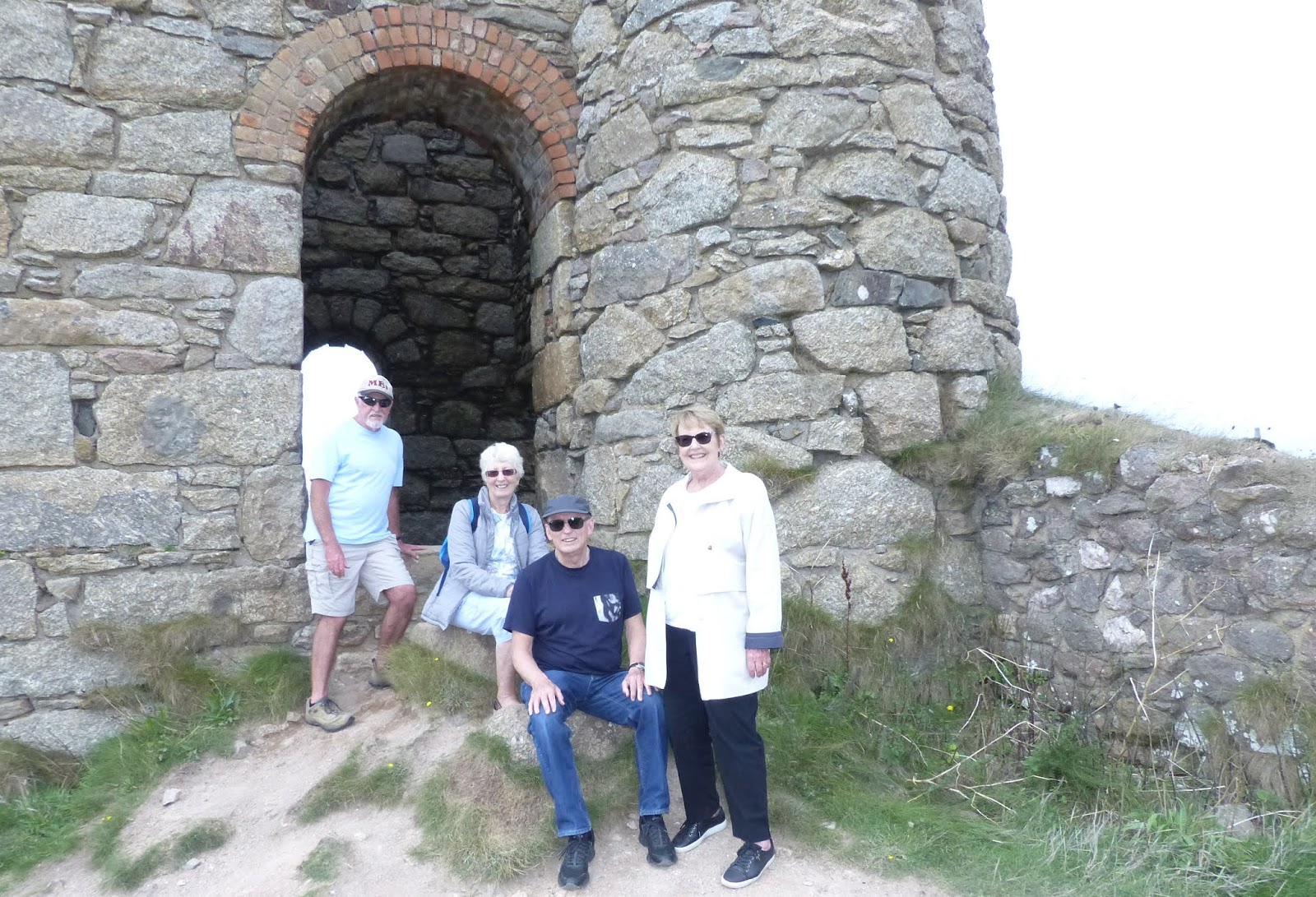
Outside the West Wheal Owles pumping engine house, which, suitably 'dressed',
was Ross Poldark's 18th century Wheal Leisure
It was great to see John and Ann, who are on a 7-week 'Grand Tour' of Europe. We will see them again in 15 months time, when John will be presenting a keynote lecture at Flotation '19. In the meantime he will be a busy man, with two 4 week trips to Namibia to make company contacts on behalf of the Namibia University of Science and Technology. He will also be travelling to China twice, to present seminars at Central South University in Changsha, and to work with Prof. Zhenghe Xu, now Dean of the Southern University of Science and Technology in Shenzhen, who was previously at the University of Alberta, Canada. John will be at the University of Alberta prior to Flotation '19 to present research seminars, and apart from all this will be delivering a keynote lecture at Metplant '19 in Perth and mentoring research teams at the University of South Australia!
But he does get the chance to relax occasionally, and what better place than for a couple of pints of real ale in Falmouth's famous Chain Locker pub.
Twitter @barrywills

Tuesday, 21 August 2018

Hi-Tech Metals '18. The option of making it a 3-day event

The two-day Hi-Tech Metals '18 is running back to back with the 3-day Process Mineralogy '18 in Cape Town in November (posting of 4th July). The programme for the final day of Process Mineralogy '18 has been timetabled to concentrate on the process mineralogy of rare earths, lithium and other hi-tech metals, and includes a keynote lecture from Prof. Frances Wall on the importance of mineralogy in the processing of rare earth deposits (posting of 8th January).
If you are travelling to Cape Town just for Hi-Tech Metals '18, you may like to take up the offer of staying an extra day and registering for the conference and the final day of Process Mineralogy '18. Full details are on the conference website.
Delegates at Process Mineralogy '17