Monday, 27 August 2018

Steinert is on board once more, as a sponsor of Physical Separation '19

The multi-national company Steinert is one of the leading players in electronic sorting, and we welcome them back as sponsors of Physical Separation '19 in Falmouth in June. This is the 3rd time that the company has sponsored the physical separation series of events. Steinert sensor sorters use NIR, HSI and x-ray technologies to help mines recover more materials from what is normally considered waste rock, in some cases eliminating the need for expensive heavy/wet media separation.
There will be much interest at the conference as to whether electronic sorting might replace DMS at Cornwall's South Crofty tin mine, which is due to reopen in a couple of years time. Up to its closure in 1998 the mine had used DMS to pre-concentrate the ore, as did the Geevor tin mine which closed eight years earlier. It will be interesting to see if electronic ore sorting is considered for the new processing circuit at South Crofty.
The pros and cons of sorting versus DMS were debated in the posting of 22nd July, and Jens-Michael Bergmann, of TOMRA Sorting GmbH, Germany, another major electronic sorting company, who I am sure will also be involved with Physical Separation '19, stated that XRT ore sorting will find its place in the future among all other technologies. He felt that it is not a "one-size-fits-all" technology, but it can be an excellent alternative for DMS or jigging. Often the grade of a rock (small inclusions of e.g. tungsten or galena or other sulfides) can be "seen" without crushing it to a liberation size where gravity-based technologies start to function, which saves a lot of crushing or transport cost, even without any water, for instance close to the mine face. He said "economically it (electronic sorting) always depends on the individual circumstances and sorting objectives: particle size, feed rates, grades, liberation, water access, permitting issues, environmental considerations, and finally cost per ton. These, at sizes +20 mm, usually are much lower that those of DMS. Therefore, nowadays XRT-Sorting replaces even existing DMS plants in various applications".
The latest updates on Physical Separation '19 can be found at #PhysicalSeparation19.
Current Physical Separation '19 sponsors
 

Friday, 24 August 2018

AusIMM Mill Operators' Conference is only 5 days away

The always excellent 'MillOps' conference begins in Brisbane next Wednesday.
Jon Wills
MEI is proud to be a media partner and we will be represented by Jon Wills, who will be accompanied by his partner Dr. Kathryn Hadler. Jon will be reporting daily on the conference and would appreciate you making yourselves known to him if you have any interesting news on innovation, people etc.
The AusIMM, unlike many major institutions, such as IMPC, has embraced social media and we look forward to seeing regular tweets on the event via #millops2018. I will be retweeting relevant postings, and I am sure that you know that the MEI tweets are fed to the right hand column of the blog.
There will be a sad note to the conference, however, and we were all very saddened to hear the news this week of the death of AusIMM stalwart David Pollard, who I had much involvement with in the past in our partnerships with the Metplant series of conferences. Our thoughts are with David's family at this time.
Twitter @barrywills

Thursday, 23 August 2018

Exploring Cornwall's rich mining heritage with the Ralstons

It's always a great pleasure to show people around our wonderful county of Cornwall. Particularly if guests have a keen interest in the history and beauty of the area, as did Prof. John Ralston and his wife Ann, who spent three nights with us this week.  South Australian of the Year, Officer of the Order of Australia, these are just two of the many accolades and awards showered on John, the founding Director of the University of South Australia's Ian Wark Research Institute (see also posting of 27 May 2014).
John and Ann are great fans of the BBC series Poldark, so in their limited time in Cornwall Barbara and I took them to some of the filming locations, beginning with the beautiful Kynance Cove on the Lizard peninsula, one of the settings for the fictitious Nampara Cove.
Overlooking Kynance Cove and "Nampara Cove" beach
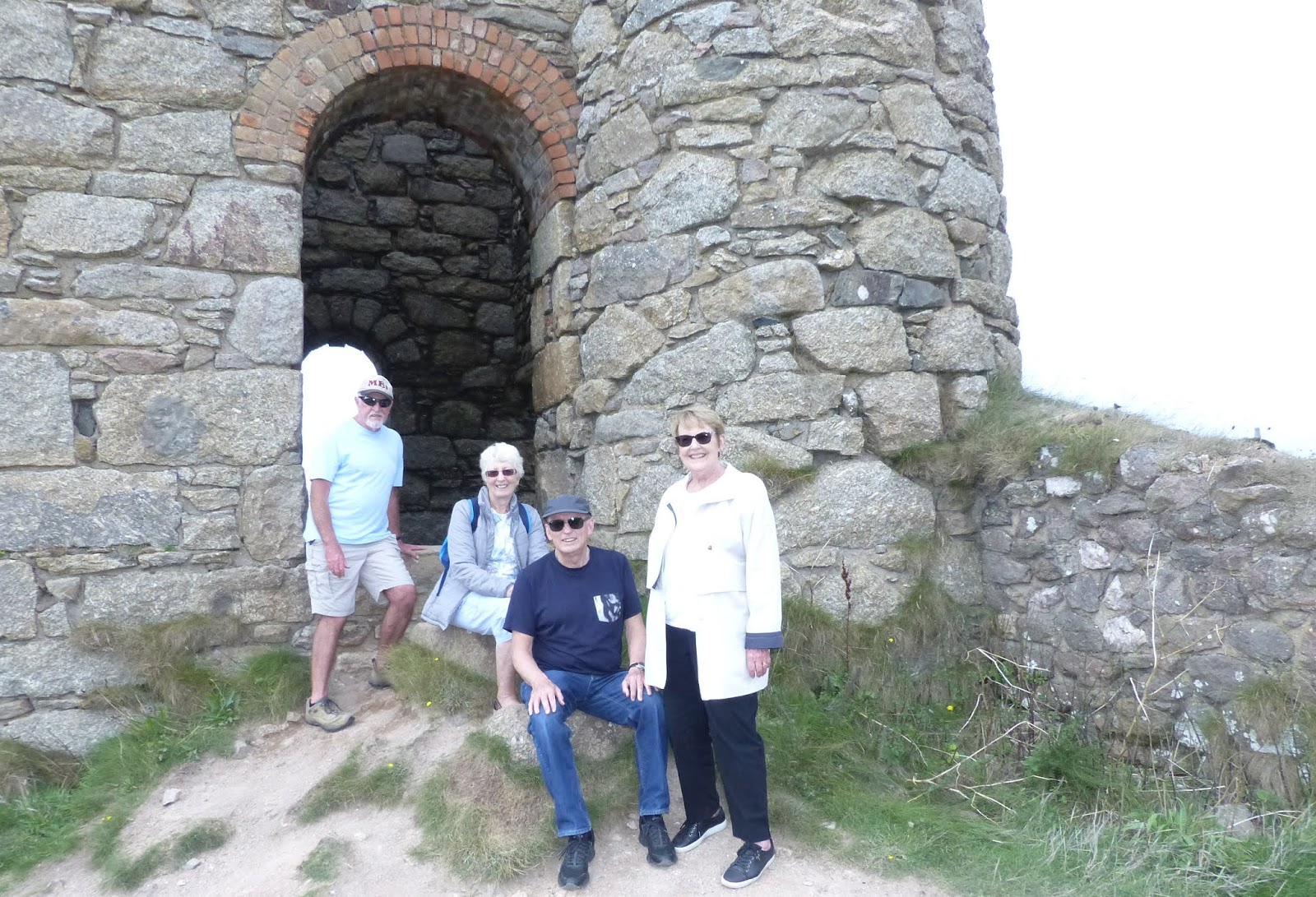
Yesterday was a long day spent exploring some of Cornwall's copper and tin mining areas, beginning with the three magnificent 19th century engine houses at Wheal Peevor, near Redruth (posting of 1st July), which we will be visiting next June with Physical Separation '19 delegates.
The large pumping engine house of Wheal Peevor
Wheal Peevor
Then on to the rugged north coast, with a quick stop to admire the stunning North Cliffs scenery before travelling to the far west for lunch in the old mining town of St. Just, and then to Botallack, the submarine mines area, and the main location for the Poldark mining scenes.
The beautiful North Cliffs
Botallack
The iconic Crowns engine houses
Outside the West Wheal Owles pumping engine house, which, suitably 'dressed',
was Ross Poldark's 18th century Wheal Leisure
It was great to see John and Ann, who are on a 7-week 'Grand Tour' of Europe. We will see them again in 15 months time, when John will be presenting a keynote lecture at Flotation '19. In the meantime he will be a busy man, with two 4 week trips to Namibia to make company contacts on behalf of the Namibia University of Science and Technology. He will also be travelling to China twice, to present seminars at Central South University in Changsha, and to work with Prof. Zhenghe Xu, now Dean of the Southern University of Science and Technology in Shenzhen, who was previously at the University of Alberta, Canada. John will be at the University of Alberta prior to Flotation '19 to present research seminars, and apart from all this will be delivering a keynote lecture at Metplant '19 in Perth and mentoring research teams at the University of South Australia!
But he does get the chance to relax occasionally, and what better place than for a couple of pints of real ale in Falmouth's famous Chain Locker pub.
Twitter @barrywills

Tuesday, 21 August 2018

Hi-Tech Metals '18. The option of making it a 3-day event

The two-day Hi-Tech Metals '18 is running back to back with the 3-day Process Mineralogy '18 in Cape Town in November (posting of 4th July). The programme for the final day of Process Mineralogy '18 has been timetabled to concentrate on the process mineralogy of rare earths, lithium and other hi-tech metals, and includes a keynote lecture from Prof. Frances Wall on the importance of mineralogy in the processing of rare earth deposits (posting of 8th January).
If you are travelling to Cape Town just for Hi-Tech Metals '18, you may like to take up the offer of staying an extra day and registering for the conference and the final day of Process Mineralogy '18. Full details are on the conference website.
Delegates at Process Mineralogy '17

Monday, 20 August 2018

Limitations to the commercial application of biohydrometallurgy for the treatment of base metal sulfide ores

Tank bioleaching is an established and competitive technology for treating refractory gold sulfide concentrates, but despite extensive research and development and considerable expenditure, the technology has had limited commercial application for treatment of base metal concentrates. Heap bioleaching is extensively used for commercial treatment of secondary copper ores but is still to be established for recovery of copper from primary chalcopyrite ores.
In the first keynote lecture at Biomining '20 in Falmouth, Dr. David Dew, of Dewality Consultants Ltd, UK, will review tank bioleach technology developed for treating base metal concentrates and discuss the process and engineering factors that determine the design and scale-up, identifying the limiting factors that affect commercial competitiveness. The development of chemical and bioleaching processes for heap leach treatment of primary copper sulfide ores will also be reviewed identifying challenges that limit bioleach performance.
Dr. Dew feels that the hydrometallurgy component of biohydrometallurgy is often largely ignored at conferences concerned with bioleaching, despite the fact that downstream iron removal, metals recovery and waste disposal are key elements that determine the viability of the overall process. He will review some of the standard methods used for metals recovery and the challenges that are imposed on the overall process, particularly relevant to heap leach operations. Considering the limitations and challenges identified, he will then present a case for opportunities where biohydrometallurgy may add value and identifies focus areas for development.
 
David Dew has 30 years international experience in the development of biohydrometallurgical processes for application in the extraction of base and precious metals. He joined Gencor Ltd., South Africa, in June 1983; in 1990, as Principal Research Metallurgist, he joined the project team responsible for development of the BIOX Process. He took a lead role in the improvement and design of the bioleach reactors, reducing power costs and establishing a methodology for pilot testing and commercial plant design. He was later appointed Manager Process Development at Billiton Plc responsible for leading research in this area. In 2001 Billiton merged with BHP to become BHP Billiton and David was appointed as Global Technology Manager at the Johannesburg Technology Centre, primarily responsible for technology development for the Base Metals Division. David became an independent consultant in 2012 and formed his own company, Dewality Consultants Limited, which he operates from his home in Cornwall. In May 2018 David joined the College of Engineering , Mathematics and Physical sciences, University of Exeter, as a Postdoctoral Research Fellow working part-time for the Horizon 2020 NEMO project, funded by the European Union. The project re-establishes his links with the Camborne School of Mines, from where he graduated in 1979. 

David's keynote is something to look forward to, but in the meantime I am sure that he would appreciate your views on the future of biohydrometallurgy for the treatment of base metal sulphide ores.
#Biomining20 for the latest updates on the conference.

Friday, 17 August 2018

Falmouth Festival Week and a great Cornish Mining Sundowner

The Cornish Mining Sundowner gets better and better, with a great turnout of around 30 yesterday at Falmouth's Chain Locker pub.
Pete and Mary Shepherd, Nick Eastwood, Barbara Wills, Tony Clarke and Steve Barber
Pauline Clarke with Process Mineralogy '18 keynote speaker Frances Wall
BW, Dave Goldburn, Nick Eastwood, Dean Eastbury, Steve Barber, Pete Walsh, Barbara Wills, Dave Dew
The Cornish Mining Renaissance is well under way, and it was good to see so many Cornish Lithium staff, pictured below with Pete Ledingham, Project Manager for the United Downs Deep Geothermal Power project, operated by Geothermal Engineering Limited (GEL). The quest to extract lithium from geothermal brines is now well under way, and Cornish Lithium has recently recruited eight more geologists to the project.
Pete Ledingham (right) with Cornish Lithium staff Adam Matthews, Beth Colgan,
Tom Naylor, George Fry, Lucy Crane and Chris harker
GEL has secured funding of £10.6 million from the European Regional Development Fund to explore the geothermal resources deep beneath Cornwall. With £2.4 million from Cornwall Council and £5 million from private investors, the funding will allow GEL to drill two deep geothermal wells from its site within the United Downs Industrial Estate and build a 1MW pilot power plant to demonstrate the technical and commercial viability of supplying both electricity and heat. Drilling hopefully starts next month, so there will be much to report on in the following months.
It was nice to talk to two young people now embarking on their minerals industry careers. Alex Perry and Sajjad Jabarkhel graduated last month from Camborne School of Mines with honours degrees in Mining Engineering. Alex was Student Union President in his final year, but still managed a first class degree. He is hoping to work in Australia, and I am sure he is set for a very bright future. Sajjad is originally from Afghanistan, and is seriously thinking of staying on at Camborne to study for an MSc in Mineral Processing.
Sajjad and Alex (right) with Tony Clarke, Dean Eastbury, Lucy Crane, Dave Goldburn, Patrick Hegarty and Rob Fitzpatrick
I was pleased to see Rob Fitzpatrick back at a sundowner. Rob is leader of the new MSc in Mineral Processing, which starts next month (MEI Online). He is pictured below with biohydrometallurgists Dave Dew and Paul Norris, and Dave Goldburn of Physical Separation '19 sponsor Holman-Wilfley. Dave Dew will be presenting a keynote lecture at Biomining '20 in Falmouth.
Dave Dew, Paul Norris, Rob Fitzpatrick and Dave Goldburn
Rob tells me that they are expecting between 5 and 10 on the programme this year, but will be pushing next year for better numbers with visits to universities with relevant undergraduate programmes amongst the other forms of advertising.  The programme addresses the industrial need for more trained minerals process engineers, offering a great opportunity for undergraduates with chemistry, engineering, geology and other related backgrounds to enter the exciting field of mineral processing. It provides an excellent opportunity for practical, hands-on learning, featuring the latest developments in mineral processing. Students will also benefit from the wealth of expertise available in industry, particularly from mineral engineering companies based in south west UK. The MSc Minerals Processing programme, including a part-time blended learning option for working professionals, is enthusiastically supported by the CSM Trust, which is currently offering five scholarships of £6k for successful applicants.
This was a great sundowner, part of a great week in Falmouth. The town has been teeming with visitors this week, for the annual Falmouth Festival Week. With its origins in a local sailing regatta dating back at least as far 1837, the Week has evolved into not only a major sailing competition in the south west but also an opportunity for tourists and locals to enjoy the many daytime and evening attractions in the town. The highlight, as always, was the display by the Red Arrows, the RAF's aerobatic team, on Tuesday evening.
The Red Arrows arrive in Falmouth to an eagerly awaiting crowd on Gyllyngvase Beach
Falmouth is certainly a great place to be, and we look forward to being at the next sundowner at the Chain Locker on Thursday September 20th, commencing 17.30.

Twitter @barrywills