Saturday, 11 February 2017

We welcome TOMRA Sorting Solutions to Physical Separation '17

The increasing importance of physical separation in mineral processing was discussed in the posting of 16th January, which highlighted how electronic ore sorting is becoming increasingly used, due to the development of rapid sensors in such sorters. So we are pleased to announce the sponsorship of another leading player in this field, TOMRA Sorting Solutions of Germany.
The mining industry consumes 2%-3% of the world’s energy, the same amount of energy used by the entire airline industry. TOMRA Sorting, which originated from CommodasUltrasort, claim that their sensor-based sorters can reduce that energy consumption by 15%, as well as reducing the amount of water used by three to four cubic meters per ton of ore.
We also welcome back Jens-Michael Bergmann, TOMRA's Sales and Project Manager Europe, who will present a paper in the fine technical programme, describing TOMRA's latest multi-channel laser sorting machine, which opens new opportunities for mining companies.
Current Physical Separation '17 sponsors

Wednesday, 8 February 2017

Memories of student days at two great mining schools

It will be great to have Tim Napier-Munn with us in Falmouth in June. He will be presenting one of the keynote lectures at Physical Separation '17 (posting of 28 January) and is looking forward to visiting the old pubs of Falmouth, and particularly the field trip to the historic Camborne-Redruth tin and copper district.
The prospect of the mine visit obviously created a surge of nostalgia, and Tim sent me these fascinating photographs of his first visit to the mines of Cornwall, with the final year Mineral Technology group from the Royal School of Mines (RSM), in 1970.
One of the very few photos of the 1970 final year together.  Left to right:  Zaki,
Lai Kim Fun (ended up in Tasmania), Alan Middleton, Mick Beaumont,
Ron Dougill,  Keith Suttill, Alan Loosely, and ?.
Standing behind Keith Suttill is Dave Wellings. 
Keith sadly died in a plane crash in the Andes in 1996
while working for Engineering & Mining Journal 
Alan Loosely, Keith Suttill, Dave Wellings and Ron Dougill
As Tim was the photographer, he unfortunately does not appear in the photos, but one of the faces I immediately recognised was that of Henry Cohen, who succeeded Marston Fleming to the Chair of Mineral Technology in 1974. Prof. Cohen's research on the magnetic properties of minerals led to work on super-conducting magnets and cryogenic systems, and in later years he supervised Tim's PhD research into dense medium cyclones, the subject of his keynote lecture in June.
Henry Cohen (2nd left front) with other staff members
I knew Prof Cohen well, as for a number of years he was External Examiner to the degree course in Mineral Processing Technology at Camborne School of Mines (CSM). Being based in Cornwall, CSM had the great advantage over RSM of having the then working mines of South Crofty, Geevor, Wheal Jane, and others, on the doorstep, such that the students became very familiar with the operations and the personalities involved. One of the great features of the CSM course was the 'pilot plant run' where second year students gained experience in operating a continuous small plant over a one week period. I have already posted photos provided by 1985 graduate Gaynor Yorath (posting of 4 December 2010), but the only person to have been involved with every pilot run is former Experimental Officer Tony Clarke, who has kindly sent me these nostalgic photos taken in the 1980s:
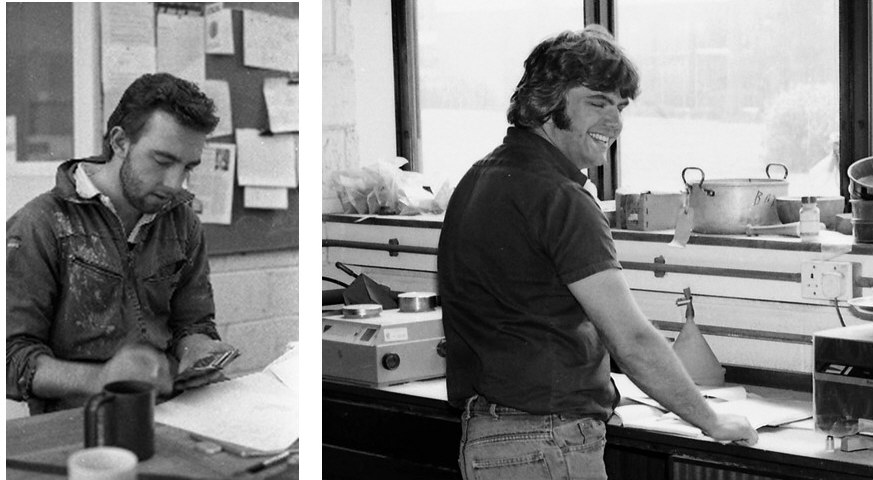
Liam MacNamara and Nick Wilshaw in their student days in the 1980s
Liam is now Vice-President Sales, FLSmidth, UK
and Nick is owner of Grinding Solutions Ltd, UK
Great memories of a bygone era when tin mining in Cornwall was still thriving.
Twitter @barrywills

Monday, 6 February 2017

Superior comminution circuit performance: integrating classification during design is the key

The synergistic relationship between comminution and classification in comminution circuits is well known and has been extensively proven both in research and plant operation practice – but why do we often get it wrong? This will be the subject of a keynote lecture at next year's Comminution '18, by Prof. Aubrey Mainza of the University of Cape Town.
Aubrey is Head of Comminution and Classification Research in the Centre for Minerals Research, his research areas including comminution and classification, where he uses Discrete Element Method, Computational Fluid Dynamics, and Positron Emission Particle Tracking as tools in his modelling methods. Aubrey is a familiar figure at international conferences, particularly MEI's comminution series, where he has acted as a consultant for a number of years.
Aubrey (centre) with Magnus Evertsson and Hakan Benzer at Comminution '16
The comminution circuit is usually made up of comminution devices operated in closed circuit with different types of classifier. The closed circuit arrangement can have separate comminution and classification devices linked through pump-sump arrangements or integrated comminution-classifier systems. It is well documented that the choice and operation of the classifier have a major influence on the performance of the comminution circuit as a whole. An inefficient classifier can increase the energy consumption of the comminution circuit and in most cases also compromise the quality of the product reporting to downstream processes, leading to losses in recovery of the valuable mineral. Despite the known pitfalls of inadequately designed classification components of the comminution circuit the status quo has continued in most design teams. Substantially more effort and resources are expended on testwork for selecting and sizing comminution equipment compared to the accompanying classifying equipment, which is subjected to minimal or sometimes no confirmatory testwork.
In his keynote Prof. Mainza will ask why clear evidence of inefficient circuit performance that is directly attributable to a mismatch of the comminution and classification devices often appear to be totally ignored, and how can this perennial problem be eliminated in our standard comminution circuit design approach? He will ask what solutions have mining research and innovation programs provided in resolving the subtle incompatibility problems between comminution and classification devices and he will address the problems encountered when common approaches are used in selecting key comminution circuit equipment, proposing amendments that should be considered to avoid the known deficiencies.  

Sunday, 5 February 2017

Cornwall Mining Alliance to sponsor Process Mineralogy '17

We are very pleased to welcome the Cornwall Mining Alliance (CMA) as a sponsor of next month's Process Mineralogy '17 in Cape Town.
The Cornwall Mining Alliance is a network of over 75 organisations based in an area of the UK where a rich history of mining, mineral extraction, research and development has resulted in a unique concentration of experts and specialist suppliers to the global mining sector. The CMA hosts 19 companies who offer mineral processing services worldwide. Several representatives of the CMA will be attending the conference to present research, meet up with colleagues and make new contacts.
Current Process Mineralogy '17 sponsors

Thursday, 2 February 2017

Nag Nagaraj completes the trio of mineral processors to be inducted into International Mining Technology's Hall of Fame

Great to see that all three mineral processing inductees into International Mining Technology's Hall of Fame are MEI Conferences keynote lecturers. Last year it was reported (posting of 16th November) that Dr. Bill Johnson, keynote at Flotation '17 and Joe Pease, who gave a keynote at Comminution '16, were inducted into the Comminution Category.
Inducted into the Concentration Category last month is Cytec's Prof. D.R. Nagaraj, keynote lecturer at Flotation '15.
Prof. Nagaraj (centre) at Flotation '15
Congratulations to all three, who will receive their awards at the International Mining awards dinner in Denver on February 20th, during SME Conference week.
Twitter @barrywills

Wednesday, 1 February 2017

Innovation in mineral processing

It is often said that mineral processing as an industry is slow to react to new and innovative technologies, but detailed reports on the perception and adoption of innovation in mineral processing seem to be few and far between. To get a better handle on this, Grinding Solutions have set up a survey on the who, what, where and when of innovation in mineral processing:

The survey is anonymous, and it consists of six categories:
• Some questions on your background to help put results into perspective.
• How do you see the speed of innovation and where is there potential for further work in various mineral processing disciplines?
• What do you see as important drivers and inhibitors to innovation?
• Who are the most successful and productive sources of innovation?
• When is the potential for innovation the greatest, and how should results/success stories be communicated?
• Appraisal of the potential benefits of innovation, i.e. at what point does an innovation become a financially viable proposition?
Grinding Solutions would be very grateful if you could spare some time to fill in this survey, which is estimated to take approximately 5 – 10 minutes. The results from this survey will be made freely available at a later date, and they will not be used for commercial purposes.
For clarity and consistency, please keep the following in mind when answering the questions:
• All questions apply specifically to mineral processing, i.e. they exclude the petroleum sector and concentrate smelters/refineries
• For the purposes of the survey, consider innovation as novel technological solutions that represent a significant improvement over existing solutions, as well as the engagement in research and development of these novel technologies.
 
On behalf of Grinding Solutions, thankyou for your time and we hope the results of this survey can be of general benefit to professionals in all sectors of mineral processing.