Friday, 18 November 2016

Promet101, the latest sponsor of Flotation '17

We are pleased to welcome back Chilean consultancy company Promet101 Consulting as a sponsor of Flotation '17. Delegates from the company attended and sponsored their first MEI Conference, Flotation '15 last November. Promet101 is also the Chilean agent for Blue Cube Systems (Pty) Ltd of South Africa, a technology company focussed on real-time in-line instrumentation for the minerals processing industry and a regular at the Flotation Conferences.
As always Flotation '17 will feature two discrete symposia, on Fundamentals and Applications, and short abstracts for the symposia should be submitted by the end of May.
Current Flotation '17 sponsors
Twitter @barrywills

Wednesday, 16 November 2016

MEI Conferences keynote lecturers inducted into International Mining Hall of Fame

Bill Johnson
Good to hear that two of MEI Conferences keynote lecturers, Joe Pease and Dr. Bill Johnson, will be inducted into the International Mining Technology Hall of Fame in the Comminution category at the gala awards dinner in Denver on February 20th, during SME Conference week.
Joe was a keynote speaker at Comminution '16 earlier this year, and Bill will be presenting a keynote at next year's Flotation '17, emphasising the intimate link between comminution and flotation.
Joe Pease (left) at Comminution '16 with Steve Morrell and Chris Greet
Full details can be found on MEI Online.
Twitter @barrywills

Good news and sad news from Australia

I was pleased to see that Prof. Alban Lynch was inducted into the Australian Prospectors & Miners' Hall of Fame earlier this month (MEI Online).
This good news was tempered, however, by the sad news that Alban's wife, Barbara died just a few days later. All of us at MEI offer our sincere condolences to Alban and his family on their loss.

Monday, 14 November 2016

Is most published research wrong?

Earlier in the year I published an article on the blog entitled Let's start to take bad science seriously, which generated a lot of interest, as I hoped that it would. It also increased awareness of the problem, which has been evident in papers submitted to Minerals Engineering, and also thanks to the vigilance of our Associate Editor Dr. Pablo Brito-Parada.
Now to supplement this posting is a thought provoking video, brought to my attention by Dr. Dee Bradshaw of University of Cape Town. I shall not attempt to summarise it, but I would suggest that anyone interested in research publication and the scientific method takes a close look at it, and hopefully comments on its content.
Dr. Norman Lotter, of Flowsheets Metallurgical Consultants Inc., Canada travels extensively giving lectures and workshops on sampling and statistics and comments thus:
An interesting discussion. It took me to my bookshelf and "Statistics for Experimenters" by Box and Hunter (1979), a book that I have used since the early eighties. Chapter 1, "Science and Statistics" offers a worthy discussion on the importance of experimental design and proper data analysis, and cautions as to the danger of incorrect data interpretation.

One point that the YouTube clip did not make was taught to me by Isobel Clark: "Make sure that you understand how the data are naturally distributed before you assume a Normal Distribution". Then tailor your approach accordingly.

In the field of flotation tests we are invariably dealing with small data sets rather than large ones, so one has to be cautious of the quirks and characteristics of these data.  A good example is the Bessel correction to the sample standard deviation to compensate for the underestimation of this parameter by small data sets.
 
Prof. Tim Napier-Munn, former JKMRC Director, is another member of the Minerals Engineering Editorial Board who I turn to for advise on statistics and design of experiments, and I thoroughly recommend his text-book Statistical Methods for Minerals Engineers. Tim writes:
Yes, a nice video on interpreting the hypothesis test P-value. A well known problem that has (rightly) been getting a lot of air time in recent years, mostly in connection with clinical trials and medical experiments. Some comments:
1. Despite the pitfalls, the use of a P-value in a hypothesis test is still massively better than guesswork which is what our profession has often indulged in in the past. Looking at two unreplicated grade-recovery curves plotted according to Excel’s scaling rules and deciding by eye that they represent different metallurgy is not acceptable any more.
2. Fisher’s recommendation of P = 0.05 as a decision level was not ‘arbitrary’ as the video says, but a carefully considered compromise based on Fisher’s extensive experience at Rothampstead of designing and analysing agricultural experiments, which have a lot in common with mineral processing experiments: eg small samples and noisy data. I discuss his full quote in my stats course to explain the background to the choice of 0.05. And I also make the point that Fisher is dead so we can choose whatever hurdle rate we like as long as we understand exactly what P implies, which many people don’t.
3. In my view (and I also emphasise this in the course and my book) decision-making using P-values should always be complemented by calculating and quoting the confidence limits on the effect found in the experiment, eg the improved recovery was 2% ± 1% with 95% confidence, and we are 95% confident that the improvement was at least 0.5% (the worst case scenario), as well as saying that because P = 0.03 then we are 97% confident that the improvement was not zero (we reject the null hypothesis with a 3% chance of being wrong in doing so). This idea has now been re-discovered and called ‘The New Statistics’ (and a book written about it) as a way of de-emphasising P-values. I believe that they should all be used together to get a full picture of the result.
4. As the video said, the key to a good experiment is power, ie enough repeats to achieve an acceptable chance of detecting an effect if it is really there. “n is king”.
5. People always underestimate the malign effect of random behaviour. To illustrate the point, in my book (page 117) I quote the example of an experiment in which repeat leach tests (it could as well be flotation, to keep Dee and Norm happy!) are conducted to determine whether some change in conditions can increase extraction (recovery). Simple calculations show that if in truth there is no difference between the two conditions, then if the experimental error of the experiment is 1% (a low figure) there is still a probability of about 8% of getting a recovery difference as high as 2% by chance. If the experimental error is 4% (high but not rare) then the chance of getting false positives increases to 36%, ie over one third of experiments will produce a spurious improvement. This is why we need to have adequate sample sizes to minimise the chance of the wrong decision.
6. Expectation bias (preferring results that comply with our prejudices) and the arbitrary removal of inconvenient data is still a problem in some cases.
7. Norm (Lotter) rightly makes the point about the nature of the data distribution. However large samples can mitigate this effect thanks to the central limit theorem.

So, Norman and Tim have kicked off the discussion. More views would be welcome.

Saturday, 12 November 2016

New book: Bubble and Foam Chemistry

Published in September by Cambridge University Press, this guide will be of interest to many flotation scientists working on froth stability. Written by Robert J. Pugh, of Nottingham Trent University, UK, it will equip the reader with a thorough understanding of the field of foaming chemistry.
Assuming only basic theoretical background knowledge, the book provides a straightforward introduction to the principles and properties of foams and foaming surfactants. It discusses the key ideas that underpin why foaming occurs, how it can be avoided and how different degrees of antifoaming can be achieved, and covers the latest test methods, including laboratory and industrial developed techniques. Detailing a variety of different kinds of foams, from wet detergents and food foams, to polymeric, material and metal foams, it connects theory to real-world applications and recent developments in foam research. Combining academic and industrial viewpoints, this book is the definitive stand-alone resource for researchers, students and industrialists working on foam technology, colloidal systems in the field of chemical engineering, fluid mechanics, physical chemistry, and applied physics.

Thursday, 10 November 2016

A Rising Star: Ahmet Deniz Bas

As you will be aware, over the past few years I have been interviewing leading luminaries in the mineral processing field, eminent people who have had illustrious careers in our profession. After discussion with my MEI partners, we felt it would be a good idea to conduct short interviews with young people who have particularly impressed us, and who are just starting out on what we hope will also be illustrious careers.
The first person in our Rising Stars series is Ahmet Deniz Bas, of Laval University Canada, who first came to my attention via his active involvement with social media (Twitter @adenizbas) and his own interviews with leading mineral processors, which are published in MEI's People News North America and People News South and Central America.
Deniz with his MetSoc Award in Quebec City
I met Deniz at the IMPC in Quebec, where he was presented with the 2016 Gordon M. Ritcey Award from MetSoc, for outstanding accomplishments in the pursuit of a graduate degree in hydrometallurgy, the first person from Laval to receive this award. As will be the format for all the forthcoming interviews, I asked him what inspired him to take up a career in mineral processing, what he has been involved with lately, and what are his plans for the near future, and his aspirations for the long term.
Deniz, who is 30 years old, obtained his BSc in mining and minerals engineering and MSc in mineral processing (in the field of hydrometallurgy) from the Mining Engineering Department of Karadeniz Technical University (KTU), Turkey, under the supervision of Prof. Haci Deveci. He is now a final year PhD candidate in Metallurgical and Materials Engineering at Laval University under the supervision of Prof. Edward Ghali. He is in the final stage of his project, currently writing up his dissertation and papers based on his results. He has so far co-authored 11 SCI journal papers, 12 conference papers, 5 other peer-reviewed journal papers, 2 translations, and 7 interviews with well-known people from academia and industry.
Internship at Kisladag Gold Mine
During his Bachelors degree he obtained a scholarship from the European Union for the Erasmus-Socrates Exchange program to study one year at the University of Leoben, Austria, where he met many people in Europe from academia and from the mineral processing industry. He then did an internship at Kisladag Gold Mine in Turkey, the largest gold producer in Europe (Tuprag Metal Mining of Eldorado Gold Corporation). Here he gained valuable experience in gold extraction including comminution, spending much of his time on heap leaching, ADR plant, electrowinning, and gold pouring. He says that this inspired him to start a career in this field.
He completed his BSc graduation project on the recovery of silver from X-ray film processing effluents, which was then published as his first international journal paper in Hydrometallurgy. He then did his MSc on the extraction of base and precious metals from E-waste (particularly from scrap TV boards) by bioleaching and chemical leaching, and during his MSc started to work as a Research Assistant at KTU, demonstrating in a mineral processing laboratory module and supervising a number of undergraduate students in their graduation projects. He was also involved in various projects on the treatment of refractory copper-gold ores, and felt that he learnt much about experimental work from his colleagues Dr. Oktay Celep and Dr. Ersin Yazici of KTU. As a result of these experiences, he realised that he enjoyed acting as a mentor, and this was the driving force for him to pursue a career in this field. In 2011, he organised a conference entitled "New Frontiers in Gold and Silver Hydrometallurgy", with the participation of Prof. Fathi Habashi, at KTU in Turkey.
As well as working on his PhD, Deniz has also been working on an interesting industrial project on the electrochemical dissolution and passivation of gold from oxidized/roasted gold ore, sponsored by NSERC, Barrick Gold Corporation, and Hydro-Québec. He was also involved as the “Poster Chair” in the organizing committee of the XXVIII IMPC. He says that this was a priceless experience as he had the opportunity to work with a professional team, sharpen his knowledge, and do some networking. 
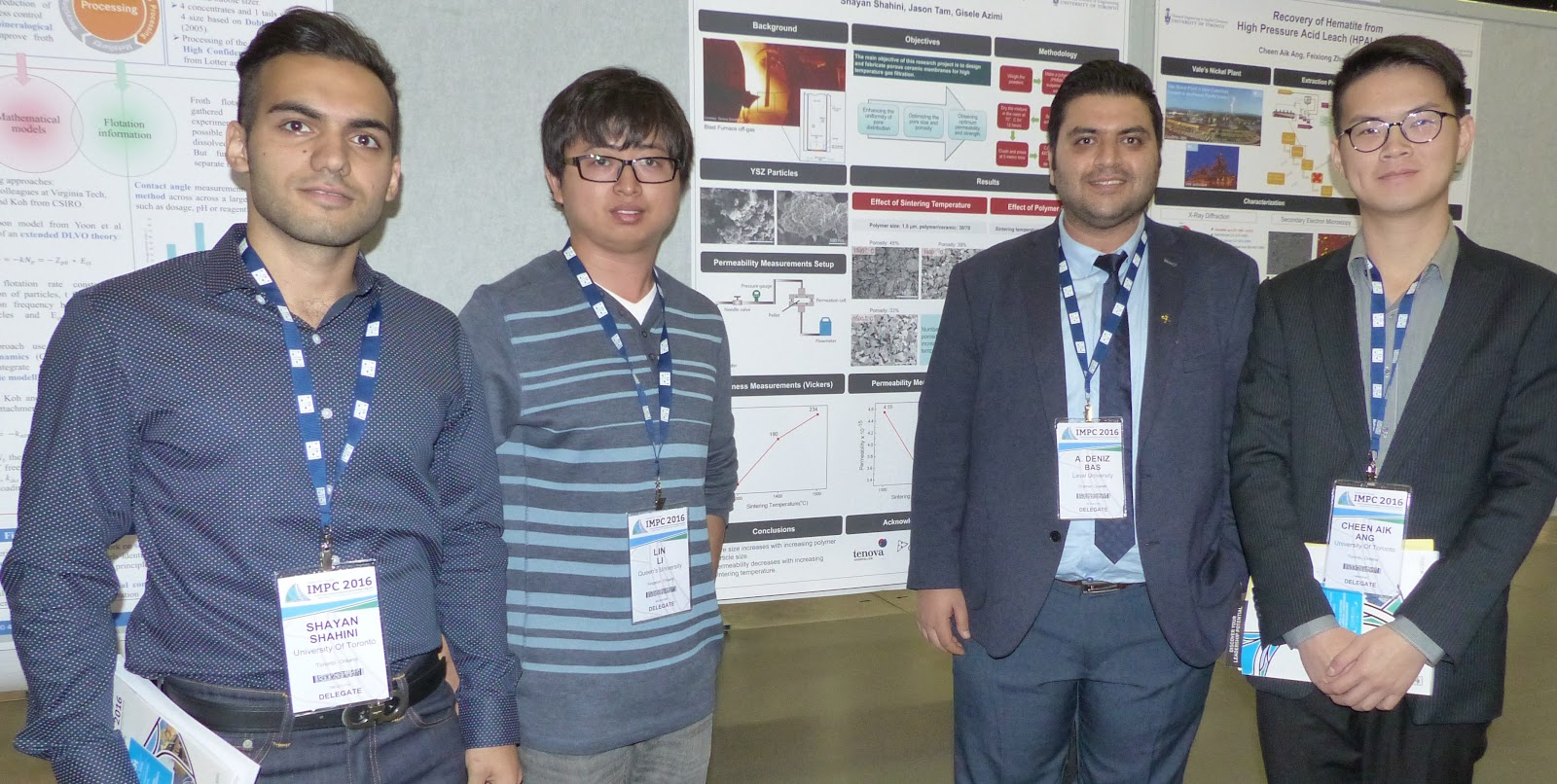
Deniz, 2nd from right, as poster chairman at IMPC
Laval University visit to Glencore Horne Smelter, Quebec in 2013
Deniz is 4th from right, back row
I asked him about his plans for the future, and he hopes, after graduation, to do a post-doc on hydrometallurgical extraction of metals preferably in a gold mining company. He feels that Barrick Gold contributes immensely to the field being, for instance, the first company to commercialise the “thiosulphate gold extraction process”, which he has a great interest in.
In the long term, he sees himself as part of a team developing innovative solutions for the industry. He would like to create more opportunities and better connections between universities and industry in terms of R&D projects and he aspires to develop his skills as a research professor. He says that it is very important to maintain connections with one's peers as long as possible and he believes that we should try harder to pave the way for young people to get involved in sharing and discussing their thoughts regarding the future of our field.
It has been a pleasure talking to Deniz and we look forward to following his undoubted progress through the industry.