Monday, 7 November 2016

Towards a Circular Economy


The "Circular Economy" has become a well known phrase in mineral processing conferences in recent years, primarily as mineral processing has a major role to play in sustainability and the move to the ultimate goal of the Circular Economy. MEI's next conference, Process Mineralogy '17, will open with a keynote address showing how process mineralogy is an essential booster of the circular economy.
In 2018 two of MEI's established conferences will move to Namibia, an ideal setting for further developing the sustainability theme, and the unique combination of Biohydrometallurgy‘18 and Sustainable Minerals‘18 will provide key theoretical, applied and industrial input.
We are fortunate to have, in Profs. Markus Reuter and Susan Harrison, consultants to Sustainable Minerals and Biohydromet, respectively, two leading scientists who feel passionately about the role that mineral processing and biohydrometallurgy have in sustainability, and they have kindly put together the following which shows our future aims:
Figure 1 shows that in order to realize resource efficiency, the Circular Economy and industrial ecologies must be optimised within the constraints of energy usage. Thus input into the industrialised system must be minimized with the least possible loss of materials from the system. Emissions from the inter-linked processes and power generation must also be minimised. Jointly these aid the maximizing of the “closure” of the technology and biological materials loop. An in-depth understanding of the various underlying fundamental theory and technology for application enables the “closure” of the loop. Furthermore, a keen understanding of the entropy creation in the system must be understood.
Figure 1: Circular Economy stakeholders according to the European Environmental Agency (EEA)
The linked conference series provide a platform to discuss the fundamental theory of biohydrometallurgy, minerals engineering and metallurgy as well as the processing of mineral wastes and minewater. These can be positioned in the context of the circular economy and industrial ecology applications, its processing technology as well as systems solutions. In these conferences, there is opportunity to focus especially on the fundamentally based tools required to quantify the impacts of various solutions from design for recycling (eco-design), processing and mining technology solutions through to integrated waste handling and the move towards both zero risk and zero waste.
While the Biohydrometallurgy series is focused on the underlying bioprocesses fuelling resource efficient use of complex ores, low grade resources and waste materials, the Sustainable Minerals series superimposes the sustainable development and resource efficiency frameworks. The integrated detailed information across these conferences is key to providing information based on first-principles to companies as well as policy to best develop the business models that are required to innovate, develop and migrate from a linear to a circular economy. Of particular emphasis are the various end-of-pipe, mine tailings as well as mine & process water recycling processing solutions and innovations as well as the fully integrated approaches to process design for minimal or zero waste and risk. A combination of nature-based biohydrometallurgical and metallurgical processing methods are being explored to achieve results and innovations. Systemic solutions, as an essential integrator at the forefront of the solutions, are being reported.
In summary, the idea that knowledge and technology of minerals and metals processing are key enablers of the circular economy and industrial ecology, both working toward resource efficiency, is the main paradigm this conference has been exploring over the years. Results of this have been, among others, published in Elsevier’s peer reviewed journal “Minerals Engineering” as can also be seen from the ResearchGate pages of the authors viz. Susan Harrison and Markus Reuter.
We have been focussing on making these inter-linked conferences a key meeting of minds between experienced academics and industrialists in the field and aspiring and inspiring young scientists and engineers drawn from a range of disciplines. Through these conference series, we aim to develop a cohort that think Circular Economy, resource efficiency and industrial ecology and have at heart the drive to use our greatly important domain knowledge in a much wider context of the process thinking. Through this ingraining of the circular economy, resource efficiency and industrial ecology, a future devoid of thinking ‘in silos’ can lead us to new paradigms of innovation. This is of great importance to realize the circularity depicted by Figure 1.

Sunday, 6 November 2016

Mixing a little business with pleasure in Mexico

Barbara and I had planned to be in Cancun, Mexico for the International Mineral Processing Congress, IMEC 2016, but unfortunately the event, scheduled to start today, had to be cancelled due to lack of support.
But what the hell, as BA offered us a pittance on flight refunds, we are here anyway, relaxing for 2 weeks at the impressive conference hotel, the Fiesta Americana Condesa, which will also be the venue for the Sustainable Industrial Processing Summit & Exhibition (SIPS '17) in October next year.
I am not a particularly good tourist, and like to have a purpose to overseas trips, mixing a bit of business with pleasure. So I have been assessing the potential of this hotel as a possible future venue for MEI Conferences supplementing Falmouth, Cape Town and Windhoek. Mexico would be a great venue for many convincing reasons.

Apart from a beautiful long coral sand Caribbean beach, Cancun is close to Mexico's most famous archaeological ruin, the ancient Mayan city of Chichen Itza. Only a 2 hour drive away, the tours from the hotel account for over 12 hours, presumably because the large coaches pick up tourists from several hotels en route and then stop off for the inevitable long lunch at a local craft shop, whereby the tour guide rakes in a little commission.
So to avoid tourist hell we decided to go with a guide, Lemuel, from a highly recommended private tour company, who whisked us to the site and then gave us a highly informative insight into this ancient city. If you are attending SIPS '17 or just holidaying in Cancun, I would strongly suggest that you contact LDS Tours Cancun.
Temple of Kukulcan, Chichen Itza


Twitter @barrywills

Saturday, 5 November 2016

The Lynch-Rao team reunited in Brisbane

A great photo below of a great team, reunited in Brisbane after many years. The names Tadimety Chakrapani (TC) Rao (posting of 16th July 2014) and Alban Lynch (posting of 11th August 2014)were synonymous in the late 1960s with the development of mathematical models of mineral processing systems.
Profs. Rao and Lynch reunited in Brisbane
Prof. Rao obtained his Ph.D degree, under the guidance of Prof. Lynch in 1965, working on the characteristics of hydrocyclones. They published their work on hydrocyclones in a number of seminal papers, and the models are still valid today, being used in many hydrocyclone manufacturers' performance curves. TC attributes their on-going validity to their simplicity, involving parameters which can be easily measured, such as vortex finder diameter, spigot diameter, and can therefore be confidently accepted by operators.
T.C. Rao was the first international PhD student of mining engineering at The University of Queensland (UQ) and on October 19th UQ held its annual Courting the Greats Ceremony which recognises significant achievements by graduates. Prof. Rao, who started his life at UQ by residing at Emmanuel College, was recognised as the UQ International Alumnus of the year (full story on MEI Online).
Congratulations TC, great news of two great mineral processors.
Twitter @barrywills

Thursday, 3 November 2016

Last month's most viewed posts

The 10 most popular blog postings in October can be seen below, together with the date of the posting and the total number of comments on the post.

Are these WASET conferences just a scam?
28 April 2013 (84)
A remarkable line-up at the IMPC in Quebec highlights the importance of flotation
3 October 2016 (15)
Congratulations, Fathi Habashi, on your 88th birthday
15 October 2016 (1)
Provisional programme for Process Mineralogy '17 now available
18 October 2016 (1)
Jan Miller to review X-Ray Tomography for mineral processing at Process Mineralogy '17
6 October 2016
Day 2 at the MillOps '16 Conference
12 October 2016
XXVIIIth IMPC Conference Diary
19 September 2016 (17)
Holman and Wilfley, well known names in mining, still going strong
10 October 2016 (3)
Official launch of the Cornwall Mining Alliance at the October sundowner
21 October 2016
Mill Operators Conference '16- how was it for you?
17 October 2016 (9)

We encourage you to share your views by submitting your comments on blog postings. Last month there were over 22,000 page views, so interacting with the blog enhances your international presence by providing you, and your company or Institute, with valuable exposure.

If you are in Web View (mobile users can access this by scolling down to the bottom of the screen) you can also check various things in the right hand column:
  • The latest MEI tweets from @barrywills
  • The most viewed posts in the last 7 days
  • Dates of blog posts (click on the black arrows to open up individual months and postings)
  • Labels, or categories
You can also subscribe to blog alerts by email, and access MEI's Facebook page and MEI Online via links in this column.

Monday, 31 October 2016

Comminution and Flotation - an intimate relationship

I would think that every mineral processor is, or should be, aware that flotation efficiency is very much linked to the product from the upstream comminution circuit. Nevertheless it is common at large conferences, such as IMPCs and SMEs, for flotation and comminution sessions to run in parallel, such that there is little opportunity for specialists in these two areas to discuss comminution-flotation as a single entity. 
I am also aware, of course, that MEI's focussed comminution and flotation conferences, by attracting specialists in these two fields, do not encourage potential fruitful collaboration. This is something that we are trying to change by inviting specialists in comminution to present appropriate work at flotation and vice-versa. It is happening only slowly however but one company that sets an example is Magotteaux, regular sponsors of MEI's comminution and flotation series, and Dr. Chris Greet, Manager Metallurgy-Minerals Processing Research at Magotteaux Australia, who has presented papers at most of the flotation conferences, and in recent years the comminution conferences, was an ideal person with whom to discuss this important link.
Chris Greet (right) at the Magotteaux booth, Flotation '13
I asked him first of all why Magotteaux obviously finds value in the MEI Conferences. He said "Magotteaux see value in both the Comminution and Flotation conferences for a number of reasons. The obvious ones are the marketing and networking opportunities, and I know our sales team do use these conferences to meet with customers (both current and potential). However, there are deeper reasons for our attendance. Both conferences provide our technical team with an opportunity to see what is new, gain a better understanding of technical problems and catch up with renowned authorities to discuss issues that we face in our technical work. The MEI conferences do bring together a very diverse group of people and it is through discussion, debate and the occasional drop of good South African red wine that we are able to focus our technical efforts to assist sales to provide the right product for their application".
He continued "Having attended both the Comminution and Flotation conferences I do note however that there does appear (at times) to be a silo mentality. At Comminution there is a huge amount of excellent work describing how breakage occurs and trying to develop more energy efficient methods to reduce particle size, but there are few studies that look beyond this to the downstream processes. Equally, at Flotation how a particle is prepared for flotation is often ignored because the exciting work is in understanding collector adsorption or the flotation behaviour of different forms of the same mineral. Do not get me wrong, the work done in both fields of endeavour is very important, but there needs to be more cross fertilisation. Finally, all is not lost, I have noticed that the topics of grinding chemistry and pulp chemistry and their influence on flotation are increasingly being discussed at conferences. This is very pleasing as I have been practicing in this area for over 25 years and I think I am starting to make some headway . . ."
Chris has highlighted here something that we have been trying to promote in recent years, and would like to become a feature of the Comminution and Flotation conferences, the fact that flotation is intimately linked to comminution, not only in regard to the size and liberation of particles, but also to pulp chemistry, and I asked him to elaborate on this:
"At plant level, most metallurgists realise that if the comminution circuit operates smoothly they have a better chance of maintaining a reasonably steady flotation circuit, and achieve the target concentrate grades and recoveries" he said. "Their primary motivation in operating the comminution circuit is to achieve a particle size distribution that has been nominated, which is presumably based on achieving liberation. Or, to put it another way the grinding circuit is designed to operate to achieve a particular percentage liberation for the subsequent flotation stage. So, in most thinking metallurgist’s mind grinding is associated with liberation.
However, there is more to it than this, as during grinding fresh particle surfaces are generated and thanks to the likes of Gaudin (or maybe his name is used in vain) it is thought that the addition of reagents (collectors, depressants, pH modifiers, activators) will have a beneficial impact on flotation. As a consequence many believe adding the reagents to grinding (either fully or partially) is a good thing. In principal it is a good plant practice to follow, but only if the chemistry is amenable.
In many instances the grinding chemistry is not taken into account. The main concerns surrounding grinding are: energy efficiency, media consumption, liner wear, and achieving the right particle size distribution. All are very important, however if the product from the comminution circuit does not produce particles with the right surface chemistry it is highly likely that concentrate grades and mineral recoveries will suffer. Despite the many non-believers grinding chemistry is critical to achieving metallurgical excellence.
There are many articles in the literature that talk of the necessity of operating in the right Eh regime to achieve collector adsorption. The CSIRO have published extensively in this area, and have shown that most sulphide minerals have an Eh threshold below which collector adsorption is weak and recoveries are low. In most instances the Eh of the plant mill discharge is well below this threshold, yet plants continue to add collector during grinding, thinking that they are doing the right thing.
For example, the threshold Eh for collector adsorption onto pentlandite is about +187 mV (SHE), and the mill discharge Eh can be as low as -250 mV (SHE). So adding the collector to the mill does not enhance pentlandite flotation. Yes, once the pulp arrives in the flotation cell and is aerated the Eh will increase and collector adsorption will occur. However, the likelihood is that the collector would have interacted with other minerals within the mill (for example, chalcopyrite, pyrrhotite), which have a lower threshold, and what results is a very non-selective flotation.
There are other reactions that occur within the comminution circuit which influence what happens in the flotation circuit. The potential list of reactions (in no particular order) are:
  • The precipitation of ionic species from the process water;
  • Inadvertent activation or depression of mineral species by ionic species and reagents in the process water;
  • The dissolution of minerals (i.e. dolomite) and the deposition of these ions onto surfaces;
  • The interaction of reagents with each other, mineral surfaces and grinding media;
  • The impact of pH (e.g. below pH 10.5 Mg(OH)2 is soluble in water above this pH is precipitates on the surfaces of minerals and can depress flotation);
  • Mineral/mineral interactions; and
  • Mineral/grinding media interactions.
All impact the pulp and surface chemistry and have an influence on the outcomes of the flotation process. So, an understanding that the comminution circuit is not only about reducing the particle size to achieve adequate liberation for the subsequent flotation stage, but is also a chemical reactor where the surface chemistry of the minerals we are trying to separate is generated is a must. To maximise metallurgical outcomes the flotation operator must take an active interest in the comminution circuit".
So important is pulp chemistry that Magotteaux has patented a laboratory mill designed to reproduce the pulp chemical conditions of the plant grinding mill in the laboratory. The Magotteaux Mill® allows the user to investigate the impact of grinding chemistry on their metallurgical process. The product generated in the laboratory has nominally the same physical properties (particle size distribution) and pulp chemical properties (Eh, pH, dissolved oxygen, oxygen demand and EDTA extractable iron) as an equivalent sample taken from the plant. This signifies a distinct advantage in testing as the results produced in the laboratory are more representative of those that would be observed in a plant.
The UK company Grinding Solutions Ltd, sponsors of three MEI Comminution conferences, including the forthcoming Comminution '18, are also very aware of the link to flotation, and recently took possession of the Magotteaux Mill in their rapidly expanding premises in Cornwall. Not surprisingly GSL's flotation consultant, Dr. Kathryn Hadler, is a regular presenter at the Flotation series of conferences and she says "The Magotteaux mill enhances significantly the ability to monitor chemical conditions during milling, which allows greater understanding (and improvement!) of flotation performance response. Furthermore, it provides an opportunity to improve the integration of mineral processing laboratory testing which is of increasing importance as we move forward with lower grade and more complex ores".
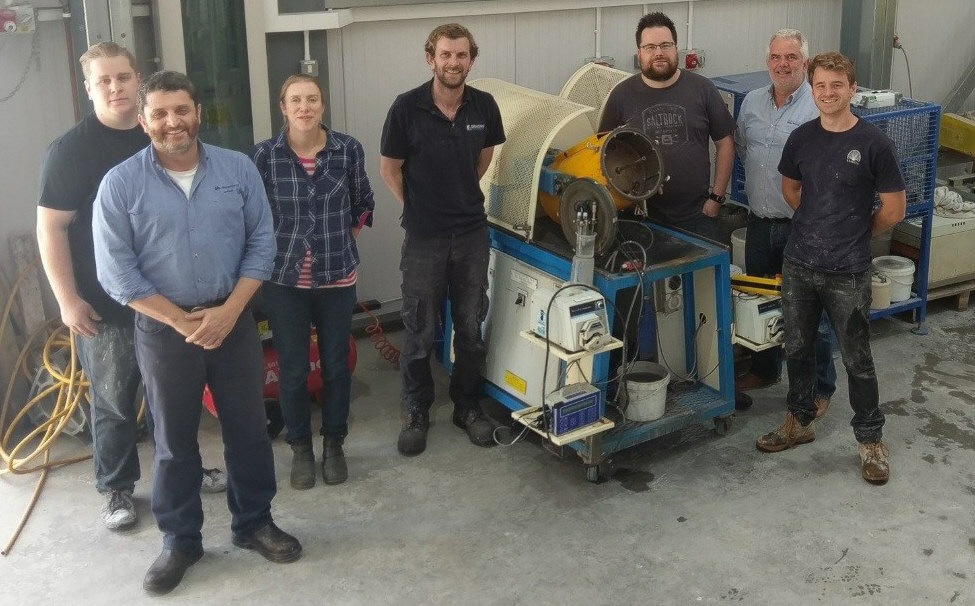
GSL staff with the new Magotteaux Mill:  From left to right:  Jon Rumbles (GSL),
Grant Small (Magotteaux), Kathryn Hadler (Flotation consultant), Tom Rescorl,
James Gaydon, Nick Wilshaw and Jack Carr (all GSL)
My hope is that these two progressive companies highlight the important links, both physical and chemical, between comminution and flotation and this awareness will be taken up by researchers in this crucial area of mineral processing.
#Comminution18
#Flotation17

Friday, 28 October 2016

Pasties, pints and advice on networking, with CSM students

I was at the University of Exeter's Penryn Campus again last night, this time for a very pleasant evening hosted by the Camborne School of Mines Association (CSMA). The CSMA currently has around 1,000 members from all over the globe and helps to organise social functions throughout the world, in Western Australia, Queensland, New South Wales, Johannesburg and Vancouver, and of course the UK, to name but a few.
Last night's event brought together CSM alumni, and past and present staff, to share pints and pasties with current CSM students in the Stannary bar, and talk about the benefits of joining the Association. Talking to people wherever and whenever possible was the all important mesasage to the students, as was the value of social media, particularly LinkedIn, Facebook and Twitter, ideal for staying abreast of what is going on.
CSMA Secretary Claire Yelland (2nd right) with students
BW with students
Students with alumnus and current lecturer Andy Wetherelt.....
....and with former lecturer Tony Batchelor
And on the subject of social media, yesterday I learned via the CSM Association's Facebook site of further developments on the resurgence of the South Crofty tin mine at Camborne, which has been closed for almost two decades. Work is set to begin next month on testing the water in the mine, with the aim of applying to the Environmental Agency for a ‘discharge permit’ to begin dewatering. According to Strongbow Exploration, the aim is to be able to treat and discharge up to 25,000m3 per day, which would allow for the mine to be dewatered over an 18-24 month period. So some cause for optimism?
Jan Cilliers (left) with award
 
Also yesterday I learned via Twitter that my old friend Prof. Jan Cilliers, of Imperial College, was awarded the IOM3's Futers Gold Medal back in June! Although we met up and had a long chat at the IMPC in Quebec, he never mentioned this- a modest chap, but well done Jan and many congratulations on a well deserved honour.
 
So the central message of last night was make use of all networking opportunities. Social media is great, but there is no substitute for talking with people face to face. And if you are not convinced, here is some even more ancient advice on networking:
"What you leave behind is not what is engraved in stone monuments, but what is woven into the lives of others".
Pericles, c 450 BC
"Travel is fatal to prejudice, bigotry, and narrow-mindedness, and many of our people need it sorely on these accounts. Broad, wholesome, charitable views of men and things cannot be acquired by vegetating in one little corner of the earth all one's lifetime".
Mark Twain c 1900