Tuesday, 18 October 2016

Provisional programme for Process Mineralogy '17 now available

We have a fine programme of international papers for Process Mineralogy '17, which will be held at the Vineyard Hotel, Cape Town, in March. The provisional programme, which is still evolving, is now available for viewing on the conference website.
Of the 60 papers currently accepted for presentation in oral and poster sessions, there are three keynote lectures by leading players in this field. "Process Mineralogy: An essential booster of the circular economy" will be given by Prof. Eric Pirard of the University of Liege, Belgium (posting of 7th March). Prof. Jan Miller, of the University of Utah, will review X-ray tomography for mineral processing (posting of 6th October) and Steve Williams, of Pasinex Resources Ltd, Canada (posting of 24 February), will review the benefits and tasks ahead for geometallurgy, a subject which will feature strongly in the conference.
As with all MEI Conferences, networking is considered of great importance, so the technical programme will be supplemented by informal social events, including a welcoming wine reception, 'happy hours' in the Vineyard gardens and a very informal conference dinner at the Lagoon Beach Hotel with its stunning view of Table Mountain.
Vineyard Hotel Gardens
It is not too late to contribute to the technical programme. If you would like to present a paper, short abstracts should be submitted as soon as possible, and, if accepted, draft papers will be required for the unrefereed Proceedings, which will be available to delegates on USB at the conference. Final papers should be submitted no later than one month after the end of the conference. These will be refereed, and, if accepted, published in a special Process Mineralogy issue of Minerals Engineering journal.
Registration details can be found on the conference website. If you have not attended an MEI Conference in Cape Town, this 7 minute video, taken at Process Mineralogy '14, will give you some idea of what to expect.
At the exhibition at Process Mineralogy '14
As ores become leaner and more and more difficult to treat, process mineralogy is becoming increasingly important to meet the current technical challenges, so we hope to see as many mineral processors, both from academia and operating plants, in Cape Town next March.

Monday, 17 October 2016

Mill Operators Conference '16 - how was it for you?

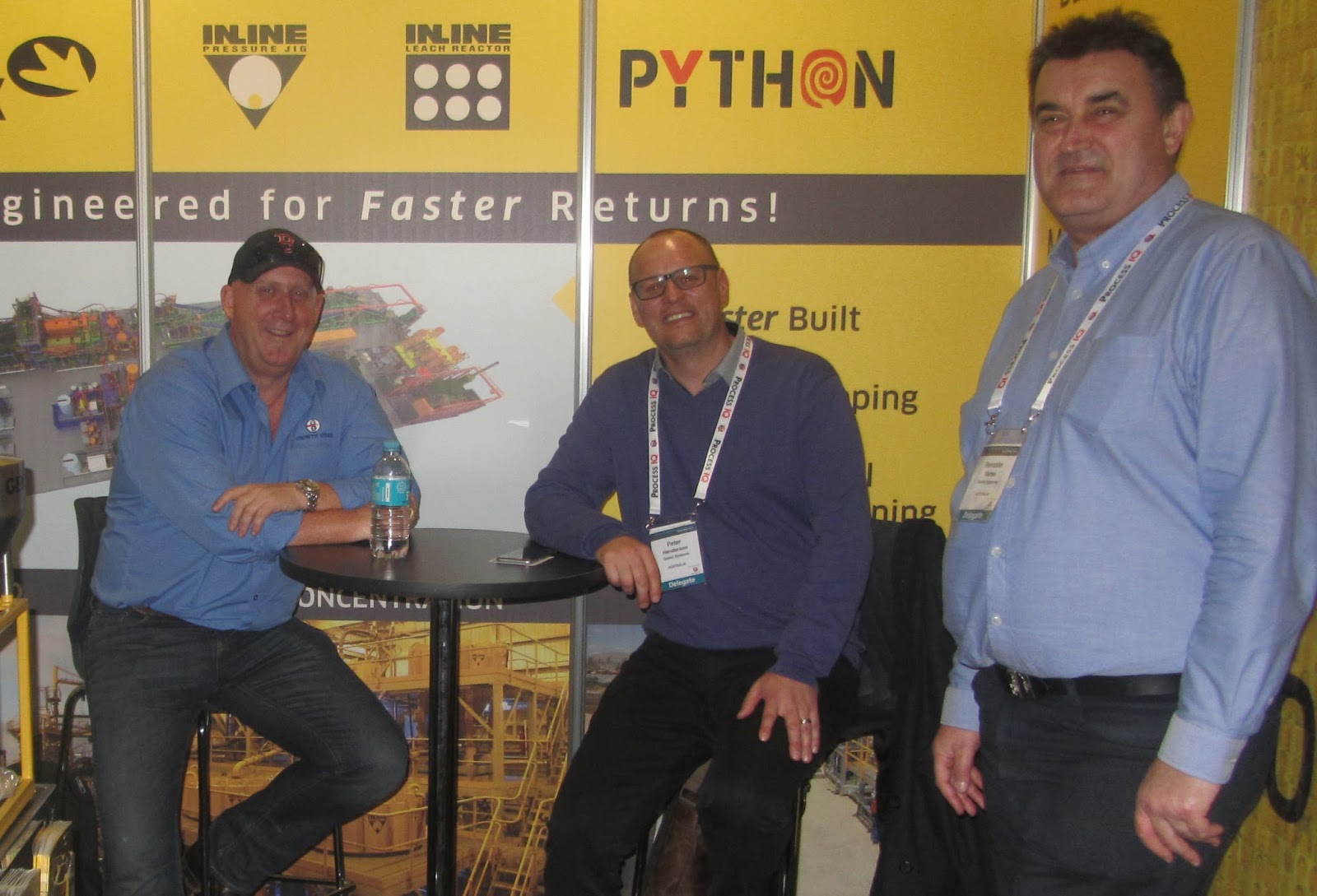
Jon's brief notes and photos from Perth (Day 1, Day 2, Day 3) suggest that last week's AusIMM Mill Operators Conference was a great success, so we now invite feedback from those who attended.
I gather from reports that the papers were of high quality and there were fewer than 50 presentations, such that there were no parallel sessions - which can be a real problem at other conferences (see IMPC 2016 report), and no posters, unusual in a conference with over 450 delegates. As Jon says, although this was a multi-disciplinary mineral processing event, the lack of parallel sessions meant that everyone broke out for coffee at the same time, and there was a real buzz during these breaks in the exhibition area, where everyone was talking about the same thing.
As at all conferences these days it is increasingly difficult to attract operators, and although Mill Ops is essentially an operators' conference series, out of the 460 delegates, only 99 were operators. This is a worry for all conference organisers, and we are still searching for an answer to this problem.
So, I invite you to submit your views- how was Mill Ops '16 for you?

Saturday, 15 October 2016

Congratulations, Fathi Habashi, on your 88th birthday

A few weeks' ago I caught up with Prof. Fathi Habashi, and he and his wife Nadia kindly showed Barbara and me around the Laval University Campus. Fathi is a remarkable man who celebrated his 88th birthday last Sunday. A few days ago I received this message from Ahmet Deniz Bas, a Ph.D. Candidate in Metallurgical and Materials Engineering at Laval:
Fathi Habashi, Professor Emeritus of Extractive Metallurgy at Laval University, Quebec, Canada, is a great man and is truly an inspiration for many of us, specially for students all around the world. His books on extractive metallurgy are regarded as pathfinders for academia and industry. Whenever you listen to him or read his paper, you gain new things not only about the subject but also about its history. As Prof. Habashi says: “Educated people are the most important wealth of a country. Students of today are the leaders of tomorrow. Therefore, the Government must supply all possible means to have well educated engineers who could fulfill their responsibilities in the future”. So, please raise your glasses to him.
We, a group of 10 doctorate students in engineering departments at Laval University, organised a surprise birthday party for Prof. Habashi with the help of Nadia, his lovely wife. Prof. Habashi made a special presentation for us telling the story of his life and giving some tips for graduate students. A few of the tips are: “(i) Once you get a satisfactory job consider getting married so that you can lead a civilized life; (ii) You may become a distinguished scientist or a merited engineer but don’t forget that you are first a human being who should be modest and considerate; (iii) Do not stay in what is called “ivory tower”. Travelling and attending conferences have enormous, some times unexpected benefits”. We enjoyed the party with birthday cake, sandwiches (handcraft of Nadia), grape, wine, and etc. One of our friends sang a song and contributed the ambience. We all spent an enjoyable afternoon today.
It was only one month ago that he delivered two presentations at the XXVIII IMPC in Quebec City, which is often called the Olympics of mineral processing. He is quite active, still travelling the world giving courses, and presenting keynote lectures. His next trip will be to Tbilisi, Georgia in two weeks’ time. We all wish you both health, happiness and love. Dear Nadia and Fathi, thank you very much for all your kindness and support.
We at MEI thank you for your comments, Ahmet, and we too wish Fathi belated birthday wishes.

Thursday, 13 October 2016

Day 3 at MillOps '16

Jon's report from Perth on the final day of the Mill Operators Conference:

There was a good turnout this morning for the keynote presentation. The last day wind down of a conference was highlighted by the conference chairman who urged people to stay until the end, always a difficult problem for organisers!
Final numbers were announced as 460, up from 380 at the last event and in the closing talks Peter Munro said the aim for 2018 should be 600. Of the 460, 99 were operators and so the challenges of getting people from plants to the conference were highlighted. This is a real challenge faced and options such as getting papers written by others using the plant data were discussed.
The exhibition ran until the afternoon which gave me a chance to look around again and get some more photos, it was especially interesting to talk to IXOM who were previously Orica and had attended MEI Conferences in the past, we hope to see them at Flotation '17!


During the close Tim Napier-Munn presented an award for the best paper to Sinclair/Hunter/Landweh for their paper entitled "Syama Gold Mine- the journey towards a class-leading Gold Mine". The best presentation award went to Campbell Haines for his paper "The transition from semi-autogenous to autogenous milling at Waaihi Gold".
Overall the conference has been viewed to be a great success, partly for two changes since last time. First the abandoning of parallel sessions (something MEI have always been fervently opposed to) and then the discussions after the talks.
I look forward to Mill Ops 2018 and MEI will post information regarding its date and location once these have been decided.

Wednesday, 12 October 2016

Day 2 at the MillOps '16 Conference

More news from Jon in Perth, of Tuesday at the AusIMM Mill Operators Conference:
 
The second day at the conference carried on with the enthusiasm from day 1. The sessions were busy and everyone was talking about the same thing, one of the bonuses of having no parallel sessions, although a necessity at some conferences, something that no one seems to like. The fact that everyone breaks out at the same time after the same papers gives a real buzz to the exhibition area where the breaks are held as everyone is talking about the same thing.
There are 46 exhibitors which is testament to the popularity of this event and it was good to catch up with many who are MEI conference regulars (but may have their Australian team here) and also to meet with companies that aren't so aware of our events.
JK staff and students, past and present


The evening dinner was, as at past Mill Ops conferences, a great event with the usual comedian, this time a member of the inaugural Australian National Sudoku team! A team he set up so he could wear the green and gold of Australia, not taking into account that he couldn't play Sudoku. Diana Drinkwater presented the CEEC Medal during the dinner and this will be reported on MEI Online shortly.
Good food, wine and company made this an enjoyable evening and a fitting end to the second day.

Tuesday, 11 October 2016

AusIMM Mill Operators' Conference- Day 1

Jon is representing MEI at the AusIMM's Mill Operators' Conference this week, and will be reporting daily on events.  Following is his report on Day 1:
 
After a gruelling 52 hour journey, including an unexpected day in Singapore, I arrived in Perth at 5am on Monday morning, just giving me time to get in to my accommodation before heading to the Pan Pacific Hotel in Perth for the start of the 13th Mill Operators conference. This is the 4th Mill Ops conference I have attended and it felt good to be back in Perth and at the former Sheraton hotel that was home to a few MEI conferences in the past.
The conference got underway with the usual welcome speeches announcing that there are around 350 delegates from around the world at the event.
The first keynote was given by Peter Munro of Mineralis Consultants and was entitled "Back to the Future - Still on the Dark Side" and in a passionate talk he discussed how in the last decade there have been no real technological breakthroughs and no improving of human capital by strengthening educational institutions or skill development schemes for graduates, something which Barry mentioned in his posting of 3rd October.
Jon with Peter Cameron
The next talk by Peter Cameron, of Split Engineering, looked to be not so pessimistic and said that the tools were there to improve things but that they were just not being used.
The organisers have introduced a new concept to the conference in that there are not traditional questions after a presentation. Instead after the session, 30 minutes is set aside for a discussion chaired by the presenters with questions being asked (maximum 1 minute allowed) and answers kept to a maximum of 2 minutes.
At the end of the day there was a 2 hour welcome reception held in the exhibition area that was well attended and gave everybody the chance to relax and catch up with old acquaintances. It was during this that I met up with some MEI regulars including Magotteaux, who have confirmed sponsorship of Flotation '17, Huntsman (regulars at the same event), Ben Tordoff of Zeiss (sponsors of Process Mineralogy '17), Scantech (exhibitors at Comminution '16), Keramos (sponsors of Comminution '18) and Steve Flatman from Maelgwyn Minerals (sponsors of Flotation '17).
Huntsman
Magotteaux

Scantech

Keramos

With fellow UK delegates Ben Tordoff  and Steve Flatman
As usual, this event looks like being a highly sociable, interesting and worthwhile event for all involved and I look forward to the next 2 days.