Tuesday, 15 March 2016

Women in Mining 2016

The photo below was taken at the Camborne School of Mines Final Year Dinner in 1977:
and this one two years later with the first graduates in Mineral Processing Technology from CSM:
The link is pretty obvious- not a female face in sight.  CSM was founded in 1888 and it was not until 1984 that the first woman, Julie Holl, graduated, with a 1st class honours in Mineral Processing Technology. Now Dr. Holl, she cut out a successful career in mineralogy in Australia. In 1985 the 2nd woman, Gaynor Yorath graduated, and I see Gaynor often at Minerals Engineering Conferences, as she has for a number of years been on the staff of the University of Cape Town.
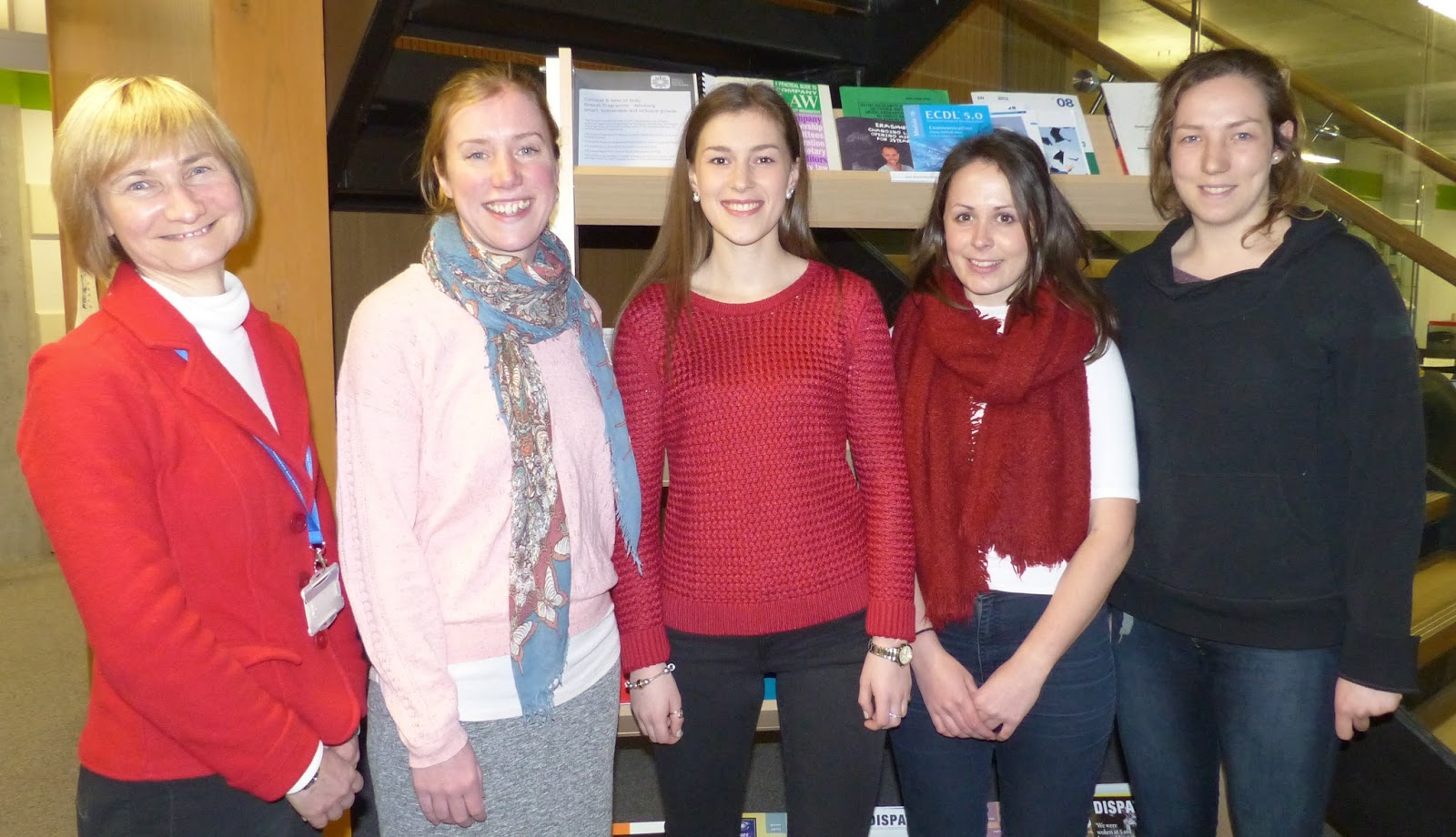
How things have progressed though! The photo below was taken last night, of CSM students in the geological museum: 
Last night was the inaugural event for CSM's Women in Mining student chapter, and Dr. Kathryn Hadler was the guest speaker. Kathryn is a lecturer in mineral processing at Imperial College, and has a strong track record as a researcher in froth flotation. She is the first woman to hold the post of Editor of the International Journal of Mineral Processing and she gave an illuminating talk "Where are the women in mineral processing", which she has promised to summarise and will be published on the blog in the very near future.
Kathryn is pictured 2nd left below, with Prof. Frances Wall, the first woman Director of CSM (2008-2014) and CSM Student Chapter members Heather Thiel (treasurer), Rachael Gallagher (Vice President) and Kate Gleadow (President), all MSc geologists.
 
Twitter @barrywills

Monday, 14 March 2016

Membrane technology to recover metals and reuse mine wastewater

Membrane technology has become widely used in various industries in recent years, but has been slow to be adopted in the ever conservative mining industry. One of the main advantages of membrane technology is that it works without the addition of chemicals and with relatively low energy use.
Membranes are used more and more often for the creation of process water from groundwater, surface water or wastewater, and they are now competitive with conventional techniques. The membrane separation process is based on the presence of semi-permeable membranes, the principle being quite simple: the membrane acts as a very specific filter that will let water flow through, while it catches suspended solids and all other salts and ions, creating a concentrated stream and a pure water stream. There are various methods to enable substances to penetrate a membrane. Examples of these methods are the applications of high pressure, the maintenance of a concentration gradient on both sides of the membrane and the introduction of an electric potential.
We are therefore delighted to introduce a new company to the MEI fold, Genesys International, who will be sponsoring Sustainable Minerals '16 in Falmouth in June. Genesys is an industry leader in the development and manufacture of speciality antiscalant and cleaning chemicals for Reverse Osmosis (RO), Nano-Filtration (NF) and Ultra-Filtration (UF) membrane systems.
In the past 5 years there has been a dramatic increase in the number of RO, NF, UF Membrane systems used in mining, and in a paper at the conference, Stephen Chesters will identify over 300 mines with potential to use RO/NF/UF membrane technology. There are sixty-one operational membrane plants and fifty-one of these have been commissioned in the last ten years, 65% of which are in gold and copper mines. In precious metal mines, waste water can be concentrated using membrane plant so additional metals can be recovered from barren liquor. Acid mine drainage (AMD) is increasingly treated and then reused or sent off site as a potable supply to the surrounding communities.
Membrane plants can suffer from rapid fouling and calcium sulphate (gypsum) scale. The reasons for this will be explored and new techniques for preventing sulphate scale and to clean fouled membranes will be introduced. Genesys has recently launched a new and innovative method for RO membrane cleaning incorporating micro-bubbles and effervescent reagents to enhance deposit removal. The company is looking to grow its business in the mining industry and is currently working on a number of research projects and is keen to form alliances to service the mining industry world-wide.
 
Twitter @barrywills

Sunday, 13 March 2016

CSM Reunions in Falmouth

The Falmouth Hotel was the venue for last night's Camborne School of Mines Annual Dinner. A short taxi ride for Barbara and me, but others had travelled from all over the world to catch up with alumni and former lecturers. It was also good to see a high turnout of current CSM students (but unfortunately very few staff). 
One of last night's many reunion photos
There are always faces from the distant past, and one surprise was Richard Thompson, one of my mineral processing students who graduated in 1986, and who I had not seen since. He is now working in the oil and gas industry. Charlie Northfield, a 1980 graduate, I do see quite often now, as he is Process Plant Manager at the Drakelands tungsten-tin mine at Hemerdon in neighbouring Devon.
Richard, me and Charlie
Pauline and Nick Clarke
Last night's Guest Speaker was Nick Clarke, who spoke of his colourful career in the mining industry after his graduation from CSM in 1974. Nick and I worked together on the annual Minerals Engineering conferences, pre-MEI, in the 1990s, when he was Director of CSM Associates. He is now CEO of Central Asia Metals, which, despite the recession, is economically producing copper in Kazakhstan. I asked him if he was optimistic about a recovery in copper prices and he felt that we were probably in for a fairly tough 18 months to two years.
I would like to thank Claire Yelland, Secretary of the CSM Association, for her splendid efforts in organising this annual event.

Twitter @barrywills

Thursday, 10 March 2016

SME recognises excellence in mineral processing

Each year the SME, at its annual meeting, presents prestigious awards to distinguished members of the mineral processing community.
I managed to attend three of the award lectures at the SME Meeting, Ron Woods (Gaudin Award), Rob Dunne (Richards Award), Dave Dreisinger (Wadsworth Award) and more information on these can be found on MEI Online.
Unfortunately I was en route to UK when the SME/AIME Awards banquet took place on Wednesday February 24th, and so missed out on two important awards. I had met up with my old friend Dave Osborne, who I had not seen for 19 years, two days previously and over coffee congratulated him on being the recipient of the Frank F. Aplan Award, for the development and application of coal preparation technologies, dissemination of knowledge through book publication, and maintaining a key global network of coal industry professionals.
I was pleased to receive the photograph below a couple of days ago, from Courtney Young, of Montana Tech, and it is great to see his family sharing in his success at the awards banquet. Prof. Young received the Mineral Industry Education Award, which was established in 1950, and is given for distinguished contributions to the advancement of mineral industry education. He is pictured with his wife Miriam, and on the left his brother Dave, and wife Sharon, with their son Nick on the right. Also good to hear that Courtney and Miriam will be in Falmouth in June for Sustainable Minerals '16.

Monday, 7 March 2016

Process Mineralogy: An essential booster of the Circular Economy

A circular economy is an alternative to a traditional linear economy (make, use, dispose) in which we keep resources in use for as long as possible, extract the maximum value from them whilst in use, then recover and regenerate products and materials in urban mines at the end of each service life. By changing the way we view our waste in relation to our urban landscapes we are able to mine – collecting and salvaging – valuable components to be reused and recycled, paving the way towards a zero-landfill future.
Eric Pirard
Eric Pirard
In order to develop efficient processes for the recovery of metals from both our primary mines and our urban mines, we will need to innovate in process mineralogy and we are pleased to announce that Eric Pirard, professor of Mineral Resources at the Faculty of Engineering of the University of Liege, Belgium, will give an overview of the role of predictive and diagnostic tools in mineralogy to achieve a more circular economy in a keynote lecture at next year's Process Mineralogy '17.
Prof. Pirard is head of the GeMMe research group totalling about forty research engineers and PhD students. This group is active in characterisation, processing and beneficiation of mineral materials at any stage of their life cycle. He is also an active member and acts as education officer of the new European Knowledge Innovation Community on raw materials: EIT Raw Materials. This is a consortium of 120 members including major universities, research centres and industries all across Europe. EIT Raw Materials is the spearhead of Europe’s innovation in raw materials and the circular economy with a total budget of close to 3 billion euros to be spent in the period 2015-2022.
Prof. Pirard has extensive experience in teaching mining engineers in less privileged countries such as Bolivia, Peru, DR Congo, etc. He is the coordinator of the European Master in Georesources Engineering degree (EMerald) jointly organized by the Universities of Liege, Nancy, Freiberg and Lulea.
We look forward to this important keynote, which will complement the geometallurgy keynote of Steve Williams.
Nine months prior to these keynotes, Sustainable Minerals '16 in Falmouth will emphasise the crucial role that mineral processing has in contributing to a circular economy, in enabling effective recycling of metals, from WEEE, automobiles and mine wastes.

Twitter @barrywills

Thursday, 3 March 2016

Last month's most viewed posts

The 10 most popular blog postings in February can be seen below, together with the date of the posting and the total number of comments on the post.

Are these WASET conferences just a scam?
28 April 2013 (71)
SME '16 Conference Diary
28 February 2016 (2)
Eminent Biohydrometallurgist joins the Editorial Board of Minerals Engineering
11 July 2014 (1)
What is a mineral processor?
11 February 2016 (12)
Biohydrometallurgy and Sustainability join forces in Falmouth
1 February 2016 (0)
Pasties and pints at the February mining sundowner
17 February 2016
African Mining Indaba '16- conference diary
13 February 2016 (1)
Geometallurgy will feature strongly at Process Mineralogy '17
24 February 2016 (2)
Is the Autogenous Mill a Cornish invention?
8 February 2016 (0)
MEI conversations
5 April 2014 (0)

We encourage you to share your views by submitting your comments on blog postings. Last month there were over 13,500 page views, so interacting with the blog enhances your international presence by providing you, and your company or Institute, with valuable exposure.

If you are in Web View (mobile users can access this by scolling down to the bottom of the screen) you can also check various things in the right hand column:
  • The latest MEI tweets from @barrywills
  • Recent comments on postings
  • The most viewed posts in the last 7 days
  • The most viewed all time
  • Dates of blog posts (click on the black arrows to open up individual months and postings)
  • Labels, or categories
You can also subscribe to blog alerts by email, and access MEI's Facebook page and MEI Online via links in this column.