Of all the places that I have visited in the world, the
Mosi-oa-Tunya (the smoke that thunders), better known as the Victoria Falls, is the most wondrous. "Real Africa" has become a bit of a cliché but this area of the mighty Zambezi, the 4th longest river in Africa, is just that- real Africa, wild and magnificent.
 |
| The spray from the Falls rises out of the African bush |
 |
| Zambia September 1969 |
This month I visited the Falls for the 7th time, and the experience never palls. Barbara and I first passed through here in 1969, en route to the Zambian Copperbelt from Cape Town (
posting of 25 November 2010), but in all our subsequent visits we have been based on the Zimbabwean side of the river. This time we spent a week on the Zambian bank, thanks to the
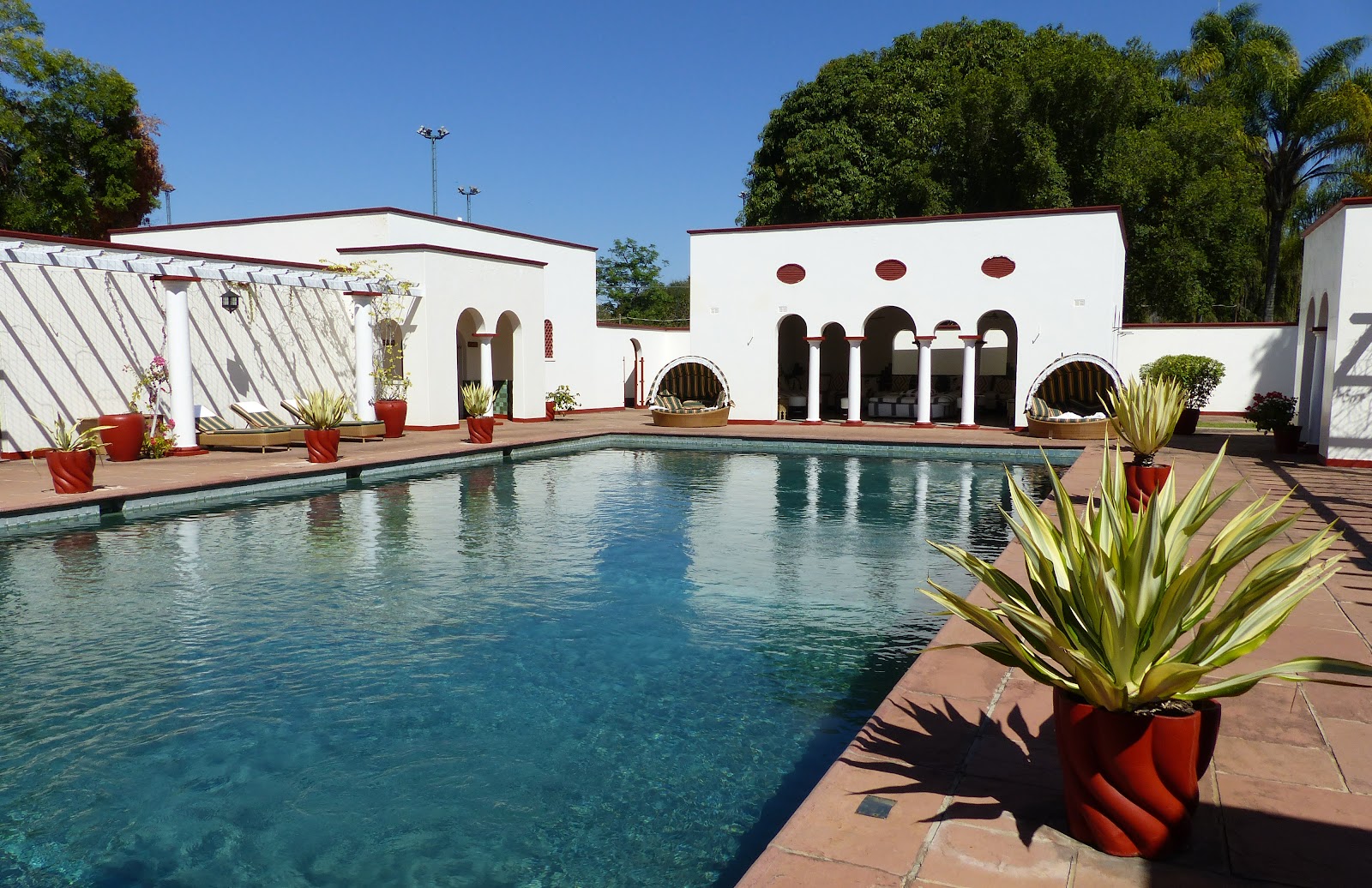
SAIMM Copper - Cobalt Conference at the Avani Victoria Falls Resort near the town of Livingstone and situated in the heart of the Mosi-oa-Tunya National Park. The Zambezi forms the border between Zambia and Zimbabwe, so the falls are shared by the two countries, and the park is 'twin' to the Victoria Falls National Park on the Zimbabwean side.
Victoria Falls is roughly twice the height of Niagara, but while it is neither the highest nor the widest waterfall in the world, it is classified as the largest, based on its width of 1,708 metres (5,604 ft) and height of 108 metres (354 ft), resulting in the world's largest sheet of falling water.
To appreciate the full grandeur of the Falls you must take to the air, so we took a short helicopter tour to view the full width of the Zambezi plunging into the awesome crevice in the relatively flat plateau.
Geologically Victoria Falls is the result of soft sandstone that fills huge cracks in the hard basalt rock of the plateau. As the Upper Zambezi flowed across the plateau in ancient times, it found the cracks and started wearing away the softer rock, eventually creating a series of deep gorges. Geologists estimate that the river has been falling into these gorges for at least the last 100,000 years. As the rock wears away, the cataract follows these gigantic cracks and moves further upriver across the plateau.
 |
| The first of the series of gorges |
 |
| The Victoria Falls bridge from the Boiling Pot |
From the first gorge the river takes a zigzag course through the gorges. When it travels through the second gorge, it passes along a pool known as the "Boiling Pot." During high water this part of the river is filled with heavy turbulence and whirlpools. It is often at this location that objects, animals, and sometimes people, are deposited along the edge of the water after they have been unlucky enough to have been swept over the falls.
A short walk down to river level in the boiling pot is definitely worth the effort and always a good place to relax and talk to local people as the river races towards the Victoria Falls bridge which spans Zambia and Zimbabwe, and also the location of one of the world's most famous bungee jumps.
 |
| Meeting friendly locals by the Boiling Pot |
The river continues zigzagging through a total of six gorges, which range from 400 to 800 feet (120-240m) deep, before settling into a steep-walled chasm known as the Batoka Gorge which is filled with wild rapids, providing one of the world's most spectacular white water trips. In the distant past, each of these gorges has been the location of an earlier version of Victoria Falls which has moved further upstream as the river has eroded away the sandstone. After travelling a further 120 miles (200km) the river empties into the man-made Lake Kariba, and then on into Mozambique and the Indian Ocean.
From the Zambian bank of the river the well maintained trail begins at the Eastern Cataract and leads to the Knife Edge bridge, which often provides a drenching due to the close proximity of the falling water, and then on to the view across the second gorge and Danger Point in Zimbabwe.
 |
| The Eastern Cataract |
 |
| The Victoria Falls and Knife-Edge bridges |
 |
| Crossing the Knife-Edge Bridge |
 |
| The Falls viewed from the second gorge |
 |
| Looking across the second gorge to Danger Point in Zimbabwe |
No visit to the Falls is complete without viewing from the Zimbabwean side, and we walked across the Victoria Falls Bridge into that beautiful country, like Zambia populated by friendly people, despite its economy and tourist industry being ruined by its despotic leader. But things are obviously improving, and Victoria Falls town was vibrant with many street cafes, and new luxury lodges have sprung up since our last visits, such as the Victoria Falls Safari Lodge, where we stopped for coffee and from the decking watched shy kudu drinking from a small waterhole, watched with interest by vultures in a nearby tree.
Victoria Falls Hotel is one of the great hotels of Africa. We first stayed there in 1970, and expected faded Victorian elegance this time, but were pleasantly surprised to see it in pristine condition, and had an excellent lunch on the terrace with the Mosi-oa-Tunya in the distance.
 |
| The magnificent Victoria Falls Hotel, Zimbabwe |
Then along the track from the hotel to the Rain Forest, to pay our US$30 entrance fee to view the Falls!
 |
| The Devil's Cataract |
 |
| The Main Falls |
 |
| Approaching Livingstone Island |
Sitting in the middle of the river on the very edge of the abyss is Livingstone Island. It was here that the Scottish missionary and explorer David Livingstone was taken by dug-out canoe, and became the first European to view the Falls on 16 November 1855. As was the tradition in those times, he named them after his Queen. In his diary he wrote: “....scenes so lovely must have been gazed upon by angels in their flight.” We visited the island for High Tea and a wet and muddy tour to view the Falls from only a metre or so from the 350 ft plunge, the highlight being a rather scary, but unforgettable, dip in one of the deep pools by the long drop.
 |
| An extreme close-up view of the Falls from the Livingstone Island rock pool |
 |
| A view of the rock pool from the Rain Forest |
From only a short distance upriver it is hard to imagine that the river will soon take its precipitous plunge into the giant crack in the surrounding plateau, and a cruise on the Zambezi is a wonderful way to enjoy an evening sundowner, watching hippos in the tranquil waters while Africa provides one of its spectacular sunsets.
 |
| Cruising the tranquil Zambezi |
Further upriver the Chobe River in nearby Botswana empties itself into the Zambezi, and we spent a day across the Botswanan border in Chobe National Park, famed for its teeming wildlife, particularly the greatest concentration of elephants anywhere in the world (see also
posting of 22nd July).
 |
| By the Chobe River, Botswana |
This was a short break that I would recommend to anyone. A very relaxing way to see "real Africa" without the long demanding drives that we have experienced in
East Africa,
Limpopo and
Namibia. However, be aware that what you see at Victoria Falls is very seasonal, due to the distinct rainy and dry seasons in this part of Africa. The minimum flow, which occurs in November, is around a tenth of the April figure; this variation in flow being greater than that of other major falls. July is usually an ideal time for visiting this area. Although it is easily accessible from Cape Town if you are attending an
MEI Conference, there is a fair chance that after a November conference, at the end of the dry season, the Falls may be less than spectacular, as the photo below shows, taken during my visit in September 1995.
 |
| The "Falls" in September 1995 |
I can guarantee, however, that if you visit after a March or April conference you will be rewarded by an awesome spectacle of the Falls in full flood, although this is not a great time for photography, or for keeping yourself and your camera dry!
 |
| "Viewing" the Falls in full flood |
More on Zambia