Monday, 23 March 2015

Carbon Capture and Storage: more research, or none at all?

There is no doubt that the requirement to reduce emissions of CO2 will have a marked impact on the minerals industry, particularly on the viability of new ventures.
In last week's The Times, Matt Ridley argues that carbon dioxide is not the most urgent problem facing humanity, compared with war, extremism, poverty and disease. "But most presidents, popes and film stars think it is, so what is the best way of solving the problem?"
The science and technology committee of the House of Lords (on which Ridley sits) told the government in a recent report on the resilience of the electricity system that it has not sufficiently informed the public about the “trilemma” facing policymakers. We cannot — in the present state of technology — make the electricity supply low-carbon, resilient and low-cost all at the same time. Decarbonisation is not achievable if politicians wish to restrain energy prices.
Which leaves plan B: to continue using fossil fuels but extract the carbon dioxide from power station exhaust by “carbon capture and storage” (CCS).
There have been many research articles on CCS published lately, some in mineral processing journals, such as Minerals Engineering which recently published a special issue on the Accelerated Carbonation conference (ACEME 2013), which also aimed at promoting mineral carbonisation in the context of CCS and Carbon Capture and Utilisation.When the topic of CCS comes up, I, like Matt Ridley, admit to being unsure whom to believe. On the one hand there are those who say: it is ready to go, it solves the problem, what are we waiting for? On the other, those who say it’s a costly white elephant going nowhere.
Ridley argues that the first problem is that the process reduces the efficiency of the power station. "A normal coal-fired power station runs at about 35 per cent efficiency — that is to say, a bit more than a third of the heat energy in the steam gets turned into electricity. Adding CCS means that the efficiency drops to maybe 26 per cent. The cost correspondingly goes up substantially, as do people’s electricity bills." The British government has been dangling a £1 billion carrot in front of the energy industry to get CCS going but delays and cancellations are affecting CCS around the world. Given that electricity is only a small part of the energy system, if CCS is to solve our problems it has to roll out to not just every coal and gas power station on the planet, but to smelters, refineries and all operations generating large quantities of CO2.
Ridley concludes that there is no way to meet our self-imposed decarbonisation target without bankrupting the country. It’s not more effort and political will we need; it’s more research.
In response to this, Frederick Bellringer, a Fellow of the Royal Society of Chemistry, felt that Matt Ridley was wrong in concluding that more research on CCS is required. He argued that carbon capture is a relatively straightforward but expensive technology. Storage, however, requires that liquid carbon dioxide has to be conveyed by pipeline to a suitable hole in the ground where it has to remain for ever. He said "In the UK we have apparently spent oil wells where this may be possible. Even in the UK the logistics of such an operation are formidable, but for the rest of the power stations throughout the world the logistical, political, technical and financial problems would be insurmountable." He concludes by saying "We do not require more research on CCS. We require a firm decision from our politicians that it is nonsense."
I know very little about this subject, so I do not wish to take sides in the argument. I would, however, like to have the opinions of those of you are involved with CCS: those who are researching this area and those of you who are affected by the need to implement such technology to reduce your carbon emissions.

Friday, 20 March 2015

Full and new moons provide spectacular displays over Swanpool, Falmouth

Last year, while walking home from an MEI Conference function, I was treated to a beautiful sight of a full moon over Falmouth Bay.

Full moon, Swanpool beach 12 June 2014
This morning at 0930 GMT the new moon, in virtually the same position, obscured the sun in a 90% solar eclipse, which was unfortunately partly obscured by heavy sea mist.

This morning's partial eclipse, Swanpool beach
This is not the first eclipse that we have seen in Falmouth. In 1999 thousands of people flocked into Falmouth, which was the only town in Britain to witness a total solar eclipse. Unfortunately the display that day was slightly disappointing as thick clouds obscured the sun but the sudden illusion of night was a memorable experience.

Barbara and Amanda (centre) at Swanpool, 11am August 11th 1999
 

Thursday, 19 March 2015

March Mining Sundowners


Penryn
The Cornish Mining Sundowner was held this evening for the first time at the Thirsty Scholar pub in the ancient town of Penryn, the site of the University of Exeter in Cornwall campus which includes the Camborne School of Mines.  It was very well attended, with a number of CSM MSc Mining Geologists, and biohydrometallurgists Paul Norris and Dave Dew in attendance. Also good to see Comminution '16 sponsor Grinding Solutions represented by Nick Wilshaw, Kathryn Hadler and Simon Bailey.

Granted a charter in the year 1216, Penryn is one of the oldest towns in Cornwall, preceding its now larger neighbour Falmouth by some 200 years and in the 15th Century it was a major port. The Thirsty Scholar is one of Penryn's listed building, set in the historic heart of the town, on a site that has been a brewery or a hostelry for more than six hundred years.


Nick Eastwood, James & Cecily Jobling-Purser, Claire Yelland,
Kathryn Hadler, Barbara, and John Eyre
Paul Norris, Simon Bailey (hidden), Dave Dew, Nick Eastwood, me and Carol Richards
With Steve Pendray (3rd left ) and MSc students
Earlier in the month 25 mining and related personnel attended the Devon Mining Sundowner at the Miners’ Arms, Hemerdon Village. Those attending included Wolf Minerals personnel from the Drakelands operation, the former AMAX Hemerdon project manager Roger Craddock and Sibelco project engineer James Tupman.

Henry Chalcraft, John Casey and Roger Craddock

New process plant supervisors Paul Brown, John Lawrey
and Michael Sanders with operations manager
Jeff Harrison (2nd right)
 

Laurie Hassall, James Tupman and Henry Chalcraft
 

Monday, 16 March 2015

In conversation with Sandy and Elizabeth Lewis-Gray: true mineral processing innovators

Sandy and Elizabeth Lewis-Gray are perhaps the most well-known and respected husband-and-wife team in minerals engineering. They are the co-founders of Gekko Systems, which is a world leader in gold processing technology, as well as the design, construction and operation of energy efficient modular plants.
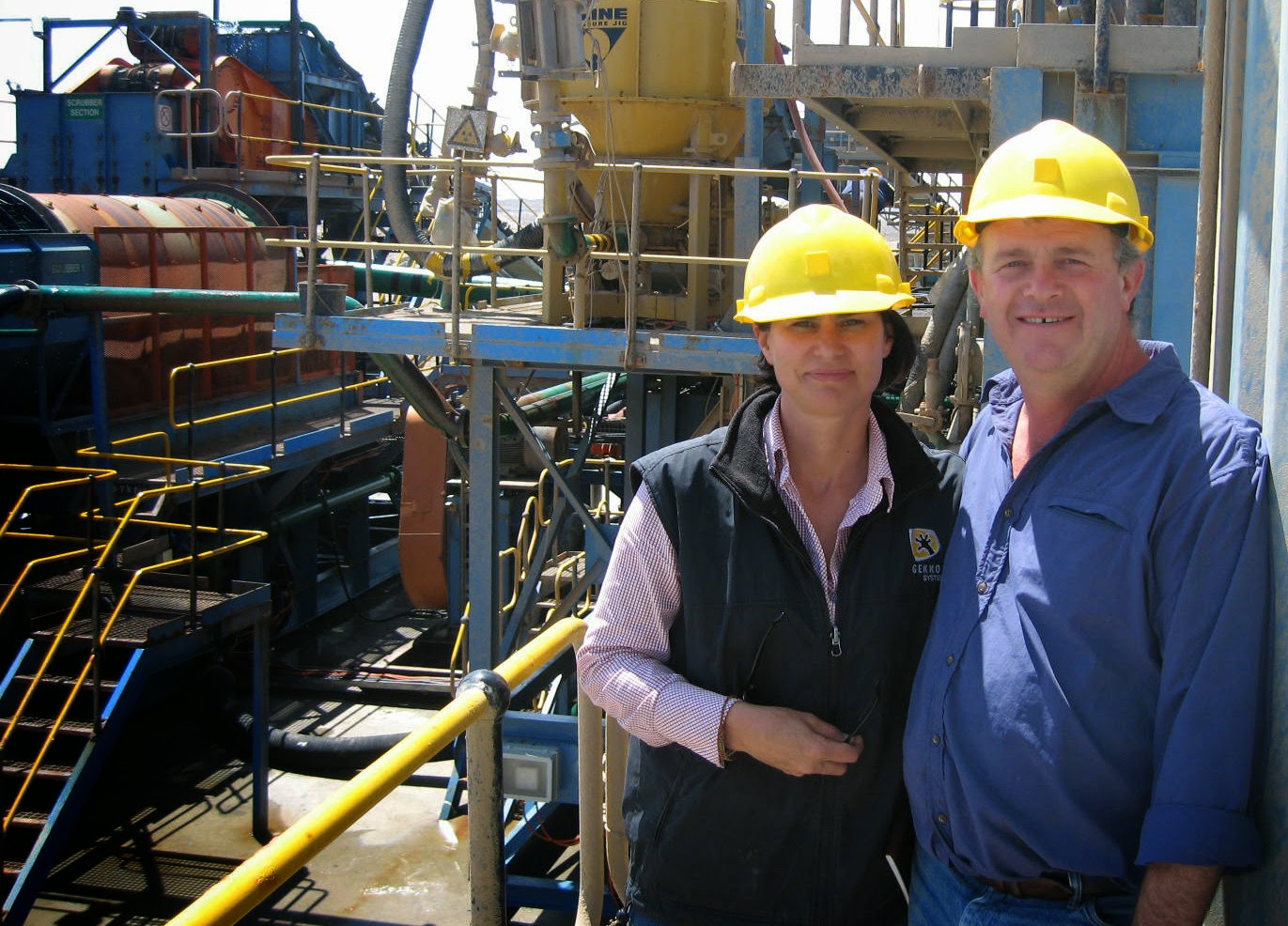

Elizabeth and Sandy at Namdeb diamond operations in Namibia, 2008
Prior to her involvement in the mining sector, Elizabeth Lewis-Gray worked in stockbroking and strategic planning and her qualifications include a Bachelor Degree in Economics, and a Masters in Business Management. Romance blossomed when Elizabeth was working in stockbroking in Melbourne and Sandy was managing a gold mining operation in regional Victoria. They married and continued their careers in different locations until the advent of their first child. On finding herself in a small country town with no career opportunities and married to Sandy, who had invented an “amazing” new gravity separation device, Elizabeth decided to take up the challenge of marketing and selling this product - the InLine Pressure Jig (MEI Online).  A small research and development grant was applied for and approved from the government, a mortgage on the house extended, and thus Gekko was created in mid-1995 and now has its head office in Ballarat (Victoria) and offices in Perth, Vancouver, and Johannesburg.

Sandy invented his first jig at 17 years of age in the Curnamona Basin in South Australia’s outback, where he learnt his craft in the field with "a brilliant man", Fred Hughes. With over 35 years of experience in mining and mineral processing operations, Sandy is now Technical Director of Gekko Systems. Since founding Gekko he has rejuvenated the art of continuous gravity separation  and he has become a world leader in low energy and pre-concentration flowsheets (gravity and float), as well as  concentrate leaching flowsheets for the gold and silver sector. He invented Gekko’s patented systems including the InLine Pressure Jig, InLine Leach Reactor, G-Rex Resin Exchange and the Python Processing Plant.  His inventions are breakthroughs in the field of mineral processing, with over 600 installations at mines in 43 different countries. The products and systems are now breaking into the coal and polymetallic sectors.

Sandy continues to invent new products and flowsheet designs. In recent years his main focus has been on improving plant economics incorporating technologies/flowsheets which focus on overall plant productivity improvements in energy, reagents, and maintenance/operations. He feels that to maximise the benefits of the new flowsheets it is necessary to have a completely integrated approach and possibly the most exciting transformation will come through the total downstream benefits of fine crushing up front for optimum liberation ahead of any further process.
 
Sandy is a recipient of the prestigious Clunies Ross Award, Australia’s pre-eminent award for scientists, technologists and innovators. Other awards he has received include the AusIMM Mineral Operating Technique Award, the Ernst & Young Entrepreneur of the Year Award and, most recently, the Victorian Premier’s Design Award in 2010 for the Python low height modular plant.

I asked him what have been the highlights in his career, and it is apparent that one of his most satisfying achievements has been the introduction of intensive cyanidation for the recovery of gravity gold concentrates into the gold industry through the development of the InLine Leach Reactor. This technology is now used in most gold mines with gravity circuits in the world. He is also proud of the design and development of the Python and its installation at Kloof in South Africa  with a commissioning period of only 6 weeks. Another success which he is justifiably proud of is the application of VSI (vertical shaft impact technology ) to improve pre-concentration outcomes through focus on liberation characteristics. This was used originally as a stop gap for HPGR but Sandy now believes it will become a standard metallurgical tool for those trying to optimise liberation.

He also mentioned his ‘hero moments’, meeting Alban Lynch (in conversation 11 August 2014) and the late Arthur Keats, who worked on flotation developments in Australia. Also the late Professor Andre Laplante (MEI Online) from McGill University - a world leader in gravity separation research with whom Sandy “co-presented, fought, agreed, and laughed on many AJ Parker gravity workshops together”.

Elizabeth Lewis-Gray is now Chairman and Managing Director of Gekko Systems and is currently Chair of Austmine, as well as Chair of Austmine’s Strategy Sub-committee.  She was a member of the Australian Federal Government’s National Precincts Board and after eight years, recently retired from the Innovation Australia Board.  She was inducted into the Australian Businesswoman’s Hall of Fame in 2000, is a Fellow of the Financial Services Institute of Australasia (FINSIA), and has won several awards including the Warren Centre’s Innovation Heroes Award. More recently Elizabeth was appointed by Industry and Science Federal Minister to Chair the METS Industry Growth Centre in Australia.

Elizabeth and Sandy receiving the Entrepreneur of the Year Award in 2005
I remember talking to Elizabeth at the IMPC in Brisbane in 2010. She enthused about a new project that she was initiating on eco-efficient comminution and, to be honest, I was a little sceptical of it ever getting off the ground. How wrong I was proven to be. She created the Coalition for Eco-Efficient Comminution (CEEC) from nothing to bring together information on energy efficiency in comminution. Under her leadership (Tim Napier-Munn refers to her as “one of the great movers and shakers”) CEEC has the capacity to have a meaningful global impact on energy consumption in mining and has recently been awarded the 2013 Mining Magazine Editor’s Award. With board members from around the world, CEEC now highlights important issues and facilitates debate in comminution energy efficiency, and MEI is proud to be involved with CEEC and its role as Industry Advocate to Comminution ’16.

I asked Elizabeth what was the inspiration behind setting up CEEC, and what are the plans for its development. “The inspiration around setting up CEEC was shock and frustration on finding out the scale of the problem and the low level of awareness and response by industry. I discovered how much energy the world was consuming in crushing and grinding (estimated as 3% global electrical consumption, 5-9% in Australia), and despite there being an enormous body of research available on this topic, I could not access it on the internet. Also there was no indication that the mining community was fully informed at senior/board level and/or changing its practises to improve the outcome.”

She said that “change is particularly important in the mining industry because the cycles are so long from test work through to application. Furthermore, it was a classic situation where information was held in “technical silos” and not being rapidly transferred. I would regard high impact, low cost marketing and story-telling as one of my skill sets so I knew I could make a big difference with a small budget. There were many members in the mining and supply community who were equally as frustrated, so I had a great deal of broad based industry support. Many people I spoke to were overjoyed that I was doing something about this.”

CEEC is now in the capable hands of EO Sarah Boucaut and Chairman Joe Pease (posting of 15th January) and is making an appreciable difference in educating the industry, especially at board level, for a very low cost investment. Elizabeth finds this very satisfying and shows why marketing is a skill set undervalued and much required in the mining industry. The establishment and impact of CEEC is an example of how someone with a non-technical background can add value and bring holistic industry change.

Elizabeth was recently named by the Canadian Institute of Mining (CIM) Magazine as one of mining’s top twelve “names to know - 12 characters whose energy, imagination and impact are catalysts for change in a tumultuous year” - for her work in founding CEEC.

Elizabeth’s current project is Austmine where she has taken on the chairmanship of the Australian peak industry body representing the mining, equipment, technology and services (METS) sector. One of the key roles for Austmine has been to undertake a comprehensive survey with the help of the Australian Federal Government which has identified that the industry has a turnover of AUD$90billion or a significant 3% of Gross Value Added in the economy (compared with mining at 10% GVA). The sector has a strong innovation platform and significant opportunities to improve productivity in the mining sector. Improving productivity, mining and supply sector relationships and accelerating the innovation cycle are key areas of focus for sectorial improvement.

I asked Elizabeth what have been the highlights in her short but illustrious career.  She particularly enjoys travelling all over the world to various mining operations and in June 2014 travelling to Canada and the U.S.A. with a small 20-strong Australian delegation led by the Prime Minister, the Hon. Tony Abbott, and Minister for Trade and Investment, the Hon. Andrew Robb. Highlights have also included leading government mining and METS missions to China and Canada.

Elizabeth with Australian Prime Minister, the Hon. Tony Abbott, left and
the Canadian Prime Minister, the Rt. Hon. Stephen Harper, right
She says that she is inspired by mining executives who have the courage to understand the ability of innovation to advance their business and engage in the process from the top down, using strong management and process to deliver results.  She is passionate about innovation and marketing. “There are so many brilliant technical ideas in the mining sector but we are missing the links between concept and application - the capacity for technical people to convert their ideas into meaningful narratives that include addressing financial impacts in a way that speaks to boards and senior executives”.  She feels that Tim Napier Munn (in conversation 12 May 2014) deserves a special mention for his technical brilliance and personal commitment to creating better outcomes for the good of the industry.

Elizabeth with CEEC Directors Tim Napier-Munn and Joe Pease
In 2013, both Sandy and Elizabeth were independently nominated for the inaugural International Mining Innovation Hall of Fame, but in different categories. They are a remarkable duo and I consider myself fortunate to know them so well, and to be able to share our recent conversations.

More Conversations

Sunday, 15 March 2015

An international gathering for the CSM Annual Dinner

Around 250 current and past students and staff of the Camborne School of Mines descended on Falmouth for last night's CSM Annual dinner. Past students had flown in from all over the globe, from as far as Australia, for what is always a great occasion, which invariably throws up a few surprises.
The first person I met in the Falmouth Hotel bar was Ray Manser. Although we swap Christmas cards it is 30 years since we last saw Ray and his wife Sally. I supervised Ray's PhD project on shaking table modelling in the mid-80s, and he is now Senior Systems Engineer with Fairport Engineering in the north of England.
With Ray and Sally Manser
Joe Bayah and his wife Glenda had flown in from Guyana. Joe, a 1980 graduate, is currently working on a magnesite project in Guyana.
With Joe and Glenda Bayah
It was good to meet the new Director of CSM, Kip Jeffrey (MEI Online), pictured below with CSM Trust Director Tony Batchelor.
Kip and Tony
After an excellent dinner, Kip gave his maiden speech as Director, highlighting the current healthy status of CSM and exciting plans for the future.
Kip sets the scene
Despite being a graduate of 'the other place', the Royal School of Mines, the guest speaker, Russell Clark got a fine reception. Russell is managing director of Wolf Minerals, who this summer will be opening the Drakelands tungsten-tin mine a few miles east of Plymouth, which will become the first new metals mine in England since the Wheal Jane copper and tin mine in Cornwall reopened for business in 1971 (posting of 10 July 2014).
“This mine has the potential to be the biggest tungsten mine in the western world and, if we just build it to the base case, it will be the second biggest,”  said Russell.
Planning permission was granted to the site in the late 1980s, but the end of the Cold War scuppered the mine. The former Soviet Union and the United States released enormous stockpiles of tungsten, which is used in weaponry and machinery because it is one of the hardest naturally occurring substances. Tungsten was mined briefly in the area during the two world wars.
He said that there had been little local opposition to the mine. “People think that as you’re on Dartmoor, there must be protests. I have never seen support like this.” The company has asked local parish councils to allow it to operate seven days a week, a step that would improve the economics of the mine. Sparkwell, one of the local parishes, has already voted in favour. 
“We’re lucky we are in an area that has a mining history,” he said. “A lot of local people are used to seeing a pit, used to seeing a quarry, and they recognise it’s good for the economy.”  Wolf is planting 40,000 trees to protect views and has built three “bat hotels” to create havens for the endangered animals.
Production of tungsten is dominated by China, which has about 60 per cent of global reserves. “Like many commodities, the tungsten price has been down in the dumps, but we think it’s going to come back quite strongly,” he said. “Unlike oil, coal or iron ore, it’s not caused by a glut in supply — it’s caused by people destocking and general demand.”
The local population certainly appear to be buying in: Wolf recently started advertising for equipment operators and about 900 candidates applied for 40 jobs.  Among those the mine has already recruited is 1980 CSM graduate Charlie Northfield, the manager of the processing plant. He left Plymouth in 1981 to work in a diamond mine in Sierra Leone and spent the next few decades working on overseas mining projects, most recently in Malaysia.  "I have been coming back to the UK regularly over the years, but to come back and be able to stay has been fantastic,” he said. Charlie will be back in Falmouth again in May to present a paper on the status of the processing plant at Physical Separation '15.

Charlie and Russell with Drakelands operations manager Jeff Harrison
It was a great night, with excellent company and food, and I thank Claire Yelland, secretary of the CSM Association, for her tireless efforts in organising this annual event.

Saturday, 14 March 2015

Amazing tribute to Falmouth's 'Bobby on the Beat'

What a wonderful town Falmouth is!  Last weekend Falmouth's popular community policeman, PC Andy Hocking, died suddenly at the age of 52. He had built up an army of friends during his time as a neighbourhood beat manager, and today thousands of people 'walked his beat' along the main street to Event Square in his memory. A moving and fitting tribute from the people of this Cornish town to a local hero.