Friday, 30 April 2021

April update: Coronavirus; tin, the 'forgotten' critical metal; the increasing importance of the mining industry

Covid took a back seat in the news early in the month with the news of the death of the Queen's consort, Prince Philip, the Duke of Edinburgh, at the age of 99. I met him very briefly in 1980 during the Royal Visit to Camborne School of Mines, where we discussed froth flotation, which must have made him feel that his visit had not been in vain. The lasting impression at CSM was of a man with a keen sense of humour, who was very ready to put you at ease.

Globally there is little good news on the pandemic, India in particular suffering dreadfully, but here in UK there was a slow return to normality on the 12th of the month, with the reopening of shops and gyms, and pubs and restaurants allowing outdoor eating and drinking, perhaps not an appealing prospect in Falmouth, where the mid-day temperature was 8C.

First pint of the year

Very many businesses have had to adapt or die during the pandemic, and MEI has made an enormous evolutionary leap which we could not have envisaged just over a year ago.  After a void of 17 months, our first online conference, Comminution '21, was successfully held two weeks ago, and the necessary move to virtual events was made possible by the efforts of Amanda and Jon, the next generation. For the first time Jon opened a comminution conference, his recorded address being filmed and edited by Amanda's eldest son, William. I took a back seat and attended the conference as a delegate.

Jon and his nephew William record the opening address

Cornwall is gearing up for the G7 summit at Carbis Bay next month, and in March world leaders made pledges to tackle climate change, the US committing to halving its emissions within a decade and the UK enshrining in law a target of 78% cuts from 1990 levels by 2035.

Many environmental groups want these targets to be achieved earlier but the sad irony is that it is many of these who also demonstrate against mining, the very industry on which these targets are reliant on (Is Zero Carbon by 2050 Attainable?).

Copper in the past has not been regarded as a critical metal, but it should be now. It is the metal needed in increasingly large amounts to produce renewables and electric vehicles. But even now supply is barely keeping up with demand. Many large mines have a head grade of only around 0.5% copper, lower than the tailings of most mines not so long ago. Although ample copper supplies next year and in 2023 will keep the market balanced, mines need to start investing in new capacity soon to meet future demand.

Lithium supply is also critical and new sources must be found to satisfy the demand for battery production. Cornwall will help when the hard rock and brine developments at Cornish Lithium and British Lithium come on stream, but what of tin, which is ready to undergo a resurgence down here in the south west? Very little focus has been given to tin, which is one of the metals critical to achieving the projected green economy, but which has had little exposure compared with lithium, cobalt, nickel, copper and rare-earth elements.

Commonly thought of as having a major use as tin-plating in 'tin cans', plating now accounts for only 12-13% of total consumption, behind 15-18% for chemical use. The major use for tin today is in solder to create electrical connections, currently accounting for close to 50% of demand. It is this use in typically small-scale electronic components that makes the metal critical to the energy transition. Every component of the low-carbon economy requires tin, as without it electrons will not flow. While other metals can theoretically be used for this purpose, given the abundance and effectiveness of tin there really is no economic substitute.

What makes the developments in Cornwall so important is that while there is no shortage of existing and potential tin supply, that supply currently comes with environmental, social and governance (ESG) risk, as most tin production comes from countries that have high ESG risk. China, and Indonesia together account for over 50% of mine supply, while Myanmar is currently the third-largest supplier, and production in the DRC is rising quickly.

Tin might become important for another reason. Stanley Wittingham, jointly awarded the Nobel Prize for Chemistry in 2019 as one of the founding fathers of lithium-ion batteries, has recently reviewed potential for tin in lithium-ion batteries. In his paper published in October 2020 with colleague Fengxia Xin, Wittingham explains how “tin-based materials are strong candidates as the anode for the next generation of lithium-ion batteries”.

It is apparent that the mining industry is going to be vital in the coming decades and that there will be enormous challenges in supplying the critical raw materials, something which much of the world's media and environmental activists seem blissfully unaware of.

@barrywills

Thursday, 29 April 2021

Recent comments

There have been comments on the following postings since the last update:

Greta Thunberg's criticism of the Cumbrian coal project highlights her naivety
Comminution '21 provisional programme now live
Thank goodness lithium grows on trees
Gordon Ritcey: 1930-2021
February: the first steps to normality?
The Levant man-engine disaster of 1919: a contemporary account
Are these WASET conferences just a scam?
Top SME Awards to three well-known mineral processors
A final call for abstracts for Sustainable Minerals '21
In conversation with Chris Kelsey- mineral processing innovator
2020 MEI Young Person's Award to Ahmad Hassanzadeh
Tony Holland-Batt, 1937-2020
Return to Nchanga, Zambia's greatest copper mine
Memories of Comminution '01, Brisbane
Controversial "invisible gold" paper published
Two new editors and a new editorial structure for Minerals Engineering
The real cost of using neodymium in wind turbines
Why good technical English is important for journal papers
New book: Of Earth, For Earth: The meaning of a mine
Comminution '21: only 4 days away
No welcoming reception for comminution delegates this year unfortunately
Comminution '21 Day 2 update
Comminution '21 Day 4 update

We welcome and encourage your comments on blog postings (see also the posting of 2nd April 2019). If you do not have a Google account, the simplest way to add a comment is by selecting 'anonymous' as your profile, but please leave your name and affiliation in the comment. Alternatively, email your comment directly to bwills@min-eng.com.

Last month there were around 17,000 page views, so interacting with the blog enhances your international presence by providing you, and your company or Institute, with valuable exposure.

If you are in Web View (mobile users can access this by scrolling down to the bottom of the screen) you can also check various things in the right hand column:
  • The latest MEI tweets from @barrywills
  • The most viewed posts in the last 7 days, month and year
  • Dates of blog posts (click on the black arrows to open up individual months and postings)
  • Labels, or categories
You can also access MEI's Facebook page and MEI Online via links in this column.
If you would like a weekly email alert to comments on the blog, please let me know via bwills@min-eng.com.

Monday, 26 April 2021

What is the future for biomining?

Biohydrometallurgy is an important technology used by the mining industry, mainly for the recovery of copper from low-grade ores and in the pre-treatment of gold-bearing refractory concentrates. 

However, despite the excitement of 40 years ago, it remains a niche technology; applied where it offers unique advantages or no alternative exists. Advances in competing hydrometallurgical processes, such as chloride leaching and HPAL mean bioleaching is at risk of losing ground. 

To halt this potential decline, and to make biomining more competitive in an increasingly busy space, serious scientific and technological advances are required, according to Dr. Chris Bryan, of BRGM, France. 

In his keynote lecture "Bridging the gaps in biomining research and application" at Biomining '21 in June, Chris will show that biohydrometallurgy is incredibly exciting, as few other technologies combine so many different disciplines. However, research is rather disparate, with relatively few resources. More than ever, as a community we need to consider how best to advance the state of the art: how to avoid the no-man’s land between academic knowledge and industrial needs and what are the key research questions. 

Chris has been a consultant for many years now on MEI's Biomining (formerly Biohydromet) conferences. Formerly a Senior Lecturer in Sustainable Mining at the Camborne School of Mines, he is now Head of the Geomicrobiology and Environmental Monitoring Unit, French Geological Survey (BRGM).

Chris Bryan (right) at Biohydromet '16 with
Shafiq Alam of University of Saskatchewan

Chris's keynote will complement that of Prof. Barrie Johnson (posting of 8th April 2021), who will give a personal critique of the limitations and untapped potential of applying bioprocessing techniques for metal extraction and recovery.

In a 3rd keynote at the conference Dr. Anna Kaksonen (posting of 12 October 2018) will show how biotechnology is set to have an increasingly important role in the quest for the circular economy, particularly in remediation, treatment of tailings, electronic and other wastes, and as a potential aid to processes such as flotation.

These three keynotes will provide the basis for the panel discussion "What is the future for biomining". The full programme for the conference will be published very soon.

#Biomining21

Thursday, 22 April 2021

Comminution '21 Day 4 update

Thursday 22nd April

It was good to have Joe Pease, of Mineralis Consultants, Australia on Tuesday's panel discussion. Four years ago he and his colleague Bill Johnson (posting of 27 August 2020) were inducted into the International Mining Hall of Fame, for their pioneering work in bringing stirred milling into the minerals industry in the mid-1990s.

Joe Pease (left) with Bill Johnson

Stirred mills were introduced into the minerals industry for ultrafine grinding of refractory ores, but their use is now being extended into coarser size ranges, the subject of a paper this morning by Monday's keynote speaker Chris Rule.

It is difficult to overestimate the impact that stirred milling has had on comminution circuits, and the morning session contained 9 presentations on stirred mills and their associated ceramic media, from Australia, Canada, France, South Africa and UK, including two from conference sponsor Keramos, an Australian based company with over 20 years experience in the manufacture and supply of cutting edge ceramic grinding media into the mining and minerals industries.

Media for stirred mills is now a very competitive business, and apart from Keramos, there are three more dedicated suppliers exhibiting, sponsor Dakot from South Africa, and two from China, sponsor King's Beads, and Betterwear New Material, a welcome new company to the comminution series. It was interesting to browse their brochures in their booth.

The final session of the conference, on Mills and Circuits, began with a presentation by Glenn Stieper, of conference sponsor Glencore Technology, Australia. He stressed that as resources degrade towards complex ores, larger plants and throughputs are needed to achieve the same project economics, but this is in conflict with a concurrent demand for better safety, environmental, capital cost, operational cost and energy performance.

To address this conflict, mineral processing must evolve and Glencore Technology has developed a concentrator design that achieves a smaller volume of capital equipment, a lower profile and footprint, less environmental impact and greater safety. This is via the marriage of its first 5MW M20,000 IsaMills with a full circuit of new and larger throughput Jameson Cells.

Australia’s Russell Mineral Equipment, a global leader in the design, manufacture and supply of grinding mill relining technologies and services, has made massive contributions to recent comminution conferences, sponsoring and having three exhibit booths and 15 representatives at Comminution '18. 

This year has been no exception. The company is sponsoring once more, has a virtual booth, and 17 registered delegates, and in the final session a presentation by Stephen Gwynn-Jones on automated mill relining, which was followed by a presentation by Waldo Verster of Multotech, South Africa on mill liner optimisation.

Following a full day of presentations Jon Wills announced the result of the draw for the generous prize donated by conference sponsor Cancha. This was a 12 month subscription to Cancha Geometallurgy Software, including training and support, worth US$2,900. Cancha is an integrated geometallurgical toolkit for sample selection, 3D visualization, model generation, and data analysis and bridges the gap between geological knowledge and comminution simulators. The lucky winner was Ann-Christin Böttcher, of TU Braunschweig, Institute For Particle Technology, Germany.

Jon then brought proceedings to an end by thanking the sponsors once more, as well as all the presenters, exhibitors, and the delegates for being so active in the discussions. All that was missing was an invitation to adjourn to the Vineyard Hotel Gardens for a final drinks function, but hopefully this will happen at Comminution '23.

Memories of Comminution '18

Despite this being our first online conference we have been very pleased with the way that it progressed. The 67 presentations were very professional and there was a great deal of delegate interaction. These discussions can continue for a further 6 months, as the conference will remain online, and we invite further registrations at any time. At the moment there are 213 registered delegates and this number is increasing daily.

We would greatly appreciate your feedback on the event, and invite you to submit your comments and criticisms to this blog post, as your opinions will be of great value to us as we progress to future events.

Thankyou all of you for your support.

@barrywills

Wednesday, 21 April 2021

Comminution '21 Day 3 update

Wednesday 21st April

Day 3 of Comminution '21 was devoted entirely to High Pressure Grinding Rolls (HPGR) and SAG Mills (see footnote), and opened with a keynote lecture from John Starkey, of Starkey & Associates, Canada, who described how to get the best performance possible from your existing machines in order to keep down operating costs.

This was an excellent presentation, very clear and concise, which should be seen by everyone involved with SAG milling. John began by saying that the SAG mill is the heart and soul of many mineral processing plants and every engineer should know how to design a SAG mill.

He was critical of JK software for design, although he felt it excellent for optimisation, and it is a shame that we have no representation from JKMRC at the conference as this could have led to an interesting discussion.

Questions started to flow into the online discussion only 15 minutes into the presentation, and I must say that we have been very pleased by the interaction between delegates and presenters via the online text facility. Although there are obvious difficulties due to time zones, questions and replies to all presentations have been coming in not only during, but also well after the presentations, and discussion can go on for another 6 months, so we do ask the presenters to dip in occasionally.

Starkey & Associates are regular sponsors and exhibitors at the comminution series, and I visited their booth during the first break, which followed two innovative presentations from Australia on hybrid comminution machines and circuits, the presentation from Mike Daniels on Eccentric High Pressure Centrifugal Comminution being the subject of a recent article in International Mining. 

This week has been my first experience of a virtual exhibition, and I was initially sceptical, but I have found it to be very relaxing and rewarding to "stroll" around the exhibits and call in at the booths to browse the literature on display. The company representatives are clearly displayed in the booth, and if they are not actually within the booth at any one time, they can easily be contacted via the meeting hub. The only drawback of a virtual booth, of course, is that there is no working equipment to view.

After the 6 morning presentations on HPGR, the afternoon session contained 11 presentations on SAG milling, including another presentation by John Starkey, and one from another conference sponsor ME Elecmetal, USA, Amit Saxena describing the optimisation of discharge flow efficiency in a SAG Mill.

Another great day ends, and we look forward to tomorrow's sessions on Stirred Mills and Milling Circuits.

@barrywills

By clicking on any presentation in the programme, you will be able to see the abstract and the biographical details of the presenter. All presentations will be available for 6 months, so you can register for the event at any time.

Tuesday, 20 April 2021

Comminution '21 Day 2 update

Tuesday 20th April

What novel machines are to be found in the future? In the first presentation of the day, Dr. Paul Cleary, of Australia's CSIRO, described in his keynote lecture the Virtual Communition Machine, an approach which is already being used to drive the rapid evolution of comminution machine design. The presentation contained truly amazing animations of simulated comminution in various machines, which allow new ideas to be trialled in a virtual framework at a fraction of traditional cost and time. The VCM can provide much greater mechanistic insight, which can improve and accelerate development of new machines, as well as machine scale-up.

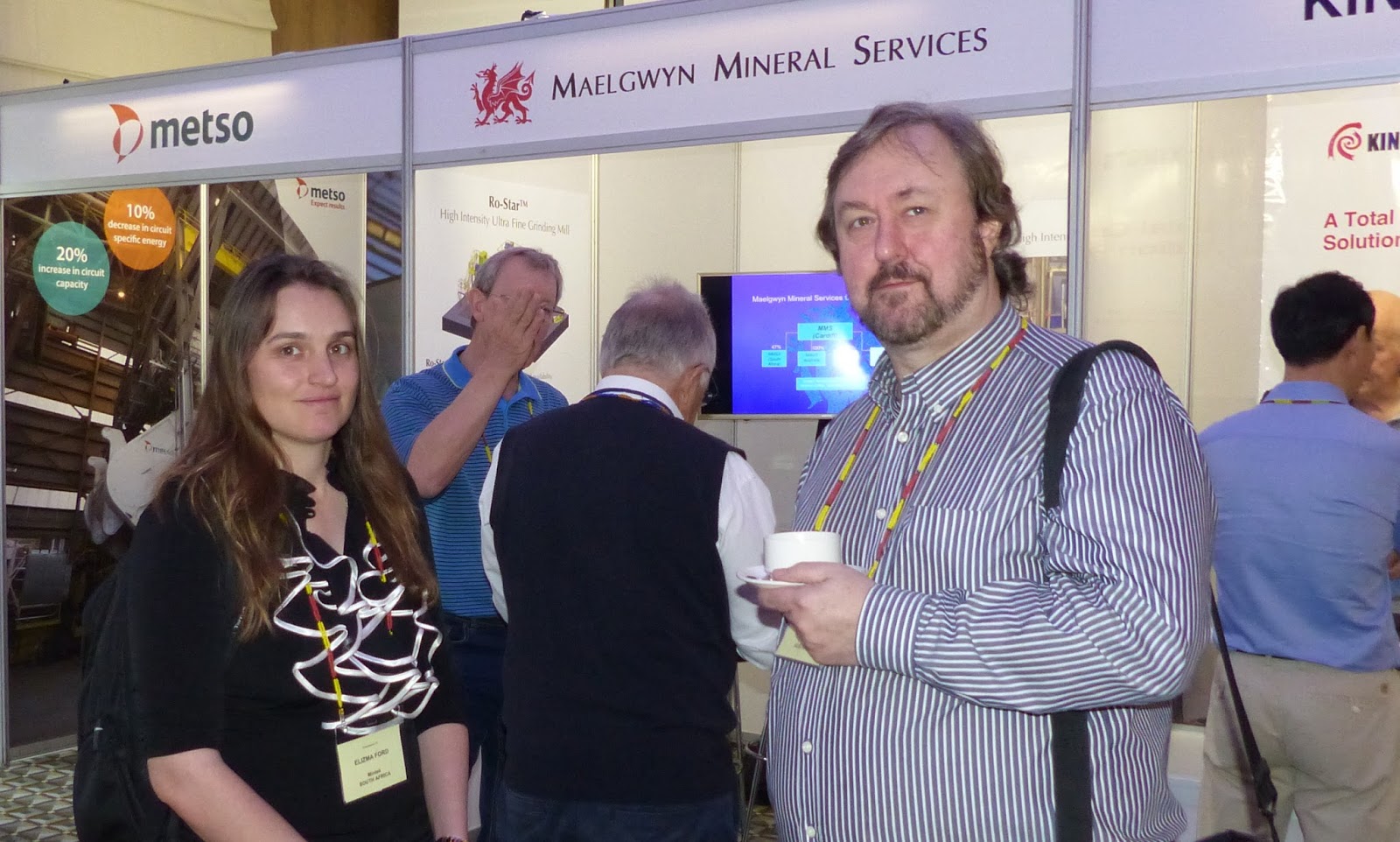
Paul at Comminution '18 with Mintek's Elizma Ford,
who will be presenting a paper on Thursday

Paul's keynote was the first paper in Modelling and Simulation, the theme of today's long technical session (see footnote). Progress in computational methods have come on at a tremendous pace in the last half century so it was a privilege to have one of the early pioneers of mathematical modelling in mineral processing, Prof. T.C. Rao with us at the conference. Prof. Rao obtained his Ph.D degree under the guidance of the JKMRC's first Director, Prof. Alban Lynch, in 1965, working on the characteristics of hydrocyclones. They published their work on hydrocyclones in a number of seminal papers, and the models are still valid today, being used in many hydrocyclone manufacturers' performance curves. 

Profs. Rao and Lynch reunited in Brisbane in 2016

Prof Lynch, who is now 91, intended to be with us today, but unfortunately was unable to do so but sent his best wishes to all at the conference. The last time Alban Lynch and Paul Cleary met at an MEI Conference was 20 years ago, at Comminution '01, and I'm sure that both Alban and TC would have loved to have spent time with Paul at this year's event, as Paul is also a pioneer of a technique which they would not have heard of in the early 1970s, but was introduced to us all at Comminution '01- DEM Modelling, the subject of a number of papers today. And they would certainly not have heard of Positron Emission Particle Tracking (PEPT) which has become a widely used tool in recent years, and two presentations from South Africa showed how PEPT has been used to validate DEM Models for tumbling mills and stirred mills.

"What will comminution circuits look like in 2050?" was the theme of the mid-day panel discussion, chaired by Mike Battersby of Maelgwyn Mineral Services Ltd, UK, and Chairman of CEEC. Giving their views were Grant Ballantyne (Australia), Joe Pease (Australia), Alex Potapov (USA), Peter Radziszewski (Canada), Paul Shelley (Australia) and Weigo Xie (USA).

There was a wide ranging discussion, but a general consensus was that coarse rejection of gangue prior to comminution, and separation at as coarse a size as possible, concomitant with recovery, would be needed to reduce energy and water consumption. It was also felt that there would be more emphasis on dry grinding and processing, although there are environmental and health concerns associated with this. Alternative technologies such as high voltage fragmentation and microwave heating, to weaken grain boundaries, might also be used but although good work at small scale has been carried out they may not be able to be fully utilised at high throughputs.

Secondary mining and processing was also touched on, and Grant Ballantyne felt that there would be much more emphasis on processing old tailings in the future, with reduced comminution requirements.

Not surprisingly there was much discussion on simulation and the use of artificial intelligence and Mike Battersby commented on Paul Cleary's keynote this morning, endorsing my opinion of the superb simulations showing how far we have come over the last couple of decades.

Grinding is evolving and changing fast, with innovations in high pressure grinding rolls and stirred mills threatening to make the tumbling mill, which has been a stalwart for well over a century, obsolete. At the panel discussion at Comminution '14 Tim Napier-Munn said that in terms of the future of comminution "we really have to get rid of tumbling mills". Are rod mills now finally obsolete? Ball mills would have dominated comminution conferences little over a decade ago, but they are mentioned only rarely now.

This question came up at the very end of today's panel discussion, and I would have liked to have heard more from the panel, who felt that tumbling mills would still play a role, but that they would be more efficient, particularly regarding the associated classification.

SAG mills are still of major importance, but I asked the question at Comminution ’12 whether ball mills would play a significant role in comminution circuits, or would they be superseded by SAG mills. Chris Rule, yesterday's keynote speaker, felt at that time that rod mills would play an insignificant role, as they are severely limited in terms of size, and ball mills may play a diminishing role as the upper feed size range of stirred mills increases. 

With HPGR grinding finer and stirred mills taking coarser feeds this is open to discussion, and we will no doubt hear more of this in the next couple of days, tomorrows sessions covering HPGR and SAG Mills, and Thursday Stirred Mills and Grinding Circuits.

@barrywills

By clicking on any presentation in the programme, you will be able to see the abstract and the biographical details of the presenter. All presentations will be available for 6 months, so you can register for the event at any time.