Process Mineralogy '24, the 7th in the series, was held at the Vineyard Hotel, Cape Town from November 11-13, 2024 and was attended by 109 delegates from 20 countries.
Following is a very brief summary of the presentations made over the three days. This summary is intended to guide you to the extended abstracts associated with the presentations, oral and poster, most of which are available online as open-access. Unfortunately not all presenters responded to requests for drafts, but for those that did their names are linked directly to their papers in the online Proceedings.
The drafts have not been refereed, but all the presenters have been invited to submit their final papers for peer-review to a virtual special issue of Minerals Engineering.
Monday November 11th
Technical Session 1: Chairpersons: Nathan Fox and Anita Parbhaker-Fox (University of Queensland, Australia)
Geometallurgy was the main theme of the morning presentations, beginning with a keynote lecture from Stewart Brand, Principal, Global Geometallurgy at BHP, Australia where he leads strategic geometallurgy projects and supports geometallurgical teams around the world. Stewart looked at the future of geometallurgy, showing that, as complex, polymetallic, lower-grade and deeper mineral deposits are forecast to be the future source of the metals and minerals required to decarbonise the global economy,the sustainable and economic extraction of these minerals will require the expert application of geometallurgy across the mining value chain, from concept through to closure.
 |
| Stewart Brand (centre) with session chairs Nathan Fox and Anita Parbhakar-Fox |
Glacialle Tiu, a post-doctoral fellow at the Luleå University of Technology, Sweden, looked at data fusion using machine learning, towards real-time implementation of geometallurgical models for ore tracking.
 |
| Glacialle Tiu (right) |
Corinne Garner is a senior mineralogist with conference sponsor Petrolab, UK. She showed why automated mineralogy is of increasing importance in the energy transition, with the need to scale mining of base metals and the drive for smarter and more environmentally friendly mining. She highlighted the benefits of trending long-term process mineralogy data.
 |
| Corinne Garner and James Strongman of Petrolab |
Monica Mendes, a master geologist with Vale's exploration and mineral projects division,described a geometallurgical program for a copper deposit during its development stage: mineralogical characterisation, flowsheet optimisation and spatial modelling.
 |
| Monica Mendes (left) at the welcoming reception |
Nathan Fox, a senior research fellow at the University of Queensland, Australia discussed the geometallurgical characterisation of a historical low-grade tungsten stockpile for ore sorting applications at Mt Carbine tungsten mine,Queensland. The results confirmed the amenability to preconcentration and led to the installation and optimisation of XRT ore sorting technology for processing both low-grade waste and new ore extracted since reopening of the mine.
Norman Lotter is the President of Flowsheets Metallurgical Consulting Inc., Canada, which he founded in 2016. A flowsheet development project was initiated at a palladium operation in Northern Ontario, so as to identify processing opportunities and develop improved metallurgical performance. Norman described the geometallurgical unit study and the process implications that developed.
 |
| Norman and Heather Lotter at the conference dinner at the Cape Town Waterfront |
Alexandra Stavropoulou is a product scientist with Oxford Instruments, UK and she described the impact of adding Backscattered Electron and X-ray imaging to geological workflows in the SEM.
 |
| Alexandra Stavropoulou and George Stonadge of Oxford Instruments |
In the last paper of the morning session Leonardo Salazars, a Geologist and Product Application Specialist at Thermo Fisher Scientific, Australia, looked at improving quantitative mineralogy through non-linear Energy Dispersive X-ray Spectroscopy calibration.
 |
| Leonardo Salazars and Aukje Benedictus of Thermofisher |
Technical Session 2: Chairpersons: Glacialle Tiu (Luleå University of Technology, Sweden) and Paulina Vallejos (Santa Maria University, Chile)
John Logos Guiang is a metallurgist at Boliden Mining Oy, Kevitsa Finland and he presented the first paper in the afternoon session, evaluating new XRD calibration and mineral analysis accuracy for process onitoring at Boliden Kevitsa.
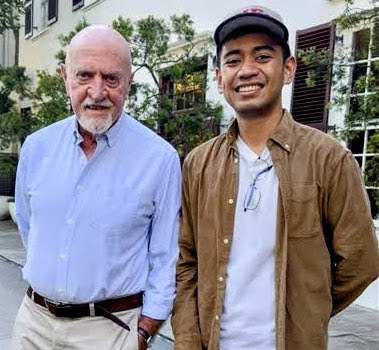 |
| With John Logos Guiang |
Geoff Nitschke is head of the Evolutionary Machine Learning group and Associate Professor at the Department of Computer Science, School of Information Technology,
University of Cape Town. He described a new automated mineralogy computational tool for particle classification and analysis, leveraging the general classification capacity of large neural networks (deep-learning), multi-label classification, and established computer-vision (machine-learning) techniques to improve particle deagglomeration across various granular specimens.
Percy Escalante is a PhD Student at the Universitat Politècnica De Catalunya, Spain,and he showed how Mineral Liberation Analysis (MLA) was employed to characterise the mineralogicalimpurities in a carbonate-rich material, revealing the presence of several accessory minerals.
 |
| Percy Escalante (centre) at the evening sundowner |
Marijn Boone is a product marketing manager for micro-CT at Tescan, Belgium. Micro-CT is a technology to non-destructively investigate the internal structure of samples. However, when it comes to material identfication, the technology has some inherent limitations and can struggle to provide contrast between minerals with similar atomic number and/or density. Marijn showed how,by incorporating a spectral detector, the 3D mineral identification in sulfide ore samples by micro-CT can be improved.
 |
| Marijn Boone with his Tescan colleague Marek Dosbaba at the sundowner |
Jacob Viljoen, a senior development engineer with Scanmin International, South Africa, showed how Scanmin's successful application of its Site Reference Standards in calibrating analysers demonstrates its potential to enhance the reliability and efficiency of Prompt Gamma Neutron Activation Analysis, promoting broader adoption of this powerful analytical technique.
 |
| Jacob Viljoen (centre) at the Scanmin booth |
Pia Lois Morales is an Assistant Professor at the
University of Chile. She showed how X-ray microTomography can be used to estimate fracture propagation during impact testing. In a second presentation she described work applying automated SEM data from intact slabs to predict comminution indicators through an extensive database derived from the characterization of physical properties and an algorithm based on comminution behavior, to predict comminution test results.
In the final paper of the day, Bjorn Von Der Heyden, a senior lecturer at Stellenbosch University, South Africa, showed how chemistry-mineralogy-texture inter-relationships can be quantified to predict manganese ore comminution response. This is important as South Africa hosts the world’s largest reserve of manganese ore, which is typically of sufficiently high quality for beneficiation solely by dry crushing and screening.
 |
| Bjorn Von Der Heyden (right) at the sundowner |
More on Day 1
Tuesday November 12th
Technical Session 3: Chairpersons: George Stonadge (Oxford Instruments, UK) and Bjorn von der Heyden (Stellenbosch University, South Africa)
The day began with a keynote lecture from Quentin Dehaine, a Senior Researcher with the Geological Survey of Finland. He assessed the trends in cobalt mining and processing in relation to mineralogy.
 |
| Quentin Dehaine (right) |
Fernando Prado Araujo, of KU Leuven. Belgium, is a geologist specialising in the geochemistry, mineralogy, and genesis of mineral deposits, with a particular interest in the geometallurgy of rare metals and battery metal ores. He assessed mineralogical controls on Ni and Co recovery from the HCl leaching of Ni laterites.
 |
| Fernando Prado Araujo (right) |
Jeremy Guignard, an experimetal mineralogist with I-ROX Technology, France showed how, with application to the Escondida ore deposit, copper sulphides liberation can be improved by using Pulse Power Comminution.
 |
| Jeremy Guignard (2nd right) |
Hajar Chamlal, a PhD student at University Mohammed VI Polytechnic, Morocco examined a Cu-flotation circuit using automated mineralogy, addressing the diverse primary and secondary copper minerals with inherent textural complexities. By understanding the textural properties of the Cu-minerals, targeted improvements were made to the flotation circuit, ultimately leading to more efficient processing.
Scott Brindle. a graduate of the University of Manchester, UK, is a Senior Geoscientist with XPS Industry Relevant Solutions, Canada. He described a case study characterising Ni-Cu sulphide ores and products from flotation to improve metallurgical outcomes through the application of process mineralogy,
 |
| Scott and Jayne Brindle at the conference dinner |
With the increasing interest in rare earth element (REE) deposits, and limited literature addressing the mineralogy of such deposits, there is a growing demand for REE mineralogical characterisation studies. Kirsten Youlton, a senior mineralogist at SGS South Africa showed how SGS Mineralogy can characterise these ores, addressing challenges, including mineral chemical variations, substitutions, impurities and solid solutions.
 |
| Kirsten Youlton (left) |
The shift towards global energy transformation relies on essential metals and minerals, with lithium playing a crucial role in energy storage through Li-ion batteries. Lepidolite, a lithium mica, is abundant in the Beauvoir rare metals granite in France, which also contains fluorine, tin, niobium, tantalum, and beryllium. Chloe Korbel, a PhD candidate at the Universite de Lorraine, France, showed how a combination of µXRF and µLIBS can be used as a tool to improve the beneficiation routes of these light elements.
 |
| Chloe Korbel (2nd right) |
Krisztian Szentpeteri is a senior Ore Geology researcher at the Geological Survey of Finland, and he described in-situ lithium quantificiation and mineral mapping using Laser Induced Breakdown Spectroscopy for lithium pegmatites.
 |
| Ivana Cupido |
Taking us to the lunch break,
Ivana Cupido, a PhD student at the
University of Cape Town, looked at predictive modelling of lithium mineral grades using data analytics and chemical assay data.
Technical Session 4: Chairperson: Natalie Shackleton (AECI Mining Chemicals, South Africa)
Speaking for the second time in the day, Fernando Prado Araujo of KU Leuven, Belgium, introduced a geometallurgical approach to by-product recovery from rare-metal granites.
Gillian Nikka Omaga of the Universite de Lorraine, France, has an MSc in Resources Engineering and a BS in Metallurgical Engineering from the University of the Philippines. She showed that as high-grade ores become depleted, attention shifts towards developing suitable beneficiation strategies for low-grade iron ores, posing significant challenges. She described the characterisation of a low-grade and complex iron ore stockpile and identification of possible beneficiation strategies.
 |
| Gillian Nikka Omaga with John Logos Guiang |
Daniel Uliana, a process mineralogist and microscopy leader at the University of Sao Paulo, Brazil, discussed the 3D quantitative mineralogical analysis of a low-grade iron ore and the main challenges in sample preparation.
 |
| Daniel Uliana (left) |
Mapadi Olifant is a senior scientist at Mintek, South Africa. She holds an Honours Degree in Geology from University of Witwatersrand and is currently pursuing Masters Degree in Geology at the University of Johannesburg. She described an iron ore case study for coarse particle characterisation to predict gravity separation performance.
 |
| Mapadi Olifant (left) |
Yann Foucaud, an associate professor in mineral processing and applied mineralogy at University of Lorraine, France presented work on the technological characterisation and preliminary beneficiation studies of iron ore from the Mont Reed deposit, Canada, to establish a viable process for producing direct reduction quality concentrate.
 |
| Yann Foucaud (2nd right) at the conference dinner |
In the final presentation of the day Cornelia Gous, a specialist geometallurgist at Kumba Iron Ore, South Africa, argued that geometallurgy is well established for base metal deposits where the metal recovery is directly linked to the mineralogy itself. However, at a bulk iron ore mine, the science of geometallurgy is relatively new and her presentation followed the journey of an iron company into geometallurgy.
 |
| Cornelia Gous (left) |
More on Day 2
Wednesday November 13th
Technical Session 5: Chairpersons: Kirsten Youlton (SGS, South Africa) and Fernando Prado Araujo (KU Leuven, Belgium)
The first five presentations of the morning session dealt with mine waste, starting with a keynote presentation from Anita Parbhakar-Fox, Principal Research Fellow at the University of Queensland, Australia, recently recognised as one of the "100 Global Inspirational Women in Mining", by Women in Mining UK. Anita stressed that meeting the needs of the energy transition is a once-in-a-generation challenge like no other before. To meet the projected metal demand to support this, the global community will produce increased volumes of mine waste requiring best practice management. Mine waste is suspected to be a host of critical metals and minerals. If identified as significant resources of critical metals, re-mining waste can support global effort to adopt circular economy principles. She showed that that mineralogical characterisation is key to identifying valorisation options for not only recovering critical metals/minerals, but to also reduce associated environmental legacy issues and mining footprints.
 |
| Anita Parbhakar-Fox at the Welcome Reception |
What not to do with mine waste was the subject of the presentation by Corinne Garner, Senior Mineralogist with conference sponsor Petrolab, UK.
Environmentally friendly mining and remediation is at the forethought of every operational mining company with some finding alternative uses for their waste, commonly as aggregate or within their paste backfill. In theory the use of mine waste as aggregate is an excellent recycling feat, however in practice this can cause widespread catastrophe. A combination of reactive sulphides within weak/porous aggregate has caused oxidation, expansive sulphate formation, and acid generation leading to blockwork cracking and disintegration. Corinne's presentation showed how the use of automated mineralogy can map and quantify these sulphides and confirm sulphate generation.
 |
| Corinne Garner and James Strongman of Petrolab |
Historical mine tailings represent both an environmental liability and an opportunity for future mineral supply. Amidst the current energy transition, they represent a potentially significant reservoir of unrecovered critical and strategic minerals. Nikita Malafeevskiy, a PhD candidate at the Norwegian University of Science and Technology. presented a study focusing on the mineralogical characterisation of historical Storwartz mine tailings from the Røros Ore District, Norway's most prolific mining district with over 300 years of mining history.
 |
| Nikita Malafeevskiy (left) at the sundowner |
Manuel Caraballo. an Associate Professor at the University of Huelva, Spain, discussed the role of carbonation and geopolymerisation processes in the cementation of alkaline activated mine tailings.
 |
| Manuel Caraballo |
The understanding of mine waste properties, particularly tailings, remains limited, as these wastes are often disposed of in tailings dams without further consideration. Current trends aim to valorise waste by reprocessing, yet a considerable waste fraction remains. A comprehensive characterisation is,therefore, crucial to fully grasp the material's properties said Sage Govender, a PhD student at the University of Cape Town. Sage showed how mineral sands mine wastes from two mines had been characterised.
 |
| Sage Govender (right) |
Despite the transition towards cleaner energy and the manufacturing of associated new technologies and the required critical minerals, gold remains the most heavily invested sector in exploration and Andrew Menzies, Senior Application Scientist with Bruker Nano Analytics, Germany, discussed the role of automated mineralogy in the elusive hunt for gold.
Taking us to the lunch break,
Carmel Vasconcelos, a Development Engineer at
Boliden, Sweden, described a study from laboratory to industrial scale on
Boliden's Kankberg ore to enhance gold-tellurium flotation performance.
Technical Session 6: Chairperson: Megan Becker, University of Cape Town, South Africa
Lucas Pereira, leader of the particle-based modelling group at the Helmholtz Institute Freiberg for Resource Technology, Germany, was one of the young author award winners at last month's IMPC in USA. He discussed the quantification of the flotation kinetics of various copper-bearing minerals under unique reagent regimes, based on their microstructures, with particle-based separation models.
 |
| Lucas Pereira (left) at registration |
Depressants are used to enhance the valuable minerals recovery and flotation selectivity and Natalie Shackleton, Metallurgy Consultant with conference sponsor AECI Mining Chemicals, South Africa, examined the performance of various depressants with the aim of gaining an understanding of the depressant and gangue minerals characteristics that play a role during froth flotation of PGM ore types.The work clearly demonstrates that the mineralogy of the ore dictates the depressant reagent type for flotation of PGM ores.
 |
| Natalie Shackleton (2nd right) |
Daniel Dodoo, a Doctoral Student at the University of Melbourne, Australia, showed how, using talc as a case study, the flotability of gangue minerals can be characterised and predicted from X-ray diffraction patterns.
 |
| Daniel Dodoo (left) |
First Quantum Minerals (FQM) established one of the world's first on-site process mineralogy teams with Auto-SEM-EDS at Kansanshi in Zambia in 2015. Lucy Little, Senior Metallurgist, Mineralogy with FQM described the application of on-site mineralogy at Kansanshi, with implications for production and planning.
 |
| Lucy Little (left) |
Water hyacinth, an invasive species, disrupts waterways and poses environmental and health risks due to its rapid growth and decomposition. To foster the sustainability of source materials, researchers are now exploring invasive plant species as an emerging source of granular activated carbon (AC). Ntanganedzeni Anastacia Tshikovhi, an R&D Technician at Mintek, South Africa, investigated the synthesis of AC from water hyacinth for potential on-site applications in mineral processing, specifically for gold adsorption in CIP processes and wastewater treatment. The synthesised AC was characterised using techniques such as BET, SEM, and FTIR.
 |
| Ntanganedzeni Anastacia Tshikovhi (centre) |
In the final presentation of the conference Pia Lois Morales, of the University of Chile. discussed the stabilisation of pulp chemistry during grinding according to mineralogy.
More on day 3
A final thanks to all concerned in making this a great conference, the sponsors, exhibitors, chairpersons, presenters and delegates, and last but not least the wonderful staff at the Vineyard Hotel. We would greatly appreciate your comments on this posting.
A reminder also that the next conference in the series, Process Mineralogy '26, will be held in November 2026. The venue is currently undecided but is likely to be in Spain.
Check out the LinkedIn Reactions at #ProcessMineralogy24