Showing posts with label Control. Show all posts

Thursday, 27 June 2024

Mill Circuits '24: a summary of the technical presentations


The inaugural Mill Circuits '24 was held at the Vineyard Hotel, Cape Town from June 13-14, 2024 and was attended by 51 delegates from 15 countries.

Following is a very brief summary of the presentations made over the two days.  This summary is intended to guide you to the extended abstracts associated with the presentations, most of which are available online as open-access. Unfortunately not all presenters responded to requests for drafts, but for those that did their names are linked directly to their papers in the online Proceedings.

The drafts have not been refereed, but all the presenters have been invited to submit their final papers for peer-review to a virtual special issue of Minerals Engineering.

Thursday June 13th

Technical Session 1

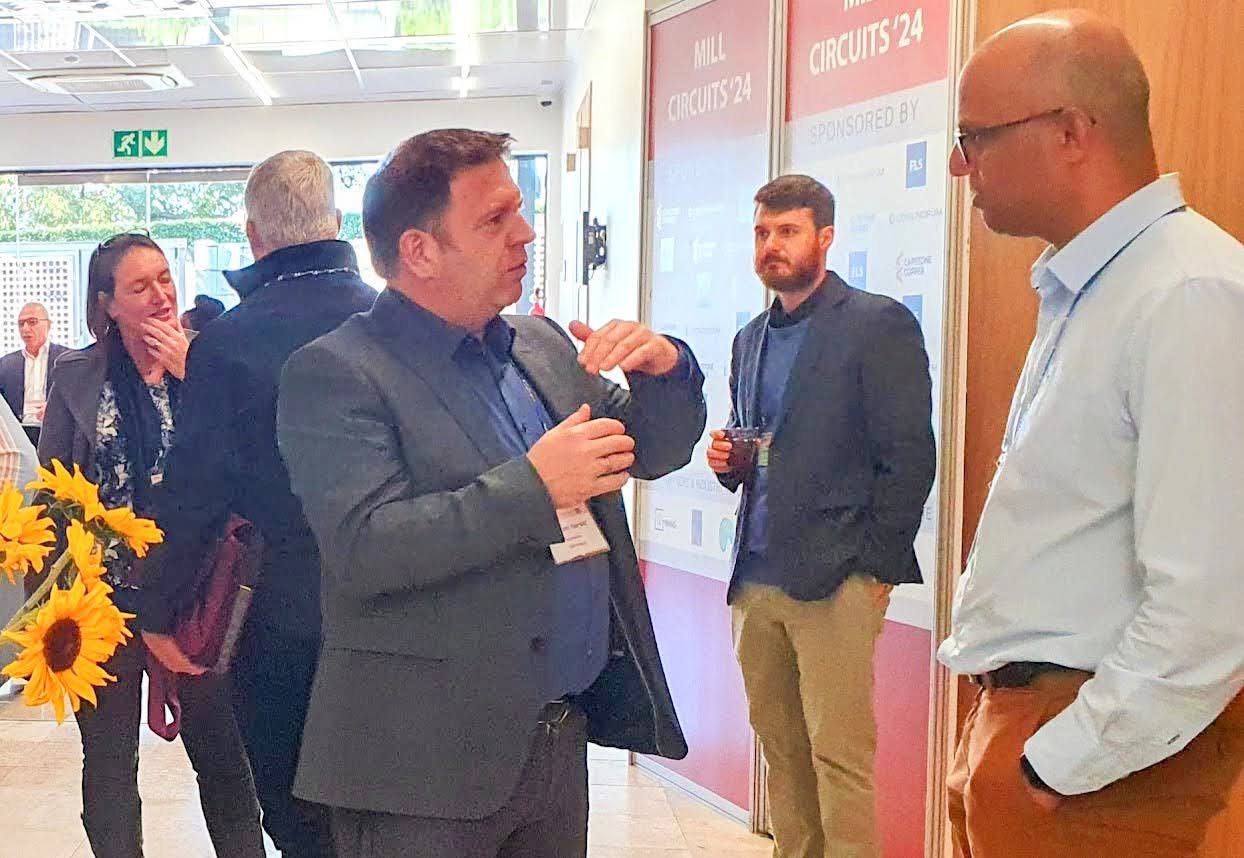
Following my morning welcome and an introduction to the evolution of mill circuits from the industrial revolution to the present day, the sessions got underway with a keynote lecture from Dariusz Lelinski, of FLSmidth, USA,  "Evolution to revolution? How can innovation in flotation technology deliver sustainable productivity, now and into the future?", exploring how different flotation technologies can improve both productivity and sustainability performance. Dariusz is a regular contributor to MEI's flotation conferences and was the keynote speaker at Flotation’13. He has been working in flotation for 33 years, the first 8 years in academia, and the last 25 years for three different FLSmidth group companies (EIMCO, FFE Minerals and FLSmidth Minerals). His flotation experience covers a wide range of subjects, from basic flotation research, through CFD analysis, scale-up methodology, to industrial process and mechanical flotation machine design.

Dariusz Lelinski (centre) and the FLSmidth team with Kevin Galvin (right),
the inventor of the Reflux Flotation cell

Technical Session 1

Following the morning coffee break, Rajiv Chandramohan, of Ausenco, Canada, asked "what would a fully autonomous mineral processing circuit look like"?. Rajiv is Global Technical Director for Operations and Optimisation at Ausenco and has spearheaded the development of numerous innovative technologies tailored to the mining sector, contributing significantly to its advancement.
Rajiv Chandramohan (right) with Carsten Gerold of Loesche, Germany

Alan Varghese, of Metso Australia discussed optimisation of mill circuit pump reliability, detailing a comprehensive approach for pump selection, design and continuous improvement. Alan is currently undertaking a PhD in Digitalisation of Centrifugal Slurry Pumps at the University of Western Australia, while serving as the Product Head of Pumps Digital at Metso.

Alan Varghese (right) at registration

Martial Sorgho is the Process Manager for the Orezone Gold Corporation Bombore Gold Mine in Burkina Faso and he described the commissioning, optimisation and continuous improvement of the mill circuit.

Martial Sorgho (2nd right) and his colleague Mohamed Ilboudo with the MEI team

WEMCO flotation cell technology was first developed in the 1930s, updated in 1968 and has been the same ever since. Although this robust and impressive design has been a technology standard for many decades, the WEMCO II with improved rotor and stator configuration boosts metallurgical performance along with improved hydrodynamics and kinetics.  Riddhika Jain, regional flotation manager with FLSmidth, USA, discussed the development and performance of the energy efficient WEMCO II at pilot scale as compared with the traditional WEMCO, followed by consecutive trials at industrial scale.

Riddhika Jain with FLSmidth colleagues at the conference dinner at Groot Constantia

Technical Session 2

Following the lunch break Lev Filippov, Professor at the National Engineering School of Geology and Head of the Minerals engineering team of the GeoRessources Laboratory of the University of Lorraine, France, described the development of alternative processing circuits to recover critical metals such as Li, Nb, Ta and Sn from the Beauvoir rare metal granite in Allier, France.

In 2022 FLSmidth launched the Lithium Shake Up Study, focused on developing a spodumene concentrator flowsheet to reduce communication energy, improve recoveries and reduce water usage.  The FLS Shake Up flowsheet has a clear potential for energy reduction in the comminution circuit, reducing water use and reducing climate change impacts. The detailed outcomes of the comminution part of the study paint a hopeful picture of a more sustainable future for the metal supply chain, as described by Jaco Labuschagne, a Senior Lead Process Engineer MissionZero at FLSmidth, USA.

Jaco Labuschagne (centre) with FLSmidth colleagues

Due to the declining higher-grade hematite ore and increased demand for iron ore, magnetite-rich tailings from previously processed ore deposits are increasingly being exploited. Niyoshaka Lameck, head of the comminution group at Mintek, South Africa, explored an alternative flowsheet to that used for processing magnetite-rich ore for the recovery of magnetite from magnetite rich tailings.

Niyoshaka Lameck with Carsten Gerold and Christian Schmitz of Loesche, Germany

Another paper from Mintek brought the day's technical sessions to a close.  Taswald Moodley is a Principal Engineer within Mintek's Mineral Processing Division, and concurrently holds an honorary research fellow position at the University of Kwazulu-Natal, South Africa. He discussed the unravelling of steady state dynamics in comminution circuits through Principal Component Analysis and Pareto Fronts.

Taswald Moodley with Peer Druephake of Argo IPS, Germany

More on Day 1

Friday June 14th

Technical Session 3

Comminution was the theme of the final morning of the conference.

Victor Portnov is the CPO and founder of conference sponsor Conundrum AI, a technology company that provides a software platform for implementing, deploying, and running AI process control in the mining industry, discussed the integration and application of a new generation of process control models, combining fuzzy logic and model predictive control for improving the performance of SAG/AG mills.

The Vertical Roller Mill (VRM) is an established technology in cement and slag grinding applications. Adam McElroy, a specialist development engineer at Boliden Mineral AB described pilot and lab scale test work on three ores to demonstrate the potential for this technology to develop in the minerals processing industry.

Adam McElroy and Victor Portnov with Jenni Sweet of Mine3, South Africa

Carston Gerold of Loesche GmbH, Germany, compared the company's VRM milling with wet milling and HPGR alternatives, showing the power and water benefits of dry VRM milling on a magnetite ore.

Carsten Gerold (2nd left) at Groot Constantia

Sandile Nkwanyana

The potential benefits of composite media milling have been reported in past MEI comminution conferences. The benefits are in terms of reduction in ball consumption and improvement in the efficiency of energy utilization. Sandile Nkwanyana a Senior Process Engineer at Mintek, South Africa, discussed the practical issues that may necessitate closed circuit pilot test-work of composite media milling prior to implementation in sites.

Wound-rotor induction motors (WRIM) have long served large power applications, including SAG and ball mills, but despite the historical preference for WRIM, advancements in this technology have stagnated over recent years, said Mario Calvo, Managing Director of Electrodrives, Spain. In contrast, medium-voltage variable frequency drives (MV VFDs) have become increasingly sophisticated and cost-effective, positioning them as a competitive choice for both fixed and variable speed mills. Building upon the foundational technology of WRIM, Mario described the development of the FlexStarter LRS, a technical solution designed to bridge the gap between traditional WRIM setups and the newer MV VFDs, providing enhanced speed and torque control.

Mario Calvo (centre) at Groot Constantia

Sandile Nkwanyana was back on the podium for the final technical presentation of the conference, discussing surface abrasion, a key mechanism of size reduction of rocks in autogenous mills. He showed how rock surface abrasion tests can provide information on the suitability of the coarse rocks in the feed to allow operation of a mill at reasonable volumetric filling degrees.

More on Day 2

A final thanks to all concerned in making this a great conference, the sponsors, exhibitors, chairpersons, presenters and delegates, and last but not least the wonderful staff at the Vineyard Hotel.  We would greatly appreciate your comments on this posting.

A reminder also that the next conference in the series, with a modified title, Mineral Processing Circuits '24, will be held at the Vineyard from April 24th to 25th, 2026.

#MillCircuits24

Thursday, 18 April 2019

Festo is the 20th sponsor of Flotation '19

Festo is a multi-national company, with over 22,000 employees worldwide, which develops tailored automation solutions for the process industry, in all project phases from engineering to operation and maintenance. The company exhibited at Flotation '17 for the first time, and now we are pleased to welcome them to Flotation '19, not only as an exhibitor once more, but also as a full time sponsor.
Russel Schwulst of Festo, South Africa, discussing reliable level control, which is critical
in flotation cells to maximize recovery, with Andrew Lewis and Martin Rudolph at Flotation '17
We are also pleased to welcome a new media partner for the conference, Minerals, an international peer-reviewed open access journal of natural mineral systems, mineral resources, mining, and mineral processing.


Updates on the conference are at #Flotation19.

Friday, 20 February 2015

SME '15: Conference Diary

Denver is the home of the Society for Mining, Metallurgy and Exploration (SME) and always attracts the highest turnout for the Annual SME Meeting, in no small part due to The Colorado Convention Centre being located in one of America's best downtown locations, with some excellent restaurants and hotels within walking distance.

The SME Meeting means different things to different people. For me it is one of the industry's great meeting places, with great networking opportunities. I forsake the technical sessions, so this report is really my diary of my wanderings, mainly around the exhibition area, seeking out familiar and new faces. Mineral processing is but a small part of the overall event, but is the area that I will concentrate on, armed with camera and notebook.

Sunday 15th February
Barbara and I attended the official opening of the huge exhibition this afternoon. Last year in Salt Lake City, 539 companies were represented in over 800 exhibition booths, a record, but this year all 900 booths were sold two weeks before the start of the event.


The first familiar faces were John and Donna Starkey of Starkey & Associates, Canada, sponsors of Comminution '16. This year will be the 10th anniversary of their SAGDesign technology which has proved successful in several new plant start ups, including Lake Shore Gold in Canada, which was designed exclusively using SAGDesign technology. The company is now focusing on designing and starting up new SAG plants at design tonnage from day one, and has recruited a young mining engineer as Project Manager, Spencer Reeves, a graduate of Queen's University.

With Donna and John Starkey and Spencer Reeves
The huge FLSmidth booth as ever provides a useful landmark, and passing by I heard familiar north of England accents, so stopped by to talk to two pump experts, Jeff Crawford, Global Sales Director and John Frater, Technical Manager, Pumps. I took the opportunity of congratulating John, who this week will be inaugurated into International Mining's Hall of Fame.

With John Frater and Jeff Crawford
International Mining is one of two regular media sponsors of MEI Conferences, the other being Industrial Minerals, the latter for many years being represented by Mike O'Driscoll, who is here this year to spread the word about IMFORMED - launched last month as the new platform for networking and knowledge for the global industrial minerals business, founded by Mike and his Industrial Minerals colleague Ismene Clarke (more details on MEI Online). Mike is pictured right at the International Mining booth with Paul Moore, Robert Pell and Phil Playle.


Browsing the booths I bumped into Vishal Gupta, formerly with FLSmidth, and now with EP Minerals, USA. He is a regular Minerals Engineering reviewer and is pictured right, below, with Rajesh Raitani of Cytec.


This is JKTech's 26th SME conference. The Australian company is here to build new relationships and maintain old ones. As well as the booth, which is manned full time by their North American representative Mark Richardson, they have already run a two day workshop on 14 and 15 February on Mine to Mill Optimisation. This was presented by Sarma Kanchibotla, of JKMRC and Sebastian Tello of JKTech Chile.

Sebastian, Mark and Sarma at the JKTech booth
After this brief sojourn around the exhibition, we enjoyed an excellent meal at Earl's Restaurant on the 16th Street Mall.

Monday 16th February

How the weather changes dramatically in Denver. When we arrived two days ago people were walking around in shorts and T-shirts, basking in the 21C temperature. Today snow is falling heavily and the temperature has fallen to 1C!

While waiting for the exhibition to open I caught up with three members of the Hazen Research team, based at nearby Golden, Director Nick Hazen, Christel Bemelmans and Hanna Horsch, a valued member of the Minerals Engineering review panel.

Nick, Christel and Hanna
It was also good to see my old friend Guven Onal, of Istanbul Technical University, accompanied by his son Erden, and with James Hendrix of Mackay School of Mines.

Guven, James and Erden

I also had coffee with Sweden's representative on the Editorial Board of Minerals Engineering, Bertil Palsson of Lulea University, who will receive the Arthur F. Taggart Award on Wednesday for his, and three co-authors', paper in Minerals and Metallurgical Processing on the validation of tumbling mill charge- induced torque as predicted by simulation.

And so into the exhibition and my first stop at the Cytec booth to photograph some of their large group representing the company at the SME in this their centenary year.


Another large group are representing Metso, sponsors of Flotation '15.


Another Flotation '15 sponsor is FLSmidth, and I looked in on their booth again, where Dariusz Lelinski (left) and Asa Weber showed me the nextSTEP rotor/stator mechanism, said to provide a “step change” in flotation metallurgical performance and energy efficiency. The mechanism is described in more detail in MEI Online.


Eriez is also very much involved with flotation these days, and I called by for a demonstration of their column flotation cell. Their Flotation Division is the leading supplier of flotation columns, with an installed base of over 1000 columns.  In the photo below Jaisen Kohmuench, Deputy Director for the USA (far left)  is explaining to me how a 3 inch diameter lab-scale column flotation works, watched by Global Managing Director Eric Wasmund.


Osvaldo Bascur was last year's recipient of the SME's prestigious Antoine Gaudin Award. He is with OSIsoft, which is featuring new tools for costs savings through the automatic capture of minor equipment-production delays and the estimation of energy and water losses for mineral and metallurgical operations.

Osvaldo (right) with James Kafer, Jie Chou and Ted Gorrie
After lunch the Mineral Processing Division Awards lectures were presented. This year's Richards Award recipient was Rick Honaker of the University of Kentucky, the Wadsworth Award lecture was by David George of Rio Tinto, Utah and the Gaudin Award lecture by Phil Walker from Winnemucca.

Rick, David and Phil
Then back to the hotel, to get free internet access rather than pay the exorbitant $80 daily rate offered to delegates by the Convention Centre.

Tuesday 17th February

A preview of the 8th edition
Looked in at the Bookshop this morning, and pleased to see that Mineral Processing Technology is still a readers' choice. Next year, however, it will be replaced by the 8th edition, currently being edited by Jim Finch and his team at McGill. I met up with Jim this morning to discuss progress, and we hope to launch the book at Flotation '15 in November. We also talked about MEI's involvement in next year's IMPC in Quebec City, for which Jim is Chairman.

I saw Jim again later talking to Joseph Lessard of Orchard Material Technology, who recently published an excellent paper on the economic impact of ore sorting in a comminution circuit in Minerals Engineering (posting of 8 Sept 2014). Joseph intends to present more work on this increasingly important technology at Physical Separation '15 in June. Ore sorting represents a future direction for the mining industry as it seeks to reduce costs associated with comminution, waste handling, and mining. Steinert, who provides state-of-the-art sorting equipment and sophisticated magnetic separation technology, is now working with OMT to generate a more complete picture of the economic ramifications (i.e. capital, operating, and maintenance costs) associated with bringing sorting to existing processes.

Jim Finch with Joseph Lessard (left) and Steinert representatives
I looked in at the mineral processing sessions and bumped into Paul Gottlieb, formerly with FEI, now Business Development Manager with Czech company Tescan Orsay Holdings, who sponsored last year's Process Mineralogy '14 conference. Paul has recently relocated from Brisbane to Brno to become Tescan’s Product Marketing Manager - TIMA. He was unhappy that he had just missed an important paper, as a no-show had caused a major change in the timetable. Probably best if I do not get too involved with my opinions of SME parallel sessions and timetabling!

I strolled over to the Tescan booth with Paul to see the Tescan Integrated Mineral Analyser (TIMA), a new generation of very rapid SEM based Automated Mineralogy (AM) systems in which the SEM and x-ray detector systems are fully integrated through proprietary hardware and software.

Paul (right) with the TESCAN team
There was much activity at the FLSmidth booth where Frank Traczyk was making a presentation on the nextSTEP rotor/stator mechanism that was described to me yesterday. The device was designed at Virginia Tech by Roe-Hoan Yoon's flotation group, consisting of two fluid mechanists (Saad Ragab and Demetri Telionis) and two flotation scientists (Jerry Luttrell and Roe-Hoan Yoon) and a number of graduate students, with input from FLSmidth in-house researchers and practitioners. A great example of cooperation between academia and industry.

Frank and Roe-Hoan
Nearby I caught up with Sam Sutherland of Univar. At the booth Kris Strickland of ArrMaz was talking to Patrick Norman, Univar Eastern Region Manager, Canada and Sam, Vice President Global Mining.

Kris, Patrick and Sam
Just before lunch I looked in at the giant Scheider Electric booth. Invensys, now a part of Schneider Electric, works in partnership with a broad range of industrial and commercial customers, including operations such as comminution and flotation, to design and supply advanced technologies, their software systems and controls enabling users to monitor, control and automate critical and demanding processes.


After lunch I dropped by the RSG Inc booth to find out what was new from my old friend Chris Martin. RSG has introduced its largest ufg-mill to date. The ufg400 is a 400 HP (265 kw) dry media mill, designed for ultrafine grinding of industrial minerals. The ufg400 coupled with ACS-200TD air classifier will produce 3 tph of 2.5 micron dolomite and is to be installed in Pennsylvania later this year.


In the evening we attended the International Reception at the Hyatt Hotel, a good opportunity to relax with overseas (ie non-USA) delegates and partners, followed by a very disappointing curry at the nearby Little India Restaurant.

Camborne School of Mines alumni representing Ireland, UK, Canada, New Zealand and Germany
Barbara with Canadian delegates Donna Starkey, Jim Finch (right) and
Jean Vavrek, Executive Director of CIM and his wife Carole
Sunset on the Rockies, from the Hyatt Hotel

Wednesday 18th February
The last morning of the SME is always relaxing, time for a last chance to stroll around the exhibits hoping to catch up with people who you may have missed.
Jon Bartholomew and Mick McCaslin of WesTech Engineering
show that the feedwell is the process heart of the thickener
At the Deister Concentrator booth
It was good to meet Pete Dunn and Bill Weldon of Mineral Technologies. Bill will be in Falmouth in June to present a paper on a new mineral sands development in Georgia at Physical Separation '15, and looks forward to the visit to the old tin and copper mines during the conference.

With Peter and Bill
Also good to catch the team from Huntsman, sponsors of Flotation '15.


Bruker is one of the early sponsors of Process Mineralogy '17, and Karsten Knorr and his team were displaying the D2 Phaser, a bench-top XRD for minerals identification and quantification.


In the next booth Omar Arafat of Metcom Technologies was talking to Edward Duda of Freeport-McMoran Copper & Gold.


Finally I called in at the SME office to congratulate the team on an excellent convention, which provided superb networking opportunities. The Membership team are pictured left, Billie Emas, Mona Vandervoort and Angie Grace. They tell me that over 7800 delegates registered for this year's event. Next year the SME Meeting will be held in Phoenix from February 21st-24th. I intend to be there!
