Showing posts with label SMEs. Show all posts

Sunday, 15 February 2026

The SME Annual Meeting in Salt Lake City is only a week away

The MEI blog began in February 2009. That same month, Jon and I attended the Society for Mining, Metallurgy and Exploration (SME) Annual Meeting in Denver, with snapshots from the event appearing in the February blog posts.

Jon and I at the Elsevier booth in Denver, 2009

The following year in Phoenix, I started writing annual reports on the SME meetings and have covered every one since, up to last year’s meeting in Denver (MINEXCHANGE 2025). That event may mark my final visit to the USA, and at next week’s Annual Meeting in Salt Lake City Jon was hoping to represent MEI, but unfortunately due to a minor operation he has had to pull out.

So I regret that there will be no MEI report and photos from this year's meeting but if you have news and photos that would be of interest to mineral processors, I would be grateful if you could pass them on. I particularly regret that we won't be able to photograph the Mineral Processing Division Award Winners this year:

Antoine Gaudin Award: Jan Cilliers
Milton E. Wadsworth Award: Ronel Kappes
Robert H. Richards Award: Rob McIvor

or the AIME's Frank Aplan Award winner James Gebhardt

The nearest I can get is photos from previous SMEs:

Jan Cilliers (2024), Ronel Kappes (2024), Rob McIvor (2022), Jim Gebhardt (2022)

Congratulations to you all. 

#MEIBlog

Monday, 3 March 2025

Report on MINEXCHANGE 2025, Denver

My first SME Annual Meeting was in 1987 in Denver, and this year's meeting (MINEXCHANGE 2025) was my 11th in Denver and my 22nd overall. MEI was proud to be associated with the event as a media partner.

This great networking event is always enhanced by associated symposia, and this year it included a symposium in honour of Prof. Komar Kawatra, of Michigan Technological University, the Editor-in-Chief of Mineral Processing & Extractive Metallurgy Review journal. Also running in parallel this year was the one and a half day World Gold 2025 and the total number of registered delegates was 7050.

These two symposia added to the already myriad parallel sessions over the three days, so as always I will not be reporting on the technical sessions- the following is my diary of encounters with people, mainly mineral processing people, particularly in the huge exhibition, with 602 companies represented.

Sunday February 23rd

Due to the associated World Gold the three-hour Exhibition Reception opened earlier than in previous years, but entering was very much déjà vu as dominating the entrance was, as always, the FLSmidth (FLS) display, with Metso close by, two huge companies who are current sponsors of MEI's Comminution '25 and Flotation '25.

FLS has shifted its approach in recent years from merely selling equipment to becoming a partner in optimising mining operations, offering audits to identify inefficiencies and opportunities for improvement, often uncovering substantial gains with minimal investment. 

I called at the booth to talk to Himesh Patel, Lance Christodoulou and Gaurav Soni about the launch of the coarseAIR Flotation Cell for coarse particle recovery in base/precious metals and industrial mineral operations. Based on the design of the REFLUX Classifier, the coarseAIR cell comprises a low-turbulence, high-density aerated fluidised bed, reducing the probability that coarse mineral particles will travel to the tails. Inclined lamella channels effectively separate ore from gangue by leveraging the Boycott effect.

"In the face of depleting ore grades, mining companies face the prospect of processing larger volumes of material just to maintain. let alone increase, production levels", said Lance Christodoulou, Global Product Director, REFLUX Technologies. "By improving the efficiency of recovery, the coarseAIR Flotation Cell offers important support for mining companies as they seek to meet the demand for metals and minerals economically and sustainably".

"We are pleased to add the coarseAIR Flotation Cell to our line of REFLUX flotation technologies", said Lance. "These technologies, which include the REFLUX Classifier, GradePro Classifier, and REFLUX Flotation Cell, are integral to our MissionZero Mine flowsheets of the future, supporting our target to provide zero-emissions mining by 2030 through enhanced ore recovery rates, reduced energy use, and lower water consumption".

Himesh, Lance and Gaurav with FLS products

Apart from the FLS products, there are a number of innovative flotation machines which will be highlighted at Flotation '25. In tomorrow's Robert E. Murray Innovation Award Lecture Jaisen Kohmuench of Eriez will describe the successful development of several new flotation technologies by Eriez over the past two decades. Early work with the Florida phosphate industry pointed to the need for a new technology for a high-capacity, coarse particle flotation cell, which resulted in the patented Eriez HydroFloat, the first-ever fluidised-bed flotation cell. Subsequent work in the sulfide industry highlighted the potential of coarse particle flotation to reduce power consumption, increase capacity, and reduce fine tailings generation.  Similar work was undertaken to revolutionise fine particle flotation, developed by the need to recover ultrafine material in the U.S. coal industry. Eriez worked collaboratively with producers, universities, engineering companies, and consultants to develop a high-rate, compact flotation machine. The resulting StackCell technology has been successfully implemented in multiple industrial applications around the world. Eriez ia also a sponsor of Flotation '25 and the Eriez team are shown below with Jaisen 3rd left.

Metso launched the first of its Concorde Cell high-intensity pneumatic flotation units in Africa last year. The Concorde Cell flotation technology is designed to improve the recovery of fine and ultra-fine particles when processing finely disseminated and complex ore grades, as well as declining ore grades. The Concorde Cell provides a very high shear environment with increased bubble surface area flux, which ensures faster flotation kinetics. It features improved froth recovery and selectivity, while forced air allows wider process control and stability for further flotation optimisation,

I called in at the Metso booth to talk to the team and view their array of process equipment models. In October 2024 Metso invested in the development of energy-saving comminution technology and signed an agreement to acquire the outstanding shares of its long-term partner Swiss Tower Mills Minerals AG (STM). STM, based in Baden, Switzerland, specialises in vertical grinding mill solutions. It is best known for the HIGmill grinding mill, which has been exclusively sold and serviced by Metso. This technology is integral to the development of energy-efficient comminution processes, for example, in combination with Metso HRCTMe high-pressure grinding rolls. Over the years of cooperation, the use of vertical grinding mill technology has seen significant growth, and the trend is expected to continue.

Metso's Concorde Cell is an invention of Prof. Graeme Jameson, and his latest invention is the NovaCell, licensed to Jord International, Australia and I called in at their booth to meet the team, who were talking to Adam Johnston of Transmin Metallurgical Consultants, UK.

The Jord team with Adam Johnston (2nd left)

The NovaCell can recover mineral particles over a wide particle size range, from the lower limit of flotation to an upper limit which depends on the liberation characteristics of the ore. In a single device, the collection of the fines and the coarse particles takes place in separate environments. The finest particles are contacted with bubbles in a high-energy aerator, while the coarse particles are captured by bubbles in the gentle environment in a fluidised bed. Jord will be profiling the NovaCell at Flotation '25.

In the next booth the team from Woodgrove Technology, Canada, were talking to James Bromstein and Jolene Baker, of Ghost Solutions, USA, about Woodgrove's innovative flotation technology, the Staged Flotation Reactor (SFR), which was developed by going back to the first principles of flotation and examining how best to optimise the various phases of flotation without preconceived constraints. The result was a machine that optimises the three stages of flotation within three separate zones, such that each zone is mutually exclusive from the requirements of the other zones. Froth drop back is minimal and tightly controlled. The constrained froth recovery zone allows for much better level control in a scavenger SFR, resulting in better recovery and upgrading.

The Woodgrove team with James and Jolene (3rd and 4th left)

I also looked in at the booth of Flotation '25 sponsor GoldOre to talk to Adrian Singh, founder and CEO, who produces another innovative flotation machine. The GoldOre MACH REACTOR, a hydrodynamic cavitation device, which harnesses the power of cavitation, is the only high shear/cavitating device currently on the market that is completely self-aspirating, allowing it to be operated without a pressurised gas supply. The self-aspiration aspect, combined with the comparatively lower power draw, makes it particularly suitable to projects where power costs are high, or power is self-generated.

Adrian Singh with Liam Gilbride, of Ruby Barickman, USA

The greatest innovations in mineral processing in recent years are not confined to flotation and comminution. Sensor-based sorting must rank very highly, in helping to achieve reduced energy and water consumption in flowsheets. I was pleased to call in to talk to Kai Bartram, Global Sales Director of TOMRA Mining, Germany, a world leader in sensor based sorting, responsible for developing and engineering cutting edge technology made to withstand harsh mining environments. He talked about TOMRA's latest AI-powered ore sorting, OBTAIN, which revolutionises ore sorting by enabling precise detection and classification of individual particles, even when clustered. Sensor- based sorting is effectively making dense medium separation obsolete and TOMRA Sorters will be used to pre-concentrate tin ore at the South Crofty tin mine in Cornwall when it reopens in 2027. Kai bemoaned the fact that MEI's Physical Separation '26 will be in Cape Town, and not in Cornwall as in the past, the reason being problems associated with Brexit!

With Kai (left) and the TOMRA team

AI will play an increasingly important role in mining and mineral processing and I was pleased to see Starla Jackson, who was marketing manager with FLSmidth for 12 years until 2020 and is now marketing coordinator with Eclipse Mining Technologies, USA. She described the company's SourceOne which can handle data in multiple formats and integrate data from multiple vendors and sources. This versatility allows users to consolidate and manage data from different technologies, streamlining the integration process.

Starla (2nd right) with her Eclipse Mining colleagues

It's always good to see the team from Derrick Corporation, a family-owned company that designs and manufactures screening equipment and screen surfaces. The company is a sponsor of Comminution '25 later this month.

Finally, on leaving the exhibition I was pleased to catch up with Osvaldo Bascur, of OSB Digital, USA and to congratulate him on being elected as a member of the National Academy of Engineering. Election to the NAE is one of the highest professional honors accorded an engineer. NAE members are among the USA's most knowledgeable engineering experts and have distinguished themselves in business and academic management, in technical positions, as university faculty, and as leaders in government and private engineering organisations. Osvaldo was recognised for applying phenomenological modeling techniques in mineral processing and process plant performance. He was with Paula Whittaker, of The Woodlands, USA. They will both be at Flotation '25, after which they will be on safari in Botswana.

Monday February 24th

MINEXCHANGE 2024 got off to a great start this morning with two high profile lectures.

The Robert E. Murray Innovation Award was established in 2017 to recognise individuals or organisations who advance the mining industry through the implementation of technical innovation. I was pleased to see that this year's recipient was Eriez Flotation Division, as the company is a regular sponsor of MEI's flotation conferences. 

The award lecture was given by Jaisen Kohmuench, who reviewed the past two decades of development by Eriez showing the great benefits of industrial partnership. We will hear much more on these developments at Flotation '25 in November.

We can also expect to hear much about artificial intelligence at Comminution '25 and Flotation '25. AI was the subject of the keynote lecture this morning, delivered by Terry Jones, Author, Global Business Executive, who showed how the integration of AI in the mining industry is revolutionising traditional practices, enhancing efficiency, safety, and sustainability. He showed that ultimately AI represents a transformative force in mining, promising to drive innovation while addressing environmental concerns and operational challenges in an increasingly competitive market.

In the exhibit hall it was great to catch up with Katja Freitag and Robert Seitz, who represent Canada and USA with Metcelerate. Metcelerate, a sponsor of Comminution '25 and Flotation '25, is a workplace-based program which provides metallurgists with crucial in-plant training, helping them build practical knowledge, make more informed decisions, and create value for themselves and their sponsoring organisations. 

Also very much involved with Comminution '25 and Flotation '25 is Chris Greet, who I caught up with in the Magotteaux booth. Chris is  a Principal Consultant at Mineralis Consultants, Australia, and is now  part-time at Magotteaux as a Global Mineral Processing Specialist. He will be presenting a paper at Comminution '25 and he is a keynote lecturer at Flotation '25, where he will discuss the bridging of the gap between comminution and flotation.

Chris Greet (2nd left) at the Magotteaux booth

International Mining is a media partner to all MEI Conferences and it is always good to see the owners each year, Paul Moore and Phil Playle. As well as producing the high quality trade magazine, both hard copy and online, they also run a highly successful annual conference, The Electric Mine, for all companies involved in the mine electrification transition, showcasing future-proofed solutions that will enable mining companies to achieve their interim and final emission targets by 2050. The next event is in Santiago, Chile from 13-15 May, 2025.

Phil and Paul

I am grateful to Ravi Rajshekar for inviting me to the Hexion booth, as this is a company new to me, although it was founded over 150 years ago. They are intending to use their vast experience in chemical manufacture to introduce new flotation collectors and depressants, to improve productivity and reduce treatment costs in the mining industry. Their intention is to profile their new reagents at Flotation '25.

Ravi Rajshekar (2nd right) with Hexion colleagues

Moving on, it was good to see the University of Utah's Xuming Wang, with two of the University's mining students.

Founded in 2008, in Somerset Pennsylvania, Somerset International is a company that specialises in mineral processing, tailings management, and water treatment for the mining industry. Founded by individuals with decades of experience in the mining and minerals industries, using technology that can transform waste streams into value, they now have offices in the United States, Australia, and Canada.

After an interesting morning, after lunch I looked in on the Mineral Processing Division (MPD) Plenary session to see the winners of this year's prestigious MPD awards.

The Antoine M. Gaudin Award to Prof. Zhenghe Xu of the University of Alberta, Canada.

The Robert H. Richards Award to Dr. Jaisen Kohmuench of Flotation '25 sponsor Eriez, USA.

The Milton E. Wadsworth Award to Prof. Michael L. Free of University of Utah, USA

Congratulations to all three recipients.

Later in the afternoon it was great to see Janine Herzig and her husband Chris Sykes, a mining engineer with MetVal Consulting, Australia. Janine is Convenor of the MetPlant Conference Series and is Executive President and Director of CEEC International, MEI's industry advocate to Comminution '25, where she will be co-chairing the first of the technical sessions.

And as I was leaving the convention centre I met up with Mike Battersby and Steve Flatman, of Welsh company Maelgwyn Mineral Services (MMS), sponsors of all MEI's flotation and comminution conferences. They were with Juan Van der Merwe and Wiehan Botes of MMS Africa, based in Randburg, South Africa.

MMS has recently been receiving an increasing number of inquiries from North America for its Aachen Shear reactors and are currently progressing these with several gold mining companies. MINEXCHANGE and the World Gold symposium have provided a useful forum to do this and and also to keep up with recent technology trends. Maelgwyn were also keen to meet new clients that are interested in scavenging base metals particularly copper fines from their existing mechanical cells using MMS's patented Imhoflot G-Cells, which work particularly well in this application due to the additional rotational forces created by the tangential feed inlets.

Steve, Mike, Juan and Wiehan

And many thanks to those who stopped me today to say hello:

Mohammad Rezaee and Chandima Subasinghe, PhD students at Penn State University College, USA, and Tushar Gupta, Mountain Pass Mine, USA

With Ernest Konadu-Yiadom, Student Colorado SOM;
Segun Oladele and Patrick Abban Sapong, Penn State University College, USA

Tuesday February 25th

In all the years that I have attended the SME Annual Meetings this is the first time that the exhibition finished on the Tuesday, so I made the most of the day.

My first stop was the ThermoFisher Scientific booth, to talk to Thomas Strombotne and Erin Farrar about their potential involvement in Process Mineralogy '26, which will be held in Sitges, Spain in November next year. The company was a sponsor of Process Mineralogy '18 in Cape Town and exhibited at Process Mineralogy '24.

ThermoFisher Scientific, Thomas and Erin 3rd and 4th left

I looked in at the giant ME Elecmetal booth, to thank the team for their sponsorship of Comminution '25.

It was good to talk to Paul Gallagher and Diego Rubio of Roytec Global, Canada. Roytec represents the Beijing General Research Institute for Mining & Metallurgy (BGRIMM), offering Western clients access to BGRIMM flotation technology, backed up with Roytec’s local support, service and spares. Very recently BGRIMM announced the world's first 800m³ flotation machine, which I am sure we will hear about at Flotation '25, where Roytec will be exhibiting.

With Diego and Paul

I had lunch in the exhibition area, and was surprised and pleased to see Roger Sawyer sharing the same table. It is 15 years since I last saw Roger, at the SME Annual Meeting in Phoenix. He was a fellow concentrator metallurgist at Nchanga in 1969, but our paths crossed only briefly as he left Zambia in 1970. We reminisced a little about the Copperbelt and the people that we still keep in touch with and the many who are now no longer with us. When we last met he was with Rio Tinto, a principal advisor on mineral processing technology and innovation. He is now a self-employed metallurgical consultant and. although a Brit like me, is based in a beautiful part of the USA, Park City in Utah, where I once had a memorable day's skiing.

One of the Nchanga names that cropped up was Willem Duyvesteyn, who I did not really know as he was Assistant Superintendent on the Leach Plant, and I was on the Concentrator. But it was a surprise to meet his daughter, Saskia Duyvesteyn, who was with my old friend Courtney Young, Professor of Metallurgical and Materials Engineering at Montana Tech. Saskia, like my daughter Amanda, was born in Zambia and she is now Chief Advisor Copper R&D with Rio Tinto Kennecott in Salt Lake City.

Taking a short break from the convention centre it was great to catch up with Corale and Jim Brierley, two of the world's most eminent biohydrometallurgists, who we were privileged to have with us at Biohydromet '14 in Falmouth, Corale delivering a keynote presentation, and Jim one of the panel members in the final discussion on the future of biohydrometallurgy. Corale and Jim were the subject of one of my MEI interviews in 2014 and Corale served on the Editorial Board of Minerals Engineering when I was Editor-in-Chief.

It was also good to see Richard Merwin, Chairman of Eriez Magnetics, who was with Luis Roman, Technical Processing Superintendent with Anglo American's Quellaveco Mine, Peru.

Back in the Convention Centre I spent a pleasant hour at the student poster session, talking to some of the 602 students attending the convention.

Mineral Processing PhD students from Michigan Technical University
With Montana Tech PhD student Isaac Joseph Cobbinah

And that was essentially the end of my time at MINEXCHANGE 2025, apart from a pleasant hour at the evening International Reception, attended by many of the 977 non-American delegates. where I was pleased to see Natalie Shackleton and Shani Engelbrecht, of AECI Mining, South Africa. AECI are sponsors of Flotation '25 and sponsored last year's Process Mineralogy '24 and Critical Minerals '24.

With Shani and Natalie

It was also good to meet Bona Lim, Researcher, and Kylie Blackwell, Group Lead, in the Gold Technology Group at WA School of Mines, Kalgoorlie, Australia.

With Bona and Kylie

And also good to talk to Wendy Tian, of Ausenco, Canada and Laurie Reemeyer of Resourceful Paths, Canada.

Finally, thanks to those who stopped to say hello today:

With Oznur Onel, of Ecolab/Nalco Water, USA and Zacharias Agioutantis of University of Kentucky

With Sabinus Essel of University of Nevada-Reno and Bowen Li, of Michigan Tech


It has been a great 3-days at MINEXCHANGE 2025 and I look forward to MINEXCHANGE 2026, which will be in Salt Lake City, February 22-25, 2026.

Monday, 20 May 2024

Prof. Komar Kawatra honoured by symposium at the SME Annual Meeting in 2025

The SME Annual Meeting is one of the mining industry's great networking events and is always more special to mineral processors when there is an associated symposium honouring a distinguished member of our profession.

I am pleased to see that at next year's event in Denver (MINEXCHANGE2025) there will be a symposium honouring Professor S. Koma Kawatra, chaired by Dr. Jayson Ripke, Dr. John Uhrie and Professor Courtney Young. Sessions will cover comminution, iron ore, phosphate and plant operations.

Dr. S. Komar Kawatra joined the faculty at Michigan Technological University as a Visiting Assistant Professor in 1977. He was promoted to Professor in 1985 and chaired the Department of Mining and Materials Processing Engineering from 2000-2002 when the Mineral Processing programme merged into Chemical Engineering. He then served as chair of the Department of Chemical Engineering from 2007 to 2017.

Prof. Kawatra was made an SME Fellow in 1992 and has been heavily-involved with SME for decades and is an accomplished researcher, mentor, teacher, and lecturer. His primary areas of research in Mineral Processing and Chemical Engineering are in instrumentation and on-line analysis for monitoring and control of chemical and particulate process plants and treatment/remediation of chemical and industrial wastes.

He has received numerous honors and awards and is currently the Editor-in-Chief of the Mineral Processing & Extractive Metallurgy Review Journal having served as Editor-in-Chief of the Minerals & Metallurgical Processing Journal. When I last met him at the SME Annual Meeting in Phoenix in 2020 we talked about the increasing problem in finding suitable reviewers for papers for his journal and for Minerals Engineering. The journals have groups of dedicated reviewers but many researchers are reluctant to review manuscripts, although they are the first to complain if their work is not assessed on time - everyone is so busy these days!

With Prof. Kawatra in Phoenix in 2020

Next year's meeting in Denver will be particularly attractive as it also incorporates World Gold 2025, which fosters academic exchanges, shares technical advances and promotes innovation and sustainable practices within the gold industry. As the world’s most influential gold technical conference, World Gold 2025 also serves as a platform for showcasing industry-wide scientific advancements.

So much to look forward to at MINEXCHANGE2025 and MEI is pleased to be a media partner for the first time.

Sunday, 10 March 2024

2024 SME Annual Meeting, Phoenix: Conference Diary

Four years ago I was in Phoenix for the Society of Mining, Metallurgy and Exploration (SME) Annual Meeting and I narrowly escaped just before the world went into lockdown.

Downtown Phoenix

Last month I was back again for my 4th visit to Arizona's capital city for MINEXCHANGE 2024 SME Annual Conference and Expo. This was my 21st SME Annual Meeting and as always I spent most of my time in the giant exhibition area, looking out for mineral processors and to catch up with their news.  So what follows is my diary of my daily wanderings and I invite all who attended to leave their impressions of the meeting in the comments section.

Sunday February 25th

The exhibition opened, as always, in the late afternoon and this is normally a good time to catch up with the exhibitors, who are usually at their most alert!

So I began my search for mineral processors and the first familiar face was that of Sam Palaniandy, General Manager at Nippon Eirich, Australia, with Eirich USA product specialist Tyler Rhea. Sam is a regular at MEI's comminution conferences and will be in Cape Town in June for Mill Circuits '24. International company Eirich Machines Inc offers a range of mills and supplementary units, including the Tower Mill, for the very fine grinding of soft to very hard materials. 

Sam and Tyler

Moving on I saw Paul Gallagher. Technical Manager with Roytec Global, Canada, with Business Director Peter Sampson and Alexei Krassnokutski, who consults with Roytec on behalf of Krassno, South Africa. 

Alexei, Paul and Peter

Roytec Global, who sponsored an MEI conference for the first time at Flotation '23, is a business partner of the Beijing General Research Institute for Mining & Metallurgy (BGRIMM) Technology Group, China, and offers a full suite of filtration, thickening and flotation technologies with manufacturing capabilities both in South Africa and China. We look forward to a presentation from Roytech at Physical Separation '24, dealing with thickening.

It was a pleasant surprise to catch up with Jan Cilliers, of Imperial College, UK and Diana Drinkwater, Principal Consultant at Mineralis, Australia. who were with Pam Hofmann, of the University of Utah. Pam is the daughter of Utah's eminent Prof. Jan Miller.

With Jan, Pam and Diana

Jan Cilliers is CFO and Diana is CEO of Metcelerate, which provides training solutions to build technical competence in the mineral processing workplace for metallurgists and engineers. Metcelerate sponsored Flotation '23, at which Diana gave a keynote address, speaking of how organisations need to manage their people like any other asset, to ensure best possible condition, use, and performance. Metcelerate won the annual IChemE 2022 Global Award for Business Start-Up companies. In accepting the award Jan Cilliers said "we are very proud and humbled to have been acknowledged in this way by an esteemed organisation such as IChemE. We started Metcelerate to assist mining companies to close the skills gap in mineral processing, one of the most important elements of mining profitability. Our experience, backed by published data, tells us that this is a serious gap for mining companies. Graduates from our program have skills and ability to produce better results, and this is supported by feedback from learners and their supervisors".

In the nearby Geopyörä booth, Robert Seitz, Chief Technical Officer with Metcelerate was talking to Marcos de Paiva Bueno, the CEO and Founder of Geopyörä Oy, Finland. His company offers state-of-the-art rock breakage characterisation technology which allows mining companies to rapidly test several samples at low cost and generate a large amount of high quality data, which can be used to better assess the ore hardness variability, reduce risks and add value to projects.

Marcos and Robert

Finally, on leaving the exhibit hall I was extremely pleased to see my old friend Guven Onal, of Istanbul Techical University, Turkey, a regular at the SME Annual Meetings. Now 84 years old he tells me that he has no intention of retiring but he was accompanied this year by a chaperone, his son Seckin Sahap Onal.

Monday February 26th

A provocative keynote
handout

The sessions got underway this morning with a controversial keynote session on why net zero by 2030 is unlikely to happen, something I have agreed on many times on the blog, and why fossil fuels such as coal are going to be needed for many years yet, again something that I agree on.

Energy expert Alex Epstein opened the keynote session with a presentation on the need for affordable and reliable energy in the future and perspectives on how coal and other fossil fuels can continue to provide improved energy delivery systems for developing nations. With nearly a billion people without reliable power and potable water, providing affordable, reliable energy encourages the innovation necessary to support developing countries.

Epstein argued that fossil fuels have fostered global human flourishing and pulled millions of people out of poverty. Factoring in an estimated coal reserve of approximately 250 billion tonnes in the United States, roughly 23% of the world reserve, these minerals continue to have an impact on the global energy mix.

Alex Epstein is a philosopher and energy expert who argues that "human flourishing" should be the guiding principle of energy and environmental progress. Global human flourishing requires more oil, coal, and natural gas, not less, according to Epstein. 

The exhibition opened at 11am this morning, and judging by the huge crowd waiting to enter and the long line of people waiting to register the exhibition might start to buzz today.

And so it did!  My first call was to see the team from International Mining, the world's number one mining trade journal, and MEI media partner.

Phil Playle, Paul Moore and Daniel Gleeson of International Mining
I then dropped by the Eriez booth to congratulate Jaisen Kohmuench for starting a new position as Chief Executive Officer at Eriez. The Eriez Flotation Division is a regular sponsor of MEI's flotation conferences and is already signed up for Flotation '25. I talked to Mike Mankosa, Executive Vice President, Global Technology, the recipient of the SME's Richards Award in 2021, about the future of research and development at Eriez and particular of their involvement with Cardiff University in the UK.

Historically, Eriez has made substantial investments in new products and technologies.  While most of this work has been internally funded, Eriez has worked with third-party sponsors in areas such as flotation, eddy current separation, coal beneficiation, and metal detection technologies.    

Over the years Eriez has also collaborated with numerous academic research institutions, and association with leading academic institutions has provided access to sophisticated research tools and world-class researchers.  Additionally this gains access to developing professional talent for future recruiting needs. 

Mike said that Eriez corporate R&D is expanding globally.  While activity has traditionally been based in the US, over the last several years the footprint has expanded to include additional resources in China. And most recently, Eriez has taken university collaboration one step further by establishing a European-based R&D branch embedded directly into the Cardiff University research park, co-locating at the university accelerating ongoing research activities in magnetics and metal detection.   

Eriez’s history of working with Cardiff University began when Eriez joined the advisory board for the university’s Magnetic Materials & Applications Research Centre. The relationship progressed into a successful Engineering and Knowledge Transfer Partnership initiative funded by the Welsh government from 2019 to 2022. The result of this effort is the soon-to-be-released digital MetAlarm metal detector.  Eriez continues its partnership with Cardiff University collaborating on an artificial intelligence feasibility study supported by the Innovate UK program.

With the Eriez team, Jose Marin,Jaisen Kohmuench, Mike Mankosa, Maoming Fan,
Brandon Kocher and Steve Ciacchini

Leaving Eriez I caught sight of Erik Spiller, Professor of Metallurgical Engineering at Colorado School of Mines, and I called in at the booth to talk to some of the CSM students and to Hugh Miller, Associate Professor in Mining Engineering.

Erik Spiller (centre) and Hugh Miller (right) with CSM students

During a conference last summer in Halifax, Nova Scotia for US and Canadian universities, a meeting was held with academics who are interested in partnering with the Colorado School of Mines to revitalise interests at the undergraduate level and provide incentives. From this Colorado School of Mines recently entered a partnership with the University of Saskatchewan and is holding meetings with the provincial government about potentially establishing a Saskatchewan School of Mines.

Moving on I stopped to say hello to Natska Ericson and Philip Thompson of FLSmidth, Midvale, Utah.

Ali Entezari-Zarandi stopped to introduce himself. Ali is a project metallurgist at Hecla Quebec- Casa Berardi Gold mine, Canada. His expertise is in hydrometallurgical treatment of ores and wastes using conventional solvents as well as the new generation of ionic liquids and deep eutectic solvents.

Cytec was a former sponsor of MEI's flotation conferences until it was acquired by Solvay in 2015, who continued the involvement with MEI.  A couple of months ago Solvay announced the new names of the future independent publicly traded companies resulting from its separation into two industry leaders: Solvay and Syensqo. We hope to continue our long standing involvement with the new branch, Syensqo Mining Solutions,  which provides reagent solutions to the mining industry. As in the past there was a big team at the event, promoting the launch of its Transfoamer product line, the first groundbreaking frother innovation in more than 65 years. 

Well suited for coarse particle recovery, Transfoamer frothers are based on a novel technology that changes froth strength in response to pH, leading to more efficient copper recovery from even the most challenging ores, a critical need as copper demand grows in response to electrification and the energy transition.

Transfoamer frothers start as strong and robust frothers in the rougher circuit. Then, in response to pH, they "switch" to weaker frothers in the cleaner circuit, where less froth is needed. This unique property is particularly attractive for use in bulk copper and molybdenum flotation.

Syensqo’s Transfoamer technology is already in use commercially in Latin America, where its ability to promote fast kinetics and mobility of value minerals has resulted in improvements to throughput, recovery and energy consumption. No doubt we will hear much more of this at Flotation '25.

The Syensqo team

Although there are very many mineral processing papers being presented at the conference it is impossible to report on them all, as they are contained in a bewildering array of parallel sessions and the only Mineral Processing Division (MPD) Plenary session contained, as always, lectures from three of the MPD Award Winners.

A well attended MPD plenary session

The Antoine M. Gaudin Award is for scientific or engineering contributions that further understanding of the technology of mineral processing and I was extremely pleased to see this awarded to Peter Amelunxen of Capstone Copper, Canada, the first winner of the MEI Young Person's Award in 2011. In his lecture "Unlocking Efficiency: Advances in Flotation Circuit Design and Optimization" Peter reviewed how uncertainties can introduce error, risk, and cost in flotation circuit design and he discussed some of the recent developments in addressing these shortcomings, and how they are being used to improve the efficiency of modern flotation circuits. 

Peter with his proud father, Roger

The Robert H. Richards Award recognises achievement in any form which unmistakably furthers the art of mineral beneficiation in any of its branches. The winner of this award was Richard Johnson, of Johnson Mining Consulting Services, USA, In his lecture "Froth Flotation Then and Now" he discussed the ongoing shift back to smaller, more efficient cells and how we got there.

The Milton E. Wadsworth Metallurgy Award recognises distinguished contributions that advance our understanding of the science and technology of non-ferrous chemical metallurgy. In his award lecture Gus Van Weert, President of Oretome Ltd, Canada, discussed how the automotive starter battery industry provides a good example of what is going to happen to most industrial metals: near complete recycling! With only residual domestic mining, U.S. steelmakers already operate with 50% steel scrap. Concrete waste and bricks are attracting attention as cement replacement and he asked what can mineral processing learn from the lead batteries?

Peter, Gus and Richard with their prestigious awards

The end of the plenaries was the end of the day for me, and I relaxed with a beer and a Cornish pasty with Gaurav Soni and Himesh Patel, metallurgists with FLSmidth (posting of 27th February).

With Gauray and Himesh

 Tuesday February 27th

While waiting for the border guards to allow us into the exhibition hall I had a chat with Xuming Wang and Srinivas Veeramasuneni. Srinivas is Chief Technology Officer with USG Corporation in Chicago and Xuming is a research professor at the University of Utah, a close colleague of Prof. Jan Miller.

Eleven years ago Xuming and Prof. Miller were involved in a serious road accident in Tibet (posting of 13 July 2013). Thankfully they both recovered well from their injuries, Prof. Miller's being the more severe.

The giant FLSmidth booth dominates the entry to the exhibits, as always. A Danish multinational technology company based in Copenhagen it provides the global mining and cement industries with equipment and services. Its MissionZero programme has set a target of providing solutions for zero-emission mining and zero-emission cement production by 2030, supporting a green transition built upon sustainable materials. 

FLSmidth has around 11,000 employees worldwide, and about 30 are represented at the meeting. MEI and FLSmidth have always had a special relationship, the company being regular sponsors of the comminution and flotation series, and this year of our new conference Mill Circuits '24 in June. 

Unusually this year Dariusz Lelinski, the Global Director for Flotation at FLSmidth, USA, was not at the SME meeting. He will be presenting the keynote lecture at Mill Circuits '24, exploring how different flotation technologies can improve both productivity and sustainability performance and will be chairing a panel discussion on the evolution of mill circuits.

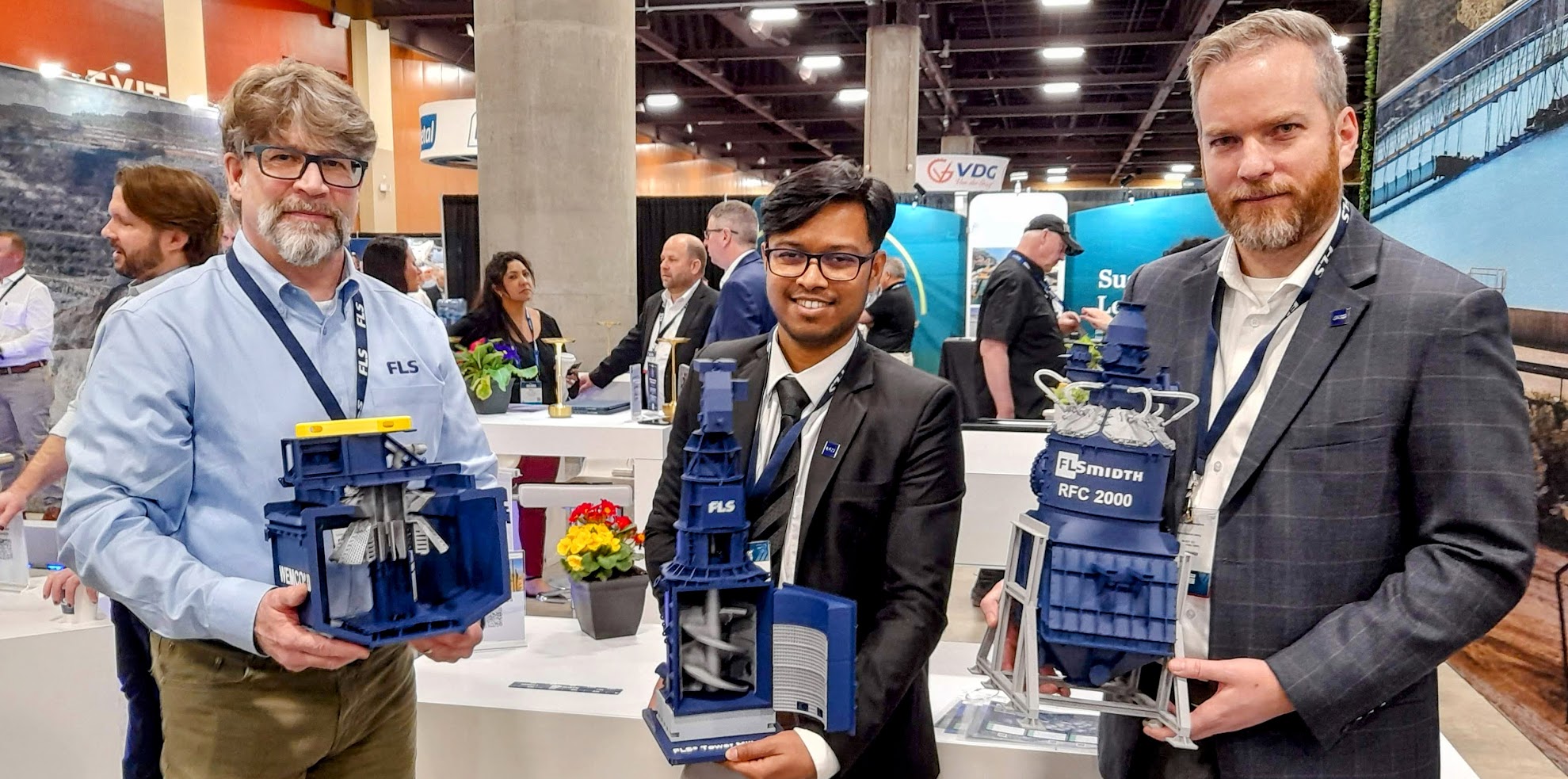
In the picture below FLSmidth's Peter Wulff, Himesh Patel and Paul Ormsbee display models of three of the company's products, the Wemco II mechanical flotation machine, the Tower Mill and the Reflux Classifier.

I took the opportunity of congratulating the company on winning the Mining Magazine Award 2024 for Technology and Innovation for the Reflux Concentrating Classifier (RCC) and HPGR Pro grinding machine, which have both received accolades for their groundbreaking features and contributions to operational efficiencies and sustainability. The RCC offers improved performance compared to traditional methods and has shown promising results in lab-scale trials, suggesting its potential for processing low-grade ores and tailings. There will be presentations on the RCC at Physical Separation '24 and Mill Circuits '24 in June.

The Mining Magazine’s Mineral Processing Award went to Vale and Weir Minerals for the innovative use of Weir's Cavex® 2 CVD hydrocyclone in iron ore desliming in a pioneering test at Vale’s Vargem Grande 2 Plant in Brazil. The team conducted an industrial trial to compare the incumbent first-generation Cavex® CVX hydrocyclones with the new Cavex® 2 CVD hydrocyclones, which saw their process optimised, needing fewer operating CVD cyclones and achieving a 9 percentage point gain in mass recovery, increasing it to 56%. Weir Minerals is a sponsor of next year's Comminution '25 in Cape Town.

It is a while since I last saw Tom Strombotne, of TS & A Consulting Services and a Minerals Product Application Specialist to Thermo Fisher Scientific and it was good to talk to him about Thermo Fisher resuming their future involvement with MEI Conferences. They sponsored Process Mineralogy '18 in Cape Town and today they confirmed a booth at Process Mineralogy '24, also in Cape Town.

Tom Strombotne (second left) with Thermo Fisher colleagues

Moving on it was good to have my annual chat with Rob McIvor and Omar Arafat of Metcom Technologies Inc, who continue to provide the industry with certified training in grinding circuit optimisation.

I almost missed the Derrick Corporation booth as there is normally a large screen deck on display, but it was good to stop by and talk about their potential involvement with Comminution '25 next year. Derrick is a family-owned and operated company offering pioneering screening technology.

After a mid-afternoon meal at nearby Seamus McCaffrey's Irish Pub I had a brief rest before heading off to the Hyatt Regency for the SME's annual international reception, attended by non-USA participants.

With Jan Cilliers (UK), Daniel Gleeson (UK), Kriss Waters (Canada),
Diana Drinkwater (Australia) and Katja Freitag (Canada)

Wednesday February 28th

I spent some time this morning talking to Mineral Processing Division students who had posters on display.

Doing the same thing was Prof. Roe-Hoan Yoon, a University Distinguished Professor in the Virginia Tech Department of Mining and Minerals Engineering and director of the Center of Advanced Separation Technologies who last year was made a Fellow of the National Academy of Inventors. He was with his former PhD student Wei Liu, who is now at the University of Utah, and they are collaborating on a project for the extraction of rare earths by a combination of physical and chemical methods, They hope to present something at Critical Minerals '24 in November.

With Wei Liu and Roe-Hoan Yoon

As MINEXCHANGE 2024 ended at lunchtime the exhibit hall was very quiet this morning but I was fortunate to spot and have a chat with Richard Merwin, the chairman of Eriez.

While all was quiet I looked in on the giant Metso booth, to thank the team for their ongoing sponsorship of MEI Conferences, only to find that only one of them had heard of MEI!  Not surprising as they are a huge global company with offices around the world and have had in the last few years merged with Outotec to form Metso-Outotec, after which they reverted to the old name of Metso.

Soon it was lunchtime, and I headed off to the Mineral Processing Division (MPD) luncheon, where the Master of Ceremonies was Dave Meadows, one of my students at Camborne School of Mines, graduating in Mineral Processing Technology in 1985. After 12 years in production in South Africa Dave moved to the USA and he is now Chief Technical Officer with Bechtel Mining and Metals in Phoenix.  He will be a panelist at Mill Circuits '24, discussing the future evolution of mill circuits.

As outgoing Chair of the MPD of the SME Dave received the Mill Gentleman of Distinction Award, which was presented by Ronel Kappes, Director of Processing at Newmont USA. Dave then passed the gavel on to Jaeheon Lee, Associate Professor at Colorado School of Mines, the 2024 Chair of the MPD.

With Dave and Jaeheon

Leaving the luncheon I was pleased when Angela Tita stopped me to say hello. From Cameroon, Angela is now at the University of Nevada, Reno, researching the extraction of lithium from clays.

MINEXCHANGE 2024 was not quite over, however, as all delegates were invited to the Awards Celebrations at the Sheraton Hotel in the late afternoon. Among the award winners I was pleased to be presented with the Frank F. Aplan Award (posting of 29th February).

At the awards reception it was announced that 6994 delegates had registered for MINEXCHANGE 2024, a record for Phoenix. As always it was a great event and the next one will be in Denver from February 23-26 next year. But before then the next major SME event is the International Mineral Processing Congress in Washington DC from September 29th-October 3rd this year, with its theme Mineral Processing for the Energy Transition. MEI is a proud media partner so I look forward to meeting up with mineral processors from all over the world.