Showing posts with label Sorting. Show all posts

Monday, 23 February 2026

We welcome COMEX as a sponsor of Physical Separation '26

Electronic sorting is increasingly important in mineral processing because it enables the early separation of valuable ore from waste rock, which is especially critical as ore grades decline and energy costs rise. By rejecting barren material before energy-intensive crushing and grinding, it reduces power consumption, operating costs, water and reagent use, and the volume of tailings produced, improving both economic efficiency and environmental sustainability. Advances in sensor technologies and real-time data analysis now allow accurate, high-throughput identification of mineral composition, making pre-concentration and the profitable treatment of lower-grade or more complex deposits possible.

We are pleased to have three leading players in this field as sponsors of Physical Separation '26. Steinert came in early, followed by TOMRA (posting of 21 July 2025) and our latest sponsor is Polish industrial machinery manufacturer COMEX, that develops and sells sensor-based sorting systems and powder-processing equipment for mining, processing plants, chemical operations and recycling applications. COMEX was also a sponsor of Physical Separation '24.

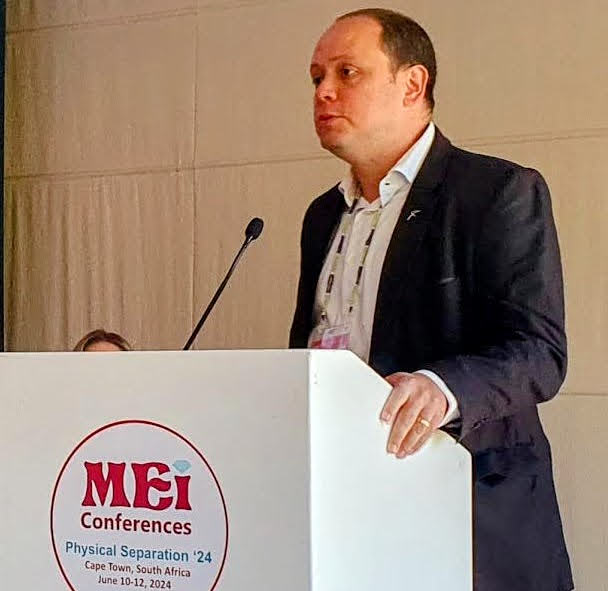
COMEX founder and CEO, Jacek Kolacz, said "The main reason for sponsoring the Physical Separation series is to enhance Comex Group visibility among the decision makers and mineral industry experts.  Sensor based sorting is steadily increasing in number of applications and bringing huge benefits in many aspects, so it is critical to reach the widest possible audience during the conference or the exhibition and through other news channels. It also provides more possibilities for building proper networking, which is necessary to connect with professionals and investors in a collaborative environment. Mineral processing is still the conservative area and sponsoring conferences like this one, where new technologies are well emphasized, can only help in making new complex equipment to be more common in the future".

Jacek Kolacz (centre) at Physical Separation '24

Registration is open for Physical Separation '26 and one exhibition booth is still available for rental.

Full programme details, including abstracts, can be found on the conference website and a timetable is available in pdf format.

#PhysicalSeparation26

Monday, 21 July 2025

Sensor-Based Sorting at the Forefront of Physical Separation '26

Not so long ago, MEI's physical separation conferences typically opened with sessions on pre-concentration, most often centred around heavy medium separation (HMS). Today HMS barely earns a mention. The spotlight has shifted decisively toward pre-concentration by sensor-based electronic sorting, reflecting the rapid evolution of this technology.

We’re therefore delighted to welcome the two leading players in this field, Steinert and TOMRA, as sponsors of Physical Separation '26, to be held in Cape Town.

Steinert, a long-standing supporter, was a sponsor of both Physical Separation '24 and Comminution '25, and confirmed its ongoing involvement some time ago (posting of 6 January 2025). We’re now especially pleased to announce the participation of TOMRA in next year’s event.

TOMRA is a Norwegian company best known for its cutting-edge sensor-based sorting systems, originally developed for recycling and reverse vending machines. Over the years, TOMRA has become a major force in the mineral processing industry through its subsidiary TOMRA Mining, which specialises in sensor-based sorting technologies tailored to mining operations.

TOMRA offers a versatile portfolio of sensor technologies, each designed to target specific mineral sorting needs:

  • X-ray Transmission (XRT): Differentiates materials based on atomic density; ideal for diamonds, gold, and base metals.
  • Near-Infrared (NIR): Identifies materials based on surface chemistry; used for industrial minerals like quartz.
  • Laser Sorting: Distinguishes materials by reflectivity and texture; particularly effective for minerals such as calcite.
  • Colour Sorting (VIS): Separates particles based on visible colour differences; used in gem and industrial mineral applications.

TOMRA's latest innovation is CONTAIN, a major development in AI-powered ore sorting, engineered to reveal what traditional sorting can’t, by detecting inclusion-type ores like tin, tungsten, nickel, sulfides, and REE that often remain hidden deep inside. It visually classifies rocks based on the probability of subsurface mineral inclusions, transforming uncertainty into precision, and waste into value.

TOMRA Mining has made significant achievements in mineral processing over the past year. A standout achievement was its role in commissioning the world’s largest lithium ore sorting facility at Pilbara Minerals’ Pilgangoora mine in Western Australia. Part of the P680 Expansion Project, the plant processes more than 1,000 tonnes of ore per hour. By combining TOMRA’s XRT and colour sorting systems, the operation effectively removes barren material at the front end, boosting lithium recovery and product quality. This pre-concentration strategy is projected to reduce downstream energy consumption by 8-15 GWh per year, while also cutting water and reagent use.

Another milestone came in August 2024, when Lucara Diamond Corp. recovered a colossal 2,492-carat diamond at its Karowe Mine in Botswana using TOMRA’s advanced XRT sorters (posting of 29 August 2024). This remarkable find ranks as the second-largest diamond ever discovered, surpassed only by the 3,106-carat Cullinan diamond found in 1905. Impressively, it is the largest diamond ever recovered directly from run-of-mine ore, a testament to the precision and robustness of TOMRA’s sorting systems.

It’s fantastic to have TOMRA and Steinert, the two global leaders in sensor-based sorting, on board for Physical Separation '26, alongside our other current sponsor, Mineral Technologies. Their presence highlights the growing importance of cutting-edge technologies in modern mineral processing.


#PhysicalSeparation26

Monday, 6 January 2025

Steinert to sponsor Comminution '25 and Physical Separation '26

I think everyone in the mining industry is now well aware of how important sensor-based electronic sorting has become and MEI is pleased to have the continuing involvement of Steinert, one of the leaders in this field. Steinert sponsored two of last year's 4 MEI conferences, Physical Separation '24 and Critical Minerals '24.

A busy Steinert booth at Physical Separation 24.......
.....and at Critical Minerals '24

It is not surprising that Steinert is to sponsor Comminution '25, as sorting waste rock and ore with low concentrations prior to comminution saves energy and water and enriches the grade of the ore.

Steinert's ‘dual energy’ x-ray transmission (XRT) is ideally suited for ore sorting because the x-ray radiation can penetrate stones with particle sizes up to 100 mm, allowing metals to be detected, even when they are not on the surface. 

In addition to XRT, Steinert offers other sensors that can be combined with one another. XRF (x-ray fluorescence) can be used to determine and sort individual chemical elements very precisely and optical sorting and lasers are well suited to the detection of ores with different colours, or crystalline structures.

Steinert is also the first sponsor to sign up for Physical Separation '26. There are many applications of Steinert technology in physical separation.  Electronic sorting has long been used in the recovery of diamonds, X-ray sorting systems screening out diamonds accurately and with high throughput rates at an early stage in the process. In contrast to conventional x-ray luminance processes, Steinert diamond sorting machines use high-resolution x-ray transmission sensors that screen the rock throughout. Detection takes place at the atomic level, and surface impurities do not affect the detection. This solution can be used early in the process in order to remove large diamonds before they are damaged or broken up in the subsequent crusher stages. Near-infrared (NIR) technology is also being used to analyse the complete material stream and reliably separate kimberlite from waste rock. Modern sorters have great advantages over the conventional sink/float process, not only in diamond processing.

We look forward to hearing the latest developments in electronic sorting at Comminution '25 and Physical Separation '26.

#Comminution25
#PhysicalSeparation26

Thursday, 29 August 2024

Sensor based electronic sorting proves itself yet again

We can expect electronic sorting to feature in next year's Comminution '25 conference, as X-Ray transmission sorting has become the process of choice for the pre-concentration of crushed ore prior to grinding.

Basic electronic sorting has been around for some time now, being first introduced in the late 1940s with fairly limited applications. Way back in 1979 it gets a mention in the 1st edition of Mineral Processing Technology with a diagram showing a typical sorter of the time, in which the ore was fed in a monolayer, as display of individual particles to the sorting device was essential. Things have progressed a great deal since then with  multi-layer beds and sensors to manage all kinds of ore properties.

1970s ore sorter

Originally their main use was for sorting diamond ores, making use of the fluorescence of diamonds under a beam of X-rays, and I remember my visit to the Premier Diamond Mine at Cullinan in South Africa in 1978, when a few months earlier the recently installed electronic sorter had picked up its first major find, the 353.9 carat Premier Rose. 

The Premier Mine was famous for the largest gem-diamond ever found, the 3106 carat Cullinan Diamond, prised out of the mine face in 1905. Last week there was news that Canada’s Lucara Diamond has recovered the second largest diamond ever found, at 2,492 carats, from its Karowe mine in Botswana. It is the largest diamond ever recovered by a mechanical process.

Lucara diamond

The diamond was detected and recovered by the company’s Mega Diamond Recovery (MDR) X-ray Transmission (XRT) technology, installed by TOMRA in 2017 to identify and preserve large, high-value stones. A computer processes the data gathered from the scan and creates a series of images that identifies individual stones by shape and density. If the density is close to that of a diamond, as the ore falls off the end of the belt, a jet of air blows the candidate into a collection bin.

According to the company, MDR XRT is particularly good for sorting out large, gem-quality diamonds and has already found some exceptional stones, including the 1,758-carat SewelĂ´ diamond and the 1,109-carat Lesedi La Rona. It reinforces the unparalleled value XRT offers not only diamond mining companies but many other operations, making it arguably the most important mineral processing development in recent years.

Monday, 22 July 2024

Integrated Sensor Based Sorting and HPGR Comminution Circuit for Improved Energy Efficiency

Energy efficiency is a primary focus for the mineral processing flowsheets of the future. In recent years, High Pressure Grinding Rolls (HPGR) have demonstrated significant energy savings as compared to conventional SAG mill circuits and Alex Doll, of Alex G. Doll Consulting Ltd, Ireland, has produced a 22 minute video which discusses the similarities, the strengths and the weaknesses of these two important comminution techniques.

The integration of energy efficient comminution with sensor-based sorting (SBS) has the potential to significantly reduce overall mineral processing energy usage, by rejecting low grade rock ahead of energy intensive comminution, and SBS has featured strongly in recent MEI Conferences, particularly in comminution conferences, and it was good to hear that a paper presented at Comminution '23, a cooperation between Steinert Latinoamericana, Nexa Resources and MinPro Solutions, has received a High Commendation from CEEC, one of our conference industry advocates. The paper proposed an interdisciplinary and holistic approach to better understand the impacts of SBS on a SABC circuit for a polymetallic ore, the results pointing to a 10% increase in grinding capacity, 44% reduction in water usage, 34% reduction in energy consumption and 43% reduction in fine tailings generation. In addition, the metal production and recovery were improved due to a better performance in flotation. 

We can expect much more on SBS at next year's Comminution '25 in Cape Town and in a keynote lecture, Bern Klein, Professor of Mineral Process Engineering at the University of British Columbia, Canada, will present a conceptual SBS with HPGR comminution circuit in tertiary and quaternary stages. The energy consumption will be compared to a conventional SABC circuit for a large copper mine. 

There is a call for abstracts for Comminution '25, which should be submitted by October 31st. If you would like to exhibit please let us know as soon as possible, as due to high demand, and the main exhibition area selling out, we have placed extra 2x1m booths outside the conference room, but only 3 are currently available.

#Comminution25

Monday, 24 June 2024

Physical Separation '24: a summary of the technical presentations

Physical Separation '24, the 8th in the series, was held at the Vineyard Hotel, Cape Town from June 10-12, 2024 and was attended by 80 delegates from 17 countries.

Following is a very brief summary of the presentations made over the three days.  This summary is intended to guide you to the extended abstracts associated with the presentations, most of which are available online as open-access. Unfortunately not all presenters responded to requests for drafts, but for those that did their names are linked directly to their papers in the online Proceedings.

The drafts have not been refereed, but all the presenters have been invited to submit their final papers for peer-review to a virtual special issue of Minerals Engineering.

Monday June 10th

Technical Session 1

Is physical separation still relevant in 2024? This was the question asked by James Agenbag, the regional sales manager for Africa and Europe for Mineral Technologies, South Africa in his opening keynote lecture. It is of critical importance he argued, as it is the most energy-efficient, chemical-free means of sorting and upgrading minerals. It will become an even more vital first-stage in future flow sheets. In addition, physical separation will also become a critical step in the recycling of batteries, cables, cell-phones and other electronics as we start to close the metal loop and start to re-use more and mine less.

James Agenbag (centre) with Mineral Technologies colleagues

Ajay Sihota, Director for Precious Metals Recovery with FLSmidth Ltd, Canada then discussed best practices in gravity circuit design and operation and the practical considerations involved in determining ore amenability, scale-up, design, operation, and maintenance of the modern gold gravity circuit. 
Ajay Sihota

The Reflux Classifier achieves powerful synergy between an upper system of inclined channels and lower fluidized bed arrangement, delivering gravity separation in a single stage of separation. With over 240 installations around the world, the technology has been used to beneficiate iron ore, mineral sands, metallurgical coal, potash, chromite, lithium, and other base metal oxides. Pedro Pinto, of ArcelorMittal, UK, evaluated the variation of fluidisation water and bed density in the performance of the Reflux Classifier on Western Africa iron ore fines.

Pedro Pinto

Kevin Galvin is the inventor of the Reflux Classifier and is Director of the ARC Centre of Excellence for Enabling Eco-Efficient Beneficiation of Minerals at the University of Newcastle, Australia. He is a recipient of numerous awards including the Ian Wark Medal, ATSE Clunies Ross Award, and Antoine Gaudin Award in mineral processing. He described the step-change improvement in gravity separation utlising the latest in a series of improvements.

Joshua Starrett is a PhD candidate, supervised by Prof. Galvin at the University of Newcastle. He discussed his work on the Reflux Classifier, aimed at maximising the performance of the particle size classification using inclined channels and the challenge of expanding the range of separation sizes beyond the previous limit of 180 microns. 

Joshua Starrett and Kevin Galvin

The GradePro is a modified version of the original Reflux Classifier technology and includes two key modifications to the original design: a reduced mixing chamber area and the use of secondary fluidisation water. These modifications allow for better stratification of particles by density and the removal of light gangue particles before they even enter the bed. Lance Christodoulou, of FLSmidth, USA showed how the the GradePro has been used to enhance the recovery of valuable minerals from low-grade ores and tailings.

Lance Christodoulou

Wynand Roux


Taking us to the lunch break, Wynand Roux, a lecturer at the University of Pretoria, South Africa, presented a study employing numerical modelling to explore the intricate hydrodynamics of a lab-scale inclined fluidised bed based on the Reflux Classifier design. 


Technical Session 2

Chris Ndoe
In the first presentation after lunch Chris Kaseba Ndoe, a PhD candidate at the University of Johannesburg described his work aimed at optimising chromite recovery from chrome plant tailings in South African Middle Group chromite seams using a Wilfley shaking table. Response surface methodology and central composite design facilitated the optimisation process.

There is a growing demand for lithium as it is primarily used in the production of batteries. Nichole Maistry, a Senior Engineer at Mintek, South Africa,described how two lithium bearing ores, namely spodumene and lepidolite, underwent gravity separation via heavy liquid separation laboratory tests to determine the amenability of each ore to upgrade by gravity processes, such as dense medium separation.

Nichole Maistry (right) with Mintek colleagues

Maria Cristina Vila

Maria Cristina Vila
is Associate Professor in the Department of Mining Engineering at the Faculty of Engineering of the University of Porto, Portugal and she showed how dense media cyclone models have applied to the pre-concentration of a diamond ore from Angola.

Tebogo Mokgomola, an Engineer at Mintek, investigated the effect of conventional crushing and HPGR on the pre-concentration of South Africa's UG2 ore by DMS to ascertain if the crushing method can minimise PGM losses.  

Tebogo Mokgomola with Mintek colleagues

Tomas Machalek is a project manager with Heidelberg Materials AG, Germany and is also studying for a PhD at VSB - Technical University of Ostrava in the Czech Republic. His work involves technical support for quarries and sand & gravel pits and he described the optimisation of a suction dredger’s discharging pipeline.

Tomas Machalek (left)
More on Day 1

Tuesday June 11th

Technical Session 3

One of the most important developments in recent years as been sensor-based sorting as a pre-concentration process prior to crushing. It is a dry process so reduces overall water as well as energy consumption.

Conference sponsor Steinert is a leading player in this field, and Priscila Esteves, is the laboratory manager at Steinert Latinoamericana, Brazil, and she leads the development of Sensor-Based-Sorting applications in Latin America. She discussed the utilisation of sensor-based-sorting technology to enhance the quality of low grade iron ore.

Priscila Esteves (centre)

Jacek Kolacz, CEO of conference sponsor Comex Polska, Poland described how ore pre-concentration by sensor-based sorting is a complex process and must be optimised, especially when several sensors are applied. Therefore, a new optimisation method has been developed using an AI model to achieve efficient identification of required materials during sorting.

Jacek Kolacz (centre)

Vitor Andrade, a Process Engineer with Vale, Brazil, showed that understanding the amenability of the sensor for each type of ore is fundamental for obtaining better performance and can help calibrate the optimum threshold. He presented a performance evaluation of a particle sorting X-ray transmission sensor for different types of copper ore and their composition influence on the sensor performance.

Vitor Andrade (centre) with Vale colleagues

After the coffee break Tom Newman, a process engineer at ST Equipment & Technology LLC, USA, described the development of a dry separation system using a tribo-electrostatic belt separator, which requires no water or chemical additives. 

Athule Ngqalakwezi, a Senior Engineer at Mintek, South Africa then looked at the effects of mineralogical difference on magnetic separation of two magnetite tailings samples sourced from the northern part of South Africa.

Athule Ngqalakwezi (centre) with Mintek colleagues

Taking us to the lunch break Thiago Piacentini, Manager at Sibelco, USA discussed how high purity quartz is pivotal in advancing decarbonization through photovoltaic cells and enabling digitization via semiconductors and optical fibers. The primary reservoir for such quartz is found in North Carolina's leucogranite Appalachian deposits, rich in plagioclase, K-feldspar, mica, and heavy minerals. Existing purification methods, mainly flotation, incur high costs due to chemical reagents, mechanical complexity and extensive waste treatment. He described a study  exploring the efficacy of Pulsating Wet High Intensity Magnetic Separation in streamlining the purification processes.

Thiago Piacentini (right) with Francois Burger (Stark Resources, South Africa)

Technical Session 4

Frikkie Enslin, applications manager with Multotec Process Equipment, South Africa, focused on an important aspect relating to maximising profits in mineral processing- the lifecycle management and optimisation of the heart of many mineral processing plants, the hydrocyclone. He showed that cyclone lifecycle optimisation must move away from "one size fits all" to customised solutions.

Frikkie Enslin (centre) at the welcoming drinks function

Following on from this, Victor Portnov, the CPO and founder of conference sponsor Conundrum AI, a technology company that provides a software platform for implementing, deploying, and running AI process control in the mining industry, described the control and optimization of hydrocyclone classification performance with predictive models.

Victor Portnov with Jenni Sweet of Mine3, South Africa at Mill Circuits '24

Khuthadzo Mudzanani,a research engineer at Mintek, South Africa, presented case studies from various mining operations on how wet sieving efficiency is influenced by mineral ore physicochemical properties and operational conditions,

Khuthadzo Mudzanani (centre) with Mintek colleagues

As the original presenter could not attend, Max Richter, of the University of Cape Town, stepped in to present work laying the groundwork for a phenomenological screening model, offering a fundamental understanding of granular transport on vibrating screens.

In the final paper of the day Lesigen Moodley, of Eskom Research, South Africa described the microlithotype particle type classification and enrichment of coal maceral concentrates with the Reflux Classifier, Float-Sink and De Beers RhoVol techniques.

More on Day 2

Wednesday June 12th

Technical Session 5

Andrew Vietti, Director at Vietti Slurrytec, South Africa, introduced a model for understanding dispersive clay behaviour for tailings solid/liquid separation applications, highly dispersive clays within tailings often being the cause of poor flocculation and of poor dewatering unit process performance.

Andrew Vietti with his colleague Fredre Dunn

With high grade iron ore deposits in South Africa depleting, focus is placed on the use of low-grade ores. Tebogo Kale, of Gravitas Minerals, South Africa, described a new fine iron ore beneficiation process, The Kalahari Process, that aims to address the shortcomings of current technologies, with the Optima Classifier® at the heart of the circuit. The Optima Classifier® has proven its ability to produce a low, medium, and high-grade iron ore concentrate at economically favorable yields while also minimizing capital and operational costs. 

Tebogo Kale with his Gravitas colleague Franco van de Venter

CO2 emissions, water consumption, and tailings generation have driven the industry to develop environmentally friendly technologies. Thailli Conte, a geologist at Vale, Brazil, described a route for dry processing of iron ore which combines microwave technology for moisture reduction with the dry concentration of hematite and goethite fines in rare-earth permanent magnet concentrators.

Thailli Conte (centre) with Vale colleagues

Gravity separation, magnetic separation or flotation are often used to upgrade ilmenite-containing ores prior to smelting. The choice of minerals processing technology depends on the mineralogical properties, liberation size and associated gangue. Getrude Marape, head of Physical Separation at Mintek presented a study investigating the recovery of fine ilmenite by magnetic separation.

Gertrude Marape (centre) with Mintek colleagues

While bauxite residue (BR) is considered a waste product, it carries metals which can be recovered while minimizing the environmental impact. Kornel Tobiczyk, head engineer at Norwegian University of Science and Technology, Norway, presented a sustainable route for efficient extraction of metals from BR using hydrogen reduction followed by magnetic separation.

Kornel Tobiczyk (3rd left)

Technical Session 6

The production of chrome ore is growing, mostly as an outcome of China's rising demand. South Africa was the top exporter globally in 2021. The typical South African chrome concentration plant consists of 4 or more stages of spirals, still discarding chrome tailings with a grade of up to 20% Cr2O3. Franco van de Venter, process manager with Gravitas Minerals, South Africa, described a new chrome recovery process, ChromEx, which employs the use of the Optima Classifier®, with the aim of increasing overall chrome recovery and decreasing the tailings grade to less than 12% Cr2O3. 

Inga Sixhuta, an engineer in training at Mintek, discussed the characterization and processing of low-grade chromite ore for development of Cr mesoporous catalysts for oxidative desulphurization of dibenzothiophene.

Inga Sixhuta (2nd right) with Mintek colleagues at registration

The Beauvoir granite is a highly differentiated intrusion considered as one of the most promising hard-rock lithium deposit in Europe. It also contains interesting amount of tin in cassiterite, niobium and tantalum in colombo-tantalite and microlite. Bastien Demeusy, of the University Of Lorraine, France, described the concentration of tin, niobium and tantalum from the Beauvoir granite using a Falcon SB concentrator.

Bastien Demeusy with his co-author Lev Filippov

The conference came to an end with two papers on microwave technology from Vale, Brazil. Mariana Pereira is a Master Analyst at Vale and she described the calcination of kaolinite in a novel microwave rotating furnace. Vale's Kassia Toccolini then showed how a pilot plant study is proving that microwave technology for drying ores is becoming a green alternative, particularly in areas where clean electricity is largely available.

With Kassia Toccolini and Mariana Pereira

More on Day 3

A final thanks to all concerned in making this a great conference, the sponsors, exhibitors, chairpersons, presenters and delegates, and last but not least the wonderful staff at the Vineyard Hotel.  We would greatly appreciate your comments on this posting.

A reminder also that the next conference in the series, Physical Separation '26, will be held at the Vineyard from April 20th to 23rd, 2026.

#PhysicalSeparation24

Monday, 4 March 2024

Major sorting company Steinert is the latest sponsor of Physical Separation '24

Sensor-based sorting has proved to be one of the most important developments in mineral processing, as a versatile pre-concentration process, reducing overall energy and water consumption and pushing the more limited and complex heavy medium separation circuits towards obsolescence.

Sensor-based sorting separates valuable ore from waste material based on the physical properties of the rocks or particles being processed. It involves the use of sensors and sophisticated sorting algorithms to identify and segregate different materials based on their characteristics such as colour, density, shape, size, or composition. Various sensors, such as near-infrared, X-ray transmission, laser, or optical sensors, scan the material as it moves along the conveyor belt, analysing the physical properties of the particles in real-time. 

By accurately sorting and segregating different ore grades, sensor-based sorting helps maintain consistent feed grades to downstream processing plants. This ensures that the final product meets quality specifications and maximizes the value of the extracted minerals. Overall the technology plays a crucial role in modern mining operations by enabling efficient, cost-effective, and sustainable extraction of valuable minerals from ore deposits.

Sorting will feature in the technical programme for Physical Separation '24 in Cape Town in June and we welcome to the conference, as a sponsor and exhibitor, Steinert, a leading provider of advanced sorting and separation solutions for various industries, including recycling, mining, and industrial processing. We are pleased that Priscila Esteves, head of the Lab at Steinert Latinoamericana, Brazil, will be presenting one of the papers in the session on sorting.

Steinert joins the Comex Group, Conundrum, and Capstone Copper as conference sponsors.

#PhysicalSeparation24

Monday, 24 April 2023

Good news from Steinert and TOMRA- leaders in the development of sensor-based sorters

It is ironic that sorting, once a major method of concentrating ores by hand, became effectively redundant, but is now enjoying a very strong resurgence thanks to high speed computers which allow pre-concentration of ores at very high rates, reducing comminution energy and water costs. 

Not too long ago little thought was given to water conservation, apart from recycling where possible, and although it was well known that mineral processing, particularly comminution, was a massive consumer of energy this was just accepted as a fact of life and no real efforts were made to attempt to minimise consumption. Now it is realised that conservation of water and energy is not just desirable, but is essential, and every effort is being made to mitigate consumption in these areas. 

Rejection of gangue at as coarse a size as possible is critical and pre-concentration within the crushing circuit aims at reducing the amount of material fed to the energy-hungry grinding circuit. Heavy medium separation has been used for years on ores which are amenable to this, such as tin and lead-zinc ores, and coal. The range of ores which can be pre-concentrated has been dramatically increased in recent years with the development of sensor-based electronic sorting, a completely dry process originally used for the concentration of diamond ores, but now being used in many other areas, due to modern sensors which can rapidly detect a range of physical properties, including grade of particles.

Sensor-based electronic sorting thus has a major role to play ins sustainability, and we welcome one of the leading players in this field, Steinert, who provide not only electronic sorters, but, since 1889, magnetic and eddy current separators, as a sponsor of Sustainable Minerals '23.

Current Sustainable Minerals '23 sponsors

TOMRA Mining also designs and manufactures sensor-based sorting technologies for the global mineral processing and mining industries, and a new, free-to-download publication outlines the different ways today’s advanced digital sorting data services can help mining operations stay in control at all times, take quicker action when necessary, and build a stronger collaboration across teams and departments.

Sensor-based sorting machines inspect every single piece of material that passes through the processing line, collecting a wealth of data. The digitalization of sorting-related services is opening up a world of new possibilities. The new e-book, titled ‘The Benefits of Data-driven Quality Control’, which can be downloaded free-of-charge, focuses on how to efficiently produce high-quality product with maximum control and minimum waste.

From a quality management perspective, every sensor in the sorters is a valuable source of information about the products that pass through them. Today’s sorting data services turn sorters into connected devices and provide a secure, near-live monitoring dashboard for the mine’s sorting lines. Mining processors are able to continuously monitor and optimize the sorting line’s output quality. 

On-site observation, manual sampling and time-consuming reporting and communication become a thing of the past:  the sorter itself provides a constant feed of information based on continuous product sampling on every object. The standard approach of regularly checking metrics on individual machines provides ‘snapshots’ of the situation at specific moments in time, but do not provide a complete overview. The continuous access to quality data across machines, lines, processes and plants put mineral processors in control all the time. Machine operators are able to move fast as required, responding to changes in material composition on the line to ensure consistently high quality of the product. 

A modern sorting data platform can be a powerful quality management tool by turning the data into actionable information by processing, enriching and visualizing it in easy-to-read graphs, creating customized reports and comparisons that provide valuable insights. Automatically recorded, remotely accessible, objective data sets are available on any computer or mobile device, easily accessible by all members of the team, streamlining information sharing and collaboration. Managers can monitor remotely distant or difficult-to-reach mining sites from their offices, enabling them to make operational and business decisions based on experience and hard facts, also comparing and benchmarking data from different sites. 

All these features enable mineral processors to optimize their decision-making and efficiency, ultimately increasing the profitability of their operation. These benefits are accessible through TOMRA Insight, the cloud-based data platform available to TOMRA machine users as a subscription-based service. 

Monday, 10 October 2022

The importance of coarse particle rejection in reducing water and energy consumption

In my keynote lecture at last month's IMPC Asia Pacific Conference I highlighted the importance of ScienceDirect in the evolution of Minerals Engineering journal. Analysis of the huge number (around half a million per year) of downloads from ScienceDirect showed that in recent years the most sought after papers were those involved with sustainability, particularly the growing need to conserve water and reduce energy consumption.

In my early years in mineral processing little thought had been given to water conservation, apart from recycling where possible, and although it was well known that mineral processing, particularly comminution, was a massive consumer of energy this was just accepted as a fact of life and no real efforts were made to attempt to minimise consumption. 

Now it is realised that conservation of water and energy is not just desirable, but is essential, and every effort is being made to mitigate consumption in these areas. Rejection of gangue at as coarse a size as possible is critical and is now an area for intensive research and innovation.

Preconcentration within the crushing circuit aims at reducing the amount of material fed to the energy-hungry grinding circuit, and heavy medium separation has been used for years on ores which are amenable to this, such as tin and lead-zinc ores, and coal. The range of ores which can be preconcentrated has been dramatically increased in recent years with the development of sensor-based electronic sorting, a completely dry process originally used for the concentration of diamond ores, but now being used in many other areas, due to modern sensors which can rapidly detect a range of physical properties, including grade of particles.

Typical electronic sorter

High Pressure Grinding Rolls (HPGR) have found favour for fine crushing, replacing tertiary cone crushing and rod milling, while stirred mills, introduced into the minerals industry to provide the need for ultra fine grinding, have replaced ball mills for many fine grinding duties. It is interesting that in recent years HPGRs have been used to grind finer while stirred mills are taking coarser and coarser feeds, replacing ball mills, which have always been known to be inefficient users of energy. Could it be that in future there will be an overlap in the product from HPGRs and the feed to stirred mills, and tumbling mills, including the SAG mill, will become obsolete?

In his forthcoming keynote lecture at Comminution '23, Prof. Arno Kwade, of Technische Universität Braunschweig, Germany will show how dry operation of stirred media mills has recently come into focus for the minerals industry, and maybe the comminution circuit of the future might be totally dry, with water being added only at the subsequent concentration stage.

A comminution circuit of the future?

Flotation is the dominant concentration method, and in my early years with Minerals Engineering, flotation research was targeted at the treatment of fine particles. In contrast, flotation at coarse sizes has become a recent focus for research and innovation.

Eriez is a regular sponsor of MEI's flotation conferences, and is one of the sponsors of Flotation '23 in Cape Town next year. One of Eriez’s products is the HydroFloat® Separator for coarse particle mineral concentration, which delivers the capacity of a density separator while maintaining the selectivity of a flotation device. Using a novel aeration system to disperse fine bubbles into a fluidised-bed environment, the HydroFloat® Separator significantly increases the selective recovery of coarse particles by applying flotation fundamentals to gravity separation, reducing water and energy consumption and producing safer tailings.

I was pleased to hear that last month Weir Minerals, a sponsor of Sustainable Minerals '22 announced a cooperative agreement with Eriez to design and develop coarse particle flotation systems. This cooperation allows both companies to better connect the Eriez equipment  with the slurry classification and conveying expertise of Weir Minerals.

A leading player in the development of coarse flotation systems has been Prof. Graeme Jameson, the inventor of the Jameson Cell, and one of his recent inventions, the Novacell, is said to be a breakthrough in flotation equipment technology, a "Universal" machine which provides efficient coarse and fine particle flotation in one device.

The HydroFloat Separator and the Novacell

It is great to see our industry, once so conservative and reluctant to change, embracing new areas of research and development.

@barrywills

Monday, 18 July 2022

Microwave-assisted comminution and electronic sorting technology receives $3.9 million grant

Physical Separation '22, originally scheduled for Falmouth, was held online in May and included a 2-hour panel discussion on the future of physical separation, which was brilliantly chaired by Dr. Erin Bobicki of the University of Alberta. Erin also co-authored a paper at the conference on the application of microwave imaging in sensor-based ore sorting.

So I am very pleased to see that Erin is the leader of a team from the Canada Mining Innovation Council (CMIC)’s cleantech solution, CanMicro, which has been named as the grand prize winner of the Crush It! Challenge, and has been awarded a C$5 million ($3.9 million) grant to further develop CanMicro, which combines microwave-assisted comminution and multi-sensor ore sorting technology to selectively break particles and sort waste from desired minerals, reducing crushing and grinding requirements. CMIC says the CanMicro technology can provide over 35% energy savings across several commodities.

Erin with colleague Darryel Boucher (right) and Kai Bartram of Steinert,
one of the leading sorting companies, at Physical Separation '19 in Falmouth

The Crush It! Challenge was announced in October 2018 by Natural Resources Canada (NRC) with the aim of realising an innovative breakthrough in the mining industry’s most energy-intensive and inefficient processes: crushing and grinding. The primary objectives of the challenge are to fight climate change by creating innovative technologies that reduce energy consumption and pollution, increase competitiveness by developing world-leading clean technologies, and transform the mining cycle to establish a new “future in mining”.

Semi-finalists (up to 12) received C$10,000 to help them pitch their ideas to the Challenge Jury, with up to six finalists being granted up to C$860,000 to build and test their clean technologies. The winner and innovator demonstrating the most superior energy breakthrough to crush and grind rocks was awarded the C$5 million prize to fully develop and roll out their solution.

CanMicro is the only technology to combine microwave-assisted comminution and sorting, according to CMIC. The treatment selectively heats value minerals, resulting in micro-fractures along grain boundaries that help reduce ore competency and increase mineral liberation after grinding. It also generates a thermal signature that can be used to sort ore particles so that only those containing value minerals are subjected to fine grinding.

Aside from the potential energy savings, which the CMIC team- Dr Bobicki (Technical Lead), Sepro Mineral Systems (Project Participants), Glencore Canada (Project Participants), COREM (Project Participants) and Queen's University (Subject Matter Experts) – believe could be up to 70%, this has significant environmental implications for tailings.

I am sure that we will here more of this technology at next year's Comminution '23 in Cape Town and we are also extremely pleased to see that one of the sponsors of that conference, and a regular sponsor of the comminution series, has also played a big part in the Crush It! Challenge. Starkey & Associates' SAGDesign technology was chosen to assess the energy reduction, by testing samples of the ore before and after microwave treatment, to measure the difference in SAG hardness that was caused by the internal heating of certain constituent valuable minerals when subjected to microwave treatment. 

Donna and John Starkey with Erik Spiller (left) at Comminution '18

SAGDesign technology was considered the most accurate way to measure ore hardness and the results are reported in kWh/t to grind the ore from a specified size to 80% minus 1.7 mm, in a SAG mill. A Bond ball mill work index test on the SAG ground ore is part of a SAGDesign test and is done to allow calculation of the total comminution energy needed to achieve the final size target grind for liberation of the ore values, prior to beneficiation which follows comminution in a plant. Starkey & Associates was pleased to provide assistance to Dr. Bobicki and her team, as part of its contribution to the research for better methods to save energy in comminution of mined ore, in Canada and the world.

Congratulations to all concerned on what could be a breakthrough in reducing comminution energy.

@barrywills