Showing posts with label Computer Applications. Show all posts

Monday, 24 August 2020

Digital Transformation in Mining Plant Operations

This is now postponed to June 2022

We are pleased to announce that the first keynote lecturer at MEI's new conference Integration, Optimisation & Design of Mineral Processing Circuits '21 (IntegratedMinPro '21) will be Dr. Osvaldo A. Bascur, Principal, OSB Digital, LLC., USA. Osvaldo is a well known figure at international conferences, and was a recipient of the SME's prestigious Antoine Gaudin Award in 2014. In 2017 Osvaldo was the subject of one of the MEI interviews.

At IntegratedMinPro '21 in Falmouth next June, Osvaldo will show in his keynote Digital Transformation in Mining Plant Operations that current grinding and flotation sensors provide large amounts of data for process optimization. As ores are becoming extremely variable, with mineralogy and hardness disturbing the grinding and flotation circuits, adding the right context and operational events enables augmentation of operational knowledge to allow proactive actions for improving the performance of the crushing, grinding, flotation and thickening/filtration circuits.

IntegratedMinPro '21, a 2-day conference, will immediately follow Physical Separation '21, the 7th conference in the series, and now over 3-days. There are calls for abstracts for both conferences, which should be submitted by the end of December.

Updates can be found at #IntegratedMinPro21 and #PhysicalSeparation21.

Tuesday, 18 June 2019

Report on Computational Modelling '19

Computational Modelling '19 was held at the National Maritime Museum, Falmouth, UK, from June 11-12. The 7th in the series, which began in Cape Town in 2005, this was by far the smallest, with an attendance of 26 delegates representing 12 countries.

This begs the question as to whether this conference series has ran its course. Computational modelling techniques, such as DEM and CFD are now accepted tools in mineral processing, and their use is a feature of all current MEI Conferences, so is there a need for a small specialised conference dealing with developments and uses of these techniques? The argument for is that the conferences do have a multi-disciplinary flavour, the papers this year covering liberation and comminution, flotation, hydrometallurgy, pyrometallurgy, dewatering and materials handling. It is always useful to bring scientists from disparate groups together, as it promotes lateral thinking, but I would like the views of those who attended this year and in previous years.

The following is my report on the papers presented. More detail on people and actvities are in the posting of 12th June.
Tuesday June 11th

Paul Cleary
Particle based modelling is well suited to predicting complex multiphase flows within mineral extraction processes. Applications include comminution with particle breakage and flow in crushers and particle breakage and slurry transport within mills and separation, both wet and dry, by screens. In such models the coarser particulate phases are represented by DEM (Discrete Element Method) and the finer slurry or powder phases by SPH (Smoothed Particle Hydrodynamics). Emerging opportunities also exist in flotation where discrete phases for bubbles and particles can be coupled to continuous free surface liquid phases. These models have become quite sophisticated and continue to increase in the range of scales modelled and the fidelity of the physics represented as computer power continues to rise and computational modelling codes continue to develop. A fine keynote lecture from Paul Cleary, of CSIRO Data61, Australia, showcased a range of leading edge application examples of this modelling and discussed the increasing role of hybrid and multiscale methods.

Process simulators have become increasingly useful for design, optimization and control in mineral processing, evolving from simple models of isolated unit operations to complex integrated simulation environments. There has been an increase in the number of mineral processing simulation platforms available and publications on their application; however, a recent overview of the topic is missing in the literature.


Juliana Segura-Salazar

Juliana Segura-Salazar, of Imperial College, UK,  presented a critical review of the state-of-the-art of process simulators for the minerals industry, discussing and contrasting their capabilities and limitations, as well as identifying some of the challenges that need to be addressed. She discussed recent developments towards the application of these simulators in a more systemic context as a support tool for decision making within the minerals sector. This is particularly relevant if process simulation is to play a key role in overcoming the multiple challenges faced by mineral processing operations in the context of sustainability.

Luis Cisternas
As highlighted by Luis Cisternas, of Universidad de Antofagasta, Chile, mineral processing usually utilizes multi-unit separations because complete separation is seldom achieved in one unit. The analysis and design of these circuits have been an active area of research in the exploration for improvements in mineral processing. Linear circuit analysis (LCA) has been proposed as a simple tool for the analysis of mineral processing circuits. Clearly, LCA is a tool with several advantages, but it does have its limitations and disadvantages. Luis analysed some limitations and disadvantages of LCA. The results show that LCA must be used carefully because its application can introduce errors and incomplete analysis.

Component wear is a key consideration for the minerals industry given the abrasive nature of particle-laden flow such as mineral slurries. Studying wear through experimentation is time-consuming and expensive, thus, an accurate simulator to understand and predict wear is highly desirable. This allows for optimisation of design and operating parameters to improve performance, as well as enhance the service life of these parts. Lily Ip, of Imperial College, UK, described a finite element based CFD wear simulator, which includes the ability to model coupled solid-fluid motion of slurries through representative Lagrangian particles and perform dynamic remeshing of geometry in response to wear and moving components. The capabilities were illustrated through examples ranging from simple geometries to that of complex moving geometries such as centrifugal pumps.

Lily Ip with Stefan Kirsch
Taking us to the lunch break, Stefan Kirsch, of Robert Bosch Packaging Technology B.V., The Netherlands and Technical University Dresden, Germany, discussed how vertical discharge and filling processes of granular media have been successfully described with the aid of DEM in the past. However, a major challenge is often the identification of accurate interaction parameters (model calibration) such as friction and restitution coefficients. In-situ bulk calibration has been shown to be an efficient approach to generate high fidelity models. However, Stefan showed that in the case of vertical transfer and especially when working with low particle counts, randomness intrinsic to the process, can be detrimental to efficient and reliable implementation. A second constraint is shortcomings in the physical model of DEM and differences between lab scale and industrial equipment. These factors can lead to systematic errors in the calibration process and may restrict model transferability. Stefan described a study where several example media were assessed to deduce suitable calibration and quantitative validation strategies for DEM models.

Grinding and liberation were the topics discussed in the five papers in the afternoon session.

Feed size distribution is one of the important parameters that affect ball milling and can be tailored to optimally produce a desired mill product. To that end, Ngonidzashe Chimwani, of the University of South Africa, described how batch tests were used to investigate the effect of feed tailoring in ball milling using a South African gold ore. Narrow-size feeds of the ore were prepared and milled with sets of single-size balls. From the experimental data obtained, milling parameters of the gold ore were determined, validated and then used to simulate the breakage patterns of different feed size distributions for further analysis, with the purpose of finding the feed size distribution that produces the highest amount of the desired size range for gold leaching.

Ngonidzashe Chimwani with Bertil Palsson and Jarrod Hart
Discrete element methods (DEM) have provided the ability to resolve the complex phenomena experienced by ore within comminution devices such as tumbling mills. The new developments in DEM techniques and the corresponding increase in computational power has made it more feasible to study the movement of individual ore particles as they traverse a tumbling mill. A range of information can be extracted on individual particle impact histories, such as kinetic energy at the time of collision, velocities of individual particles, per-particle stress tensors, impulse and collision energy. DEM codes have been modified to provide the required information that can be analysed in an associated software to investigate the impact of varied operational parameters on the resultant granular dynamics, and we were looking forward to Olumide Ogunmodimu, of JKMRC, Australia, exploring the reaction of individual ore particles to the breakage environment within a tumbling mill using DEM techniques, studying the stressing conditions that would lead to either impact or abrasive breakage. Unfortunately, however, entirely due to no fault of his own, Olumide was unable to attend the conference but his paper is available on the Proceedings USB.

Simon Larsson
Modelling of wet grinding in stirred media mills requires the simultaneous modelling of grinding media, a moving internal stirrer, and the pulp fluid. Simon Larsson of Luleå University of Technology, Sweden, showed how wet grinding in a stirred media mill was simulated using coupled incompressible computational fluid dynamics (ICFD) and discrete element method (DEM) and finite element method (FEM) simulations. The grinding media was modelled with the DEM, the pulp fluid flow using the ICFD and the mill structure using the FEM. The combined model was used to predict the wear rate in the system. The model can be used to study process parameters and their effect on the wear map distribution and power consumption. The two-way fully coupled ICFD-DEM-FEM preserves the robustness and efficiency, and it allows the use of large time steps for the fluid with very low computation times.

The main roles of liners are to protect the mill shell and promote effective ball motion for grinding. For this reason the liner profile is carefully selected to ensure that the productivity is maximized and due liner replacement is made when this objective is no longer met. These issues have been extensively studied on shell liners as mill relining is a significant cost component of ball milling. To date, not much has been written about end-liners and the kind of forces they are subjected to. In his second paper,   Ngonidzashe Chimwani described a DEM simulation scheme which was conducted to look at how ball size distribution, mill filling, end-liner configuration and shape affect the distribution of forces acting on the few liners that were used as a case study to understand end-liner wear and damage.
Mapilane Madiba
In mineral processing plants there is a challenge in turnaround time for issuing results timely to reduce delays in the decision-making process. Mineral liberation is considered as one of the efficiency drivers for downstream processes such as flotation. Thus, delayed decision could be costly. Mapilane Madiba of University of South Africa, described the development of a procedure to quantify and minimise the time analysis for mineral liberation.

After a good first day of presentations, a number of hardy souls braved the cold and windy conditions for a 3 mile walk around the Pendennis Headland and to awaiting drinks in one of Falmouth's oldest pubs, the Chain Locker.
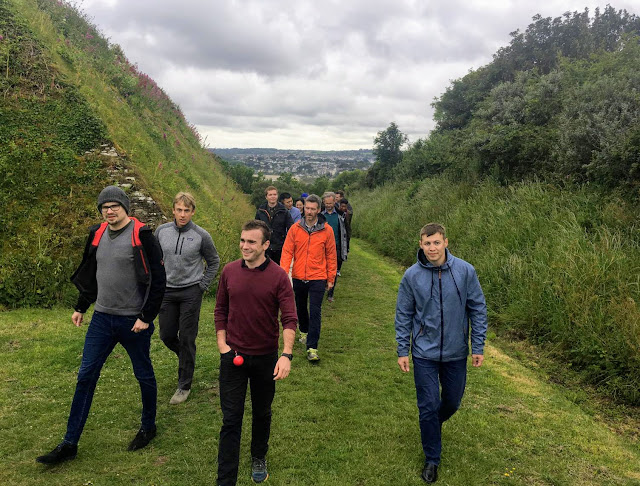
In the 16th century Pendennis Castle moat
Welcome ale in the Chain Locker
Wednesday June 12th

Mapilane Madiba of University of South Africa was back on the podium first thing to further review correction methods to solve limited representativeness in mineralogical analysis of measured liberation data. Although progress is being achieved, there are still challenges facing correction methods. Therefore, the advantages and disadvantages of specific issues, such as point spread function, excitation energies and the monochromatic assumption of X- Ray source, facing the correction methods were discussed.

Flotation then dominated the morning session. Luis Cisternas, of Universidad de Antofagasta, Chile discussed how regrinding of rougher concentrate, scavenger concentrate, and/or cleaner tailing is common practice to liberate valuable mineral attached to gangue particles. However, the methodologies proposed for the design of flotation circuit based on optimization usually do not consider regrinding. Luis analysed the effect of regrinding in the design of flotation circuit structures.
Guichao Wang
Guichao Wang, of Southern University of Science & Technology, China, showed how direct numerical simulations of a particle-bubble collision system composed of monosized spherical solid particles and air bubbles in a quiescent liquid and homogeneous isotropic turbulence have been performed. Particle-bubble collisions in a quiescent liquid were first simulated and compared to the existing experimental work of particle-bubble collisions. A DNS model for studying the effect of turbulence on the collisions between particles and bubbles was then developed. Turbulence was found to first increase particle-bubble collisions to a certain extent, and, with further increase turbulence intensity, the particle-bubble collision rate was reduced.

Phil Schwarz described how the flow field, gas dispersion and solids concentration in a flotation cell fitted with an Outotec flotation mechanism were studied at CSIRO Minerals Resources, Australia, using both experimental and multi-phase CFD modelling. He showed that the complex multi-phase CFD model can be used to predict the major characteristics determining flotation kinetics: namely turbulence, bubble size and distribution, and solids distribution. The CFD flotation model can therefore be used for investigations on the design and operation of the cell, for example, in parametric studies on the effect of stirring speeds and aeration.

Phil Schwarz (centre) with Guichao Wang and Russia's Dmitrii Maiorov
at the Chain Locker

Asmaa Hadane
Flotation is an important separation process for beneficiation of sedimentary phosphate rocks. In order to evaluate hydrodynamic efficiency, Asmaa Hadane, Mohammed V University in Rabat and Mohammed 6th Polytechnic University, Morocco, showed how a CFD multiphase model of water-phosphate flow was used to investigate the main hydrodynamic criteria namely: the agitator power consumption and the solid distribution in the flotation cell depending on the impeller rotational speed and the phosphate volume fraction.  A second CFD study considered the injection of air bubbles. She described work on the air dispersion and the solid distribution in the complete cell volume, in order to analyse the phosphate-air contacts within the flotation tank, which represent the key elements to establish convenient conditions to maximize the flotation performance.

Several ore deposits are polymetallic with two, three or more base metals. These base metals include copper, lead, zinc, cobalt, nickel, molybdenum, and pyrite among others. Usually, polymetallic ore is separated by sequential flotation circuits for each base metal. In his 3rd paper of the conference, Luis Cisternas argued that the methodologies proposed in the literature for the design of flotation circuits consider only one base metal and there is no literature for the design of integrated flotation circuit for polymetallic ores. Luis proposed a procedure for the design of polymetallic integrated flotation circuits, the methodology considering a superstructure to represent the set of feasible flotation circuits, disjunctive expressions for the selection of operation conditions of flotation stages, and a mixed integer nonlinear programming model. The integrated flotation designs were compared with sequential flotation circuits, and advantages and disadvantages identified. 

A better understanding of controlling factors in mineral flotation will undoubtedly be possible using advanced CFD simulations over entire full-scale industrial cells. Such macro-scale simulations require sub-models to quantitatively describe the rates of bubble-particle attachment and detachment: the huge number of particles and bubbles in an industrial cell mean that macro-scale models cannot resolve the details of bubble-particle interaction. Micro-scale models and experimental investigations can be used to improve sub-model formulas for attachment and detachment rates. In his second paper, Phil Schwarz, of CSIRO, showed how micro-scale models of bubble-particle interaction are extended to account for near-field hydrodynamic effects, ie effects that have influence on particle motion near the bubble interface. These near-field effects include the mobility of the bubble interface (which influences the shear rate near the interface); the so-called lubrication force (which slows the particle approach); lift force; and modification to the drag force on the particle. The micro-scale CFD simulations show that the lubrication force is the most significant of these additional affects, and that the degree of interface mobility has an important influence on the magnitude of the other additional forces. Recommendations for sub-models for use in macro-scale CFD models were discussed.

Yann Foucaud
Continuing with the flotation theme after lunch, Yann Foucaud, of Université de Lorraine, France, stressed that understanding the adsorption mechanisms of reagents is a key step to enhance flotation. New depressants and collectors, which are more efficient, selective, and environmental friendly have been developed, but few experimental methods can currently identify the surface molecular mechanisms with accuracy and confidence. Yann showed that atomistic simulations aid understanding of the mechanisms involved in reagent adsorption.
Derek Machalek

 
After Yann's presentation, there was a complete change of direction. Derek Machalek, of the University of Utah, USA, showed that rotary kilns require large fans to blow air through them to support processing of minerals and if fan controls can be modified to respond to rapid changes in electric demand, they can become valuable grid assets. Due to their considerable thermal inertia, kilns and the associated fans are traditionally operated continuously in a steady manner to avoid process disruption. However, advanced model predictive control (MPC) can allow for the rigid process to be operated flexibly. Ultimately the flexible process can respond to grid demand requirements by ramping the kiln fan.

In a further paper Derek showed how the evolution of the electrical grid requires flexibility in electricity consumption. Given the tremendous amount of electricity consumed by mineral processing, these facilities could become a grid asset if they can leverage sources of flexibility. While facilities generally try to maximize ore throughput, de-watering represents one source of flexibility due to the holdup capacity of the water table itself and storage tanks to which the water is pumped. A second source of flexibility is intermediate product transportation with storage capabilities at each end. By developing predictive automation algorithms, these holdup capacities can be effectively leveraged. This makes the facility able to respond to grid signals, which can save on demand charges, while also becoming an asset to the grid.

Alireza Eslamian
Alireza Eslamian, of ESS Engineering Software Steyr GmbH, Austria, presented a novel coupled DEM-SPH method that simulates agglomeration and spheronization of powder mixtures to produce pellets. Optimal design of iron ore pelletizers, which allows generation of pellets of uniform size and form, is a common challenge and demands a deep insight into the physics of powder mixture accumulation and agglomeration. Iron ore pellets are spheres ranging between 6 and 16 mm, used as feed for blast furnaces, and usually contain 64-72% Fe, while the residuals consist of limestone, dolomite, and bentonite as binder.  Alireza said that no method for simulating the formation of pellets out of raw material mixtures in pelletizers has yet been proposed. He showed how a coupled DEM-SPH method has been developed by ESS. SPH is used to simulate the raw material mixture as a continuum media, while DEM simulates the formation of pellets in connection with raw material mixture.

It is standard practice to never stop the drive on a thickener, even during a shutdown, unless the bed in the thickener is drawn down to such an extent that the soft bed remaining will not pose a problem during restart. To avoid this, thickeners are typically equipped with an uninterrupted power supply to ensure non-stop raking. In the final paper of the conference Justin Jacobs, of Paterson & Cooke Ltd, USA, described how a client was interested in being able to stop and restart the thickener rake as needed, without drawing down the thickener bed. For this case, hydraulic transport and deposition of the thickener underflow required a specific rheology, eliminating the drawing down option. Justin showed how a complete rheology characterisation, using CFD established the drive size required to make a thickener restart under load possible. The CFD model was validated using an existing thickener rake with a known geometry, fluid rheology, and motor torque measurements.

Justin Jacobs (right) relaxing with delegates at the Chain Locker

Despite the low numbers this has been a productive conference and I will, of course, advise if we intend to continue with this series. All the papers presented are available on USB from MEI.

Twitter @barrywills

Wednesday, 12 June 2019

MEI's latest conference venue debuts with the first day of Computational Modelling '19

Yesterday was the first of 4 days of conferences at MEI's brand new venue, the National Maritime Museum in Falmouth, Cornwall. Ironically Computational Modelling '19 has turned out to be the smallest conference in the series, which began in Cape Town in 2005, while Physical Separation '19, which starts on Thursday, the 7th in the series, has a record number of attendees.

The National Maritime Museum

Over the next few days we will have well over 100 delegates in Falmouth from all over the world. Many will have had long journeys to London, followed by a 5 hour train journey to Falmouth. It's worth reflecting, however, that before the railway came to Cornwall in the late 1850s the journey to and from London must have been formidable, travellers often updating their wills before departing, so dangerous was the journey, with the ever-present fear of highway robbers, as well as the elements, on the inhospitable moors of Bodmin and Dartmoor.
The mid 19th century was the heyday of Cornish tin and copper mining, and mine owners would have to make regular journeys to London, the most prestigious service being the London to Falmouth Royal Mail Coach. This left Falmouth at 1.45am and after travelling through Cornwall via Truro, St Austell, and Liskeard, crossed the river Tamar and headed for an overnight stop at Devonport.
Departing the following morning at 9.30am it then passed through Plymouth, Ashburton, Exeter, Honiton, Ilminster and Amesbury that day, departing from Andover at 12.19am the following morning and after another overnight stop, arriving in London at 7.05am, a total journey time of nearly 3 days!! So maybe relaxing for a few hours on one of Britain's most beautiful train journeys puts into context how times have changed.
For eight of the Computational Modelling '19 delegates this was their first visit to the UK so we were hoping to showcase Falmouth at its best, but unfortunately the weather has been unseasonably atrocious and we are hoping for more clement weather later in the week.

UK debutants Guichao Wang (China), Alireza Eslamian (Austria), Dmitrii Maiorov (Russia),
Jane Mulenshi (Sweden), Mapilane Madiba (South Africa), Aaron Young (USA) and Derek Machalek (USA)

Dr. Guichao Wang is our only Chinese delegate this week, and the first ever from the Southern University of Science and Technology in Shenzhen. He will be presenting a paper today (Wednesday) on the simulation of particle-bubble collisions in flotation, and I hope to see more of him and his colleagues at Flotation '19.

And Dmitrii Maiorov is our sole delegate from Russia, and the first from Rusal, the world's second largest aluminium company by primary output. He works on the modelling of various sub-processes and is in Falmouth to network with world leaders in CFD and DEM.

Conference regulars Bertil Palsson, Pablo Brito-Parada and Luis Cisternas
with Jane Mulenshi

Yesterday began with an excellent keynote from one of the world's leading experts on mineral processing simulation, Dr. Paul Cleary, of Australia's CSIRO, who reviewed the recent developments and future of modelling in mineral processing using particle methods, after which there were nine presentations from Australia, Chile, Netherlands, South Africa, Sweden, and UK. A full technical report will be published on the blog early next week.

The day ended ended with a guided walk by Jon Wills around the beautiful Fal estuary to awaiting local ale in the 17th century Chain Locker pub.

The fifteen hardy delegates who braved the wintry conditions around the Pendennis Headland


Saturday, 24 November 2018

Final Calls for Abstracts: Physical Separation '19 and Computational Modelling '19

There is a lot to look forward to in Falmouth next June, with two well-established MEI Conferences, Computational Modelling '19 and Physical Separation '19 at a new venue- Cornwall's National Maritime Museum in the harbour area.
Falmouth's inner harbour with the Maritime Museum in the background
We are now calling for abstracts, which should be submitted by the end of January. Authors of accepted abstracts will be required to submit draft papers, which will form an unrefereed Proceedings.
Following each conference authors will then be invited to submit final papers to Minerals Engineering. These will be refereed, and, if accepted, published immediately in the first available regular issue of the journal, and included in the Virtual Special Issue of the conference on ScienceDirect. This is an ideal opportunity to present your work to an international audience and have your paper published in a refereed journal of high repute.
Computational Modelling '19 is the 7th conference in the series, the aim being to bring together both users and developers of computational modelling from academia and industry to share their knowledge and expertise. This conference is aimed at the full spectrum of people involved in computational modelling in minerals processing and materials handling, from model development, validation and all the way through to application. This year we have a very eminent keynote speaker, a leader in this field, Dr. Paul Cleary, of CSIRO, Australia, who will present "Recent developments and future of modelling in mineral processing using particle methods" (posting of 13th November).
This conference is a must for anyone involved with modelling of mineral processes, and it will be followed by Physical Separation '19, the 5th in the series covering an area which is becoming of increasing importance in an industry where efforts to reduce energy and water consumption are crucial. It is no surprise that two of our major sponsors, Steinert and TOMRA are leaders in sensor based automatic ore sorting, and our industry advocate is the Coalition for Eco-Efficient Comminution (CEEC). Other major sponsors are Holman-Wilfley, Hudbay Minerals, Master Magnets and Outotec. Our media partner for both events is International Mining.

High capacity microwave treatment of ores may soon be a reality, and we are fortunate to have Prof. Sam Kingman, of the University of Nottingham, to present a keynote "What's cooking in mining?" where he will show for the first time that microwave technology can be used in commercial mineral processing plants and that it can be used at significant scale with several of the largest microwave processing plants ever built being applied (posting of 29th October).
The last afternoon of Physical Separation conferences has always been devoted to visits to Cornwall's historic copper and tin mining areas, and this year, for the first time, we will be making a short trip to Wheal Peevor, situated in a remote area 1.5 miles north-east of the once rich mining town of Redruth. The five hectare site is unusual because it is the only 3 engine-house mine site in the important central mining district around Camborne and Redruth. It contains the remains of three engine houses: the largest engine was used for pumping water out of the mine; the second, used for winching material in and out of its shaft and the third operated 48 heads of Californian stamps for crushing the ore, which was then treated in buddles, and the concentrate calcined to remove arsenic, the ruins of the processing plant also being part of the trail.
As with all Falmouth conferences, we will give you a taster of the beauty of Cornwall on our evening walks, where we will finish at the 17th century Chain Locker pub to sample some of the fine Cornish ales.
Physical Separation '17 delegates by the Fal estuary
Welcome drinks at the Chain Locker
But if you are making the effort to join us down in this remote area of England, try to make some time in your busy schedule to stay on and see more of this most beautiful area of the world. Some ideas of what to do if you are travelling without a car can be found here, and there is much information on Cornwall and walks on the magnificent coastline on the blog.
The latest updates on the conferences are at #ComputationalModelling19 and #PhysicalSeparation19 and full reports on Computational Modelling '17 and Physical Separation '17 are available on the blog.

Twitter @barrywills

Tuesday, 13 November 2018

Recent Developments and Future of Modelling in Mineral Processing

Dr. Paul Cleary is a very familiar face at MEI and other major conferences around the world. A Chief Research Scientist at Australia's CSIRO Data61, he is a world-renowned expert on particle based modelling for industrial, geophysical and biophysical applications, including simulation of rock and slurry flow in mills. We are very privileged, therefore, to have Paul present a keynote lecture "Recent developments and future of modelling in mineral processing using particle methods" at Computational Modelling '19 in Falmouth next June.
Particle based modelling is well suited to predicting complex multiphase flows within mineral extraction processes. Applications include comminution with particle breakage and flow in crushers and particle breakage and slurry transport within mills and separation, both wet and dry, by screens. In such models the coarser particulate phases are represented by DEM (Discrete Element Method) and the finer slurry or powder phases by SPH (Smoothed Particle Hydrodynamics). Emerging opportunities also exist in flotation where discrete phases for bubbles and particles can be coupled to continuous free surface liquid phases. These models have become quite sophisticated and continue to increase in the range of scales modelled and the fidelity of the physics represented as computer power continues to rise and computational modelling codes continue to develop.
Dr. Cleary's presentation will showcase a range of leading edge application examples of this modelling and discuss the increasing role of hybrid and multiscale methods.

Monday, 19 June 2017

Computational Modelling '17 Conference Diary

The conferences in MEI's Computational Modelling series are the smallest, but most specialised of all our events, and attract a core of researchers working in this cutting edge field. Computational Modelling '17, the sixth in the series, was held at the St. Michael's Hotel, Falmouth, UK, from June 13-14, and below is my short report on the event, which I hope captures the flavour of the two days.
 
Tuesday June 13th
Stephen Neethling and Jon Wills
The conference was opened this morning by MEI's Jon Wills, who introduced the 33 delegates from 12 countries to beautiful Falmouth and Cornwall, after which Stephen Neethling, of Imperial College, UK, set the scene for the conference with his keynote lecture on the modelling of multi-phase minerals processing systems.
Minerals processing is characterised by complex multi-phase flows that present significant modelling and simulation challenges. Recent advances in not just computational power, but also the models, algorithms and implementations, especially in terms of parallel processing, have resulted in significant improvements in our ability to directly simulate these systems. Despite the computational resources available, the shear range of scales at which important phenomena occur at in minerals processing means that no one technique can hope to resolve all the complexity of these systems. This means that the approach used needs to be tailored to the system and scale being studied, and Stephen examined a range of different approaches that have been applied within the Imperial College group (more info: s.neethling@imperial.ac.uk).
In his paper "Decoupling the impact of rock properties and operational settings on minerals processing performance: a data-driven approach", Suriadi Suriadi of the Queensland University of Technology, Australia showed that mining operations record a large amount of data from multiple sources (e.g. block model, online processing information) which, currently, is neither effectively nor systematically used to understand and improve operational performance. He proposed a generic semi-automatable data analytics method, the Integrated Analysis Method (IAM) which addresses the disconnection between disparate datasets. IAM enables evidence-based understanding of rock and machine parameters, laying the foundation for a more sophisticated way to model and predict mining processes to deliver financial value (more info: s.suriadi@qut.edu.au).
Adrian Hinde is a well known face at MEI Conferences. Formerly with Mintek, South Africa, he is now an independent consultant. He discussed how, in mining operations, comminution or size reduction usually begins with the use of explosives to generate a run-of-mine product suitable for transport to the metallurgical plant. At the plant, the ore is crushed and milled in stages to liberate and concentrate the valuable mineral species. As a result of laboratory and pilot scale comminution tests it is possible to develop mathematical models of comminution equipment to guide the design, control and optimisation of production scale circuits. Data from these tests can be subject to significant levels of experimental error. Adrian looked at the application of statistical resampling techniques to estimate model parameters and their confidence limits, irrespective of whether the models are linear or nonlinear in structure. Consideration was also given to the application of these techniques for reconciling mass balances around comminution circuits with recycle streams (more info: adrianh@icon.co.za).
Following the coffee break Yuande Zhou, of Tsinghua University, China, asked what can we learn from single spherical particle breakage. The role of single particle breakage has been recognized to be of great significance in many industrial practices as well as in geotechnical and geological events. Many types of single particle breakage test methods have been proposed in the literature and widely used to determine the comminution characteristics of ore particles, such as the twin pendulum test, the JK drop weight test, and the short impact load cell test. Considering the randomness and heterogeneity of ore particles, the breakage distribution function has been more widely adopted for describing the size distribution after crushing or grinding from a statistical aspect. Yuande presented an investigation into the breakage performance of single spherical particle under quasi-static platen compression (more info zhouyd@tsinghua.edu.cn).
Tuande Zhou (centre) and Ahad Harzanagh prepare for their presentations
Vertically stirred mills are widely used for comminution in wet and dry conditions in numerous industrial applications. This type of mill has lower specific energy consumption (kWh/t) compared with the ball mill and part of this efficiency is due to the spectrum of energy involved in grinding media movement. The vertical mill does not waste energy with the lifting of balls, for example, and imposes impacts of lesser magnitude and greater frequency of collisions with the grinding media. Douglas Mazzinghy of the Universidade Federal de Minas Gerais, Brazil, discussed numerical analysis of vertical stirred mills scale-up using the discrete element method to obtain the spectrum of energy of the grinding media for vertical mill and ball mills (more info dmazzinghy@demin.ufmg.br).
Domenico Daraio, of Johnson Matthey Technology Centre, UK also discussed attritor mill- grinding media dynamics, showing how a full understanding of both media motion and medial ball-impeller-grinding chamber interactions are the key features to improve performance and/or product quality. He presented results of a study using the DEM modelling to provide information on the grinding media dynamics and the state of stress inside an attritor mill when changing impeller designs (more info domenico.daraio@matthey.com).
Elizma Ford, of Mintek, South Africa, also used DEM in experimental testing conducted in a batch stirred mill, to investigate the effect of bead size and stirrer speed on product particle size (more info elizmaf@mintek.co.za). 
Elizma Ford, with Janco Strydom, Matti Lampinen, Ahad Harzanagh and Stephen Neethling
Following the lunch break, Luis Cisternas, of Universidad de Antofagasta, Chile, discussed how the use of simulation in milling operations is a difficult task because there are uncertainties in operation conditions and mill model parameters, no papers having been published in the literature that propose how to consider these uncertainties. He showed that uncertainty analysis (UA) and global sensitivity analysis (GSA) can be useful tools in the identification of operational conditions for mill systems under uncertainties. A semi-autogenous grinding was used to explain the procedure, UA being used to study the effect of distribution and magnitude of the uncertainties of the input variables on the responses of the grinding process and control of the uncertainty of the significant input variables allowing control of the uncertainty in output variables (more info luis.cisternas@uantof.cl).
This was followed by two papers from Luleå University of Technology, Sweden. Par Jonsén said that modelling of wet grinding in a tumbling mill is an interesting challenge. A key factor is that the pulp fluid and its simultaneous interactions with both the charge and the mill structure have to be handled in a computationally efficient approach. He showed how the pulp fluids can be modelled with a Lagrange based method called incompressible computational fluid dynamics (ICFD) that gives opportunity to model free surface flow (more info par.jonsen@ltu.se).
In the second Luleå paper, Simon Larsson discussed an experimental and numerical study of granular flow using particle methods, and the application in handling of potassium chloride. He showed how advanced optical measurements using digital speckle photography were utilised to obtain the flow characteristics and to support the development of a numerical model of the material flow (more info simon.larsson@ltu.se).
As explained by Christian Ihle, of the University of Chile, slurry pipelines transporting a coarse –the comminution product– and a fine fraction, both in the presence of seawater, can cause an alteration of the liquid phase chemical composition, and he presented results of work on numerical simulation of cation exchange in fine-coarse seawater slurry pipeline flow (more info cihle@ing.uchile.cl).
Christian Isle and Michail Akritopoulos
In the final paper of the day, Chenwen Wang, of Lanzhou University, China, discussed the removal efficiency of industrial particles resulting from aggregation with different amounts of water vapour in a cyclone separator, demonstrating that improving wetting, and choosing the appropriate humidity conditions, in agglomeration and collection could be an effective way to collect ultrafine dust from industry (more info wangchw16@lzu.edu.cn).
We are enjoying glorious weather in Falmouth, ideal conditions for delegates to unwind at the end of the day, for the 3 and a half miles coastal walk to the Quayside Inn in old Falmouth, led by Jon (see also posting of 13th June).
Overlooking the Fal Estuary

Wednesday June 14th
Screening is one of the most widely used unit operations in mineral processing plants. In crushing circuits, the proper selection and sizing, optimization and their operation as efficient as possible is essential in terms of the performance and profitability of crushing circuit and the whole plant. Ahad Harzanagh of Hacettepe University, Turkey, discussed the effects of various design and operating variables on the efficiency of screening, investigated by means of DEM simulation of industrial vibrating screens (more info ahad.aghlmandi@gmail.com).
Wet high intensity magnetic separators (WHIMS) are used in magnetic separation of minerals with low susceptibility. The dynamic process of material built-up in the matrix is influenced, among others, by the matrix geometry, gradient and strength of the magnetic field. These factors, however, do change with the built-up of magnetic material in the matrix. Detecting the built-up of magnetic material is crucial to the continuous operation of WHIMS. Raheel Rasool of the Institute of Mineral Processing Machines, Germany, presented a numerical modelling approach for WHIMS. The electro-magnetic and the fluid flow field are modelled with the FEM, while the material particles are identified and evolved using the Level-set approach. Such a framework retains the influence of magnetic particles on the surrounding magnetic field and can be used to detect and predict material build-up in the matrix (more info holger.lieberwirth@iam.tu-freiberg.de).
Raheel Rasool (right) with Holger Lieberwirth
Jiangang Ku, of Fuzhou University, China, studied the magnetic flux density distribution of particles based on finite element analysis, to produce a simplified model for calculating the magnetic induction field (MIF) of an irregular magnetic particle. The results show that sphericity is the key factor affecting the MIF of an irregular particle, the calculated value of the MIF distribution using the particle volume radius becoming more accurate the higher the sphericity (more info kkcc22@163.com).
Luis Cisternas of Universidad de Antofagasta, Chile, presented what he said was a comprehensive review of all significant research applying computational optimization to flotation design problems. Specifically, the optimization algorithms, superstructures utilized, objective functions, cell and bank models, and the incorporation of uncertainty were considered, and the new knowledge generated using these techniques was highlighted (more info luis.cisternas@uantof.cl).
More on flotation after the coffee-break, with Pablo Brito-Parada, of Imperial College, UK, presenting a three-dimensional numerical framework for the modelling of the pulp phase in froth flotation. It is important to understand the dynamics of the turbulent three-phase flow in the pulp phase to design efficient flotation tanks. Computational fluid dynamics (CFD) has been used in the past for simulating the hydrodynamics of the pulp phase and flotation rate estimates have been calculated using these models for simple flotation cell geometries. However, the aforementioned simulations have made use of commercially available codes, which provide limited tractability, and have often considered multiphase models that are limited to monosized bubbles and/or particles. To address these limitations, the group at Imperial has implemented polydispersed flow models in an open-source finite element code called Fluidity (more info gaurav.bhutani@gmail.com).
The morning session finished with five papers on pyrometallurgy. Par Jonsén, of Luleå University of Technology, Sweden, discussed the numerical prediction of fracture in iron ore pellets during handling and transportation (more info par.jonsen@ltu.se).
Chris Pickles, of Queen's University, Canada discussed advances in the modelling of pyrometallurgical processes. Pyrometallurgical processes tend to operate at relatively high temperatures and thus equilibrium is usually approached. Modelling is an attractive alternative to performing both costly and time consuming pyrometallurgical experiments, and Chris reviewed some of the software available and its application to pyrometallurgical processes (more info christopher.pickles@queensu.ca).
The refractory linings used in smelting furnaces undergo cooling and heat-up cycles when the furnaces are shut down and restarted. Herman Kotze, of the University of Pretoria, South Africa, described the development of a 3D finite element model of a DC smelting furnace, to reach an improved understanding of furnace refractory linings under transient thermal and mechanical loads (more info ah.kotze@gmail.com).
Herman Kotze, Philip Schwarz and Matti Lampinen
Mineral industries require effective processes of both combustion and mineral transformation. Mostly, general purpose computational fluid dynamics (CFD) models are inadequate and interactive combustion and mineralization calculations are essential in reasonably predicting the gas species, temperature and flow fields as well as emissions and calcination/transformation levels of the minerals. Michalis Akritopoulos, of CINAR Ltd, UK) discussed modelling and experimental results from a Parallel Flow Regenerative Kiln (PFRK). The PFRK kilns are considered the most energy efficient in the lime industry and exhibit energy efficiency of about 85% in most cases (more info tahir@cinar.co.uk).
Rotary kilns are used in several minerals processing operations, as well as related industries such as cement manufacture. They have been found to be ideal for some roasting and calcining processes, as well as some other operations such as nodulization. Examples are alumina calcining, the ilmenite reduction stage of the Becher process, iron ore reduction, and pet coke calcination. Taking us to the lunch-break, Philip Schwarz, of CSIRO Mineral Resources, Australia, described a hybrid simulation methodology for rotary kilns including granular flow and heat transfer (more info phil.Schwarz@csiro.au).
Hydrometallurgy was the theme of the afternoon, and final, session of the conference. Matti Lampinen, of Lappeenranta University of Technology, Finland, stressed that hydrometallurgical reactor leaching is a multiphase reaction system, and research and development of reactor leaching faces many of the challenges typically found with such systems. In view of the complexity of the task, the use of sophisticated modeling and simulation tools is a valid approach for analysis of the important phenomena behind the leaching process, their interactions and relative importance. Matti presented modelling and simulation work that provides good premises for the development of leaching reactors, based on atmospheric direct leaching of zinc concentrates (more info: matti.lampinen@lut.fi).
Heap leaching is a major recovery method for extracting metal from low grade ores. Due to the long leach cycles and solution residence times it is desirable to simulate these systems for both control and optimisation purposes as the impact of an operational change on the performance is very slow. Due to the wide range of length scales involved, the effect of micro-scale mineralogical and textural properties have to be approximated and parametrised when modelling at the heap scale. Normally this is calibrated using experimental data obtained from time-consuming leaching experiments. Francisco Reyes, of Imperial College, UK, showed that by combining X-ray micro-computed-tomography (XMT) and an appropriate simulation environment, leaching rate kinetics can be assessed in a more comprehensive and time efficient way (more info f.reyes-leiva14@imperial.ac.uk).
In the final paper, Janco Strydom, of Stellenbosch University, South Africa, described the simulation of a high-pressure base metal leaching operation, including control layers and abnormal event detection. The critical control layers included sensors, actuators, regulatory controllers, alarm systems, safety interlocks and supervisory control. With the help of expert knowledge, a fault (abnormal event) library was incorporated into the dynamic model. With the use of this dynamic process model, fault detection and identification techniques can be more accurately evaluated for hydrometallurgical industry use. Furthermore, with the use of economic performance functions, an economic case can be made for the use of process monitoring in industry (more info lauret@sun.ac.za).
MEI's Amanda Wills closed the conference, and invited delegates to attend Computational Modelling '19, which is planned to be held in April 2019 in Cape Town, where the series began back in 2005.
A final Cornish cream tea in the hotel gardens
Draft papers presented at the conference are available from MEI Online, and authors have been invited to submit final papers for peer-review to a special Computational Modelling issue of Minerals Engineering.
Twitter @barrywills

Monday, 24 October 2016

Modelling Multi-phase Minerals Processing Systems

Minerals processing is characterised by complex multi-phase flows that present significant modelling and simulation challenges. Recent advances in not just computational power, but also the models, algorithms and implementations, especially in terms of parallel processing, have resulted in significant improvements in our ability to directly simulate these systems. Despite the computational resources available, the shear range of scales at which important phenomena occur at in minerals processing means that no one technique can hope to resolve all the complexity of these systems. This means that the approach used needs to be tailored to the system and scale being studied.
MEI's highly specialised Computational Modelling conferences now attract an elite group of scientists from around the world, to discuss the rapid advances in this field. Prof. Stephen Neethling is just one of this highly focused band, who has attended all five of these meetings.
Stephen is currently a Professor of Minerals Processing in the Department of Earth Science and Engineering (Royal School of Mines) at Imperial College London, where he has worked for the last 11 years. Prior to that he worked in the Department of Chemical Engineering at UMIST/University of Manchester, where he also obtained his PhD. He is originally from South Africa and did his undergraduate studies at the University of Cape Town. His main research area is in the modelling and simulation of minerals processing systems, with particular emphasis on flotation and heap leaching. He is particularly interested in how the models and results obtained from them can be applied in industry and to this end he has worked closely with a range of major mining and mining equipment companies including Rio Tinto, Weir Minerals, Imerys and Outotec.
Stephen will be presenting an eponymous keynote at Computational Modelling '17 in Falmouth next June, in which he will examine a range of different approaches that have been applied within his group at Imperial College. At the equipment scale continuum Finite Element and Control Volume based Eulerian-Eulerian simulations are often most appropriate, with the discontinuous phase being modelled using approaches such as population balancing. This, though, requires assumptions to be made about both the interactions between phases and about how the behaviour of an ensemble of discrete particles is averaged. Some of these issues can be resolved by treating the discrete phase in a Lagrangian fashion either by using representative particles or by using a full DEM approach to model the particles in the system and coupling this behaviour to either an Eulerian or Lagrangian fluid flow simulation. These types of approaches, though, will typically come at the cost of a significant increase in the simulation complexity and computational effort required. The utility and shortcomings of all these approaches will be discussed in the context of the modelling of a variety of minerals processing systems and equipment, including flotation, heap leaching, mills and wear in slurry pumps.
Computational Modelling '17 will be held at the St. Michael's Hotel in Falmouth, Cornwall, back to back with Physical Separation '17.