The IMPC Asia Pacific Conference was held in Melbourne, Australia from 22-24 August. The conference was organised by the AusIMM, with co-hosts CSIRO and the International Mineral Processing Council. Due to Covid the planned IMPC 2022 was cancelled last year, and this regional event put in its place.
It was a hybrid conference, so delegates had the option of attending personally or presenting and viewing presentations online. The IMPC committee asked for submissions from the global community, which focused on industry challenges, future operations, and advances in mineral processing. This enabled attendees to benefit from 160 technical papers and nine keynote speakers in a technical program showcasing the latest innovations and thinking in mineral processing. The conference was attended by 460 delegates from 20 countries, with 277 opting to attend face to face, the remainder online.
As I had been invited to present a keynote lecture, I opted to attend the conference in person and my aim was to meet as many old friends and colleagues as possible and to make new contacts. As the presentations were arranged in three parallel sessions each day it would be impossible to report fairly on these, so I opted to attend all nine keynotes in the plenary sessions, and what follows is my personal diary of my three days at the conference.
Monday 22 August
Following the welcoming remarks from the IMPC and the AusIMM, the first two of the three keynotes were presented online. Ian Macfarlane, Chief Executive of the Queensland Resources Council, discussed the quest for zero carbon and that those in power must be educated in the important role that mining has in providing the critical minerals needed for this transition. Ironically last Monday 's blog posting suggested that politicians, at least in the UK, are waking up to this fact at last.
In the second keynote Dr. Silvia Franca, Director of CETEM, Brazil, looked at the challenges facing the mining industry in South America. Water conservation is of prime importance and Chile is a pioneer in the use of sea water, 25% of the water used on the mines being from the sea, and 75% of all water is recirculated.
Efficient dewatering is also of prime importance and efficient filter pressing can obviate the need for tailings dams, the dry tailings being dry stacked or used for backfill. Latin American mines are also switching to renewable energy, which is important for ESG and the move to a sustainable future.
Andrew Jenkin, Research Programme Director at CSIRO, also stressed the importance of ESG when discussing innovation in the minerals industry.
Due to the talks over-running the coffee break was fairly short before the three parallel sessions on Physicochemical Separation, Comminution and Geometallurgy, and these were followed by lunch in the exhibition area, which gave me the opportunity to catch up with some familiar faces and meet new ones.
 |
Delegates from Indian Institute of Technology
Photo: AusIMM |
It's always good to catch up with Graeme Jameson and Kevin Galvin of Australia's University of Newcastle, a breeding ground for innovation in mineral processing. Kevin's latest innovation, the Reflux Flotation Cell is being manufactured by FLSmidth. Graeme and Kevin are pictured below with Peipei Wang, also of University of Newcastle, and collaborative researchers Seher Ata of University of Sydney and Yesinia Moreno of Newcrest Mining.
And always a pleasure to catch up with my old CSM students Ted and Claire Bearman of Bear Rock Solutions.
A long standing, and current member of the Minerals Engineering editorial board is Juan Yianatos of Santa Maria University, Chile, seen below with Diana Drinkwater, representing Flotation '23 sponsor Metcelerate. After a chat with Diana, she has agreed to present a keynote at Flotation '23 on the role of Metcelerate in training mining personnel.
It was also nice to talk to the team from Mintek, South Africa, Taswald Moodley, Mehdi Safari and Sandile Nkwanyana.
Following the afternoon parallel sessions there was a belated welcome reception. A great opportunity for that long awaited ritual of social interaction, or networking. There was a very big delegation from the JKMRC, pictured below:
 |
| Photo: Mohsen Yahyaei |
I had not seen Jannie van Deventer, founder of Zeobond, for several years. He was perhaps the longest standing member of the Minerals Engineering editorial board. It was also good to meet his wife Helen. Jannie is a global pioneer in geopolymerisation and the vision of his company is to provide a practical and realistic solution to creating a sustainable alternative to the manufacture of cement, one of the world's most polluting activities. I'm hoping we will see him at next year's Sustainable Minerals '23 in Falmouth.
It was also great to have a long chat with Janine Herzig, the relatively new Executive President and Director of MEI's long standing industry advocate, CEEC. Janine and I are pictured below with Ralph Holmes, of CSIRO, Chairman of the IMPC and the conference co-chair.
A very pleasant way to end a long day.
Tuesday 23 August
The first of the three keynotes this morning was given by Prof. Michael Hitch of WASM-Curtin University, and he talked about the quest for a circular economy, highlighting the difficulties in recycling.
Greg Lane, of Ausenco, then gave his views on future mineral processing plants, and this was followed by the final keynote of the morning from Dr. Kathy Ehrig the Superintendent of Geometallurgy at BHP, who showed that rock type controls throughput, and mineralogy controls metallurgy. Geologists need to understand how their deposit mineralogy impacts on final products and waste streams.
Graeme Jameson's NovaCell™ is said to be a breakthrough in flotation equipment technology, providing efficient coarse and fine particle flotation in one device. It is manufactured by Jord International and I called in at their booth to talk to Graeme and the Jord team about their possible involvement in Flotation '23 next year.
 |
| Photo: Mohsen Yahyaei |
The CEEC 2021 Awards followed the days technical sessions. The medal for technical research was awarded to the authors of the paper Double Wheel Breakage Test. This was presented at Comminution '21 by Marcos Bueno and was published in Minerals Engineering, Volume 168, July 2021. The authors collaborated from across the world, comprising Finland’s Marcos Bueno of Geopyörä, the University of Oulu’s Janne Torvela, and Toni Liedes and Tábatha Chávez Matus of Oulu Mining School; Rajiv Chandramohan from Ausenco, Canada and Malcolm Powell of Julius Kruttschnitt Mineral Research Centre, The University of Queensland, Australia. The winning paper shares the development of a prototype breakage testing device, Geopyörä, and shows breakage calibration results that indicate its potential to improve geometallurgical ore testing.
The medal for operations was awarded to Ben Wraith, Justin Resta, Johan Welmans from Bluestone Mines Tasmania Joint Venture, Australia for their paper Recent improvements in ore sorting at the Renison Tin Concentrator - target 1 Mt/a. This was presented at the AusIMM Mill Operators' Conference in Brisbane, Australia in June 2021.
Renison is the largest tin producer in Australia, and the paper documents how the site overcame challenging conditions and increased processing rates by upgrading its ore through XRT Ore Sorting and other Mine to Mill and Geo-metallurgy practices.
 |
| Janie Herzig of CEEC with medal winners Malcolm Powell, Ben Wraith and Justin Resta |
The day then ended with another enjoyable networking session, a chance to relax and talk informally with people.
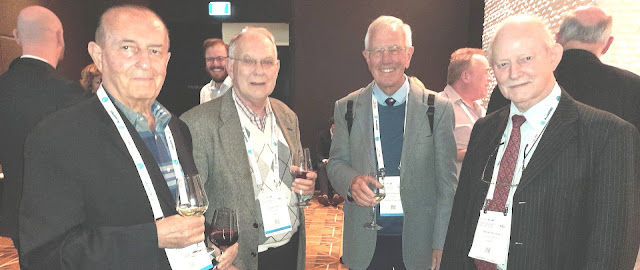 |
| IMPC members Guven Onal (Turkey), Rod Elvish (Australia), outgoing chairman Cyril O'Connor (South Africa) and new chairman Ralph Holmes of Australia |
Later I saw Guven Onal with some of the delegation from Turkey:
It was also nice to see more overseas participants, including representatives from South Africa.
 |
| Some of the University of Cape Town participants |
Australian company Gekko, set up originally by Sandy and Elizabeth Lewis Gray, has been a great success story, and now has a large team. Below I am with some of that team, Austell Lanyon, Mxolisi Ntombela, Theo Dzingai and Ben Wraith.
Wednesday 24 August
My keynote on the birth and evolution of Minerals Engineering journal was one of the three keynotes in the final plenary session and was sandwiched between two others. This is a good opportunity for me to thank the IMPC and the AusIMM for inviting me to Melbourne as the honorary guest speaker. I am honoured by this and it is greatly appreciated.
Australia's Chief Scientist, Dr. Cathy Foley, was this morning's first keynote speaker, and she detailed, in an Australian context, the role of critical minerals in achieving net zero, saying that global growth in demand for critical minerals over the next decade is staggering, something I have emphasised many times on the blog.
Following my presentation, the last keynote of the conference was given by Ingrid Oyarzun Olave, of BHP, who discussed the need for re-thinking tailings and water technology strategies. This was a stimulating talk which generated a number of questions, from the audience and from online delegates.
During the lunch break I called at the Metso Outotec booth. The company is a regular sponsor of MEI conferences and will be involved with next year's Comminution '23 and Flotation '23. They are manufacturers of another of Graeme Jameson's many inventions, the Concorde Cell, a model of which was on display. The Concorde cell is a high intensity pneumatic flotation cell which is designed to recover fine and ultra-fine particles, minimising operating costs and energy and water consumption. The team is shown below, with the model of the cell in the centre.
Finally I managed to get the team from CSIRO together, to congratulate them on the co-organisation of a very successful conference.
The last full IMPC conference was held in Moscow in 2018. The Cape Town IMPC scheduled for 2020 was postponed to 2021 due to the pandemic, and again to 2026 as the pandemic raged on. Melbourne was the the original scheduled venue for 2022 and this was cancelled due to the severe lockdowns in Australia. The IMPC, AusIMM and CSIRO then took a big gamble in organising IMPC Asia Pacific 2022 within eight months, so they must be highly commended for a successful conference, bringing mineral processors together after this long lay off. Everyone agreed that it was a great pleasure to be able to talk to people again face to face rather than via a computer screen, and to relax at the end of the day and enjoy a few drinks with colleagues.
 |
Rrelaxing after the conference with Graeme Jameson, Lachlan Bartsch,
Martin Rudolph and Ron Goodman |
The IMPC has now rewarded Melbourne with a full Congress in 2028, but before that the next IMP Congress will be in Washington in 2024, organised by SME.
@barrywills