Saturday, 5 August 2017

Contrasting geology in South Devon

Devon is the only English county which shares a border with Cornwall, and the only county which gives its name to a geological epoch.
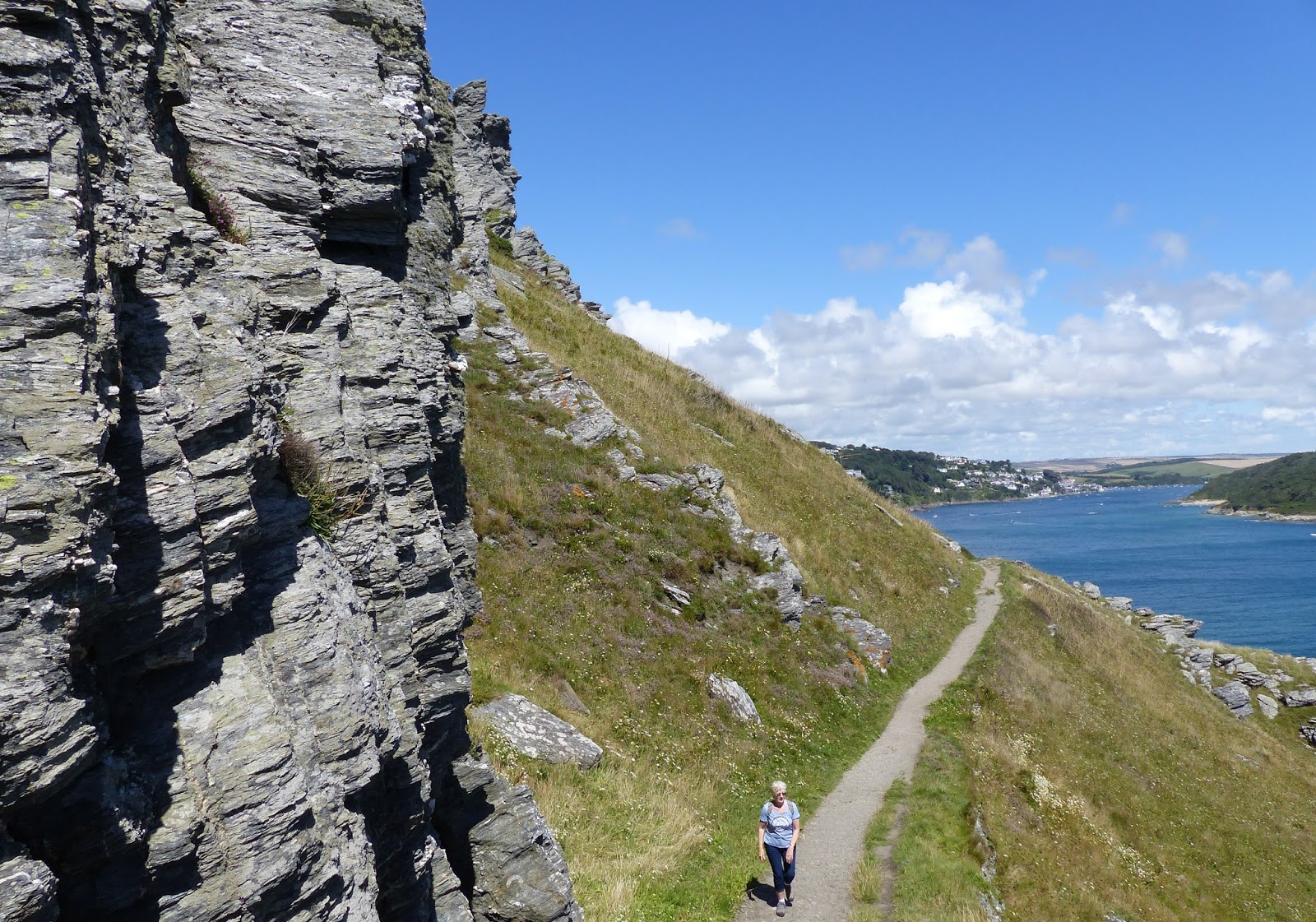
Barbara and I have just returned from a week in South Devon, the highlight of which was a short but spectacular coast path walk in the South Hams, from the Kingsbridge estuary, near Salcombe, to Sharp Tor, an area of jagged Devonian schist outcrops.
Kingsbridge estuary near Salcombe
 
Unfortunately we based ourselves further north in the relatively unattractive town of Paignton in the centre of the "English Riviera" between Brixham and Torquay.
This stretch of coast, up to Dawlish, is very different from that of Cornwall, or of Devon's South Hams. It is dominated by New Red Sandstone sediments, which give rise to the distinctive red cliffs and beaches of this region.
Red sandstone beach at Paignton
The area most familiar with visitors travelling to Cornwall by train will be that near Dawlish, where Brunel's Victorian rail tracks (posting of 10 December 2012) cut dramatically through the red cliffs, formed from aeolian (wind-blown) sand which was laid down in the Permian period around  250 million years ago.
The Penzance to London Paddington mainline train passing by the sandstone cliffs at Dawlish
 

Thursday, 3 August 2017

1st Announcement- Physical Separation '19 and Computational Modelling '19

The Physical Separation series of conferences began in 2009, and were born out of the merger of MEI's more specialised Gravity Concentration, Hydrocyclones and Solid-Liquid Separation conferences.
All five Physical Separation conferences have been held in Falmouth, and June's Physical Separation '17 attracted a record number of 71 delegates, stretching the facilities at Falmouth's small conference venue.
As physical separation techniques are becoming more sophisticated and widely used in mineral processing, it is expected that delegate numbers will continue to rise, and for that reason Physical Separation '19 will be held in early May 2019 in our larger venue, the Vineyard Hotel, in Cape Town. Moving the conference to the Vineyard will also allow us to hold an exhibition of services, which was not possible in Falmouth.
The spacious facilities at Cape Town's Vineyard Hotel
Computational Modelling '19 will be the 7th in this series of small conferences, which attract a very specialised and highly focussed group of researchers. The first in the series was held at the Mount Nelson Hotel in Cape Town in 2005, followed by 2008 at the Vineyard. The past four events have been held back to back with Physical Separation in Falmouth, so it is appropriate to bring Computational Modelling '19 to Cape Town to sit with Physical Separation '19; there are common elements in both conferences, and a number of delegates stick around for both.
Both conferences have International Mining as a media partner, and for the first time the Coalition for Eco-Efficient Comminution (CEEC) will be an industry advocate for Physical Separation.

Monday, 31 July 2017

When Scientists and Engineers Talk – Lessons from the Oil Industry and Applications to Mining

The mineralogy of a rock (the individual constituents defined by their unique combinations of chemistry and crystallography) and the texture of a rock (the way in which the minerals are arranged geospatially, particularly with respect to each other, voids, pores and fractures), together largely control, or influence in some way, every major geological, petrophysical and engineering attribute relevant to the petroleum industry, whether it be density (sonic), hardness and brittleness (frackability), electrical conductivity (resistivity), radioactivity (gamma ray), rock type and lithotype (sedimentary, igneous or metamorphic components).
Can the same be said for mining? Almost certainly yes, according to Alan Butcher, Professor of Geomaterials and Applied Mineralogy at the Geological Survey of Finland, who will be presenting an eponymous keynote lecture at Process Mineralogy '18 in Cape Town next year. Prof. Butcher has spent the last 20 years developing automated mineralogical techniques for the mining, geoscience and petroleum sectors, where he has gained much experience in examining rocks of commercial importance. Prior to this, he was a lecturer in igneous petrology and course director of the MSc in Mining Geology at the Camborne School of Mines, University of Exeter, UK.
Alan will show how the application of mineral and petrographic information is often quite different, as unlike the oil industry - where the commodities (oil and/or gas) are not measured directly, only the areas in the rock where they reside (mostly pores) - in mining, we investigate the nature of the commodity directly (ore-forming minerals). This leads us to tackle similar challenges but from completely different perspectives. In mineral processing, we are typically concerned with predicting, measuring, monitoring and improving the behaviour of the (mostly valuable) components as they pass through the drilling, blasting, comminution and separation stages of the mining cycle. There is no question that an ore’s performance is strongly controlled and influenced by its original starting mineralogy and texture.
The keynote will review which minerals are most likely to cause significant production problems in both worlds. It will compare the analytical work flows used to characterize the so-called menace minerals, and will suggest what learnings can be made. For example, knowing that one has the right type of pore-lining clay in a reservoir rock is critical to a petroleum engineer; likewise, being made aware that clay is present in an ore before it is processed (rather than after) is very helpful to a minerals engineer. The two industries typically approach characterizing clays from completely different angles, partly because the applications are different, but also the budgets and risk factors are not on the same scale.
But that aside, given that the minerals in each case may be similar (or virtually identical), and that it is applied mineralogists (scientists) who document and deliver the information to the engineers, it is important that all professionals involved in the greater natural resources community share their best practices across what are traditionally separate industrial segments, and that innovations are openly discussed so they can be adopted, if found to be useful. The paper will be a major contribution to popularizing such a cross-disciplinary approach between the oil and gas and mining industries.  

Friday, 28 July 2017

Memories of Minerals Engineering '97

Minerals Engineering '97 began 20 years ago today at the Crowne Plaza Hotel in Santiago, Chile. The first, and only, of the Minerals Engineering series to be held in South America, it was organised by CSMA Minerals Ltd, Minerals Engineering journal, Camborne School of Mines, and the Universities of Chile, Santa Maria and Concepcion. The sole sponsor was Hazen Research, USA.
Unfortunately no report on the event remains, and the only two photos in the MEI archives are those below:
The conference dinner, with Jim Finch, Jan Cilliers and Eileen Barfuss

Wine tasting in the Casablanca Valley with Richard Williams (left) and Todd Harvey (right)
 Twitter @barrywills

Wednesday, 26 July 2017

Drinks with two well known metallurgists

It was good to reminisce over a few beers by Falmouth's inner harbour on Monday evening, with two old friends, Dave Dew and Frank Crundwell.
Dave, me, Frank
Frank I first met in Falmouth in 1996 when he represented the University of the Witwatersrand at Biotech '96. He is in the UK this week to set up a metallurgical consultancy, as a sister company to his South African company CM-Solutions, which he hopes to operate from London. He is down in Cornwall to present a seminar today at the Camborne School of Mines.
Biotech '96. Left to right are Jim Watson (UK), me, John Wells (Chile), Barbara, Sue Harrison (South Africa),
Jan Cilliers (UK), Frank Crundwell (South Africa) and Andy Sarosi (UK)
Dave I have known for 40 years. He was in the Camborne School of Mines class of '79, one of the first graduates in mineral processing. In 1978 he was one of a party of vacation students from various British universities whose projects I supervised in Anglo American mines in South Africa.
British mineral processing students in Johannesburg, 1978. Dave Dew is the one standing
After graduating from CSM Dave stayed on to complete a PhD, then returned to South Africa in 1983, where he had great success with Gencor Ltd, and became a leading player in the relatively new field of biohydrometallurgy. Initially he was involved in development projects related to gold recovery by carbon-in-pulp and carbon-in-leach technology, which was rapidly taking over from the conventional cyanidation for treatment of gold ores.
In 1990, as Principal Research Metallurgist, he joined the project team responsible for development of the BIOX™ Process. He took a lead role in the improvement and design of the bioleach reactors reducing power costs and establishing a methodology for pilot testing and commercial plant design. The technology was applied in a number of new operations notably Sao Bento in Brazil, Wiluna in Australia and Ashanti Goldfields in Ghana.
When in 1998 the assets of Gencor excluding platinum, were transferred to Billiton, Dave continued with the development of bioleaching technology with a focus on the treatment of nickel and copper sulfide concentrates. He was appointed Manager Process Development responsible for leading research in this area, resulting in the successful pilot scale demonstration of the BioNIC™ Process for treatment of an Australian nickel sulfide concentrate and the demonstration of the BioCOP™ Process in 2000 under the Alliance Copper Joint Venture with Codelco, producing 20 000 tpa copper from chalcopyrite concentrates contaminated with arsenic.
In 2001 Billiton merged with BHP to become BHP Billiton and Dave was appointed as Global Technology Manager at the Johannesburg Technology Centre primarily responsible for technology development for the Base Metals division. During the period from 2001 to 2009 the centre focused on the development of bioheap leaching and chemical heap leaching technology for treatment of low grade primary copper sulfide ores. The bioleaching technology for high temperature leaching of low grade chalcopyrite ore was tested in a 250 000 pilot test heap at the Escondida Mine in Chile over the period 2005-2008. In 2009 the Technology group of BHP Billiton was restructured and the research laboratories in Johannesburg were closed and key activities related to development of heap leaching technology were transferred to a new, purpose built facility at the Escondida Mine, Chile.
Dave became an independent consultant in 2012 and formed his own company, Dewality Consultants Ltd, which he operates from his home in Cornwall. He is still very much involved with Chile, specialising in bioheap leaching of sulphides. He is also an honorary associate of CSM and advises on research projects, including rare earth resources, their security of supply and methods of concentration.
Dave and Frank also go back a long way, having first met in South Africa in 1990 when Frank was a young research officer at Wits, working on a project funded by Gencor. I will be catching up with Frank at Flotation '17 in November where he will be presenting a paper on the mechanism of the flotation of soluble and semi-soluble salts. Dave I am still trying to persuade to take some time out of his very busy schedule to present a keynote lecture at Biohydromet '18 next June in Namibia!
Twitter @barrywills

Monday, 24 July 2017

What is the point of world University rankings?

The ShanghaiRanking Consultancy (SRC), which claims to be the official publisher of the Academic Ranking of World Universities, has published its rankings of mining and mineral engineering university departments for 2017.  I am sure that those listed in the top 10 will be very pleased with this publication, but I am equally sure that many departments will feel that they have been hard done by, particularly when the listing is compared with the 2017 QS World Ranking of Top Mineral & Mining Universities. I criticised the QS list in 2016 (posting of 5th April 2016), as many of the ranked universities did not have minerals departments, which makes you wonder how these lists are put together.
For the 2nd year running the Colorado School of Mines is #1 in the QS ranking, but only merits #45 by the SRC. The top ranked SRC university, the admirable University of Science and Technology Beijing, does not merit a place in the QS rankings!
Of the universities in the listings, there is only one which appears in the top 10 of both listings- the University of Queensland. The world renowned Camborne School of Mines does not appear in the top 50 of either listing.
So I ask once again- what is the point of these listings? At best they are controversial, and at worst they create much ill-feelings and despondency, and I am sure can be very damaging to the reputation of many departments.
Twitter @barrywills