Biohydrometallurgy '12 (
Biohydromet '12), sponsored by FLSmidth and ProMine, with media sponsorship by International Mining was held at the St. Michael's Hotel, Falmouth, UK from June 18-20. The following are my personal views on the conference, which I hope will be supplemented by the views of all who attended.
Monday June 18th
This morning I welcomed a record number of delegates to this, the 6th MEI symposium on biohydrometallurgy. The next few days should prove ideal for networking, as the 81 delegates represent no less than 22 countries- Australia, Belgium, Brazil, Canada, China, DR Congo, Finland, France, Germany, Japan, Kazakhstan, Malaysia, Netherlands, Norway, Rep. Korea, Russia, South Africa, Sweden, Switzerland, Turkey, UK and USA.
After a brief introduction to Cornwall and the UK, I handed over to
Dr. Chris Bryan, of Curtin University, Australia, and one of the three MEI consultants to this conference. Chris spoke about the history of biohydrometallurgy, from the ideology of the early 80's, where it was going to revolutionise mining and replace pyrometallurgy completely, to the abrupt dose of reality in
Corale Brierley's IBS 2005 keynote address "we need to wake up to the fact that this is, and only ever will be, a niche technology", and the need for pragmatism.
Biohydrometallurgy has a poor reputation in certain circles, as a technology that is too unpredictable, but Chris highlighted that it is often used as an avenue of last resort on ores that are untreatable with other methods. It is a complex technology and there is a need for an all-encompassing approach, with fundamental understanding of microbiology, engineering, mineralogy, hydrometallurgy etc.
Chris concluded by noting that
Biohydromet '12 has a great mix of industry and academia, from diverse geographical and technology backgrounds, and it is essential that this conference series encourages collaboration, in terms of identifying gaps in knowledge and expertise, and in better communication between industry and academia.
The first of the three keynote lectures was presented by
Marja Riekkola-Vanhanen, of Talvivaara Nickel Mining Co, Finland. The Talvivaara Sotkamo Mine in NE Finland is the most recent commercial application of bioleaching, and the first in Europe. The ore is low grade black schist, and contains pentlandite, pyrrhotite, chalcopyrite, sphalerite and pyrite as the main sulfide minerals. The ore and the possible utilization of the deposits have been extensively studied for over 20 years. Bioheapleaching technology was chosen for the extraction of nickel from the ore based on its favorable capital and operational costs and the good performance data obtained in a large on-site pilot trial. Mining was started in Sotkamo in April 2008 and building of the industrial scale bioheap in August 2008.The first shipment of nickel sulfide product was delivered to the customer in February 2009.
MEI Consultant
Dr. Patrick d'Hugues, of BRGM, France, then presented a short overview of the of FP7 European project, operated by conference sponsor ProMine.The EU is currently heavily dependent on mineral and metal imports and the trade balance in the field is negative. For some strategic metals, the EU is totally dependent on import. The efficiency of the overall production chain of minerals and metals in Europe should be enhanced by putting higher quality and added value products on the market. This will be addressed by the four year long project ProMine, which started in May 2009. The ProMine consortium, led by the Geological Survey of Finland (GTK), includes 27 partners from 11 EU member states. Industry partners in the ProMine consortium produce more than 70% of metals in the EU, so implementation of results from the project will translate into direct and significant economic benefits.
Dr. Wolfgang Baum, representing our other major conference sponsor, FLSmidth, of USA then discussed how bio leach operations are emerging as the most economic and metallurgically viable partner for concentrators, or alternatives for increasingly lower grade and complex ores. Wolfgang's presentation provided a condensed overview of bio leach opportunities in concert with future concentrator operations and/or as stand-alone alternatives using site and ore-specific designed heaps and hybrid heap-stockpile operations which may incorporate HPGR technology for enhanced bacterial access.
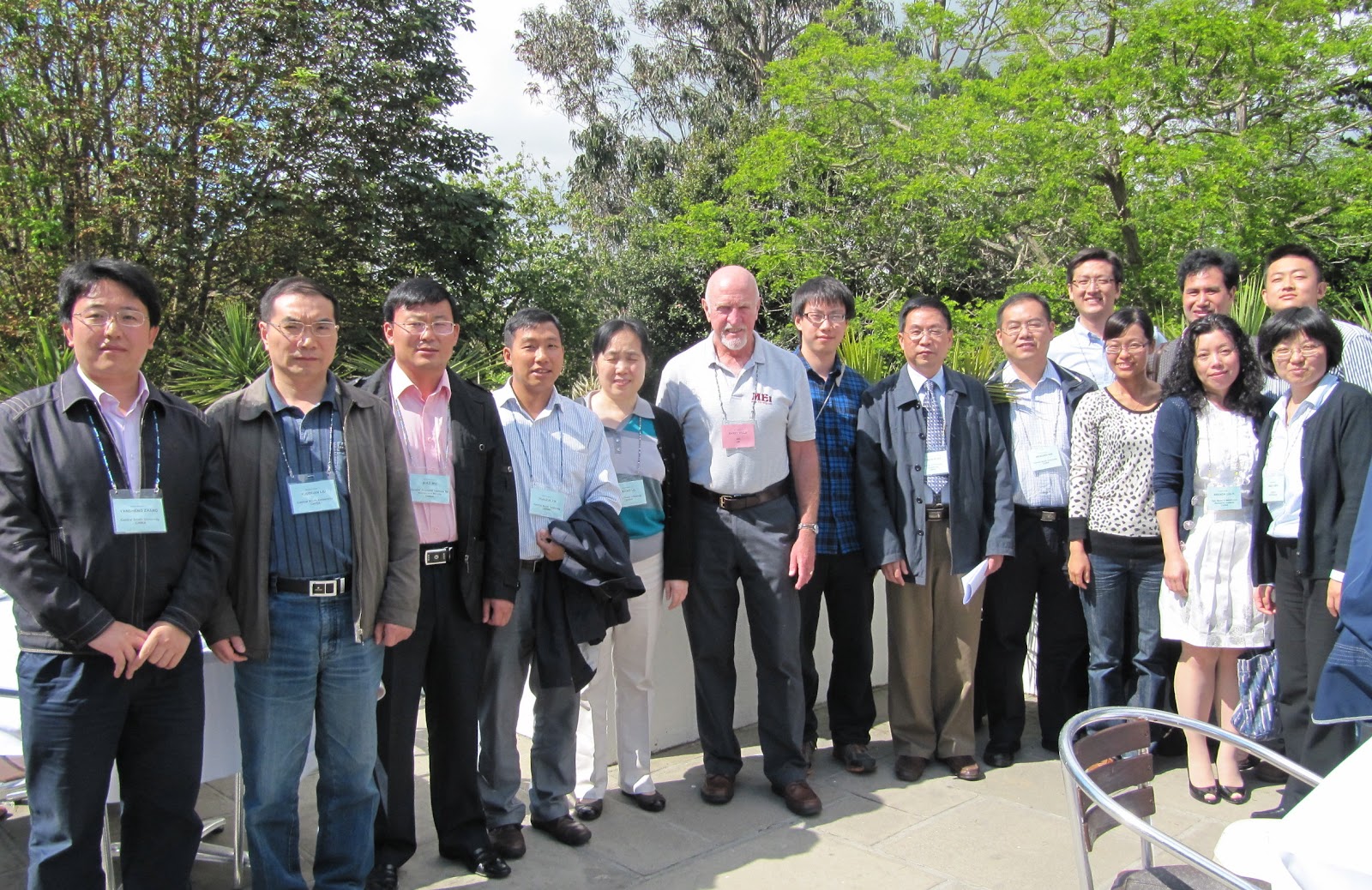
After an extended coffee break to give everyone the chance to get to know each other, four papers on bioleaching included the first three of the nine presentations which will be made from workers from China, now a major player in biohydrometallurgy research. We are pleased to see 13 delegates from China, 8 of whom are from the Central South University in Changsha.
 |
| With the delegates from China |
After a short afternoon session, with papers from Australia, Brazil and China we unwound with a 5 mile walk on the coastal path (
see also 19th June), passing Henry VIII's ancient castle, and the busy Falmouth Docks, into Falmouth town, and a welcome beer in the old Chain Locker pub.
 |
| Overlooking Swanpool Beach |
 |
| At the Chain Locker pub |
Tuesday June 19th
The day started with a keynote lecture on high temperature bioleaching from
Dr. Paul Norris of the University of Warwick, UK. It has long been recognized that thermophilic, iron- and sulfur-oxidizing microorganisms can efficiently oxidize mineral sulfides at 65-85°C. They may be active in some ore leaching heaps or dumps at elevated temperatures but they have not yet found premeditated application in commercial mineral processing at these temperatures. One of the questions in potential process development is the choice of microbial culture.
The first thermophiles with potential for mineral sulfide processing at temperatures above 65°C were revealed during the mid 1960s in the USA, and later renamed as
Acidianus species. The first demonstrations of rapid processing of copper concentrates were made with
Sulfolobus metallicus at about 70°C in the early 1980s and more efficient leaching at higher temperature (about 80°C) was demonstrated in the early 1990s at Warwick University with species which remain un-named. These un-named strains were tested in continuous leaching of copper concentrates in the mid to late 1990s and used at pilot scale in the HIOX process at BRGM (France) and in the BioCOPTM Process at BHP Billiton (South Africa), the latter process reaching a commercial scale demonstration with Alliance Copper Ltd. in Chile in 2003. Meanwhile, concentrate processing with thermophiles had also been developed by Mintek (South Africa) and continued with pilot scale work through the EU BioMinE project up to 2008 using cultures dominated by
Acidianus species at 70°C.
With this background availability of a variety of thermophiles, Dr. Norris considered the characteristics of several different cultures in two contexts: the past developments with bioreactors; and ore heap leaching, where high temperature would be desirable (for chalcopyrite dissolution) or is inevitable (because of the rate of exothermic mineral sulfide oxidation, such as with the Talvivaara operation in Finland).
Following on from Paul's lecture there was a full day of presentations on the role of various microorganisms in bioleaching, including heap leaching operations, as well as in the recovery of metals from mine waters and acid mine drainage. These contributions were from workers in The Netherlands, South Africa, Australia, USA, Sweden, UK, Brazil, Japan, China and Turkey, this geographical diversity bringing different perspectives and viewpoints to the active discussions.
 |
| Coffee break in the hotel gardens |
After welcome afternoon coffee, we set off for the china clay mining town of St. Austell, and for a barbecue dinner in the Mediterranean Biome of the world famous
Eden Project (see also
June 20th).
 |
| The Eden Project |
Wednesday June 20th
The final day began with the 3rd keynote lecture, by
Prof. Sue Harrison of the University of Cape Town, who discussed microbial attachment, colonisation and activity as key steps in establishing the desired microbial community for attaining a well functioned heap.
Following this was an eclectic range of innovative papers dealing with bioleaching operations in the Democratic Republic of Congo and Kazakhstan, to the use of biohydrometallurgy in the recovery of valuable metals from WEEE, and from spent automotive catalyst leachates in order to produce new catalysts. A paper from Korea evaluated the potential of cyanide producing microorganisms to recover gold from low grade ore, and a Brazilian presentation dealt with the flotation of the apatite-quartz system using microorganisms as flotation reagents.
Cutting edge technology which will develop into very effective ways of analysing bioleaching operations were introduced in work from CSIRO in Australia and from collaborative efforts between the University of Cambridge, the University of Western Australia and the University of Cape Town. In the latter paper the use of Magnetic Resonance Imaging was shown to be effective in acquiring images non-evasively of an irrigated ore bed, in order to better understand the phase distribution of heaps on the pore scale. The CSIRO paper discussed the use of X-ray absorption near edge structure (XANES), a synchroton based technique that is sensitive to both crystal and non crystal structures and is ideal for the characterisation of species shift of a particular element in a complex system.
An innovative paper from the University of British Columbia, Canada, discussed alternative approaches for concentrating metallic minerals of economic interest without the direct use of bacteria. Bacteriophage are bacterial viruses that contain protein coats which surround the genetic material (DNA). The coat proteins can be genetically engineered to contain many different sequences of amino acids that can be selected for their ability to bind to organic or inorganic substrates. Using this process of phage display, binding sequences for chalcopyrite and sphalerite were identified and it was shown that the presence of a biofilm of phage bound to target mineral particles alters the electrical and surface properties of the minerals in ways that could allow separation from other particles to form a concentrate. The group is exploring different ways that phage display technology can be applied to mineral processing. Current challenges include the binding affinities of phage to mineral particles and the survival of phage in the hostile ore slurry environment.
 |
| Chris, Sue and Patrick |
After an excellent 3 days, MEI consultants
Patrick d'Hugues,
Sue Harrison and
Chris Bryan summarised the conference. It is evident that bioheap leaching is one of the main targets for R&D and industrial applications, but tank leaching still has an important role. There is great potential for the use of biotechnology in the processing of secondary resources such as mine wastes and waste electronic equipment, and emphasis should be given to co-processing of primary and secondary resources, as mining and recycling should not be seen as competitors.
Multi-disciplinary collaboration between processors, mineralogists, chemists and chemical engineers is becoming more prevalent, as is multi-national interaction. In this respect it was good to see so many new players in this field, exemplified by the many Chinese researchers who made the effort to travel to Falmouth. It is also good to see the increased interest in this technology from the major mining companies and metal producers.
MEI's
Amanda then closed the conference and invited delegates to attend the 7th symposium,
Biohydromet '14, which will be held in Falmouth again from June 9-11, 2014, and will be held back to back with
Sustainability through Resource Conservation and Recycling (
SRCR '14).
Personally I have found this to have been a very special conference, as it has come at a time when rapid advances in our understanding of the science of microorganisms has in effect awoken biohydrometallurgy from its long slumber, and it now looks as though it might start to realise its true potential and provide real benefits to the minerals industry. This is merely my opinion as an objective non-biotechnologist, so I would very much appreciate comments from the specialists who attended the conference, and for those who didn't I would also like your views on how you see the future of mineral bioprocessing.